
🌿 Rounded Dwarf Mistletoe subsp. grandicaule
Botanical form, not a garden cultivar — and a parasite: do NOT plant or propagate this plant. This guide covers identification, ecology, host impact, and management only.
What it looks like
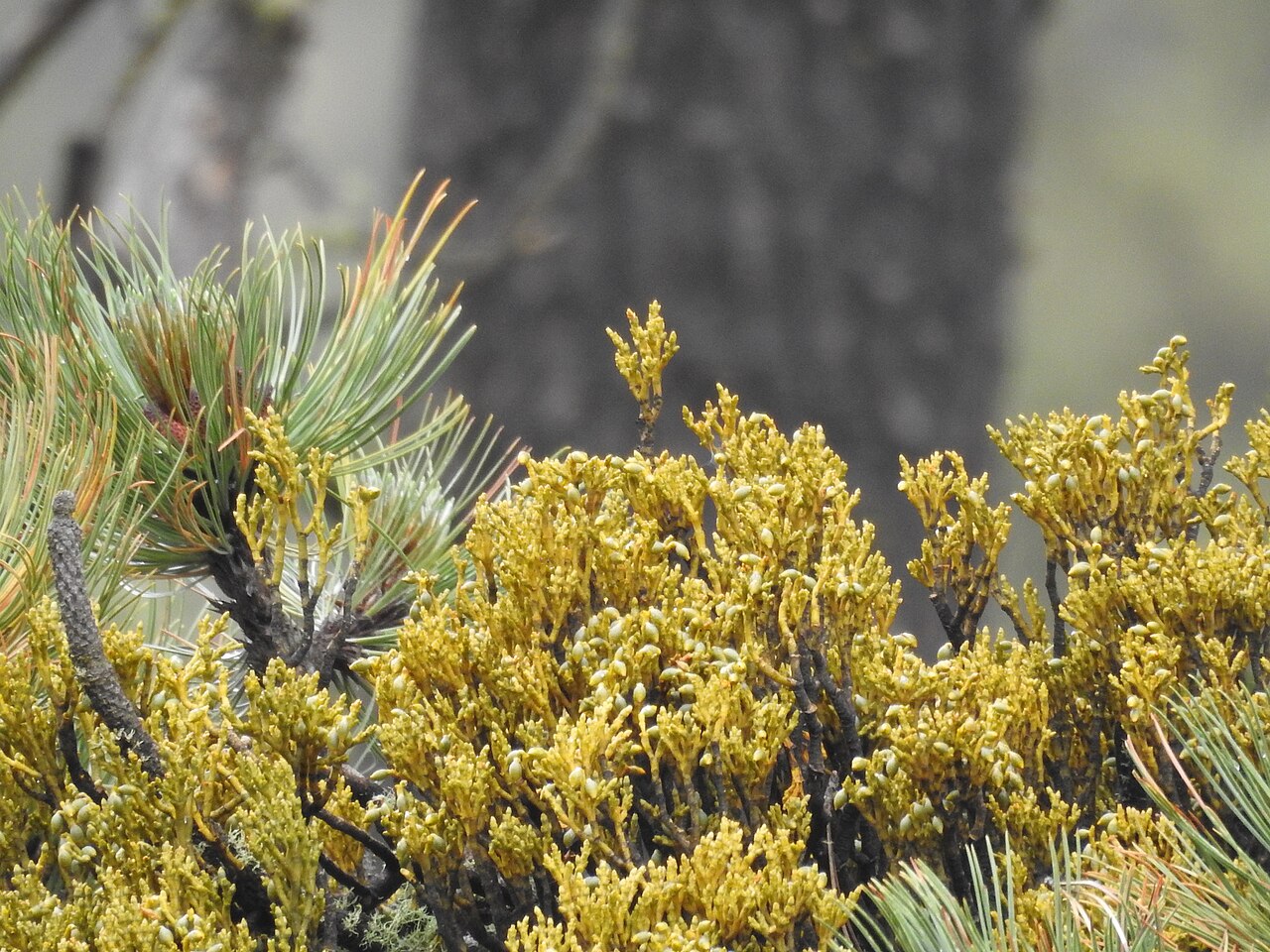
Subsp. grandicaule is the heavyweight of its genus: the largest Arceuthobium known, with yellow-green to olive shoots that can reach about 70 cm tall and 5 cm thick at the base — practically a shrub by dwarf-mistletoe standards, where most of its cousins top out at a few inches. It frequently sprouts from the trunks of pines as well as the branches, forming dense, broomy clumps that are hard to mistake for anything else once you know what you are looking at. Like all dwarf mistletoes it has no proper leaves to speak of, just jointed, scale-bearing shoots doing photosynthesis on the side while the real work — stealing water and nutrients — happens inside the host branch through a hidden root-like system.
Why this variety
There are two reasons to know this plant, and neither one involves growing it. First, it is a genuine botanical curiosity: the biggest member of a genus famous for being tiny, parasitizing at least ten pine species across central Mexico and the highlands of western Guatemala. Second, it is a forest-health story — dwarf mistletoes are among the most damaging parasitic plants on North American conifers, and grandicaule’s size means a heavy infection is a serious drain on its host. Knowing it on sight is the difference between admiring a weird pine and accidentally helping a parasite spread.
How it lives
Grandicaule does not grow in gardens, and that is the whole point of this section: it grows only on living pines, in the highlands of central Mexico and western Guatemala, where it infects branches and trunks and spreads by explosively discharged, sticky seeds that glue themselves to nearby pine foliage. There is no soil mix, no pot, and no planting guide, because planting a parasite is how forests get ruined. If you are reading this from Florida, you will not meet this plant in your yard — its hosts and its climate are a continent away — but the management principles below are the same ones foresters use for every dwarf mistletoe.
Hosts & habitat
Hosts for this subspecies are pines of the Mexican and Guatemalan highlands — at least ten species have been recorded. A healthy pine tolerates a light infection for years, but the parasite draws water and nutrients year-round, so infected branches grow slowly, swell at the infection site, and throw the tangled twig clusters foresters call witches’ brooms. Heavy infections cut height and diameter growth, and over decades can kill branches or whole trees, while also opening the door to bark beetles and other stress followers.
Host impact & management
- Witches’ brooms and branch swelling — the classic sign: dense, tangled twig clusters at infection points, with swollen branch tissue beneath.
- Growth loss — infected pines grow measurably slower; severe infections cause dieback and, eventually, tree death.
- Seed spread to neighboring pines — sticky seeds shoot from ripe fruit and glue onto nearby host foliage, so one infected tree seeds the next.
- Do not move it — never carry brooms, branches, or seed to another tree or region; you would be the dispersal agent.
If you find it
If you find a dwarf mistletoe on a pine, the useful response is identification and, where it matters, management: prune out brooms and infected branches well below the visible infection, remove heavily infested trees where they threaten healthy neighbors, and replant with non-host species. On a forest scale that is a forester’s call, not a weekend project. In a garden context the lesson transfers neatly: admire parasitic plants in the wild, keep them out of your plantings, and never buy, swap, or plant one on purpose.
See also: Rounded Dwarf Mistletoe: Growing Guide