
🌿 Savanna Aster
What it looks like
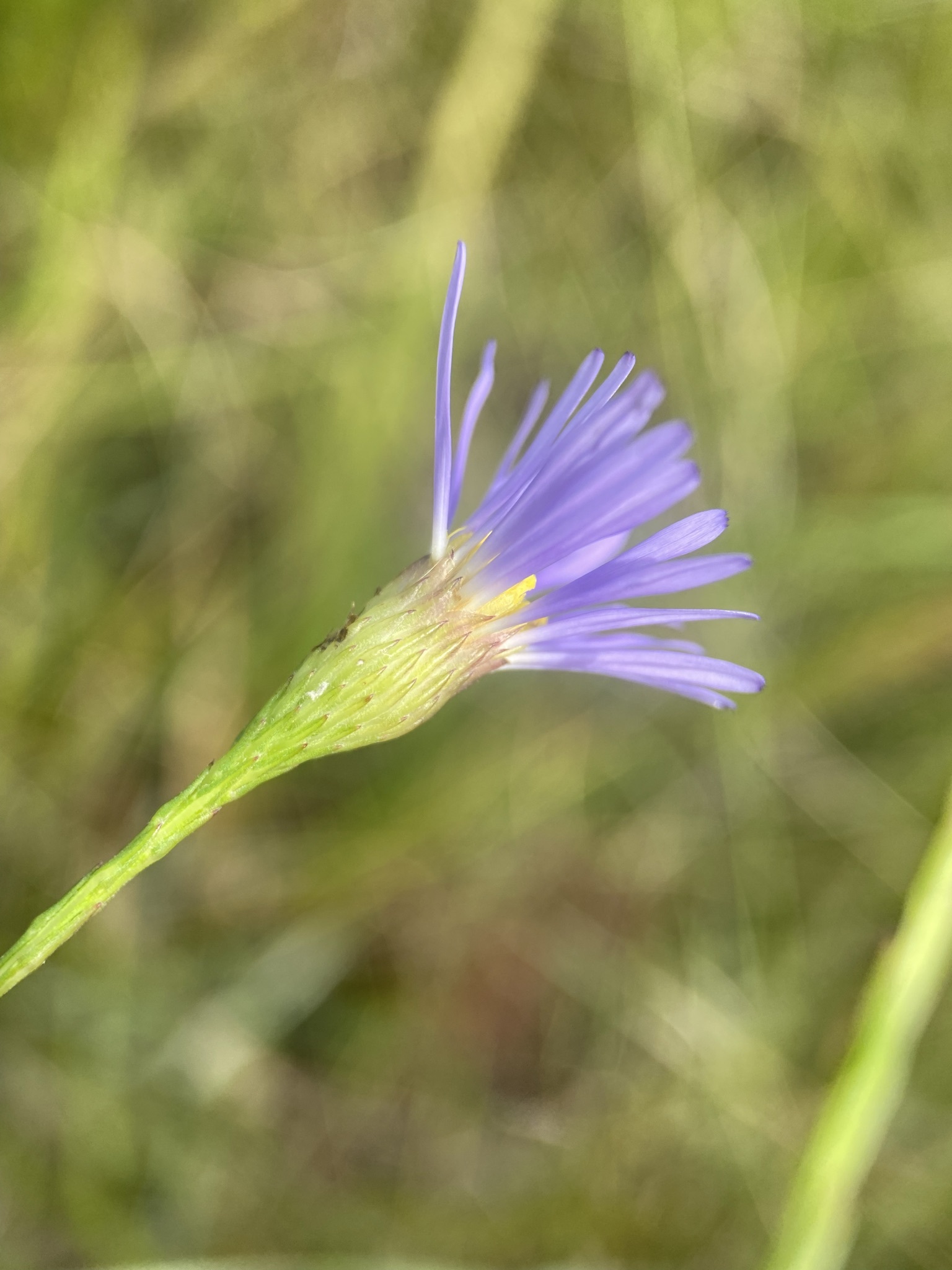
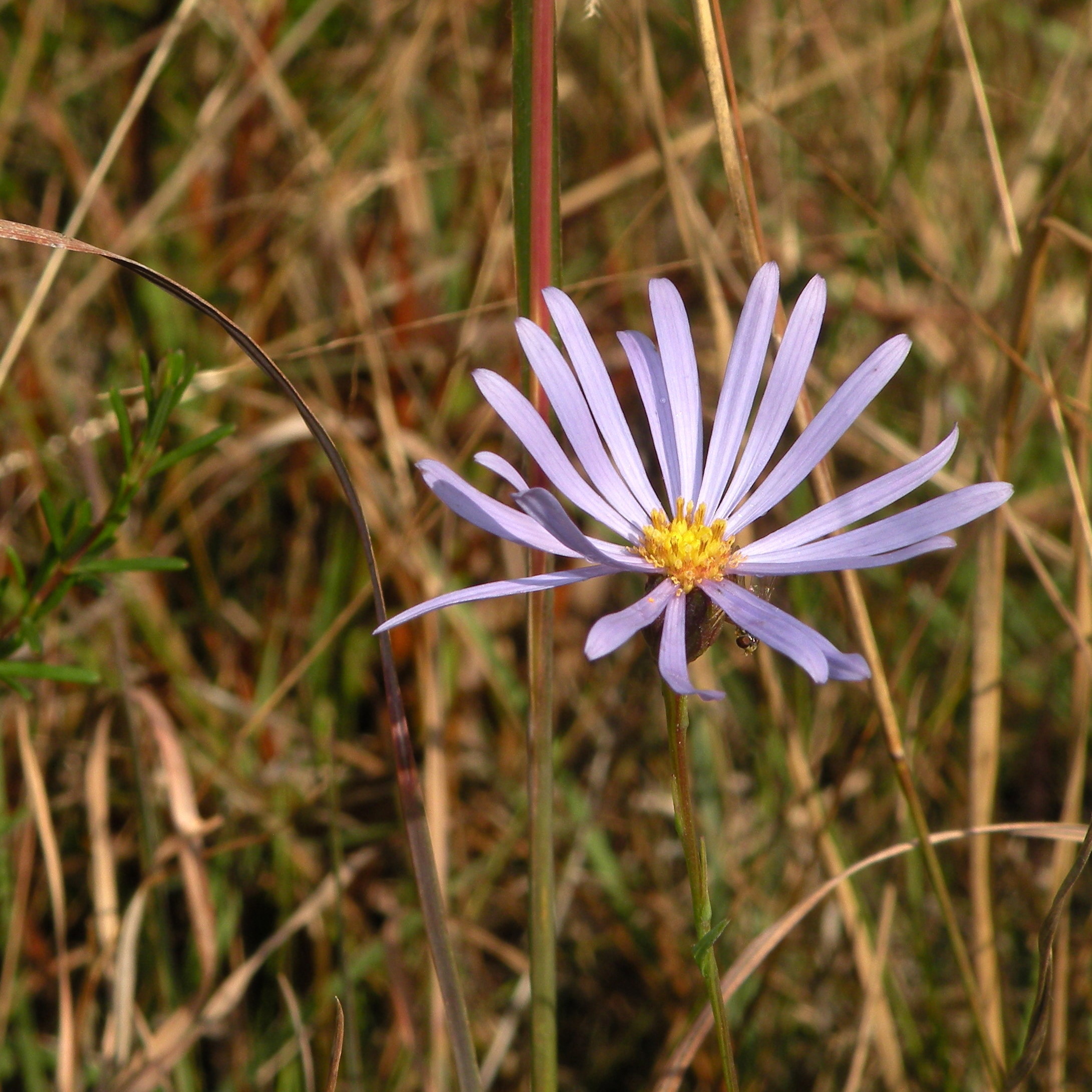
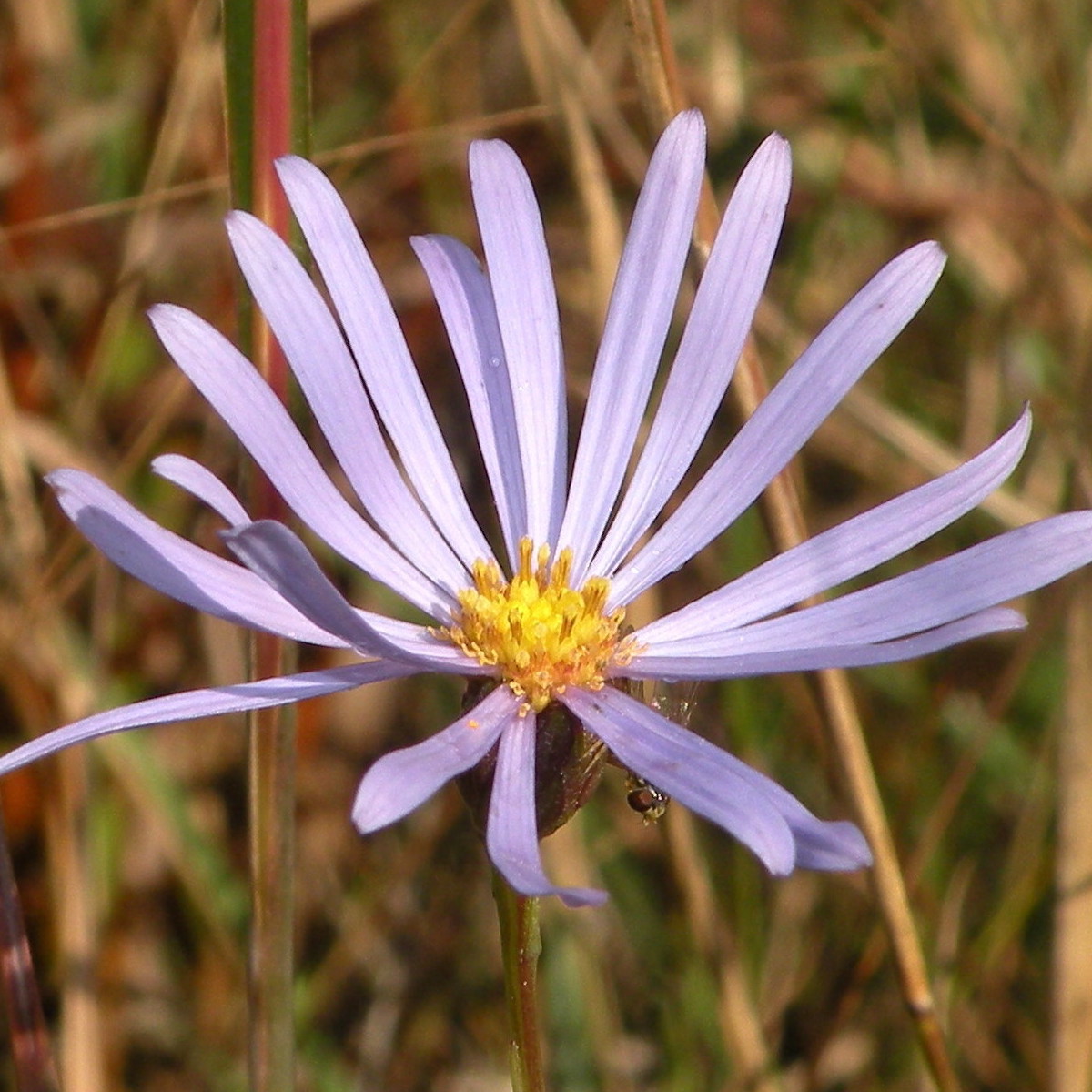
Savanna aster is a perennial herb, usually one to three feet tall, growing from a clump-forming (cespitose) root system with stout rhizomes. It carries one to three erect, hairless stems, and the whole plant has a spare, grassy look even in flower — which is the first clue, because the leaves are the giveaway. The basal leaves are linear, long-stalked, and many times longer than they are wide: Franck’s key to the Florida asters separates this species on basal leaves 25–70 times longer than wide, and the Flora of North America describes the lower stem leaves as narrow blades roughly 42–105 mm long but only 1–3 mm wide. Up the stem the leaves get shorter and more awl-shaped, clasping the stem at their bases.
The flower heads are the reward for looking down at your feet in a wet savanna in autumn. Each head carries 8–23 purple to pale blue-lavender ray florets, 10–20 mm long, around 47–57 pale yellow disk florets. The involucre — the little cup of green bracts under the flower — is cylinder-bell shaped, with green, purple-tipped phyllaries in four to six rows. It blooms September through November, sometimes into December. The fruit is a small tan to gray-brown cypsela with a yellowish pappus, and the pappus is a botanical oddity in its own right: a triple pappus of fine mid-length outer bristles, long tapering bristles, and long club-shaped inner bristles.
The name tells a taxonomic story. Savanna aster is the only species in its subgenus, Symphyotrichum subg. Chapmaniana — it sits at the very base of the Symphyotrichum family tree, the most basal species in the genus, yet it carries a derived chromosome number of 2n = 14. It has been shuffled between genera as botanists argued about it: first described as Aster chapmanii in 1841, later treated as Heleastrum chapmanii and then as Eurybia chapmanii, before DNA work placed it firmly in Symphyotrichum. The species honors Alvan Wentworth Chapman, the physician-botanist who documented the flora of the Apalachicola region in the 1800s. Both spellings of the common name are in use — savanna aster and savannah aster — and it is also called Chapman’s aster.
Where it grows in Florida
Savanna aster is a plant of one river. Its core range is the Apalachicola River drainage basin of the Florida Panhandle and adjacent southeast Alabama, with a disjunct population in St. Lucie County on the Atlantic coast. In Florida it has been vouchered in Alachua, Bay, Calhoun, Franklin, Gulf, Jackson, Liberty, Okaloosa, Santa Rosa, St. Lucie, Wakulla, Walton, and Washington counties — most of those in the Panhandle, around the Apalachicola. In Alabama it may already be extirpated: the Flora of North America notes it is possibly gone there, and the species is effectively a Florida plant now.
Its habitat is wet, acidic, open ground: wet savannas, wet pine flatwoods, bogs, and acid swamps, from sea level to about 30 meters elevation. These are fire-shaped places — open, sunny, nutrient-poor, seasonally wet — and savanna aster is part of a whole community of rare Panhandle wet-prairie plants, growing alongside pitcher plants, meadowbeauties, pipeworts, and Chapman’s butterwort. It does not grow in gardens, in shade, or in dry soil. If you are standing in a wet Panhandle savanna in October and a low purple aster is blooming at your ankles among the grasses, you may be looking at it — and that is exactly where it belongs.
Conservation status — read this first
Savanna aster is imperiled. NatureServe ranks it G2, Imperiled, globally — one of only nine Symphyotrichum species at that rank — and the Flora of North America lists it as a species of conservation concern. Its entire world is a handful of wet savannas in one river basin plus one disjunct county, and that world is shrinking under drainage, fire suppression, and development.
That status sets the terms for everything else in this guide. There is no attraction advice here, no collection advice, and no “go find one” invitation. Do not dig it, do not pick it, do not take seed, and do not try to move it to your garden — a rare wetland plant ripped out of a fire-dependent savanna does not survive the move, and every plant removed is a piece of a population that cannot spare it. If you think you have found one, photograph it from the path, note the location, and report the sighting to the Florida Natural Areas Inventory or your local Florida Native Plant Society chapter; a documented sighting helps protect the ground it stands on far more than a plant in a pot ever could. The way to help savanna aster is to protect wet savannas and the fire that keeps them open.
How to tell it from its lookalikes
Florida has plenty of purple asters, and in a wet flatwoods in October several of them can be blooming at once. Savanna aster separates on a combination no other Florida aster shares: the grass-like linear leaves, the wet-savanna habitat, and the flower-head measurements.
- The leaves are the test. Basal leaves 25–70 times longer than wide — blades like grass, not like aster leaves. If the plant has broad, clasping, or obviously toothed leaves, it is not savanna aster. Check the leaves before you check the flower.
- Elliott’s aster (Symphyotrichum elliottii) shares the wet habitat and purple rays, but it is a much bigger, coarser plant: its stem base is 5–15 mm wide, its stem leaves are 2–5 cm wide with sheath-like bases, and its involucres reach 8–15 mm. Savanna aster is a slender plant with thread-like leaves and smaller heads.
- Scaleleaf aster (Symphyotrichum adnatum) also grows in Florida flatwoods, but its stem leaves are small, scale-like, and pressed flat against the stem for more than half their length — a completely different silhouette from savanna aster’s long, grassy, spreading leaves.
- Georgia aster (Symphyotrichum georgianum) has purple rays too, but its leaves clasp the stem with broadened, ear-like bases, its leaf margins roll under, and its phyllaries are sticky-glandular. Savanna aster’s leaves are linear and its phyllaries are not glandular.
- Habitat narrows it fast. A purple aster in a dry sandhill or a shady hammock is not savanna aster. A purple aster with grass-like leaves in a wet, open, acidic savanna in the Apalachicola basin in October is worth a careful second look — and a photograph, not a picking.
Grow it or leave it?
Leave it. Savanna aster is a wildflower of protected, fire-dependent wetlands, not a garden plant. There is no verified cultivation guidance for it: no nursery trade, no published garden protocol, no seed source — and no honest guide would invent one. It needs saturated, acidic, nutrient-poor soil, full sun, and a fire return interval of a few years to keep its habitat open; a garden bed cannot offer any of that, and a plant taken from the wild would not survive the attempt.
What a gardener can do instead is grow the common Florida asters that do belong in gardens — Elliott’s aster for wet spots, Georgia aster for dry sun — and leave the rare one to the savannas. If you own or manage wet flatwoods in the Apalachicola basin, the single most useful thing you can do for savanna aster is keep fire in the landscape on a natural cycle and keep the hydrology intact: no ditching, no draining, no bedding the savanna up into pine rows. The plant has survived in these wet prairies since long before there were gardens; it needs the prairie, not a pot.
Pollinators and wildlife
No published pollinator records specific to savanna aster were found — this is a rare plant in remote wetlands, and nobody has sat in a bog with a notebook counting its visitors. What can be said honestly is the general aster story: fall-blooming asters offer nectar and pollen to generalist bees, butterflies, and flies at a season when little else is flowering, and savanna aster blooms in September through November, exactly when those insects are fueling up for winter. Its seeds, like other asters’, are small wind-dispersed cypselae that birds may also take. Anything more specific than that would be guessing, and this plant deserves better than guesses.
Frequently asked questions
Is savanna aster the same as savannah aster?
Yes — same plant, two spellings. “Savanna aster” is the spelling used by the Flora of North America and Wikipedia; “savannah aster” is the spelling used by the Florida Native Plant Society and the Atlas of Florida Plants. It is also called Chapman’s aster, after botanist A. W. Chapman.
Where in Florida can I see savanna aster?
In wet savannas and wet pine flatwoods of the Apalachicola River basin — Franklin, Liberty, Gulf, Bay, Calhoun, Jackson, Walton, and neighboring Panhandle counties — plus a disjunct population in St. Lucie County. The best-known public ground is Apalachicola National Forest. Go in October, stay on paths and roadsides, and look low: it is a one-to-three-foot plant among grasses.
Is it endangered?
It is ranked G2, Imperiled, by NatureServe — not federally listed as endangered, but globally imperiled, with its whole range confined to one river basin. It may already be extirpated in Alabama. Treat it as a plant that cannot afford to lose individuals.
Can I grow savanna aster in my garden?
No — honestly, no. It needs saturated acidic savanna soil, full sun, and regular fire, and there is no nursery trade or published garden protocol for it. Do not dig wild plants. Grow Elliott’s aster or Georgia aster instead.
Can I collect seed?
No. Do not collect seed from an imperiled species. If you are a researcher or a restoration practitioner, work through the Florida Natural Areas Inventory and the land manager; everyone else should leave the seed where it falls.
When does it bloom?
September through November, sometimes into December, according to the Flora of North America. The Florida Native Plant Society lists August to November. Either way, it is a fall bloomer — plan an October visit.
How do I tell it from other purple asters?
The leaves. Basal leaves 25–70 times longer than wide — grass-like threads, not aster-shaped leaves. Combine that with wet savanna habitat, 8–23 purple to blue-lavender rays, and a cylinder-bell involucre with purple-tipped phyllaries, and you have it. When in doubt, photograph the leaves and the flower head together.
Why is it in its own subgenus?
Because DNA and morphology both say it is the odd one out: it is the most basal species in Symphyotrichum, with a chromosome number (2n = 14) unlike its relatives, a corm-like rootstock, and a triple pappus no other aster in the genus shares. Botanists gave it a subgenus of one rather than force it into a group it does not fit.
What is threatening it?
Loss and change of its wetland habitat: drainage and ditching, fire suppression that lets shrubs and trees close over the open savanna, conversion to pine plantation, and development in the Apalachicola basin. Wet savannas need fire every few years to stay open; without it, savanna aster gets shaded out.
What should I do if I think I found one?
Photograph it — leaves and flower head — from where you stand, note the location and date, and report it to the Florida Natural Areas Inventory or your local Florida Native Plant Society chapter. A documented sighting is genuinely useful for conservation. Do not pick it, dig it, or post exact locations publicly.
Species
Savanna aster (Symphyotrichum chapmanii (Torr. & A.Gray) Semple & Brouillet; formerly Aster chapmanii, Eurybia chapmanii, and Heleastrum chapmanii) is the species this guide covers — the sole species of Symphyotrichum subgenus Chapmaniana. No varieties are recognized. Elliott’s aster, scaleleaf aster, and Georgia aster are different species and none is covered here. No named garden varieties of the wild species were verified, and none is claimed here. This guide covers Symphyotrichum chapmanii only.
Keep learning 🌱
Where to go next: