
Silky aster is the most beautiful aster in Florida that you should never plant. It is a small, silvery plant — leaves and flower cups covered in fine silk, like frost that never melts — with rose-purple flowers the size of a quarter, and in Florida it lives in exactly one kind of place: the thin-soiled limestone glades of the eastern Panhandle, around Chattahoochee in Gadsden County and across the line in Liberty County. It is state-listed Endangered in Florida, ranked S1 — critically imperiled in the state — and the whole Florida population grows on thirteen glade sites around Chattahoochee in Gadsden County, totaling about fourteen and a half acres. This guide exists so you can recognize it, admire it from the trail, and leave it exactly where it is.
First, the name, because this plant has two of them and the confusion is the whole story. Florida follows Wunderlin & Hansen, and Franck’s 2025 Flora of Florida: the plant is Symphyotrichum sericeum var. microphyllum — the small-leaved southern variety of the silky aster. The western variety, var. sericeum, the “western silvery aster” of the Great Plains, does not occur in Florida at all. But Flora of North America and several other authorities split the southeastern plants off as a separate species, Symphyotrichum pratense, the barrens silky aster. Same plant, two filing systems. The photographs in this guide are filed under S. pratense on Wikimedia Commons because that is the name their photographers used — and they show the southeastern plant, which is exactly the plant Florida calls var. microphyllum. Microphyllum means “small-leaved,” and it is the variety’s calling card: smaller leaves, less densely hairy than the western plant, with larger, broadly ovate outer phyllaries that flare outward.
What it looks like
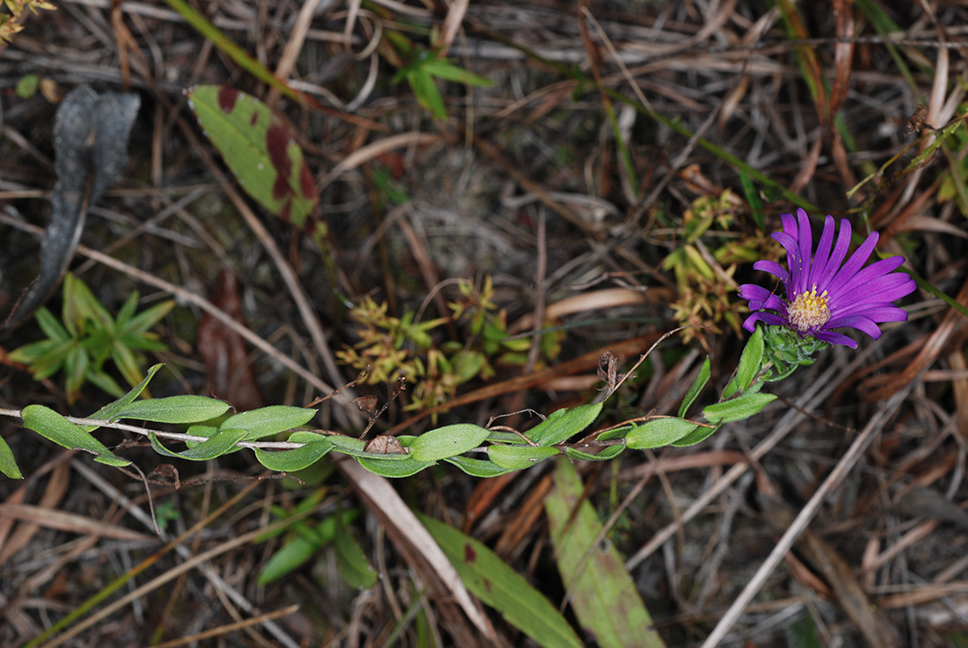
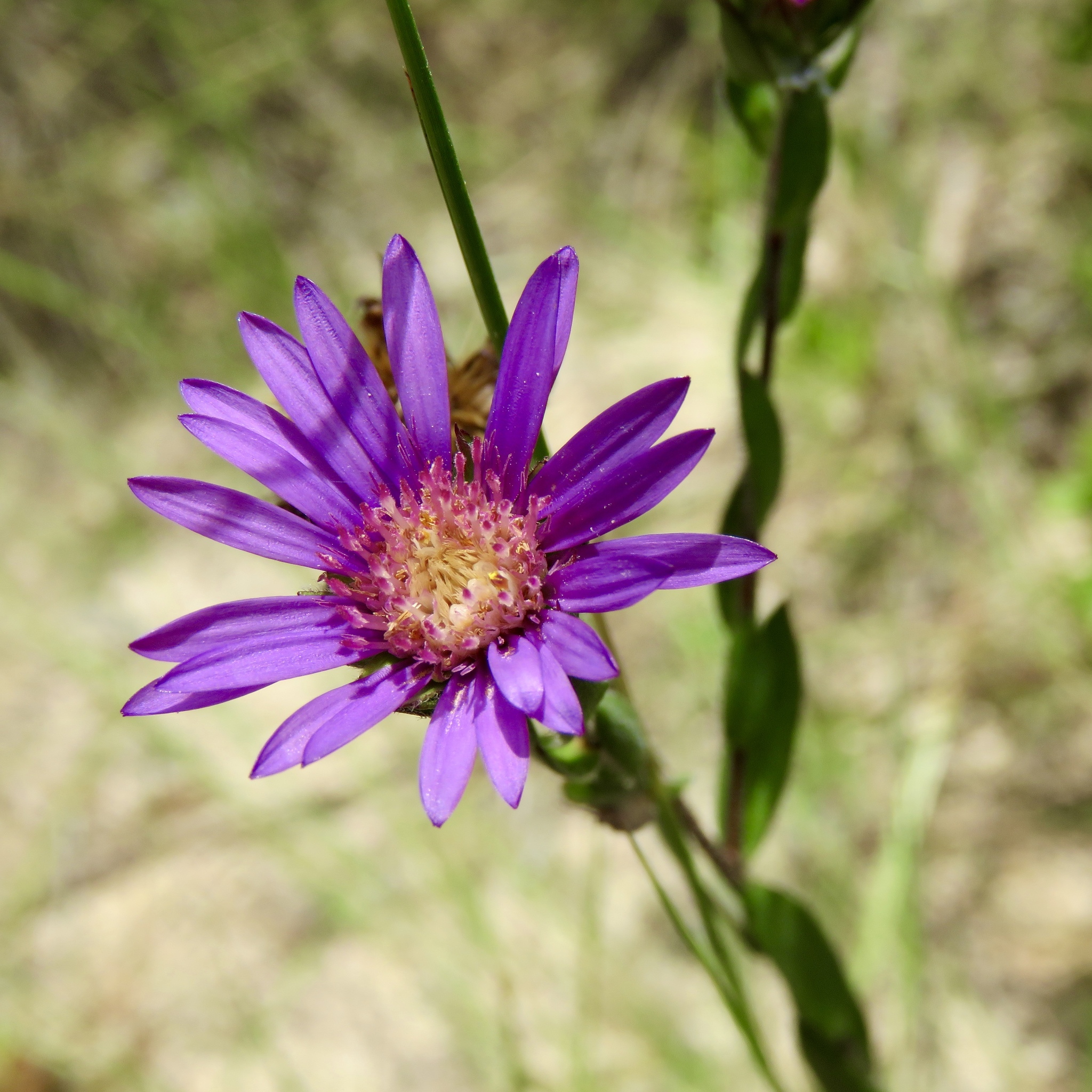
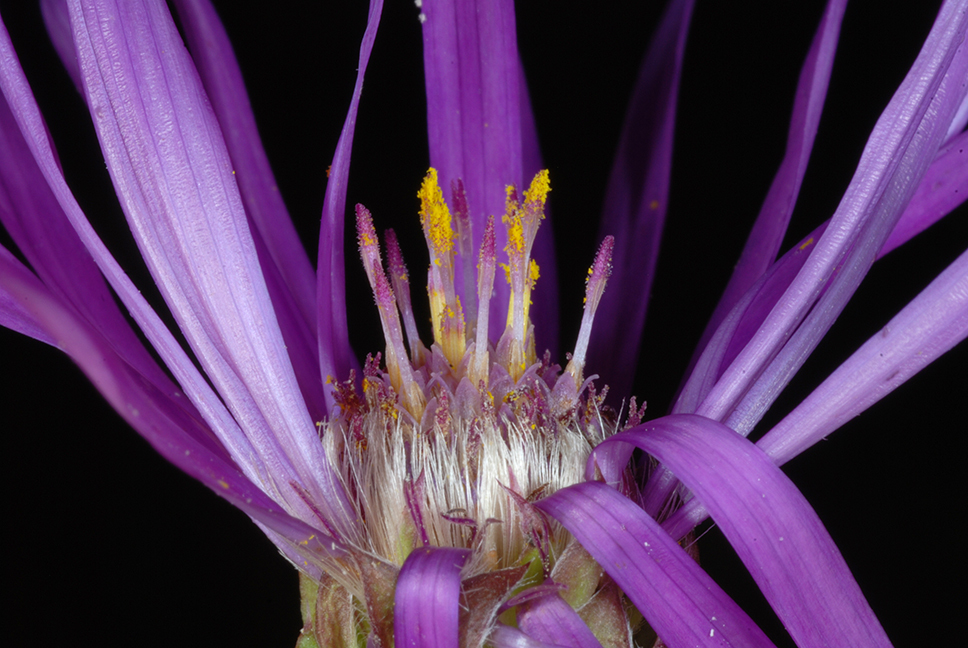
Silky aster is a tufted perennial, 40 to 60 centimeters tall (about a foot and a half to two feet) in its southeastern form — the western variety runs 30 to 70 centimeters — growing from a short, woody, corm-like rootstock rather than running rhizomes. The stems are ascending to erect, brown, smooth or sparsely hairy toward the top. The leaves are firm and grayish green, stalkless, with entire margins. The basal leaves wither by flowering; the stem leaves are oblanceolate, 20 to 30 millimeters long and 5 to 13 wide, getting smaller up the stem, the uppermost oblong-lance-shaped, 15 to 25 by 4 to 6 millimeters, with white-tipped points. The leaf faces are smooth to moderately rough-haired — noticeably less hairy than the western variety, whose leaves are densely silky — and the margins are fringed with fine hairs.
The flower heads sit in an open panicle, one to five or more heads per branch, on stalks that are smooth or sparsely hairy, with oblong-lance-shaped bracts grading into the phyllaries. The involucre is narrowly bell-shaped, 6 to 11 millimeters long. The phyllaries are in 3 to 4 series, the outer ones broadly lance-shaped and flaring outward, leaf-like, with long hairy-fringed margins and faces that are smooth or only sparsely short-hairy — again, much less hairy than the western variety’s densely long-silky phyllaries. Each head carries 13 to 15 ray florets (occasionally up to 36), rose-purple, the rays 8 to 13 millimeters long, around 16 to 34 disc florets that start pink and turn purple. The seeds are purple or brown, 2 to 3 millimeters long, prominently 7- to 10-nerved, with a whitish to tawny pappus 6 to 7 millimeters long. In the Southeast it flowers October to November — later than the western variety, which blooms August to October.
Lookalikes: eastern silver aster, plumose aster, and the western variety
The closest lookalike in Florida is eastern silver aster (Symphyotrichum concolor), another silvery-leaved aster with a corm-like rootstock — and Franck’s key separates the two by the shape of the flower cluster. Eastern silver aster carries its heads in a narrow, wand-shaped array, with only 7 to 12 ray florets and 9 to 21 disc florets per head; silky aster’s arrays are open and panicle-shaped, with 13 to 15 (or more) rays and 16 to 34 disc florets. Eastern silver aster’s two varieties split on hairiness — var. concolor has silky distal leaves and phyllaries, var. devestitum, the Panhandle form, is smooth or sparsely hairy — but neither has silky aster’s broad, flaring outer phyllaries.
Plumose aster (Symphyotrichum plumosum), the Florida endemic, is the other silvery relative: it has branched stems, open panicle-shaped arrays, and 13 to 36 ray florets, and its seeds are smooth rather than hairy. It is a plant of the central peninsula, not the Panhandle glades, and its leaves are larger — distal leaves 10 to 30 by 4 to 8 millimeters — with outer phyllaries that are leaf-like at least toward the tip. The western variety, var. sericeum, does not occur in Florida, but it is the plant most photographs labeled “silky aster” actually show: denser silky hairs on leaves and phyllaries, phyllaries with expanded green tips, and densely silky-hairy flower stalks. If the plant in the photograph looks like it was dipped in frost, it is probably the western one; the Florida plant is the sparer, smaller-leaved, less hairy cousin.
In Florida
Silky aster is native to Florida and listed as Native in the Atlas of Florida Plants — and it is also one of the rarest plants in the state. It is listed as Endangered on Florida’s Regulated Plant Index (Florida Administrative Code 5B-40.0055, which lists Symphyotrichum sericeum, western silver aster, on the Endangered Plant List), and the Florida Natural Areas Inventory ranks it S1, critically imperiled in Florida. It is not federally listed. Preserved specimens voucher it in Florida only from Gadsden and Liberty counties in the eastern Panhandle.
Its Florida habitat is the upland glade: a largely herbaceous community on thin soils over limestone outcrops, on steep topography, found only in Jackson and Gadsden counties in Florida (and adjacent Decatur County, Georgia), in two clusters about thirty miles apart — one northwest of Marianna in Jackson County, nine sites totaling 8.5 acres, and one south and east of Chattahoochee in Gadsden County, thirteen sites totaling 14.5 acres. Silky aster grows on the Gadsden County glades, not the Jackson County ones, on the limestone of the Miocene Chattahoochee Formation. Beyond Florida it ranges through the Southeast — Alabama, Arkansas, Georgia, Kentucky, Louisiana, Mississippi, Tennessee, Texas, and Virginia — in prairies, oak woodlands, pine-oak scrub, fields, and roadsides, while the western variety occupies the Great Plains from Texas to North Dakota and southern Canada.
Grow it or leave it
Leave it. That is the whole guidance for this plant, and it is not a hedge. Silky aster is state-listed Endangered in Florida, its entire Florida population lives on a handful of limestone glades, and it is not in the nursery trade — there is no legitimate source of plants or seed, and collecting from the wild would be both illegal and the fastest way to finish off a population that is already hanging by a thread. If you find it on a glade, photograph it, note the location for the Florida Natural Areas Inventory or iNaturalist, and walk away without picking, digging, or trampling the thin soil around it. The glades themselves are the rarest part of the story: the whole community type is ranked G1/S1, critically imperiled globally and in the state, and the aster is one of its flagship residents.
If you garden in Gadsden or Liberty counties and want the look — a small, silvery, purple fall aster — the honest substitute is a different native aster that is actually available and legal to grow. Georgia aster is a purple fall aster with presence, and it is a Florida native you can plant without a second thought. What you cannot do is recreate a limestone glade in a garden bed: the plant wants thin soil over rock, full sun, and the particular chemistry of that ground, and a rich garden bed would kill it with kindness. The garden’s job here is not to grow the plant but to protect the ground it grows on — which, for a gardener in the Panhandle, mostly means leaving glades alone and supporting the land trusts and agencies that hold them.
Pollinators and wildlife
For the species as a whole, the nectar and pollen attract bumblebees, leaf-cutting bees, green metallic bees, syrphid flies, and small- to medium-sized butterflies — including, in the north, the endangered Karner Blue — and the plant is self-incompatible, depending on insect visitors to set seed. Its fall bloom coincides with the monarch migration through the central states, where late-blooming asters are among the most important fuel sources for migrating butterflies. In Florida, where the plant flowers in October and November on its glades, its pollinators are the same late-season crew — native bees provisioning their last nests of the year and butterflies fueling up before winter — working a plant that blooms when almost everything else on the glade has finished. The caterpillars of aster-feeding moths and butterflies use the foliage, as they do across the genus, and the seeds feed birds.
Varieties
The varieties are the point of this guide, so here they are plainly. Var. microphyllum is the Florida variety — the small-leaved southern form, with smaller leaves, less densely hairy foliage and phyllaries, larger broadly ovate outer phyllaries that flare outward, and an October-to-November bloom. It ranges through the southeastern United States, and in Florida it is known only from Gadsden and Liberty counties. Var. sericeum, the western silvery aster, is the nominate variety: densely silky leaves and phyllaries, phyllaries with expanded green tips, densely silky-hairy flower stalks, and a range across the Great Plains from Texas to North Dakota and southern Canada. It does not occur in Florida. Some authorities, including Flora of North America, treat the southeastern plants as a separate species, Symphyotrichum pratense (barrens silky aster); Florida’s flora follows Wunderlin & Hansen and treats them as var. microphyllum. There are no named garden varieties, and none is claimed here. This guide covers Symphyotrichum sericeum var. microphyllum only.
Frequently asked questions
Is silky aster native to Florida?
Yes — it is listed as Native in the Atlas of Florida Plants. But it is extremely rare here: vouchered only from Gadsden and Liberty counties in the eastern Panhandle, on limestone upland glades.
Is it endangered?
In Florida, yes. It is listed as Endangered on Florida’s Regulated Plant Index (F.A.C. 5B-40.0055) and ranked S1, critically imperiled in the state, by the Florida Natural Areas Inventory. It is not federally listed, and it is globally secure — its rarity is a Florida story, not a global one.
Can I grow it in my garden?
No — and you should not try. It is state-listed Endangered, it is not in the nursery trade, there is no legitimate source of plants or seed, and collecting it from the wild is illegal. It also wants thin soil over limestone, which a garden bed cannot reproduce. Grow Georgia aster instead for the same purple fall color.
What is the difference between var. microphyllum and var. sericeum?
Var. microphyllum is the small-leaved southern variety: smaller leaves, less densely hairy foliage and phyllaries, larger broadly ovate outer phyllaries that flare outward, blooming October to November. Var. sericeum is the western variety: densely silky leaves and phyllaries, expanded green phyllary tips, densely silky flower stalks. The western variety does not occur in Florida.
Is it the same plant as Symphyotrichum pratense?
It depends on which flora you follow. Flora of North America treats the southeastern plants as a separate species, S. pratense (barrens silky aster). Florida’s flora follows Wunderlin & Hansen and treats them as S. sericeum var. microphyllum. Same plant, two filing systems — and the photos in this guide are filed under S. pratense because that is the name their photographers used.
Where in Florida does it grow?
Only on upland glades — thin-soiled limestone outcrops — around Chattahoochee in Gadsden County, with specimens also from Liberty County. The glade community itself is critically imperiled, with about 22 acres total across its two Florida clusters.
How do I tell it from eastern silver aster?
Look at the flower cluster. Silky aster has open, panicle-shaped arrays with 13–15 or more ray florets per head. Eastern silver aster (S. concolor) has narrow, wand-shaped arrays with only 7–12 rays per head. Silky aster also has broad, flaring outer phyllaries that eastern silver aster lacks.
When does it bloom?
October to November in the Southeast — later than the western variety, which blooms August to October. It is one of the last flowers on the glade, blooming when almost everything else has finished.
What pollinators visit it?
Bumblebees, leaf-cutting bees, green metallic bees, syrphid flies, and small- to medium-sized butterflies. It is self-incompatible, so it depends on insect visitors to set seed — which is one more reason the glades need their pollinators left alone.
I think I found one — what should I do?
Photograph it without picking or digging anything, note the location, and report it — to iNaturalist, or to the Florida Natural Areas Inventory. Do not collect seed or plants, do not trample the thin soil around it, and do not share precise locations publicly for a state-listed endangered plant.
🌱 Keep learning
Three related guides worth reading next:
- Georgia Aster — The plantable purple fall aster — a Florida native with presence, and the honest garden substitute for this one.
- Heath Aster — Another small, tough aster of open ground, and the white-flowered contrast to silky aster’s purple.
- Aster — The genus guide: how the North American asters got their name back from Aster, and what ties them all together.