
💜 Simmond’s Aster
There is a moment in a Florida fall — late October, usually, when the light has gone low and gold — when a wet flatwoods edge turns lavender all at once. Not one plant, not a drift, but a whole colony of tall, stiff-stemmed asters blooming in unison, hundreds of pale lilac heads nodding over the grasses, and you realize the “empty” field you walked past all summer was never empty at all. That is Simmond’s aster, and it is one of the most Florida plants there is: endemic to the southeastern Coastal Plain, most prevalent throughout peninsular Florida, and almost unknown anywhere else on Earth.
It is also a plant with a small mystery attached to it, which seems fitting. The botanist John Kunkel Small described it in 1913 as Aster simmondsii — and nobody has ever pinned down, with confidence, which Simmonds he was naming it for. Candidates have been proposed; none of them quite fit. So the plant carries a person’s name, and the person has slipped out of the record. The aster, meanwhile, is doing just fine without him, blooming October through January in wet prairies and ditches across the peninsula, as it presumably did long before anyone thought to name it at all.
If you have ever confused it with rice button aster, you are in good company — the two are close cousins, they overlap in range and season, and they look alike from a distance. Up close, though, Simmond’s is the bigger, bolder, rougher one: larger heads, longer rays, broader sandpapery leaves, and stems like thin green rebar. Learn those four differences and you will never mix them up again.
At a glance
- Latin name: Symphyotrichum simmondsii (formerly Aster simmondsii Small, 1913)
- Family: Asteraceae — the aster, composite, or daisy family
- Common name: Simmond’s aster (also written Simmonds’ aster)
- Life cycle: Perennial herbaceous wildflower; colonial, sometimes extensively, spreading by long underground rhizomes
- Height: Up to 4 feet (10–120 cm), on 1–3+ erect, rigid stems
- Flowers: 18–38 ray florets, pale lilac or lavender to pale purple, 9–11 mm long; 24–37 disc florets, yellow becoming reddish with maturity
- Bloom: October through January (peak December–February in some Florida records)
- Habitat: Wet prairies, wet pine flatwoods, ditches, and other moist to wet habitats; also tolerates moist to dry calcareous soils
- Light: Full sun to part shade
- Florida range: Prevalent throughout peninsular Florida; endemic to the southeastern Coastal Plain (southeastern North Carolina south to southern Florida, west to southern Alabama)
- Wildlife value: Late-season nectar and pollen for butterflies, bees, and other pollinators, blooming when little else is flowering
- Availability: Not commercially available — visit a natural area to see it
How to recognize it
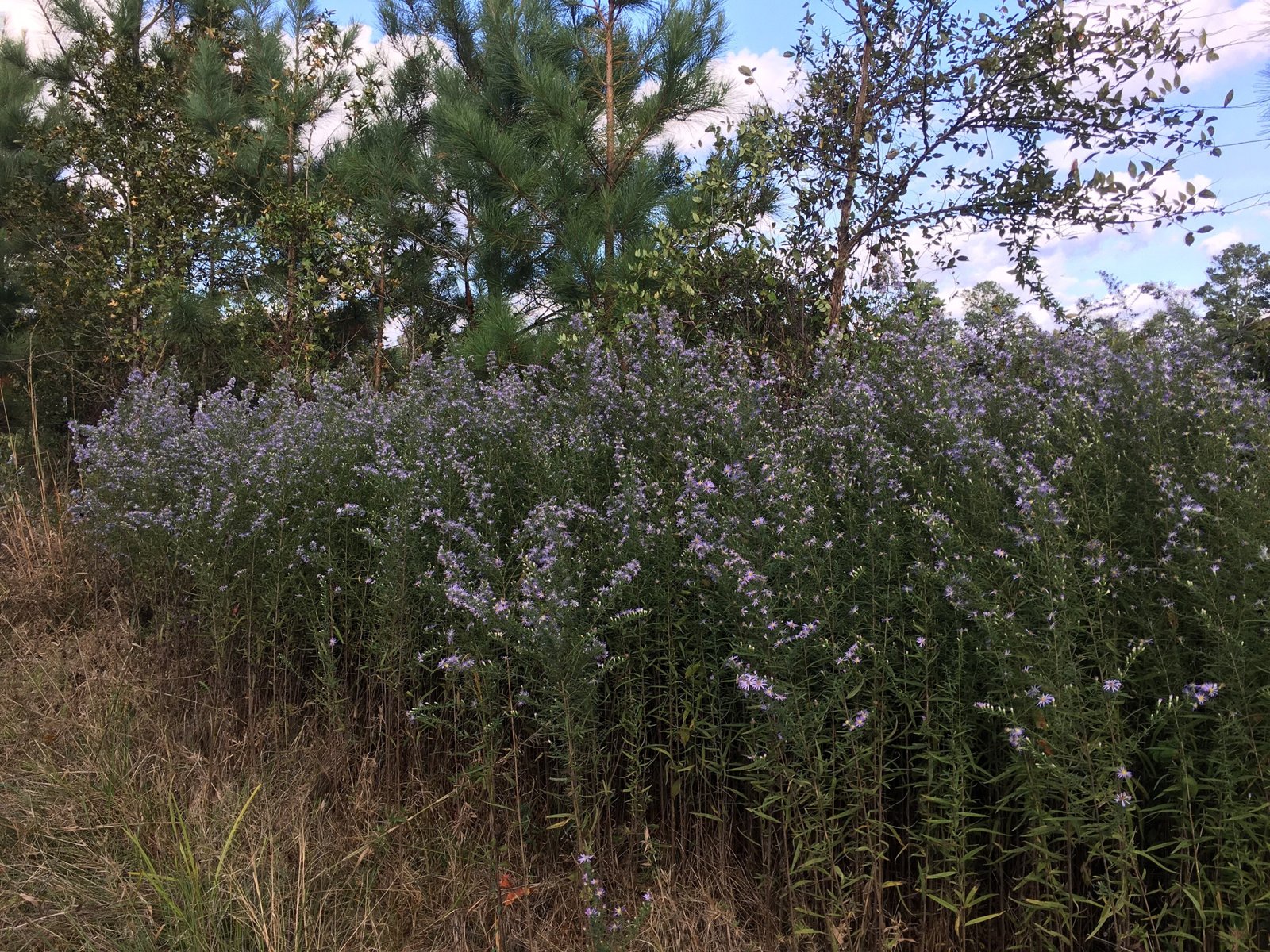
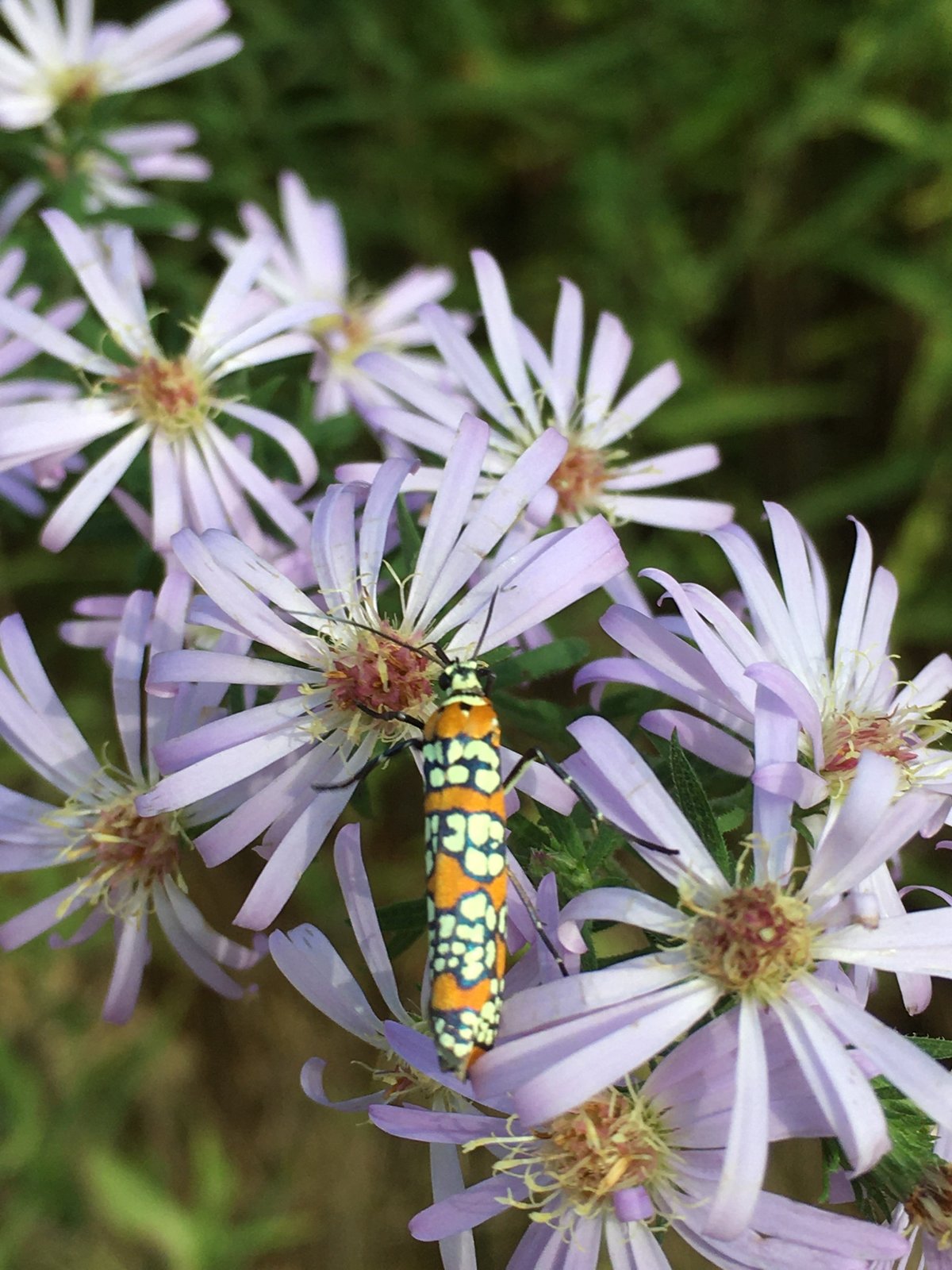
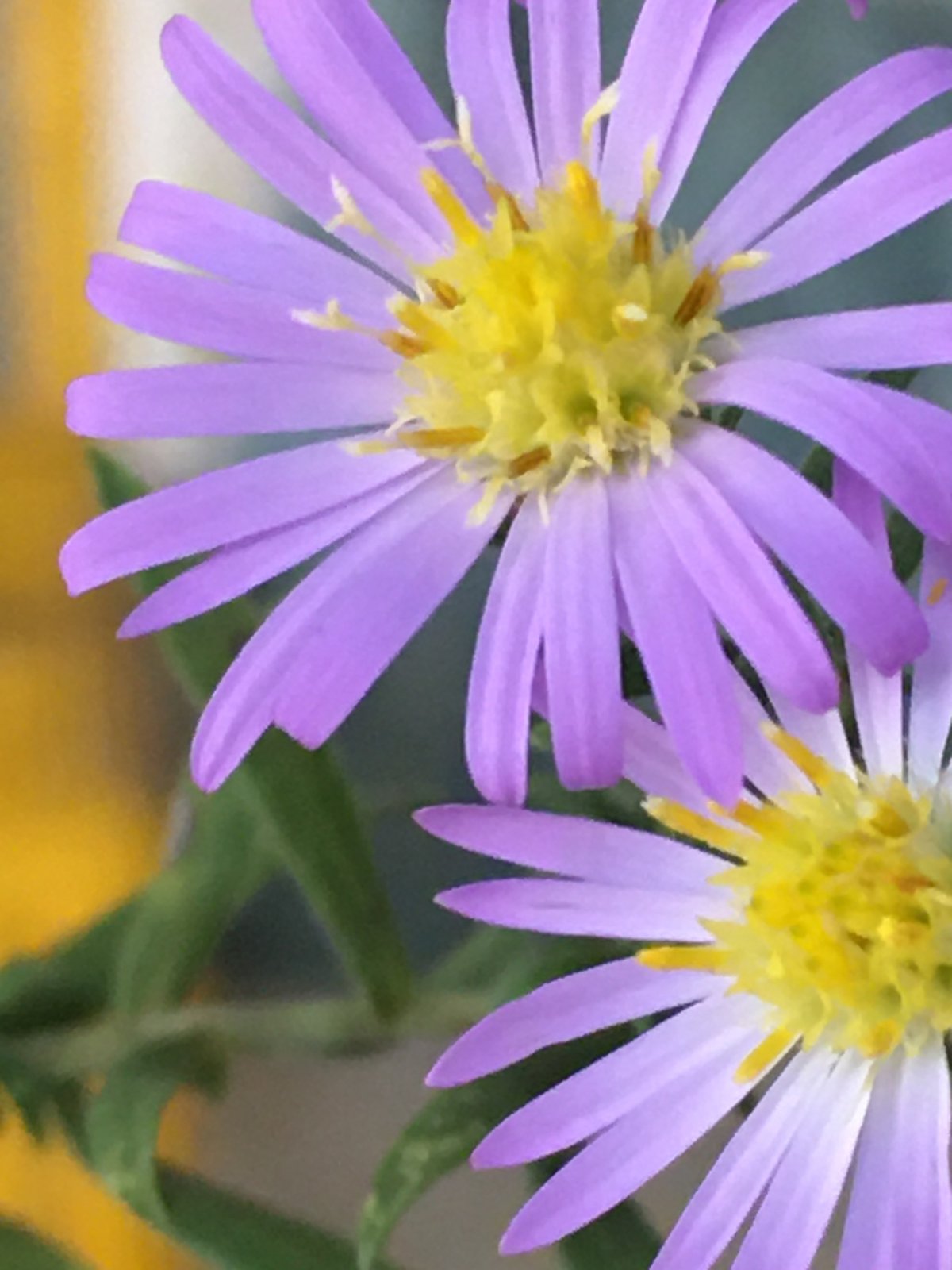
Start with the flower heads, because they are the whole argument. Each head carries 18 to 38 ray florets — the petal-like straps — in pale lilac or lavender to pale purple, and each ray is 9 to 11 millimeters long. That length is the number to remember: it is nearly twice the 5 to 7 millimeter rays of rice button aster, and it is why Simmond’s heads look visibly bigger and showier, even though the plant is still, by any honest measure, a small-flowered aster. The disc florets in the center number 24 to 37, start out yellow, and turn reddish as they mature — so an older head looks like it has a rusty heart, and a colony in full bloom shows yellow centers, reddish centers, and every stage in between. The cup beneath each head — the involucre — is bell-shaped, 6 to 8 millimeters long, with five to six rows of strongly unequal bracts, sometimes purple-tipped.
Then touch the leaves. Simmond’s leaves are oblanceolate — widest above the middle, narrowing toward the base, like a tiny spoon or a teardrop held upside down — and they are scabrous, which is botanist-speak for rough like fine sandpaper. Run a finger along one and you will feel it. The basal leaves wither by flowering time, so what you actually see are the stem leaves: elliptic to oblanceolate or lance-shaped lower down, getting smaller and narrower as they climb, and then sharply reduced on the flowering branches — the leaves on the flower-bearing branchlets shrink abruptly, leaving the heads standing out on nearly bare, leafy-but-not-quite stems. That sharp reduction on the array branches is one of the characters the Flora of Florida key uses to separate it from its relatives, and once you have seen it, it is hard to unsee.
The stems are the third check: one to three or more per plant, erect, straight, and rigid — sometimes stout — ranging from sparsely rough to nearly smooth. This is not a floppy plant. A four-foot Simmond’s aster stands up like it means it, even in a wet prairie wind, and a colony of them reads as a stiff lavender hedge rather than a soft cloud.
And the fourth check is the one you notice before you ever bend down: the colony. Simmond’s aster spreads by long underground rhizomes and forms colonies, sometimes extensively. You rarely find one plant alone. You find a patch, or a drift, or a whole flatwoods edge gone lavender — dozens of stems rising from a shared underground network, all blooming at once. If you are looking at a single lonely aster, keep walking; if you are looking at a lavender thicket, you are probably in the right place.
Where it grows in Florida
Simmond’s aster is endemic to the southeastern Coastal Plain — meaning it grows naturally nowhere else on Earth — and within that narrow range, it is most prevalent throughout peninsular Florida. The full range runs from southeastern North Carolina south to southern Florida and west to southern Alabama, but Florida is its stronghold: the Atlas of Florida Plants vouchers it across roughly three-quarters of the state, and it is a familiar sight in wet country from the Panhandle down through the peninsula.
Its favorite ground is wet: wet prairies, wet pine flatwoods, ditches, and other moist to wet habitats. That is the headline, and it is the first thing to look for — if the ground squelches, Simmond’s is a candidate. But it is more flexible than the “wet” label suggests: the Florida Wildflower Foundation also records it on moist to dry calcareous soils, and Flora of North America simply says “moist or dry soils.” The honest summary is that it tolerates a wide range of moisture but is at its best, and most common, in wet ground — which is exactly the opposite of what you would expect from an aster, since most of its Florida cousins want it dry. That wet preference is itself a field clue: a big lavender aster in a ditch or a wet prairie in November is Simmond’s until proven otherwise.
It blooms October through January — the latest of the fall asters, carrying the season past Christmas and into the new year. Some Florida records put the peak in December through February. Either way, it is a plant that blooms when almost nothing else is: the last nectar bar open before winter, in a landscape that has mostly gone brown and quiet.
Growing it — or leaving it be
Here the guidance is short, and it is not what a gardening site usually gets to say: you almost certainly cannot grow this plant, and you should not try to dig one up. The Florida Wildflower Foundation puts it plainly — “Simmond’s aster is not commercially available. Visit a natural area to see it.” No nursery grows it, no seed house lists it, and there are no verified cultivation notes to pass along, because nobody has made a regular practice of growing it.
That is not a failure of the plant. It is a plant of wet prairies and flatwoods, of long rhizome colonies in ground that floods and dries on its own schedule — conditions a garden bed cannot honestly reproduce, and conditions that matter to the plant. A dug-up Simmond’s aster is a dead Simmond’s aster with extra steps, and a wild colony is doing late-season pollinator work that no garden substitute can replace.
So the advice for this one is to go see it. Find a wet flatwoods trail, a prairie edge, or a ditch bank in November or December, and look for the lavender drift. Bring a camera, bring a ruler — the 9 to 11 millimeter rays are worth measuring at least once — and leave the rhizomes in the ground. Some plants you grow. Some plants you visit. Simmond’s aster, for now, is a visiting plant, and Florida is lucky to be the place you visit it.
If the day ever comes when a native nursery cracks its propagation, this section will get a proper growing guide. Until then, the honest thing is to say so, and to point you at the flatwoods instead of the garden center.
Pollinators and wildlife value
Simmond’s aster blooms October through January, and that timing is its whole ecological job. By late fall, the summer flowers are done, the goldenrods are fading, and the pollinators still flying — butterflies, native bees, moths, and the rest of the late-season crew — are working a landscape with very little left on the menu. A colony of Simmond’s aster in full bloom is hundreds of open, flat, nectar-and-pollen-rich heads, in exactly the wet, sunny places where those insects are still active. The flowers’ open shape means any insect with a short tongue can feed, so the plant serves generalists by the dozen rather than one specialist.
The close-up photo above catches the point in action: an Ailanthus webworm moth, all orange and turquoise and improbable, feeding on a Simmond’s aster head. That is the plant’s daily business in November — feeding whatever is still flying, in whatever color it happens to come in. It is not recorded as a larval host for a particular butterfly the way its cousin rice button aster is for the Pearl crescent, and this guide will not invent one. What it is, reliably and documentably, is a late-season nectar source at scale — and in a Florida winter, that is no small thing.
Varieties
None. Flora of North America lists no lower taxa for Symphyotrichum simmondsii — no varieties, no subspecies. What you see is the species, whole and undivided, from North Carolina to southern Florida. That is worth stating plainly, because in a genus where some species split into half a dozen named varieties, a clean single form is the exception, and it makes identification simpler: there is no “which variety is this?” question to answer after you have named the plant.
Lookalikes: check before you decide
Simmond’s aster’s closest confusion is the plant it is most often photographed next to, and the one this guide series started with.
Rice button aster (Symphyotrichum dumosum) — the smaller, paler cousin. The two overlap in range and bloom season, and from six feet away they are both “small lavender-white aster on a twiggy stem.” Up close, the differences are decisive. Rice button aster’s heads are smaller — 3/8 to 3/4 of an inch across, with rays only 5 to 7 millimeters long, against Simmond’s 9 to 11. Its rays are usually white to pale pink rather than pale lavender to lilac. And its leaves are narrow, linear, and smooth, where Simmond’s are broader, oblanceolate, and rough to the touch. The quick field test: measure a ray. If it is under 7 millimeters and the leaves are smooth and grass-like, it is rice button. If it is 9 millimeters or more and the leaves feel like sandpaper, it is Simmond’s.
Willowleaf aster (Symphyotrichum praealtum) — the waxy one. The Flora of Florida key separates these two on leaf surface and disc color, and both characters are checkable in the field. Willowleaf aster’s leaves are waxy on their upper faces — smooth, almost polished-looking, catching the light — where Simmond’s leaves are rough and dull. And its disc florets are cream to pale yellow, turning pinkish, where Simmond’s discs turn a more definite reddish with maturity. Willowleaf is also a plant of wetter ground and a taller, willow-leaved habit, with its stem leaves progressively (not sharply) reduced up the flowering branches. If the leaves shine and the discs stay pale, think willowleaf; if the leaves are sandpapery and the disc centers go rusty-red, think Simmond’s.
Habitat helps too, and it helps in the direction people forget: Simmond’s aster at its best is a wet-ground plant — wet prairies, wet flatwoods, ditches. Rice button aster is a dry-ground plant — sandhills, dry flatwoods, hammocks. If your feet are wet, lean Simmond’s; if the sand is dry underfoot, lean rice button. It is not a proof — both tolerate a range — but it is a good first guess, and it is right more often than it is wrong.
Fun facts
- Simmond’s aster is named for a Simmonds nobody can identify. John Kunkel Small described it in 1913, and researchers since have proposed candidates for the namesake without ever settling the question.
- It is endemic to the southeastern Coastal Plain — it grows naturally nowhere else on Earth — yet within peninsular Florida it is prevalent and widespread, not rare.
- Its ray florets are nearly twice as long as its closest cousin’s: 9 to 11 millimeters against rice button aster’s 5 to 7. That two-millimeter gap is the difference between “small white aster” and “wait, that one looks bigger.”
- It can form extensive colonies from long underground rhizomes, so a whole lavender hillside can be, in a sense, one plant wearing many hats.
- It blooms October through January — one of the latest-blooming asters in Florida, feeding pollinators when almost everything else has finished for the year.
- A report of it from New Jersey, based on a single incomplete specimen, is considered doubtful by Flora of North America. Florida and the coastal Carolinas are its real home.
Frequently asked questions
Who was Simmonds?
Nobody knows for sure. John Kunkel Small named the plant Aster simmondsii in 1913, and researchers have proposed candidates for the namesake without ever pinning one down with confidence. The plant keeps the name; the person has slipped out of the record.
Where does Simmond’s aster grow?
It is endemic to the southeastern Coastal Plain — southeastern North Carolina south to southern Florida, west to southern Alabama — and most prevalent throughout peninsular Florida. Its favorite ground is wet: wet prairies, wet pine flatwoods, and ditches, though it also tolerates moist to dry calcareous soils.
When does it bloom?
October through January, with some Florida records peaking December through February. It is one of the latest-blooming asters in the state.
How is it different from rice button aster?
Three things: head size (Simmond’s rays are 9–11 mm long, nearly twice rice button’s 5–7 mm), ray color (pale lavender to lilac, where rice button is usually white to pale pink), and leaves (broader, oblanceolate, and rough to the touch, where rice button’s are narrow, linear, and smooth). Wet feet also lean Simmond’s; dry sand leans rice button.
Can I buy Simmond’s aster for my garden?
No — it is not commercially available, and there are no verified cultivation notes. The Florida Wildflower Foundation’s advice is to visit a natural area to see it. Enjoy it in wet flatwoods and prairies in November and December, and leave the rhizomes in the ground.
Is Simmond’s aster rare?
It is endemic to the southeastern Coastal Plain, which sounds rare — but within peninsular Florida it is prevalent and widespread, forming large colonies in wet habitats. It is a narrow-range plant that is common where it occurs, not a plant of special conservation concern.
What pollinators does it feed?
Late-season butterflies, bees, moths, and other pollinators, drawn by hundreds of open nectar-and-pollen-rich heads at a time of year when little else is flowering. The close-up photo above shows an Ailanthus webworm moth feeding on one — that is the plant’s daily business in November.
Does it have varieties?
No. Flora of North America lists no lower taxa for this species — no varieties or subspecies. What you see is the species, whole and undivided, across its whole range.
Why are the centers reddish?
The disc florets start out yellow and turn reddish as they mature. A head with a rusty-red center is an older head, not a different species — and a colony in full bloom will show yellow centers, reddish centers, and everything in between at the same time.
Is it related to the garden asters in nurseries?
Distantly. The garden asters sold in nurseries are mostly New England aster (S. novae-angliae) and New York aster (S. novi-belgii) cultivars — same genus, different species, bred for big showy flowers. Simmond’s aster is a wild Florida native that has never been brought into cultivation.
🌱 Keep learning
Three related guides worth reading next:
- Rice Button Aster — Simmond’s smaller, paler cousin — the plant that started this aster series — and how a ruler tells them apart.
- Elliott’s Aster — Another tall Florida native aster, this one of wet places too, with fragrant blooms that pull in butterflies by the dozen.
- Aster: The Genus Guide — How the old genus Aster split into ten genera, and where Symphyotrichum fits in the family.