
🌿 Smooth Blue Aster
What it looks like
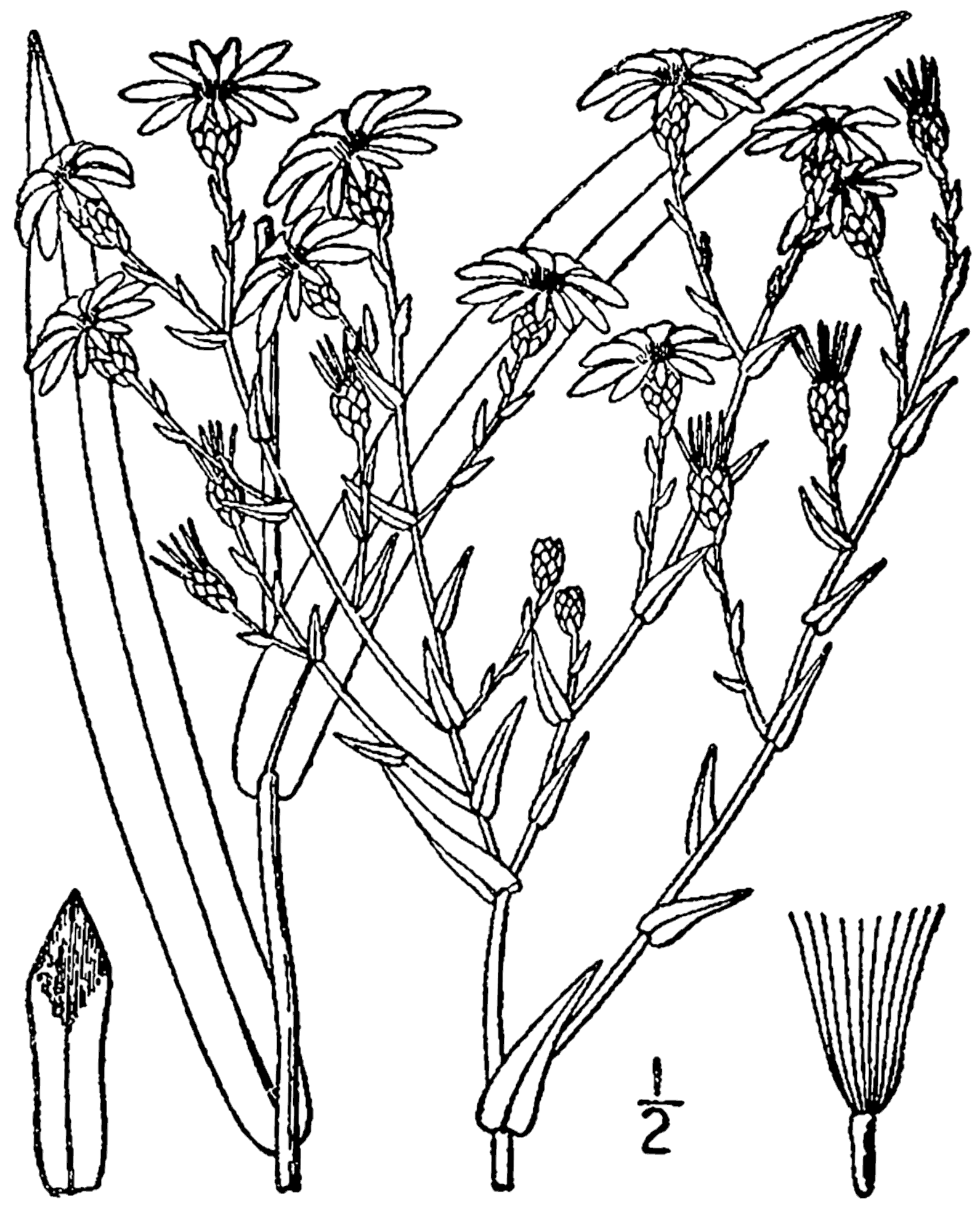
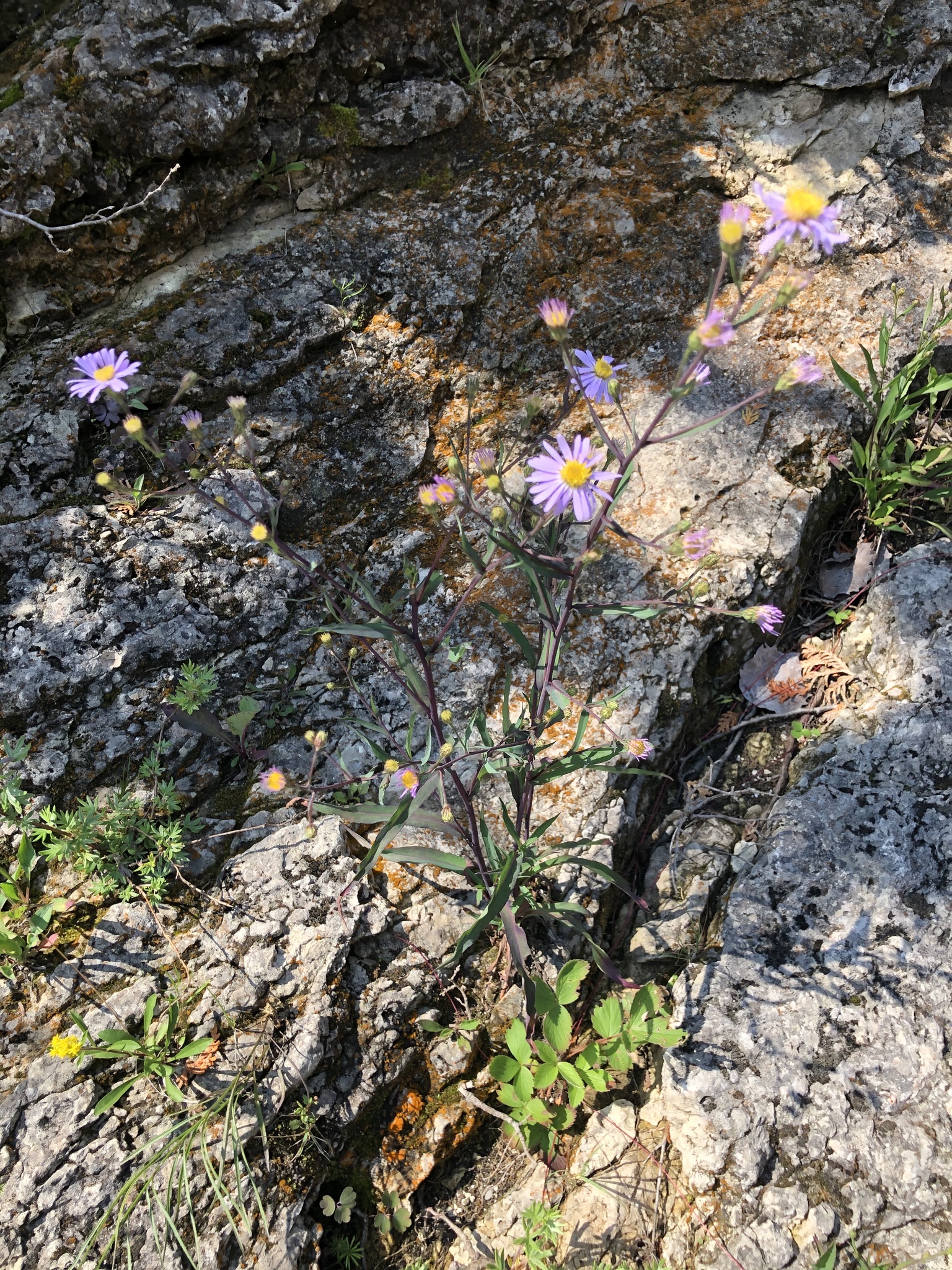
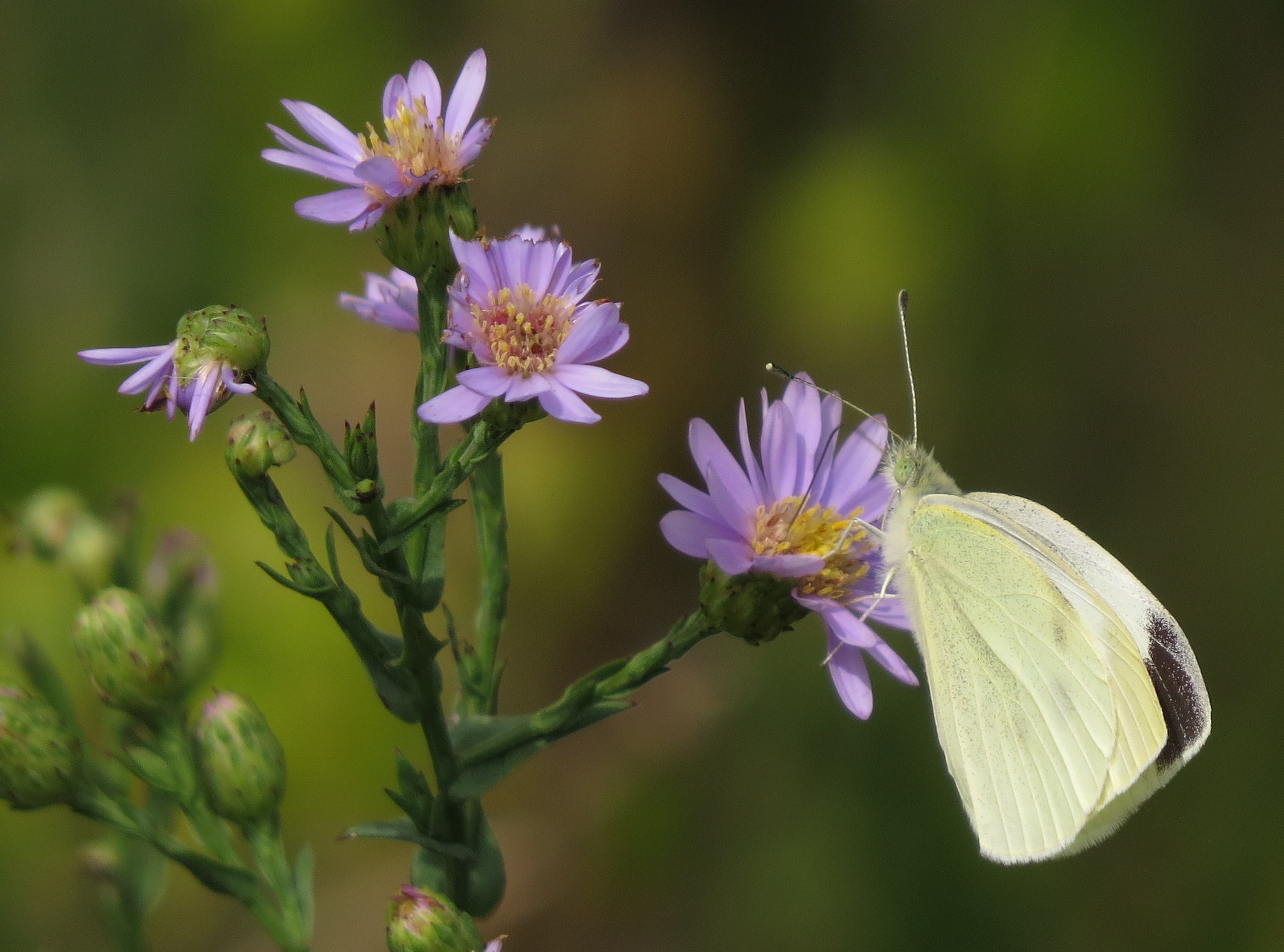
Smooth blue aster is a perennial, usually eight inches to a little over two feet tall in its Florida form (the species can reach four feet farther north), growing in a clump from a short, stout rhizome with a thick, woody base. The whole plant has a cool, blue-green cast — the stems and leaves are glaucous, coated in a thin waxy bloom that gives them a dusty blue-green sheen, like a grape with its bloom still on. Run a finger along a leaf and it is smooth. That is the whole point of the plant, and the whole point of its name: laeve is Latin for smooth.
The leaves are thick, firm, and slightly fleshy, with faces that are glabrous — completely hairless — and margins that are finely toothed or entire, with a rough edge you can feel more than see. The basal leaves wither away by flowering time. The stem leaves are the identification: in this variety they are linear-lance-shaped, slightly clasping at the base, and strikingly narrow — usually more than five times as long as they are wide, and rarely more than an inch (2.5 centimeters) wide. A leaf that is six inches long and one inch wide is a typical Florida smooth blue aster leaf, and that narrowness is what separates this variety from the broader-leaved northern form. The leaves are also slightly fleshy and sessile, sitting directly on the stem without a stalk.
The flowers are the payoff. Each head carries 13 to 23 ray florets in pale to dark blue or purple — seldom white — each ray roughly a third to a half inch long, around a center of 19 to 33 disc florets that open yellow and age purplish-red. The heads sit in broad, sometimes almost flat-topped, branching panicles, and the cup beneath each head — the involucre — is bell- to cylinder-shaped, 5 to 7 millimeters long, with four to six series of bracts whose green zones are diamond-shaped in this variety. The seeds are deep purple to brown, oblong, and wear a tawny to rose-tinged tuft of bristles. It flowers in September and October.
One honest note about the photographs above: the two color photos show the species Symphyotrichum laeve, photographed outside Florida, and are captioned that way on purpose. No verifiable photograph of the Florida variety itself — var. concinnum, in a Jackson County glade — exists in the public collections this guide could verify, so the variety is illustrated here by the 1913 Britton & Brown botanical drawing, which was drawn from this exact variety. The flowers in the photos are what the Florida plant’s flowers look like; the leaves in the drawing are what its narrow leaves look like. Neither is presented as something it is not.
How to tell it from its lookalikes
The Flora of Florida key puts smooth blue aster in the clasping-leaf group, and the test that separates it from its neighbors is almost comically simple: touch the leaf face.
- Azure aster (Symphyotrichum oolentangiense). The key’s direct neighbor and the plant most likely to be confused with it. Azure aster’s leaf faces are scabrous — rough — and strongly bristly-hairy on the upper surface, hairy to shaggy below. Smooth blue aster’s leaf faces are glabrous: smooth, hairless, waxy. Rough leaf, azure aster; smooth leaf, smooth blue aster. The name is the field mark.
- Late purple aster (Symphyotrichum patens). Also clasping-leaved, but its lower leaf bases are broadened just above a pinched constriction, and its upper leaves are egg-shaped with strongly heart-shaped, clasping bases. Smooth blue aster’s leaves are narrow, linear-lance-shaped, and only slightly clasping, with no pinched constriction anywhere.
- Wavyleaf aster (Symphyotrichum undulatum). Its stem leaves sit on winged stalks whose wings widen abruptly at strongly clasping, ear-like bases. Smooth blue aster’s leaves are sessile — no stalk, no wings, no ear-like flare.
- Short’s aster (Symphyotrichum shortii). Its basal leaves are deeply heart-shaped at the base. Smooth blue aster’s basal leaves are gone by flowering and were never deeply heart-shaped in the first place.
The practical checklist for Florida is short, because the plant itself is rare: a smooth, hairless, blue-green aster with narrow leaves more than five times as long as wide, in a dry upland glade in Jackson County, flowering in September or October. If the leaves are rough, it is not this plant. If you are anywhere else in Florida, it is almost certainly not this plant either.
Where it grows in Florida
Here is the whole Florida story, and it is a short one: smooth blue aster grows in Florida in one county, Jackson County, in the panhandle, in upland limestone glades. The Florida Natural Areas Inventory records only one recent record in the state, and ranks the taxon G5T4 globally but S1 in Florida — critically imperiled within the state. Its habitat is limestone glade: dry, open, rocky ground over limestone, a rare and vulnerable community type in Florida.
Rangewide, the variety is an eastern plant, occurring from New York and Kentucky south through the Appalachians and Piedmont to Georgia, panhandle Florida, and Mississippi, in dry open woods, mostly on Piedmont and mountain ground, from 50 to 1,000 meters elevation. Florida is the southern tip of that range, and the Jackson County glades are the last toehold. The northern variety, var. laeve, does not occur in Florida at all — its range is the north and the interior, and its leaves are broader and more strongly clasping. If you see a “smooth blue aster” for sale or in a garden farther south, check the label: the Florida plant is var. concinnum, narrow-leaved, and it is not the plant in the nursery trade.
How to grow it — or leave it
This one is a “leave it” plant, and the reasons are unusually clear. It is S1 — critically imperiled — in Florida, with one recent record in one county in one rare habitat type. There is no nursery source for the Florida variety, no documented cultivation of it in Florida, and no reason to try: a plant that lives on a limestone glade in Jackson County is not going to thrive in a Keystone Heights backyard, and digging or collecting it would be an additional pressure on a population that may already be a single glade.
The species as a whole is a different story elsewhere. North of Florida, smooth blue aster is a well-known garden plant — a tough, drought-tolerant perennial for full sun to part shade, hardy in USDA zones 4a to 8b according to NC State Extension, grown for its blue-purple fall flowers and its waxy, disease-resistant foliage. The popular cultivar ‘Bluebird’ is a selection of the species. None of that applies to the Florida variety in a Florida garden, and this guide does not pretend otherwise. A Florida gardener who wants a blue fall aster should look at the site’s other Florida asters — Georgia aster is the showy purple one, and heath aster is the white cloud — and leave the Jackson County glades alone.
Pollinators & wildlife
Smooth blue aster is a late-season pollinator plant wherever it grows: its open, daisy-like heads in September and October feed small native bees, syrphid flies, skippers, and butterflies at a moment when the summer flowers are fading and the fall migrants are fueling up. The blue-purple rays and yellow disc are the classic aster advertisement, and the nectar is accessible to generalists with short tongues.
It is also a caterpillar host plant. The site’s heath aster guide notes that the Pearl Crescent guide’s host list names “true asters, especially smooth-leaved species (Symphyotrichum species, formerly Aster), including smooth aster” — and smooth aster is this plant. Pearl Crescent caterpillars feed gregariously in silk webs on their aster hosts, and a dense aster patch is a whole apartment block of leaves for a whole family of caterpillars. That host relationship is documented at the species level for S. laeve, and this guide claims it at that level, not as a Florida-specific observation — because in Florida, with one recent record, nobody has watched a Pearl Crescent eat this variety in a Jackson County glade. The seeds feed small birds through the winter, and the standing stems shelter overwintering insects.
Varieties
The species Symphyotrichum laeve has four recognized varieties in the Flora of North America, and Florida has exactly one of them. This guide covers that one — var. concinnum — and names the other three so the picture is complete.
- Var. concinnum — this plant. The eastern, narrow-leaved race: basal leaves withering by flowering, stem leaves linear-lance-shaped, often more than five times as long as wide, slightly clasping; bracts strongly unequal with diamond-shaped green zones. From New York and Kentucky south to Georgia, panhandle Florida (Jackson County), and Mississippi. Also called narrow-leaved smooth aster. Concinnum means neat, elegant, well-formed — a fair description of a plant with not a hair out of place.
- Var. laeve — the northern smooth blue aster. Leaves lance-shaped to egg-shaped and conspicuously clasping, less than five times as long as wide; bracts strongly unequal with diamond-shaped green zones. The common northern form, and the one most garden plants and most photographs show. It does not occur in Florida.
- Var. geyeri — Geyer’s aster. The western variety, with bracts whose green zones are lance-shaped rather than diamond-shaped. It does not occur in Florida.
- Var. purpuratum. The southeastern variety, with leaves mostly basal and near the base at flowering, mostly linear. It does not occur in Florida.
Two naming notes. First, some authorities — including the Florida Natural Areas Inventory and Weakley’s Flora of the Southeastern United States — treat this taxon as a full species, Symphyotrichum concinnum, rather than a variety of S. laeve. This guide follows Franck 2025, the Flora of Florida, which keeps it as var. concinnum; if you see the name S. concinnum on a field guide or a conservation list, it is the same plant. Second, the old name Aster laevis — Linnaeus, 1753 — is the basionym, and it is the reason the plant is still called “smooth aster” in some older books.
Frequently asked questions
Is smooth blue aster native to Florida?
Yes — the variety concinnum is native, and it is the only variety of smooth blue aster that occurs in Florida. But “native” does not mean “common”: it is recorded from Jackson County only, with one recent record, and ranked S1 (critically imperiled) in the state by the Florida Natural Areas Inventory.
What is var. concinnum, and how is it different from var. laeve?
They are two varieties of the same species. Var. concinnum — the Florida one — has narrow, linear-lance-shaped stem leaves, usually more than five times as long as wide and rarely more than an inch wide. Var. laeve — the northern one — has broader, lance-shaped to egg-shaped leaves that clasp the stem conspicuously and are less than five times as long as wide. Var. laeve does not occur in Florida.
Why are there no color photos of the Florida plant?
Because no verifiable photograph of var. concinnum in Florida exists in the public collections this guide could check. The two color photos show the species Symphyotrichum laeve and are captioned as such; the variety itself is illustrated by the 1913 Britton & Brown drawing, which was drawn from this variety. This guide would rather show a 113-year-old drawing of the right plant than a modern photo of the wrong one.
How do I tell it from azure aster?
Touch the leaf. Azure aster (Symphyotrichum oolentangiense) has rough, strongly bristly-hairy leaf faces. Smooth blue aster’s leaf faces are glabrous — smooth and hairless. That single test is the Flora of Florida key’s own distinction between the two.
Can I grow it in my Florida garden?
Not the Florida variety, no. It is critically imperiled in the state, lives in one rare habitat type in one county, is not sold by nurseries, and has no documented Florida cultivation. The species is a fine garden plant farther north — hardy in USDA zones 4a to 8b, full sun to part shade, drought-tolerant once established — but that is a northern plant’s story, not a Florida one.
Is it endangered?
It has no federal legal status and no Florida state legal status, but the Florida Natural Areas Inventory ranks it S1 — critically imperiled in Florida — with one recent record. “Not legally listed” and “not at risk” are different things, and for this plant the ranking is the honest signal.
What does “concinnum” mean?
Neat, elegant, well-formed — from the Latin concinnus. It is a good name for a plant whose leaves are smooth, whose stems are waxy blue-green, and whose whole habit looks tidy even in a wild glade.
When does it bloom?
September to October, according to the Flora of North America. In Florida that is the heart of the fall aster season, and the Jackson County glades are one of the few places in the state where a blue aster is in flower at all.
What pollinators use it?
Generalist late-season pollinators — small native bees, syrphid flies, skippers, and butterflies — and it is a documented caterpillar host for the Pearl Crescent butterfly at the species level: the Pearl Crescent host list names smooth aster among the true asters its caterpillars feed on. No Florida-specific pollinator observation exists for the Jackson County population, and this guide does not invent one.
Why is it also called Symphyotrichum concinnum?
Because some authorities, including Weakley’s Flora of the Southeastern United States and the Florida Natural Areas Inventory, treat this taxon as a full species rather than a variety of S. laeve. This guide follows the Flora of Florida (Franck 2025), which keeps it as var. concinnum. Both names describe the same plant — if you see S. concinnum on a list, it is this one.
🌱 Keep learning
Three related guides worth reading next:
- Aster: Growing Guide — Asters as a group — how the genus works, and where smooth blue aster fits inside it.
- Georgia Aster (Symphyotrichum georgianum) — Another rare Florida aster with big purple flowers — and one of the three other rare asters the FNAI lists alongside this one.
- Heath Aster: Growing Guide — The white-flowered aster whose guide explains the Pearl Crescent host list that includes smooth aster.