
🍼 Spice Baby Korean Spice Viburnum
What it looks like
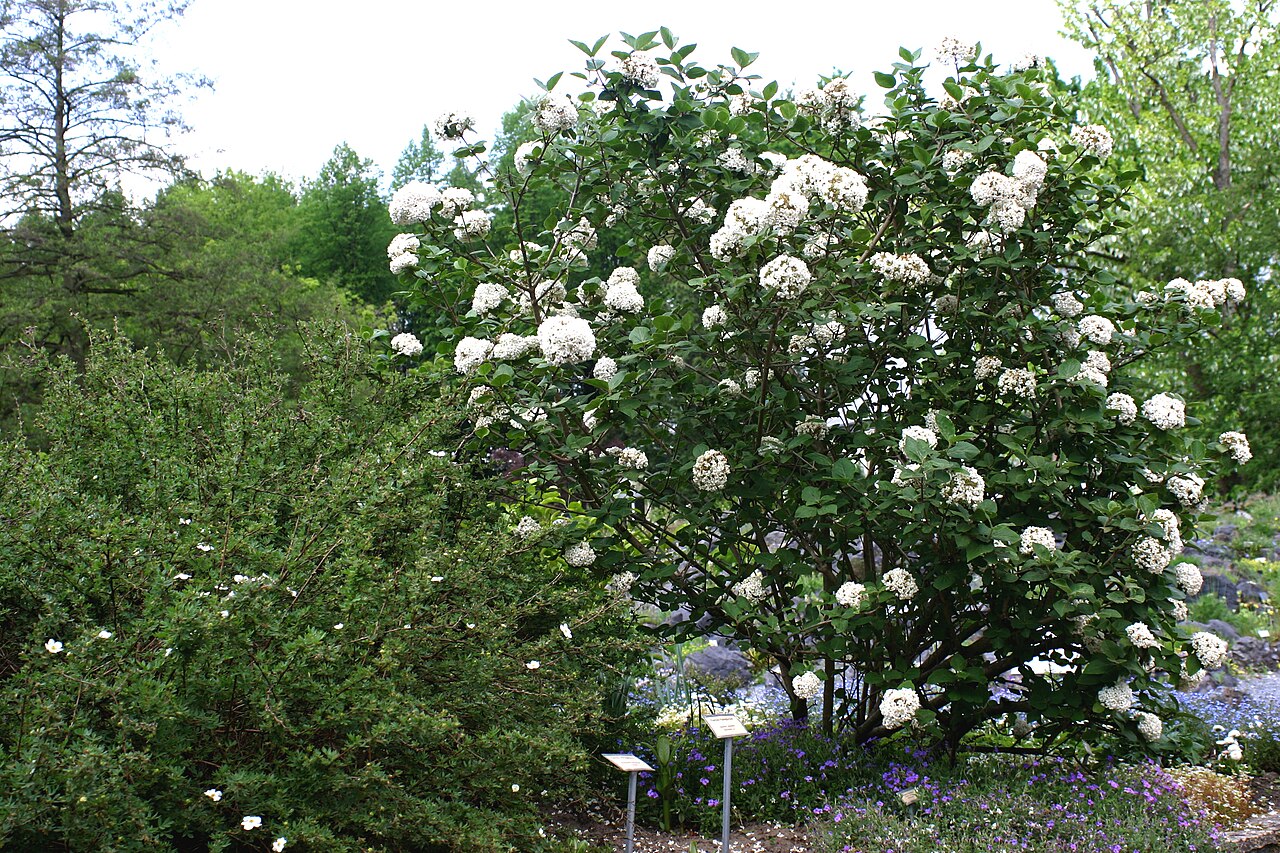
This photo was taken by Rüdiger Wölk. Please credit this photo Rüdiger Wölk, Münster.
View all photos (large page) of Rüdiger Wölk
I would also appreciate an email to rudiger.wolk@gmail.com with details of use.
Für Hinweise auf Veröffentlichungen (rudiger.wolk@gmail.com) oder Belegexemplare bin ich Ihnen dankbar., CC BY-SA 2.5.


Why this variety
Spice Baby is the modern compact Korean spice viburnum: 3 to 5 feet tall and just as wide, with the species’ sweet, spicy fragrance in blush-pink blossoms in spring, on a plant sized for gardens where the 8-foot species would swallow the border. It is the dwarf that makes Korean spice possible for small lots, foundation beds, and containers kept where the fragrance can be enjoyed at nose level.
The trade-off is fruit: like many compact selections, Spice Baby sets showy berries best with another V. carlesii nearby for cross-pollination, so plant a companion if you want the red-to-black fruit display as well as the flowers. Flowers do not need a partner — only the fruit does. Florida honesty: this viburnum needs real winter cold to bloom well, and Florida mostly does not provide it — in Florida treat it as a north-Florida experiment, not a reliable bloomer. Without enough chill, flowering is sparse and the plant spends summer merely surviving heat it was never bred for.
If you are new to choosing between cultivars, the Varieties Matter guide explains why the name after the plant matters as much as the plant itself. See also the species guide: Korean Spice Viburnum.
How to grow
Plant in full sun to part shade in moist, well-drained soil. Space plants 4-5 feet apart and water in well. Site it near a path, patio, or window — fragrance is the point, and fragrance planted at the back of the lot is fragrance wasted.
Water & feeding
Water to establish and in dry spells; steady moisture beats heavy feeding. Work worm castings into the planting hole and mulch to hold moisture. Feed lightly in spring.
Common problems
- Sparse fruit without a pollination partner — plant another V. carlesii nearby if berries matter.
- Sparse bloom after hard pruning — flowers on old wood, so prune only right after flowering.
- Leaf spot in wet weather — improve air flow, clean up fallen leaves.
- Aphids on new growth — blast with water.
- Winter dieback at the cold edge — mulch the root zone.
Pruning & care
Prune immediately after flowering finishes, lightly, to keep the compact rounded form. Never shear into a formal shape — a sheared Korean spice viburnum loses both its natural grace and much of its next bloom.
Browse all plant & pest guides
Saving seeds
Spice Baby is the modern compact Korean spice viburnum: 3 to 5 feet tall and just as wide, with the species’ sweet, spicy fragrance in blush-pink blossoms in spring, on a plant sized for gardens where the 8-foot species would swallow the border. It is the dwarf that makes Korean spice possible for small lots, foundation beds, and containers kept where the fragrance can be enjoyed at nose level. As a named Korean spice viburnum it is kept true by cuttings, not by seed — plant in full sun to part shade in moist, well-drained soil. Space plants 4-5 feet apart and water in well. Site it near a path, patio, or window — fragrance is the point, and fragrance planted at the back of the lot is fragrance wasted. Florida honesty: this viburnum needs real winter cold to bloom well, and Florida mostly does not provide it — in Florida treat it as a north-Florida experiment, not a reliable bloomer. The full method is in the Saving seeds section of the Korean Spice Viburnum guide.