
🌿 Southeastern Annual Saltmarsh Aster
What it looks like
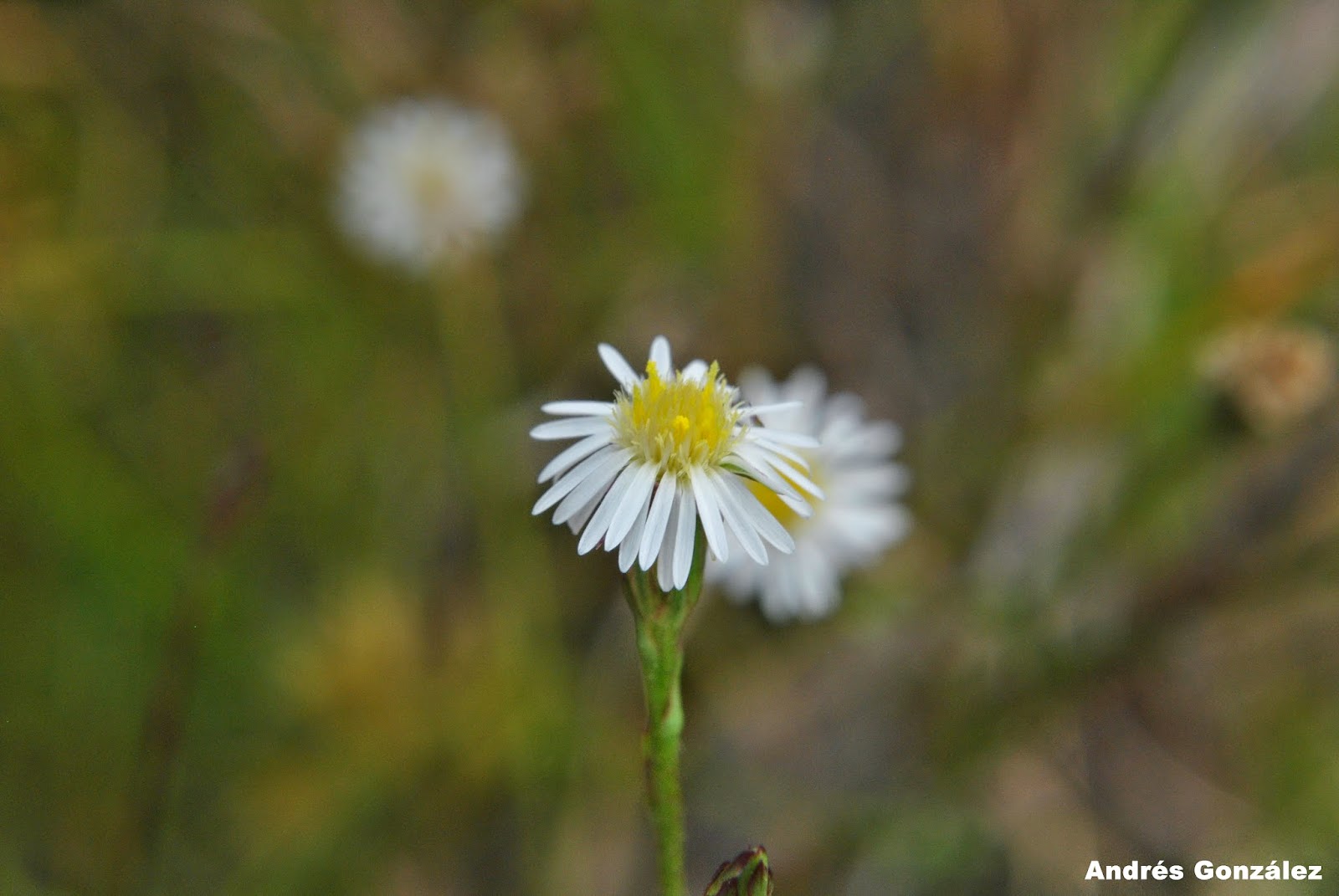
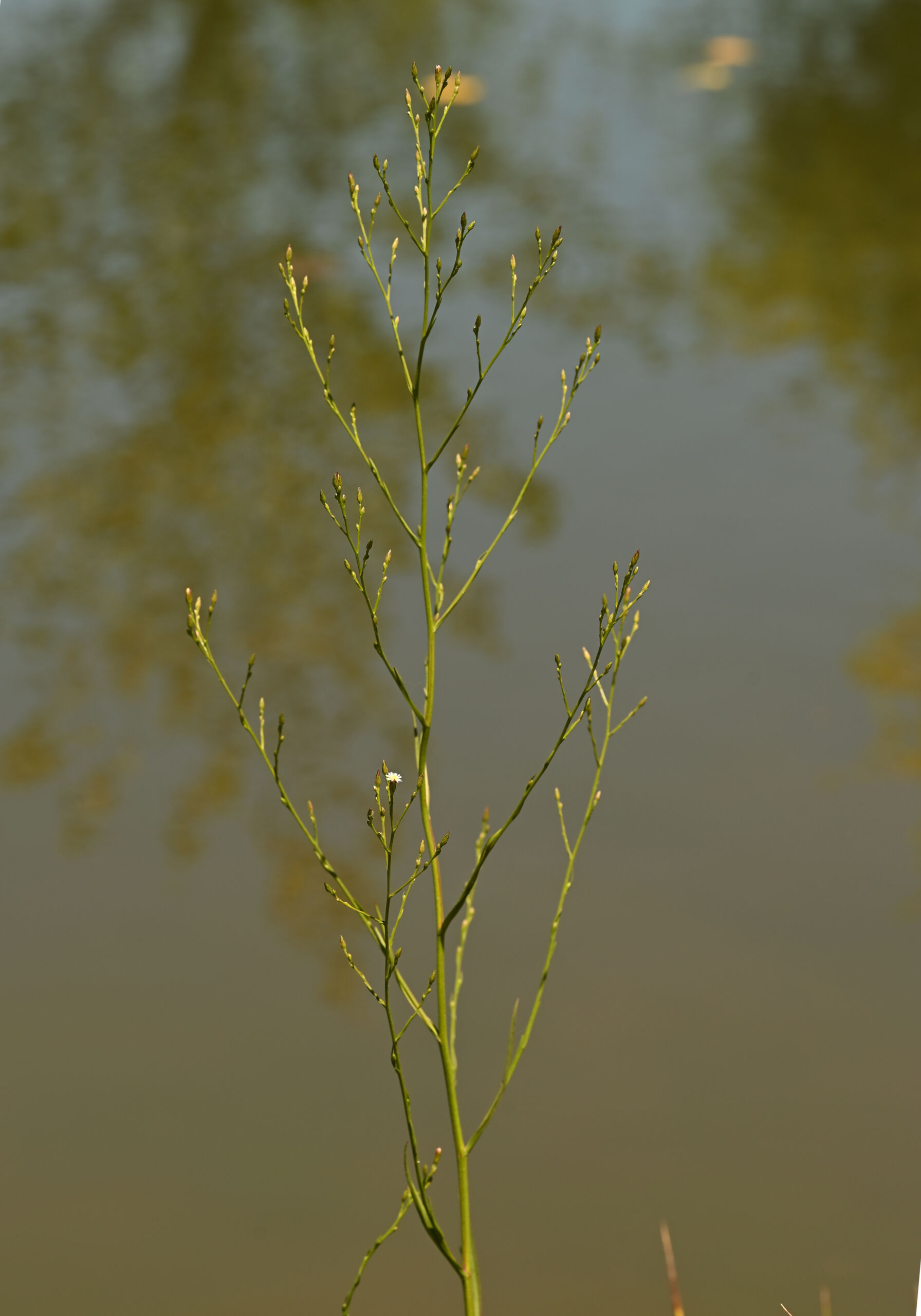
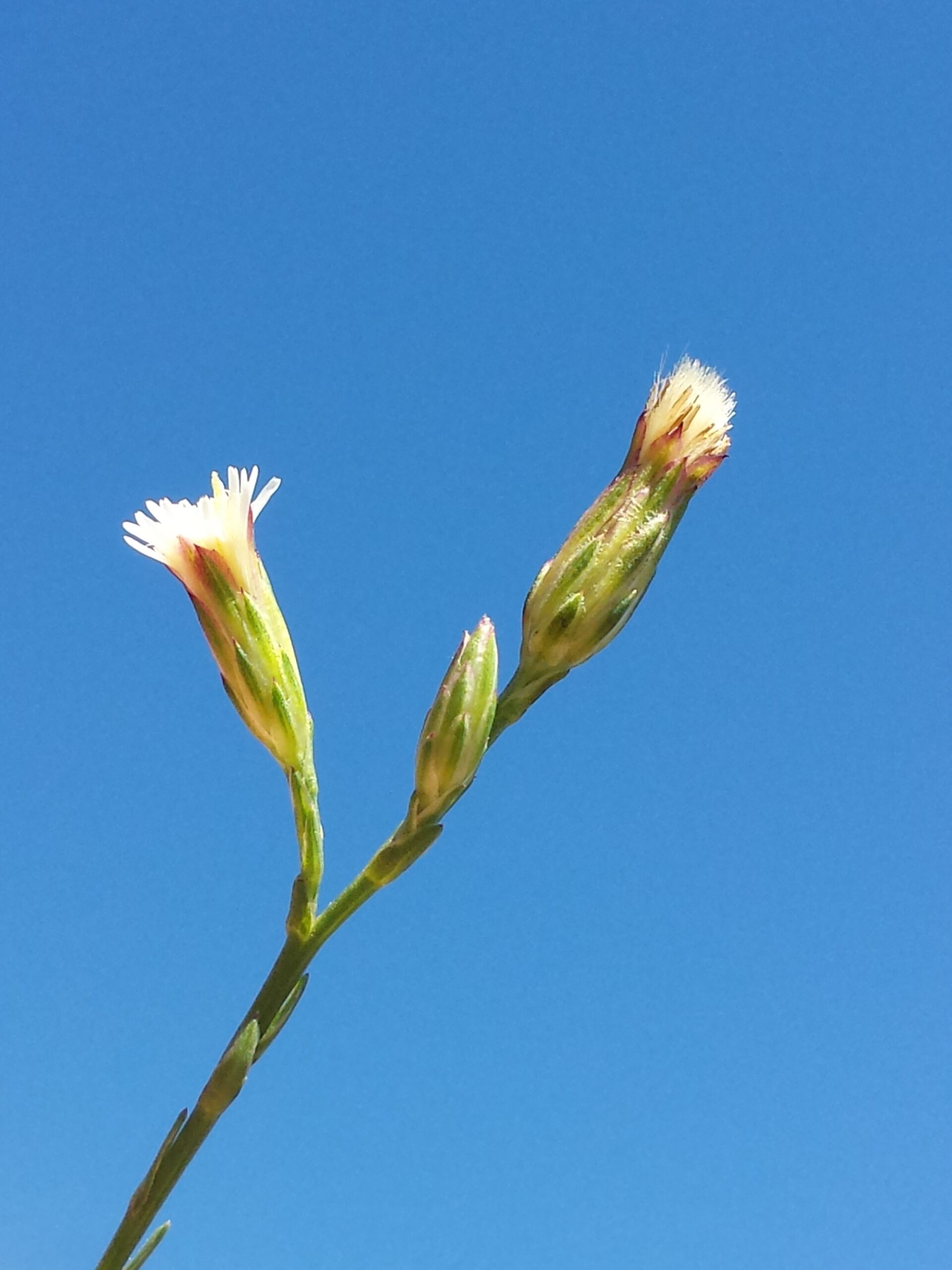
Southeastern annual saltmarsh aster is a slender annual, one to five feet tall, with a single stem that branches near the base. The leaves are narrow and lance-shaped, the stems are smooth, and the plant carries thirty to a hundred small flower heads in an open, airy spray. Each head is modest: an involucre five to seven millimeters tall, wrapped in eighteen to thirty narrow bracts (phyllaries), with twenty-one to twenty-eight tiny white ray florets — each barely a sixteenth of an inch long — around seven to fourteen disc florets. The rays dry white or pale lavender and curl inward as they age. It flowers from July into November.
The two details that matter for identification are microscopic in spirit but visible with a hand lens. First, the green zones on the phyllaries — the green stripe down the middle of each bract — are broadly lance-shaped but nearly absent from the lower (proximal) portion of the bract; the bract looks pale at the base and green only toward the tip. Second, the ray florets sit in two to three series (rows), not two. Those two characters, plus the white rays and the small head count, are what separate it from its native lookalikes.
Its name is a small geography lesson. The species was described from a plant collected at Montevideo, Uruguay, as Conyza squamata by Sprengel in 1826, and squamatum means “scaly” — a nod to those overlapping bracts. It is native to South America, and every North American occurrence is an introduction.
An introduced species — stated plainly
This guide is an identification guide, not a growing guide, and that distinction is the point. Southeastern annual saltmarsh aster is not native to Florida. The Atlas of Florida Plants lists its status as “Not Native.” The Flora of the Southeastern United States calls it the South American salt-marsh aster, native to South America, reported as an introduction in Florida only in Escambia County. The Flora of North America lists it as introduced in Alabama, Florida, Louisiana, North Carolina, and Texas, and as introduced in Europe, Asia, and Australia as well.
In Florida it is a waif, not an established invader: the documented history is a plant of disturbed ground — first collected on waste ground at Pensacola in 1899 — that occasionally escapes to coastal marsh and dune. It is not a plant to buy, plant, sow, or spread. If you think you have found it, the useful response is a photograph and a careful identification, not a trowel. The native annual saltmarsh aster (its closest relative, covered in its own guide) is the plant to celebrate in Florida’s salt marshes; this one is the plant to recognize and leave alone.
How to tell it apart from its native cousins
Southeastern annual saltmarsh aster belongs to the annual saltmarsh aster group — the Symphyotrichum subulatum group, which Franck’s 2025 Flora of Florida also counts as including Bahama aster and southwestern annual saltmarsh aster. All four are annuals with fibrous taproots, generally straight stems, and very small white-to-pink rays. Telling them apart takes a hand lens and a little patience, and the key below is the one to use.
- Annual saltmarsh aster (Symphyotrichum subulatum). The closest lookalike and the native one. Its phyllary green zones extend the full length of the bract (not absent at the base), its rays sit in 2 series (not 2–3), it has 16–30 rays and only 4–10(–13) disc florets, and its chromosome count is 2n = 10, where squamatum is 2n = 20.
- Bahama aster (Symphyotrichum bahamense). Its rays are pink to lavender (not white) and dry in two to three coils, and it has 11–23 disc florets.
- Southwestern annual saltmarsh aster (Symphyotrichum expansum). Its heads carry 30–42 phyllaries (not 18–30), and its ray laminae are longer than the pappus bristles.
One more caution: the Flora of North America does not treat this plant as a full species at all — it treats it as Symphyotrichum subulatum var. squamatum. Franck’s Florida flora and Nesom’s taxonomy treat it as a species in its own right. Both treatments describe the same plant, and both agree on the field marks above; the disagreement is about rank, not identity.
Where it grows in Florida
Almost nowhere — and that is the honest answer. In Florida the plant is documented from Escambia County, at the far western end of the Panhandle, where it was first collected on waste ground at Pensacola in 1899. The Flora of the Southeastern United States describes its habitat as disturbed areas, historically on ship ballast, escaped to coastal marsh and dune. The Flora of North America places it in salt marshes and brackish marshes at low elevation. There is no documented occurrence in peninsular Florida, and no evidence it has naturalized broadly in the state. It is a coastal waif that arrived with shipping and commerce, found a toehold in disturbed salty ground, and has stayed rare.
That rarity is not a reason to plant it “to help it along.” Introduced plants that stay rare are doing the state a favor, and the correct response to a rare waif is to watch it, not to cultivate it.
Pollinators & wildlife
Like other small-flowered asters, it offers nectar and pollen to small bees, flies, and butterflies while it blooms — but that is not a reason to grow it. Florida’s native saltmarsh asters provide the same nectar without the introduced baggage, and they are the plants that belong in the marsh food web. No caterpillar-host relationship is documented for this species in Florida, and none is claimed here. Its wildlife value is real but small, and it is outweighed by the one fact that matters: it is not native, and Florida’s marshes do not need it.
Varieties
No varieties are recognized under the species treatment used in this guide. The taxonomic wrinkle is the one noted above: the Flora of North America treats this plant as a variety of annual saltmarsh aster — Symphyotrichum subulatum var. squamatum — while Franck’s Flora of Florida and Nesom treat it as a full species, Symphyotrichum squamatum. This guide follows Franck, the Florida authority, and notes the FNA treatment so readers using either flora can find the same plant. There are no named garden varieties, and none is claimed here.
Frequently asked questions
Is southeastern annual saltmarsh aster native to Florida?
No. It is native to South America and introduced in Florida, where it is documented only from Escambia County. The Atlas of Florida Plants lists it as “Not Native.”
Why does it have two common names?
The Atlas of Florida Plants calls it southeastern annual saltmarsh aster; the Flora of the Southeastern United States calls it South American salt-marsh aster. Both names describe the same plant — the first says where in North America it turns up, the second says where it is from. This guide uses the Atlas name as its title and gives the other name here.
Can I plant it?
No. It is an introduced species with no garden role in Florida. If you want a saltmarsh aster, grow the native annual saltmarsh aster — and even that one belongs in a marsh, not a flower bed.
How is it different from annual saltmarsh aster?
Three field marks: its phyllary green zones are nearly absent from the base of the bract (annual saltmarsh aster’s run the full length), its rays sit in two to three rows instead of two, and it has more disc florets (7–14 versus 4–10). Under the microscope, its chromosome count is 2n = 20 versus 2n = 10.
Is it invasive in Florida?
There is no evidence it has become invasive in Florida — it is a rare waif, documented from one county since 1899. But “rare waif” is not “harmless garden plant”: it is introduced, and planting it would be working against the marshes it occasionally visits.
Where in Florida has it been found?
Escambia County only, first collected on waste ground at Pensacola in 1899. Its habitat is disturbed ground and, occasionally, coastal marsh and dune.
Is it the same plant as Symphyotrichum subulatum var. squamatum?
Yes — same plant, different rank. The Flora of North America treats it as a variety of annual saltmarsh aster; Franck’s Florida flora treats it as its own species. The field marks are identical either way.
What does squamatum mean?
“Scaly,” from the overlapping, scale-like bracts (phyllaries) that wrap each flower head. The species was first described as Conyza squamata from a specimen collected at Montevideo, Uruguay.
I think I found it — what should I do?
Photograph the whole plant, a close-up of a flower head, and — if you can — a phyllary showing the green zone. Compare it against annual saltmarsh aster using the marks above, and do not collect seed or transplant it.
What should I plant instead?
For a saltmarsh native, the native annual saltmarsh aster in its own habitat. For a garden aster, any of Florida’s widespread native asters. This one stays in the “recognize, don’t plant” column.
Keep learning 🌱
Where to go next: