
🌿 Walter’s Aster
What it looks like
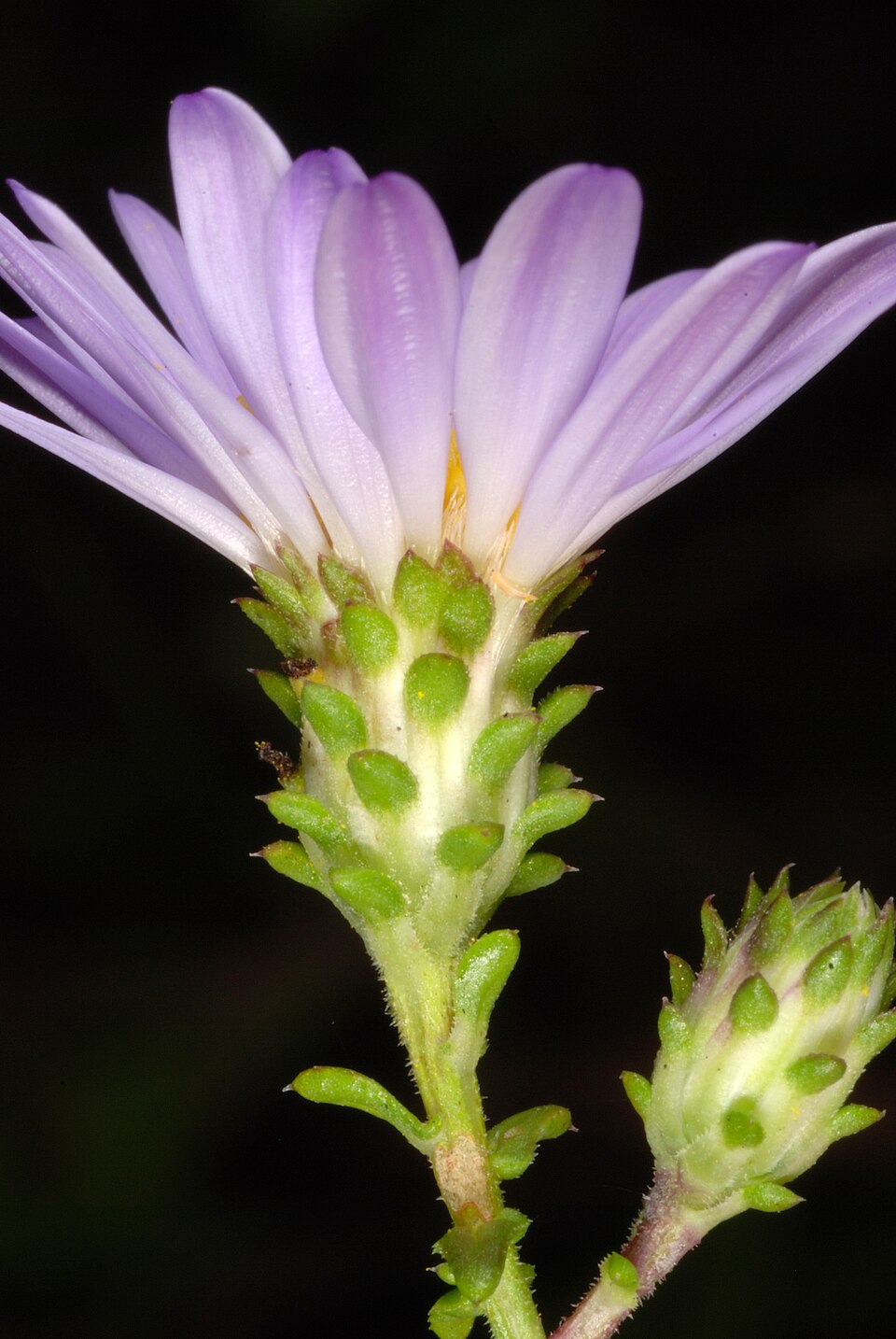
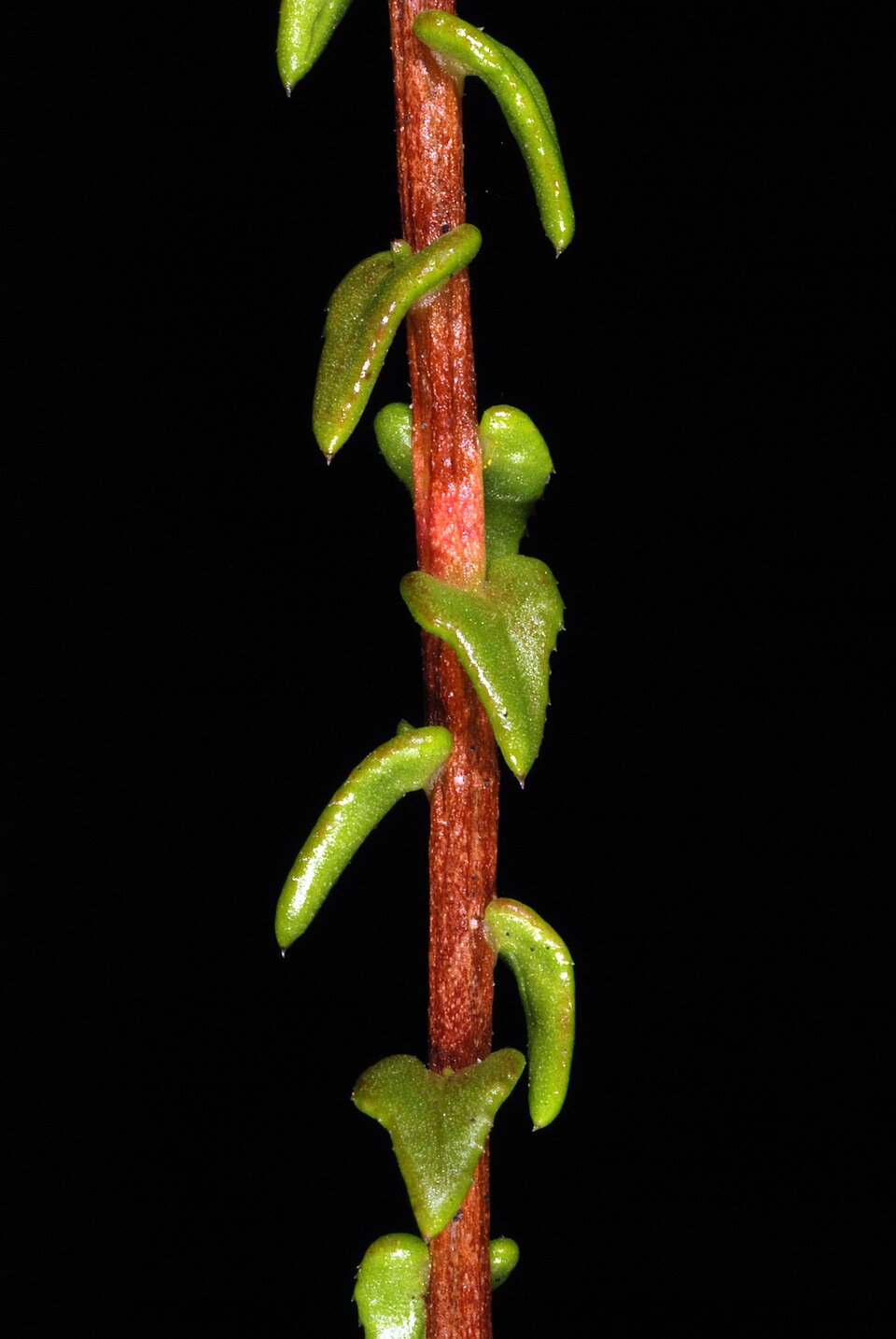
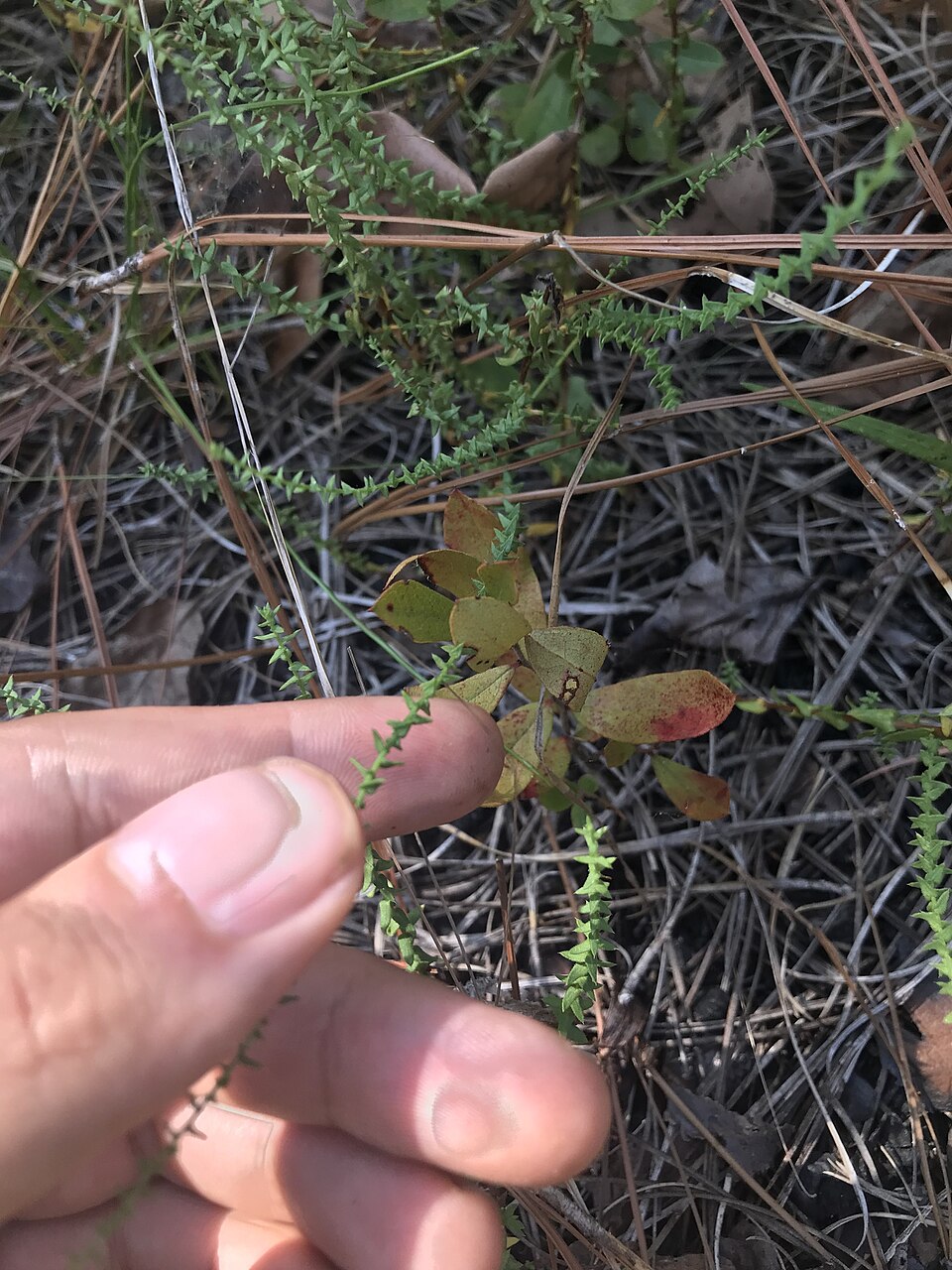
Walter’s aster does not look like an aster until it flowers, and that is the whole point of it. The plant is a perennial, eight inches to a little over three feet tall, growing from long rhizomes with thick, almost corm-like woody rootstocks. The stems are mid to dark brown, branched from the middle, and they sprawl — erect to scandent-sprawling, in the flora’s words, meaning they lean, sprawl, and scramble without ever quite becoming a vine. And the leaves: thick, firm, almost succulent, bright green and shiny, reduced to stiff little scales that stick out from the stem and clasp it at their bases. A stem of Walter’s aster looks less like a flower plant and more like a tiny pine branch that lost its needles and grew scales instead.
Then October arrives, and the scales turn out to have been a disguise. Each head is borne singly in a diffusely spreading array, with 11 to 26 bluish-purple rays around 15 to 25 yellow disk florets, and the whole sprawling plant lights up with lavender flowers in late fall and early winter — October to December — when most of the sandhills has already finished blooming. The Florida Wildflower Foundation puts it plainly: it blooms in late fall and early winter, providing nectar and pollen to butterflies, bees, and other pollinators at a time when floral resources are limited. A plant that flowers when nothing else does is not late. It is on time for the pollinators that need it.
The leaves are the identification, and the flora’s description is worth reading slowly: the lower stem leaves are sessile, spreading to reflexed, ovate to lanceolate, with cordate-clasping bases; the upper ones shrink to lanceolate or triangular scales, reduced to bracts toward the top, with finely scabrous margins and white-spinulose tips. The involucres — the green cup under each flower — are 5 to 7 mm, with phyllaries in four to five series whose green zones are diamond-shaped in the distal quarter to half. If you can see the diamond-shaped green zones and the shiny, spreading, clasping scale-leaves on a brown sprawling stem, you have Walter’s aster. If the leaves are pressed flat against the stem instead of spreading out, you have its lookalike, below.
How to grow
The honest answer: admire it where it grows, and think twice before moving it. Walter’s aster is a plant of sandhills and pine flatwoods, sandy or clayey soils, woodland margins, open oak-pine scrub, fields, and roadsides — dry, sunny, fast-draining ground in Central and North Florida, where it is scattered through many counties. It is not commercially available, per the Florida Wildflower Foundation, and the right way to see it is to visit a natural area in late fall, when the sandhills are quiet and this plant is the one still blooming.
It wants what the sandhills give it: full sun, sandy well-drained soil, no irrigation, no fertilizer, and a fire-adapted landscape that stays open. A wet, rich, heavily watered garden bed is the opposite of its home, and a plant that evolved to sprawl through pine needles in a flatwoods does not have a backup plan for a sprinkler. If you are lucky enough to have it on your land, the best care is benign neglect: keep the canopy open, keep the leaf litter and pine straw, do not irrigate it, do not fertilize it, and do not mow it in the fall when it is setting up to bloom.
If you garden on dry, sandy ground and want the same late-season lavender, the practical move is a Florida-native aster that is actually in the trade and built for your site — not a wild Walter’s dug out of a flatwoods. Wild plants stay wild; garden plants come from nurseries. That rule protects both.
Water & feeding
Water: little, and only until established if you ever plant a nursery-grown one. This is a dry-soil plant of sandhills and pine flatwoods, and overwatering — especially in heavy soil that stays wet — is the fastest way to kill it. Its thick, almost succulent leaves are part of the deal: succulence is how a plant stores water while sitting in sand that drains in minutes. In a rainy climate, the only honest site for it is a slope or a raised bed with gritty, fast-draining soil.
Feeding: none. It grows in lean, sandy or clayey soils, and rich soil plus fertilizer mostly produces floppy stems that fall over in the first autumn rain. If your soil is decent garden loam, that is already more than it asks for. A thin mulch of pine straw in winter is plenty, and the soil science here is the sandhills bargain: the plant spends the whole year building a wiry, scaly scaffold on almost nothing, then spends it all at once on lavender flowers in October, because in a sandhills the pollinators that matter in late fall are generalists, and a spray of small flowers beats one big one when your customers are small, cold, and in a hurry.
Common problems
- Confusing it with scaleleaf aster. This is the split that matters, and Franck’s key makes it in one couplet: both species have stems densely covered in stiff, scale-like leaves. Scaleleaf aster (S. adnatum) is scabridulous — rough to the touch — with cauline leaves appressed to the stem and adnate (fused along the stem) for half or more of their length. Walter’s aster is glabrate — nearly smooth — with cauline leaves spreading outward and clasping at the base. Leaves pressed flat and stuck to the stem: scaleleaf. Leaves sticking out and hugging the stem: Walter’s.
- Thinking it is a vine. The stems sprawl and scramble and can look like they are climbing, but Walter’s aster has no tendrils, no twining, and no climbing mechanism — it is a sprawler, not a climber. True climbing aster (S. carolinianum) is a wetland vine with much larger heads and a completely different habitat.
- Missing it entirely. Out of flower, Walter’s aster is a brown, scaly, sprawling stem that looks like dead twigs in the pine straw. It is easiest to find in October through December, when the lavender flowers give it away — and hardest to find the rest of the year, which is exactly how a sandhills plant survives.
- Planting it wet. The most common garden failure is not identification — it is irrigation. A sandhills aster in a wet, rich, irrigated bed will rot or flop, and no amount of goodwill fixes a wrong site.
- Mowing the flatwoods edge in fall. The plant blooms October to December, later than almost every other aster. A fall mow takes the whole show — and the pollinators’ last pantry of the year — in one pass.
Harvest
There is no crop here, and the harvest is the bloom season itself: lavender flowers sprawling through the pine straw in November, with butterflies and bees working them while the rest of the flatwoods has gone quiet. Cut stems only from garden-grown plants, if you ever have one — the small flowers hold in water and make a loose, wiry filler — and leave wild plants standing for seed and shelter. The seeds feed birds through winter, the standing stems shelter insects, and the rootstock comes back every spring without asking. The simplest harvest is a late-fall walk in a pine flatwoods with no agenda: purple flowers, bees working them in the slanting light, and the knowledge that the garden’s last act is also one of its best.
Saving seeds
Do not collect seed from wild populations — this is a wildflower of sandhills and pine flatwoods, and its seed belongs where it falls. The general aster rules, for any nursery-grown material, are the same as for other asters: wait until the heads turn brown and fluffy and the seeds separate easily when brushed, cut them into a paper bag on a calm day, dry them thoroughly before any sealed container, and sow in fall so winter settles the dormancy question. No species-specific germination protocol was verified for Walter’s aster, so fall sowing outdoors — pressing the seed lightly into the soil and letting the season do the work — is the honest recommendation. In Florida, dry seed thoroughly before airtight storage and add a desiccant, because Florida humidity will quietly spoil a paper envelope of aster seed long before spring.
Species
Walter’s aster (Symphyotrichum walteri (Alexander) G.L. Nesom; basionym Aster walteri Alexander 1933, based on Aster squarrosus Walter 1788, not Allioni 1785; also placed in Lasallea and Virgulus by other authors) is the species this guide covers. No varieties are recognized, and no named garden varieties of the wild species were verified — the North Carolina Extension Gardener Plant Toolbox lists cultivars and varieties as none. Scaleleaf aster (S. adnatum) and climbing aster (S. carolinianum) are different species and neither is covered here. This guide covers Symphyotrichum walteri only. Vouchered Florida distribution and status: Atlas of Florida Plants species page; full technical treatment: Flora of North America.
Frequently asked questions
Who was Walter?
Thomas Walter (c. 1740–1789), a British botanist who lived in South Carolina and wrote Flora Caroliniana (1788), the first North American flora to use the Linnean binomial naming system. He described this plant as Aster squarrosus, but that name was already taken, so it was renamed walteri in his honor in 1933.
How do I tell Walter’s aster from scaleleaf aster?
Look at how the scale-leaves sit on the stem. Both species have stems densely covered in stiff scale-like leaves, but scaleleaf aster (S. adnatum) is rough to the touch with leaves pressed flat against the stem and fused along it for half their length, while Walter’s aster is nearly smooth with leaves spreading outward and clasping at the base. Pressed flat: scaleleaf. Sticking out: Walter’s.
Why are the leaves so small and scaly?
Because the plant lives in dry sandhills and pine flatwoods, where small, thick, shiny leaves lose less water than big soft ones. The scale-leaves are a drought adaptation — the same reason cacti have spines and pines have needles. The plant trades leaf area for water savings, then spends the savings on flowers.
Does it climb?
No — it sprawls. The stems lean, scramble, and sprawl through surrounding vegetation, but Walter’s aster has no tendrils, no twining habit, and no climbing mechanism. True climbing aster (S. carolinianum) is a wetland vine and a completely different plant.
Can I buy Walter’s aster?
Not from any Florida nursery we could verify — the Florida Wildflower Foundation says it is not commercially available, and the advice is to visit a natural area to see it. If you garden on dry, sandy ground and want late lavender flowers, plant a Florida-native aster that is actually in the trade.
What zones does it grow in?
USDA zones 8a through 9b, per the North Carolina Extension Gardener Plant Toolbox — which covers its range from central North Carolina south to Florida. In Florida it is scattered through many Central and North Florida counties, in sandhills and pine flatwoods.
When does it bloom?
October to December — later than almost every other Florida aster. That late bloom is its ecological job: it feeds butterflies, bees, and other pollinators in late fall and early winter, when floral resources are limited and most other flowers have finished.
Is Walter’s aster rare?
It is not listed as rare or imperiled — NatureServe rates it Apparently Secure — but it is scattered rather than common, and it depends on sandhills and pine flatwoods habitat that is itself under pressure. Treat any population you find as a treasure, not a transplant.
Will it spread in my yard?
It is colonial or clump-forming, with long rhizomes and thick woody rootstocks, so a happy plant will spread slowly into a patch. It will not take over a bed the way a running aster can — the bigger risk is the opposite: planted in the wrong (wet, rich) site, it will simply decline.
🌱 Keep learning
Three related guides worth reading next:
- Aster: Growing Guide — The genus guide: asters as a group, how the old genus Aster became Symphyotrichum, and where this sandhills species fits.
- Heath Aster: Growing Guide — Another dry-soil aster of wiry stems and tiny leaves — the classic late-season pollinator bank for lean, sunny ground.
- Georgia Aster (Symphyotrichum georgianum) — A big, showy purple aster of dry woods and roadsides — the bold end of the dry-site aster spectrum from Walter’s quiet scales.