
The peace lily is the houseplant world’s greatest drama queen, and we mean that with affection. Forget to water it and it collapses into a limp green puddle on the floor, looking for all the world like it has given up on life entirely. Water it, and within hours it stands back up, glossy and smug, as if the whole performance never happened. It is the plant that teaches you to read a plant — and it is also one of the best low-light houseplants ever sold, a rainforest-floor native that flowers in the shade and asks for very little beyond a drink and some humidity.
A note on names, because this one matters: the peace lily you buy in a store is Spathiphyllum wallisii, the species this guide covers. The genus Spathiphyllum holds around fifty species, all from the rainforests of the Americas, but the houseplant trade is overwhelmingly wallisii and its cultivars — ‘Mauna Loa’, the big one, and ‘Sensation’, the enormous one. Everything in this guide is written for S. wallisii and its cultivars, which is what you almost certainly have.

What it looks like
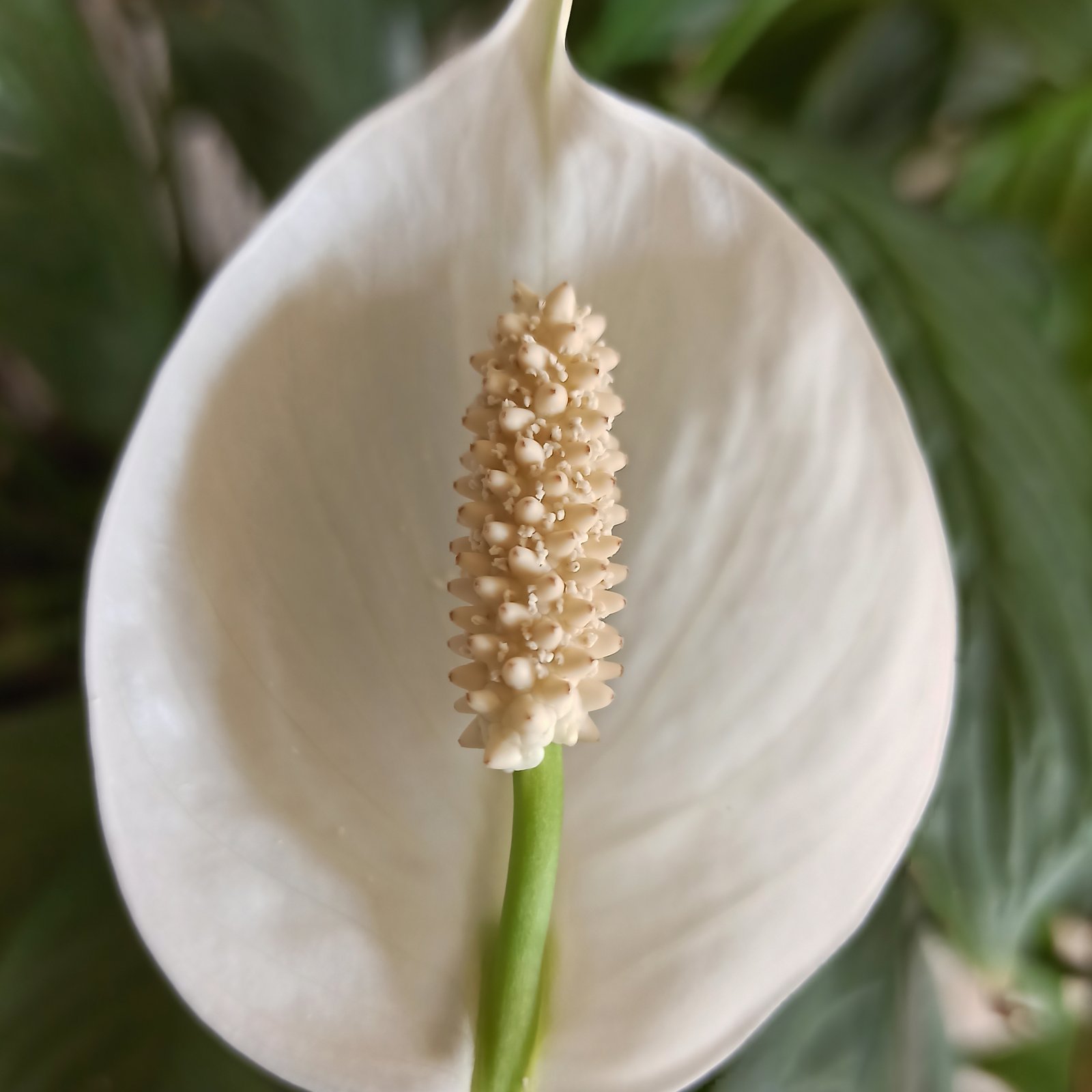
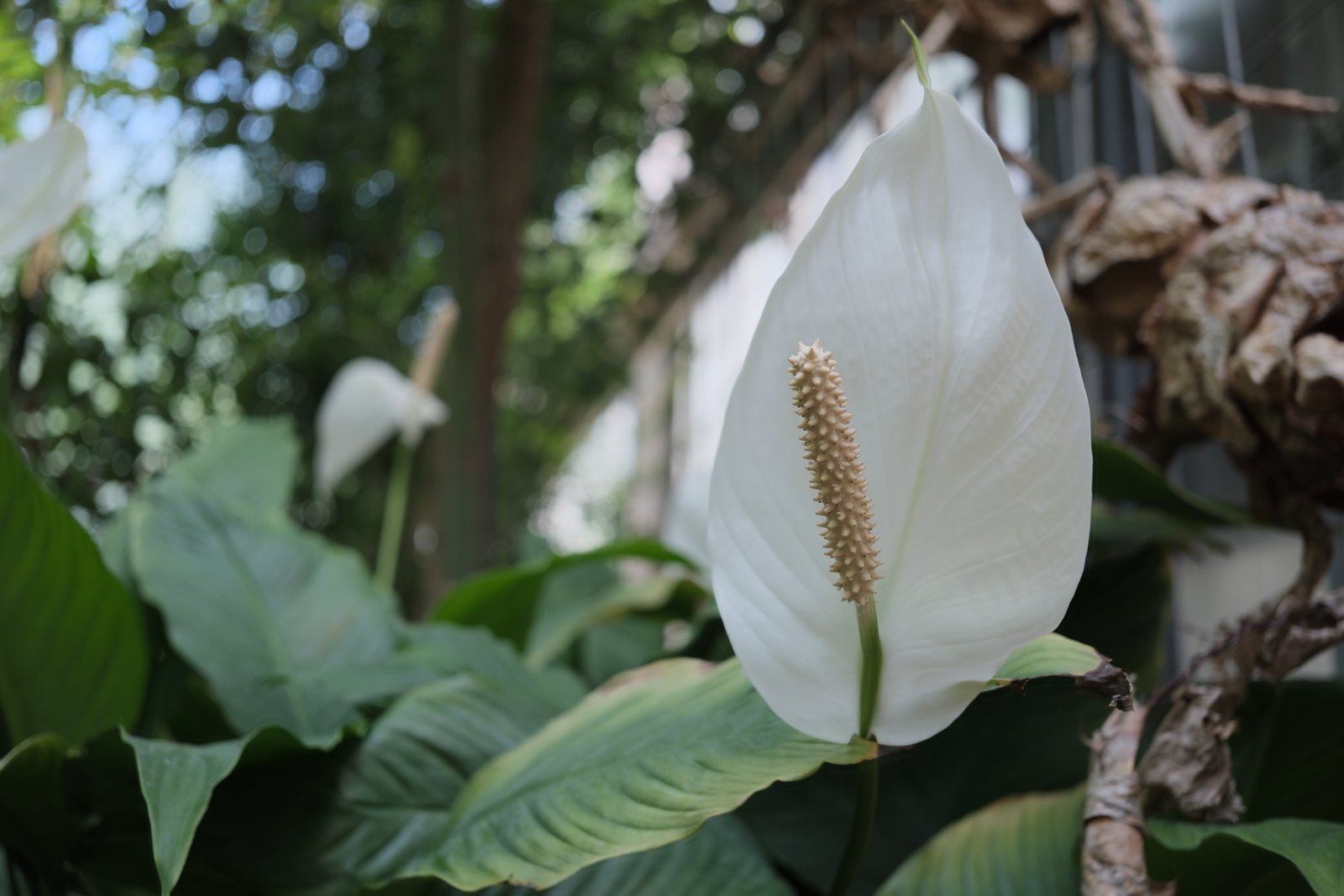
A peace lily is a clump of glossy, deep-green leaves that rise straight from the soil on slender stalks — no woody stem, no trunk, just leaf after leaf unfurling from the base like a fountain that never stops. The leaves are lance-shaped, six to twelve inches long on a standard plant, with a pointed tip and a slightly rippled edge. The flowers are the famous part, and they are not what they look like: the white “petal” is a spathe, a modified leaf that acts as a flag to pollinators, and the real flowers are the tiny bumps on the creamy spike — the spadix — standing up in the middle of it. The whole structure is the calling card of the arum family, Araceae, the same family that gave us philodendrons and monsteras.
There are two common confusions worth clearing up. First, the peace lily is not a true lily at all — it is an aroid that borrowed the name, the way a cover band borrows a hit. Second, its white spathe can make people think of anthurium, its flashier cousin; anthurium spathes are waxy and usually red or pink, while a peace lily’s is soft, white, and turns green with age before fading. If a mystery plant in your home is flowering and you are not sure what it is, the What’s This? photo tool will sort it out faster than a group chat will.
Light: low light is fine, no light is not
Peace lily is one of the few flowering houseplants that genuinely tolerates low light, because it evolved on a rainforest floor under a canopy that filtered the sun to a green glow. A bright spot out of direct sun is ideal — near a north- or east-facing window, or a few feet back from a brighter one — and it will flower best there. It will survive in a dim corner, but it will flower less and grow slower, which is the plant politely telling you it would like a little more light. Direct Florida sun through a window will scorch the leaves, so keep it out of the sunbeam; this is a shade plant that happens to live in a pot.
If your peace lily has not flowered in a year, light is the first thing to check, and age is the second: young plants and recently divided plants often skip a season while they settle in. A plant that gets bright indirect light, regular water, and a little food in spring will usually flower in spring and summer, sometimes nearly year-round indoors.
Water: the droop is a feature, not a bug
Peace lily likes its soil evenly moist — not soggy, not dry, a state gardeners call “moist like a wrung-out sponge” and beginners call “how am I supposed to know that.” Here is how you know: stick a finger an inch into the soil. Dry? Water. Damp? Wait. In a Florida home that usually means once a week, more in summer, less in winter. And if you miss the cue, the plant will tell you — dramatically. A thirsty peace lily droops so hard it looks dead, then stands back up within hours of watering. It is the most forgiving over-dramatic plant in the house, and that droop is the best watering alarm ever invented. Do not make a habit of it, though: repeated wilting stresses the plant and browns the leaf tips.
Two water-quality notes matter more in Florida than most places. Peace lily is sensitive to fluoride and to the salts that build up in potting soil, and both show up as brown, crispy leaf tips — the plant’s most common complaint. If your tap water is heavily treated, letting it sit out overnight before watering helps the chlorine, and flushing the pot with plain water every month or two washes accumulated salts out of the soil. Rainwater, if you collect it, is the peace lily’s favorite drink.
Soil and pot: rich, loose, and always draining
Peace lily wants a rich, loose potting mix that holds moisture without staying soggy — ordinary houseplant potting mix with a handful of perlite or orchid bark mixed in is about right. The roots are thick and fleshy and they rot fast in a pot with no drainage, so a drainage hole is non-negotiable, and the saucer should be emptied after watering rather than left as a swamp. A peace lily that sits in standing water will yellow from the bottom up, and by the time the whole plant looks sick the roots are already gone.
Repot every year or two in spring, when the roots start circling the bottom of the pot or the plant dries out suspiciously fast after watering. Go up just one pot size — a pot that is too big holds wet soil the roots cannot reach, which is the same rot problem wearing a different hat. Spring repotting is also the moment to divide the plant, if it has outgrown its corner (see propagation).
Feeding: light and seasonal
Feed lightly in spring and summer, when the plant is growing and flowering: a half-strength balanced liquid fertilizer once a month is plenty, or a thin top-dressing of worm castings in spring, which feeds the soil gently and will not burn the roots. Do not feed in fall and winter, and never feed a plant that is wilted, freshly repotted, or already showing brown tips — fertilizer salts make the brown tips worse. Brown tips with a white crust on the soil surface are almost always a salt problem, not a hunger problem, and the fix is a flush with plain water, not more food.
Common problems
Drooping. Thirst, almost always. Water thoroughly and wait a few hours. If it does not recover, check the roots — a plant that stays limp after watering may have rotted roots from overwatering, which is the one droop that water will not fix.
Brown leaf tips. The classic peace lily complaint. Causes, in order: fluoride or salts in the water, over-fertilizing, low humidity, and letting the plant wilt too often. Trim the brown edges with clean scissors, following the leaf’s shape, and fix the cause — it will not heal the brown, but new leaves will come in clean.
Yellow leaves. Old leaves at the bottom yellow and die naturally; snip them off. If many leaves yellow at once, suspect overwatering or a pot with no drainage.
No flowers. Usually too little light, or a plant too young or too recently divided to bother. Move it brighter, feed lightly in spring, and give it a season.
Pests. Spider mites love a dry, dusty peace lily — look for fine webbing and speckled leaves, and raise the humidity while you wipe the leaves down. Mealybugs show up as white cottony clumps in the leaf joints; dab them off with rubbing alcohol. Both are rarer on a plant that is watered properly and kept humid.
Toxicity note. Peace lily contains calcium oxalate crystals, the same irritant found in philodendrons, and it is toxic to dogs and cats if chewed — drooling, mouth pain, vomiting — and irritating to people who eat it. It is a look-don’t-taste plant, and it belongs out of reach of pets and small children who sample the greenery.
Propagation: division, the easy way
Peace lily does not propagate from leaf cuttings, and it rarely sets seed indoors — but it divides beautifully, because it grows as a clump of crowns that slowly multiply. In spring, when you repot, tip the plant out of its pot and look at the base: you will see several crowns, each with its own leaves and roots. Gently pull or cut the clump apart so each division has at least a few leaves and a good chunk of roots, pot each one in fresh mix, water well, and keep it out of direct sun for a week while it settles.
Divisions often sulk for a few weeks — drooping, skipping a flower season — and then take off. One pot becomes two or three, which is how peace lilies have colonized so many Florida living rooms. It is also the perfect gift plant, because a division from a healthy mother is already a proven survivor.
Florida notes
Peace lily is a Florida natural in the ways that matter and a Florida liability in one. It loves our humidity — the air here does half the work of keeping its leaves glossy — and it can summer outdoors in deep shade, on a covered porch or under a live oak, where it will grow faster than it ever does inside. But it is a tropical plant with no cold tolerance at all: it is damaged below about 40°F and killed by frost, so for most of Florida it is an indoor plant that visits the porch, not a landscape plant. Bring it in well before the first cold front, and never leave it out on a night that might dip into the 40s.
Outdoors in summer, watch the watering: a peace lily on a shaded porch in July can dry out faster than an indoor one, and the droop will tell you. Indoors, the opposite problem applies — Florida’s air conditioning dries the air, so a plant near a vent may show brown tips even when the soil is fine. Move it away from the vent, group it with other plants, or set the pot on a tray of pebbles and water, and the humidity around the leaves will rise enough to keep the tips green.
🌱 Keep learning
Three related guides worth reading next:
- Palm: Growing Guide — another tropical favorite that likes humidity, shade, and a steady drink.
- Plants for Black Thumbs: 10 Plants That Refuse to Die (in Florida) — ten ranked Florida picks for beginners, for the days when even the peace lily tests you.
- Compost Accelerators: 12 Things That Actually Wake Up a Lazy Pile — the biology behind the castings and compost your peace lily’s soil will love.