
Heartleaf philodendron, Philodendron hederaceum, is the plant that taught a generation of people they could keep something alive. It trails, it climbs, it tolerates the dim corner by the bookshelf, and it forgives the watering schedule of a person who travels. It is the classic hanging-basket plant, the vine draped over the top of the bookshelf in every photo of a cozy room, and it has been doing this job since before houseplants were fashionable. This guide covers heartleaf philodendron specifically — the small-leaved trailing species with the heart-shaped leaves — not the whole philodendron genus, which holds hundreds of species from tree-sized monsters to plants with leaves bigger than your torso. Heartleaf is the friendly one, the one that fits on a shelf.
In the wild, heartleaf is a hemiepiphyte of the rainforests of Mexico, Central America, and the Caribbean: it starts life on the forest floor, finds a tree, and climbs it with aerial roots, reaching for the canopy light. In your house it does the same thing on a smaller scale — give it something to climb and it will climb it; give it nothing and it will trail gracefully off the shelf and toward the floor, which is also a plan.
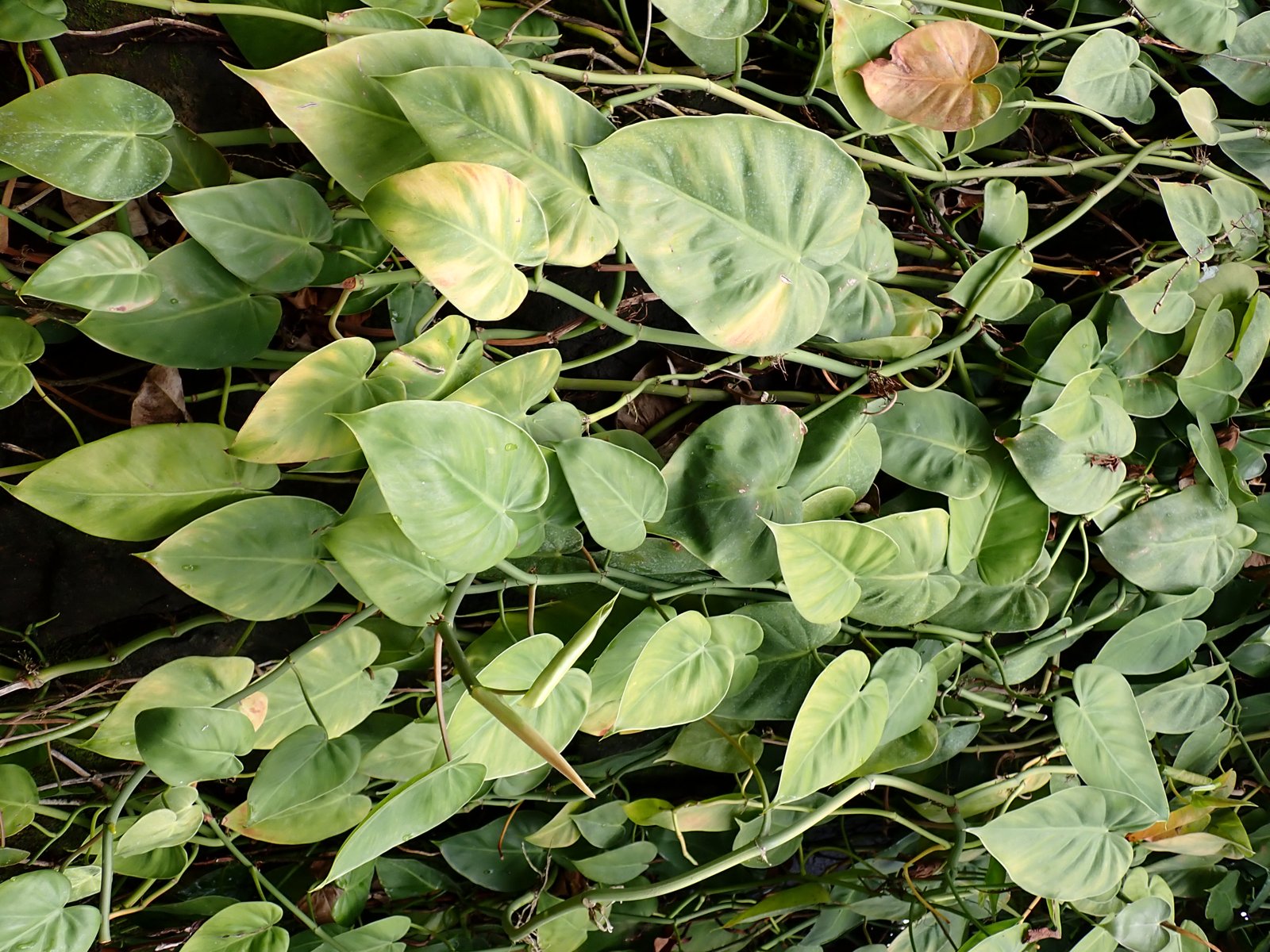
What it looks like
The name gives it away: the leaves are heart-shaped, two to four inches long on a trailing plant, glossy dark green, and smooth-edged, each one hanging from a slender stem on a petiole about as long as the leaf itself. New leaves emerge from a protective sheath called a cataphyll — a papery pinkish tube that dries and falls away as the leaf unfurls, which is a neat bit of botanical packaging and a useful ID clue. The stems are thin and flexible, and wherever a stem meets a leaf, you will find a small bump — a node — that can sprout a root, a leaf, or a whole new branch. Those nodes are the whole secret of this plant: every one of them is a backup plan.
The most common confusion is with pothos, Epipremnum aureum, which looks almost identical from across the room and is sold next to it in every store. Tell them apart by the details: heartleaf leaves are thinner, softer, and more purely heart-shaped, with a smooth petiole; pothos leaves are thicker and waxier, often variegated, and their petioles have a little groove. Heartleaf’s new leaves come from cataphylls; pothos does not make them. If you are still not sure which vine you own, the What’s This? photo tool will settle it in seconds, and it matters — the two plants want slightly different care.

Light: bright and indirect, with a low-light superpower
Heartleaf philodendron wants bright, indirect light — near a window, out of the direct sun — and it will grow fastest there, with leaves packed close together and vines that actually fill in. But its real superpower is that it tolerates low light better than almost any trailing plant: a north-facing window, a room lit only by a lamp, the shelf in the hallway that gets no direct sun at all. It will grow slower there, and the leaves will be smaller and spaced further apart, but it will grow, which is more than most plants offer in that spot.
Direct Florida sun through a window will scorch the leaves, so keep it out of the sunbeam; a south-facing windowsill in July is too much. The sign of too little light is a vine that gets leggy — long bare stems with a leaf every few inches, the plant reaching for a window it cannot see. Move it brighter and trim the bare sections back, and it will branch from the nodes you left behind.
Water: moist, not wet, and forgiving either way
Water when the top inch or two of soil feels dry — usually once a week indoors, more in a hot Florida summer, less in winter. Water thoroughly until it runs out the drainage holes, empty the saucer, and let the soil dry again before the next round. Heartleaf is forgiving in both directions: it will survive a missed watering by drooping slightly and recovering, and it will survive a slightly heavy hand as long as the pot drains. What it will not survive is soil that never dries out, because the roots rot in standing water just like any other tropical plant’s.
The leaves are the gauge. Soft, drooping leaves mean thirst; yellow leaves, especially lower ones, usually mean too much water or soil that stays wet. If the whole vine yellows at once, check the roots and the drainage before you reach for the fertilizer — the problem is almost always water, not food.
Soil and pot: loose, airy, and draining
Heartleaf wants a loose, airy potting mix that drains freely — ordinary houseplant mix with a generous handful of perlite or orchid bark is about right, and a mix that stays wet for a week after watering is a mix that needs more perlite. A drainage hole is non-negotiable. Repot every year or two in spring, going up one pot size, or simply refresh the top few inches of soil if the plant is the size you want it to stay.
Here is where heartleaf gets fun: give it something to climb, and it changes. A moss pole, a trellis, or a rough piece of bark lets the aerial roots grab hold, and the leaves get noticeably bigger as the vine climbs — the plant’s way of celebrating that it found a tree, the way its wild ancestors did. A trailing plant stays small-leaved and delicate; a climbing plant gets bold. Both are the same species, just living different lives, and you get to choose which one you want on your shelf.
Feeding: a little, in season
Feed lightly in spring and summer: a half-strength balanced liquid fertilizer once a month while the plant is actively growing, or a thin top-dressing of worm castings in spring for the slow, gentle option. Do not feed in fall and winter, and never feed a dry, wilted, or freshly repotted plant. Heartleaf is a light feeder and a heavy feeder in the same plant — it will take the food and grow faster, but it will also happily grow without it, which is why it is the plant people forget to feed for years and then wonder why it looks so good anyway.
Varieties worth knowing
The straight species is the classic green heartleaf, but a few cultivars are common enough to know by name. ‘Brasil’ is the most popular: the same heart-shaped leaves with a bright chartreuse stripe down the center, which needs a little more light than the green form to keep its variegation. ‘Lemon Lime’ is the all-yellow-green version, a neon vine that glows on a shelf and wants bright indirect light to stay vivid. ‘Micans’ is the velvet one, with smaller leaves that shimmer bronze-green in the light and feel soft to the touch. All three are the same species with different outfits, and all three want the same care — which is why this guide covers them all under the heartleaf name.

Common problems
Leggy, bare vines. Too little light, or a vine that has simply gotten long. Cut the bare sections back to a node and the plant will branch; root the cuttings and you get a fuller plant for free.
Yellow leaves. Usually overwatering, sometimes natural aging of the oldest leaves. Check the soil moisture before you do anything else — if it is wet, let it dry.
Brown leaf edges. Low humidity, fertilizer salts, or water that is heavy with minerals. Florida’s air conditioning dries indoor air, so a plant near a vent may crisp at the edges; move it away from the vent and the problem usually stops.
Pests. Spider mites show up as fine webbing and speckled leaves on a dry, dusty plant — wipe the leaves and raise the humidity. Mealybugs appear as white cottony clumps in the leaf joints; dab them off with rubbing alcohol and check weekly. Both are rare on a plant that is watered properly and kept out of a bone-dry draft.
Toxicity note. Like its cousin the peace lily, heartleaf philodendron contains calcium oxalate crystals and is toxic to dogs and cats if chewed — drooling, mouth irritation, vomiting — and irritating to people who eat it. Keep trailing vines out of reach of pets that sample the greenery, and wash your hands after pruning if your skin is sensitive to plant sap.
Propagation: cuttings, the easiest win in houseplants
Heartleaf propagation is so easy it feels like cheating, and it is the reason this plant has spread from living room to living room for decades. The method is stem cuttings, and every node is a new plant waiting to happen:
Cut a healthy vine just below a node — the little bump where a leaf meets the stem — making sure your cutting has at least one node and one or two leaves. Remove the lowest leaf if it would sit in water or soil, then root the cutting in one of two ways. In water: stand it in a jar of water with the node submerged, change the water weekly, and pot it up once the roots are a couple of inches long. In soil: stick the node directly into moist potting mix, keep it damp for the first couple of weeks, and it will root where it sits. Water rooting is faster to watch and slower to establish; soil rooting is invisible and tougher. Both work, and both take a few weeks.
The best time is spring and summer, when the plant is growing fast, but a healthy vine will root in any season indoors. One long vine makes five or six cuttings, and five or six cuttings make a full, bushy basket — which is why the correct number of heartleaf philodendrons to own is always one more than you currently have.
Florida notes
Heartleaf loves Florida’s humidity and hates Florida’s cold, which makes it an indoor plant that summers outside in the shade. From spring through fall it will grow faster on a covered porch or under a live oak than it ever does inside, as long as it is out of direct sun and out of the rain’s worst — a hanging basket under a porch roof is the sweet spot. But it is damaged below about 50°F and killed by frost, so bring it in well before the first cold front, and never leave it out on a night that might dip into the 50s.
One honest warning for the outdoor months: heartleaf roots enthusiastically into anything damp, including the soil of a neighboring pot, a crack in a wall, or the ground itself if a trailing vine touches it. Keep trailing vines off the ground and away from other pots unless you want a philodendron that has adopted the whole porch. Indoors, the air conditioning is the bigger issue — a vine hanging near a vent will dry out faster and crisp at the edges, so hang it somewhere the air moves gently rather than blowing straight at it.
🌱 Keep learning
Three related guides worth reading next:
- Plants for Black Thumbs: 10 Plants That Refuse to Die (in Florida) — ten ranked Florida picks for beginners, including the porch-and-pot plants that pair with a trailing philodendron.
- Palm: Growing Guide — another tropical favorite that likes humidity, shade, and a steady drink.
- Compost Accelerators: 12 Things That Actually Wake Up a Lazy Pile — the biology behind the castings your philodendron’s soil will love.