
It is fast, it has too many legs, and it just ran across your bathroom wall at a speed that seems physically unreasonable. Before you reach for a shoe, stop: the animal in front of you is probably the best pest control you have ever had, working for free. Garden centipedes — the house centipede in the bathroom, the blue centipede under the log, the soil centipedes in the beds, the stone centipedes under the pavers — are the fast, one-leg-pair-per-segment half of the many-legged world, and they are the reason the millipede guides in this library keep saying “count the legs.” Centipedes are predators. Millipedes are recyclers. Mixing them up is the one identification mistake in this library that actually matters, because centipedes can bite and millipedes cannot. This guide is about telling them apart, knowing which centipedes you are meeting, and deciding which ones to welcome and which ones to leave alone.
And if you are reading this in Florida because you just found a fast, many-legged animal in the house and need to know whether to panic — stay with us. The short answer is almost always no, and the long answer is below.
What a centipede is (and the one check that matters)
A centipede is a fast, flattened, many-legged predator with one pair of legs per body segment. That “one pair per segment” is the single most important fact in this guide, because it is the check that separates centipedes from millipedes, which carry two pairs per segment. Count the legs on one segment: one pair means centipede, two pairs means millipede. Then watch the speed: centipedes dart, millipedes amble. Then watch what it does when poked: centipedes run, millipedes curl up. Three checks, three answers, and you will never mix them up again.
Centipedes are also venomous, in the honest sense of the word: the front pair of legs is modified into a pair of fangs called forcipules, which inject venom into prey. That is how a centipede kills insects, spiders, and slugs much larger than itself would suggest — it grabs them, bites, and waits for the venom to work. For people, the venom of the garden centipedes in this guide ranges from a non-event (house centipede, stone centipede) to a painful but not dangerous bite (Florida blue centipede), and the rule for all of them is the same: do not pick one up, and it will not bite you. Centipedes do not want to bite people. They want to eat the cockroach in your bathroom and be left alone.
The centipedes a Florida gardener actually meets fall into four groups, and the rest of this guide takes them one at a time: the house centipede indoors, the Florida blue centipede in the leaf litter, the soil centipedes underground, and the stone centipedes under the rocks. They look different, live in different places, and want different things from you — but they are all the same deal: fast predators that eat the animals you do not want, and ask only for damp and dark in return.
The house centipede (Scutigera coleoptrata)
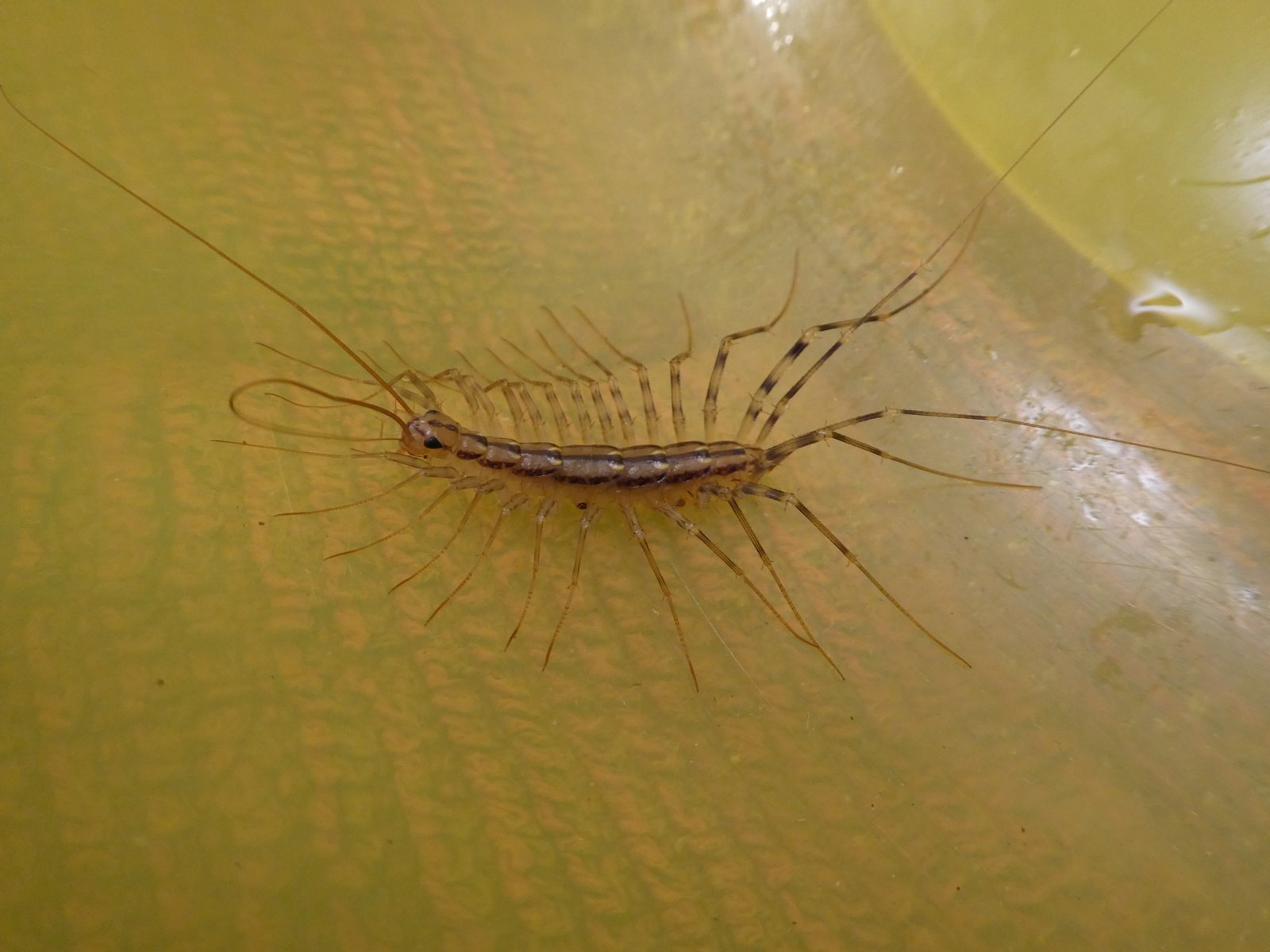
The house centipede is the one you already know, even if you did not know its name. It is yellow-grey with three dark stripes down its back, a body about an inch long, and fifteen pairs of legs so long that the animal looks much bigger than it is — like a spider that borrowed a centipede’s body. The legs get longer toward the rear, the antennae are long, and the whole animal is built for speed: it is the fastest centipede you will meet, and it can cross a bathroom wall in the time it takes you to decide whether to scream.
It is also the most useful animal in your house. House centipedes eat cockroaches, silverfish, ants, termites, flies, and spiders — the household pests you actually want gone — and they do it at night, silently, for free. They are, in the honest sense, beneficial predators, and pest-control guides routinely advise leaving them alone. They do not eat food, damage buildings, or chew furnishings. They are occasional invaders of damp houses, not colonists: they come in through gaps at ground level, hunt for a few nights, and die in a dry house within days if they cannot find damp. They were introduced to North America from the Mediterranean long ago and are now common in houses across the United States, including Florida, where the warm, damp climate suits them year-round.
Can it bite you? Technically yes — those front fangs can break skin — but it almost never does, and a house centipede bite is comparable to a bee sting at worst: painful, red, and gone in a day. Do not pick one up and you will never find out. If you cannot stand sharing a house with one, catch it in a jar and put it outside near the woodpile, where it will keep hunting. Do not spray: killing the house centipede does not kill the cockroaches it was eating.
The Florida blue centipede (Scolopendra viridis)
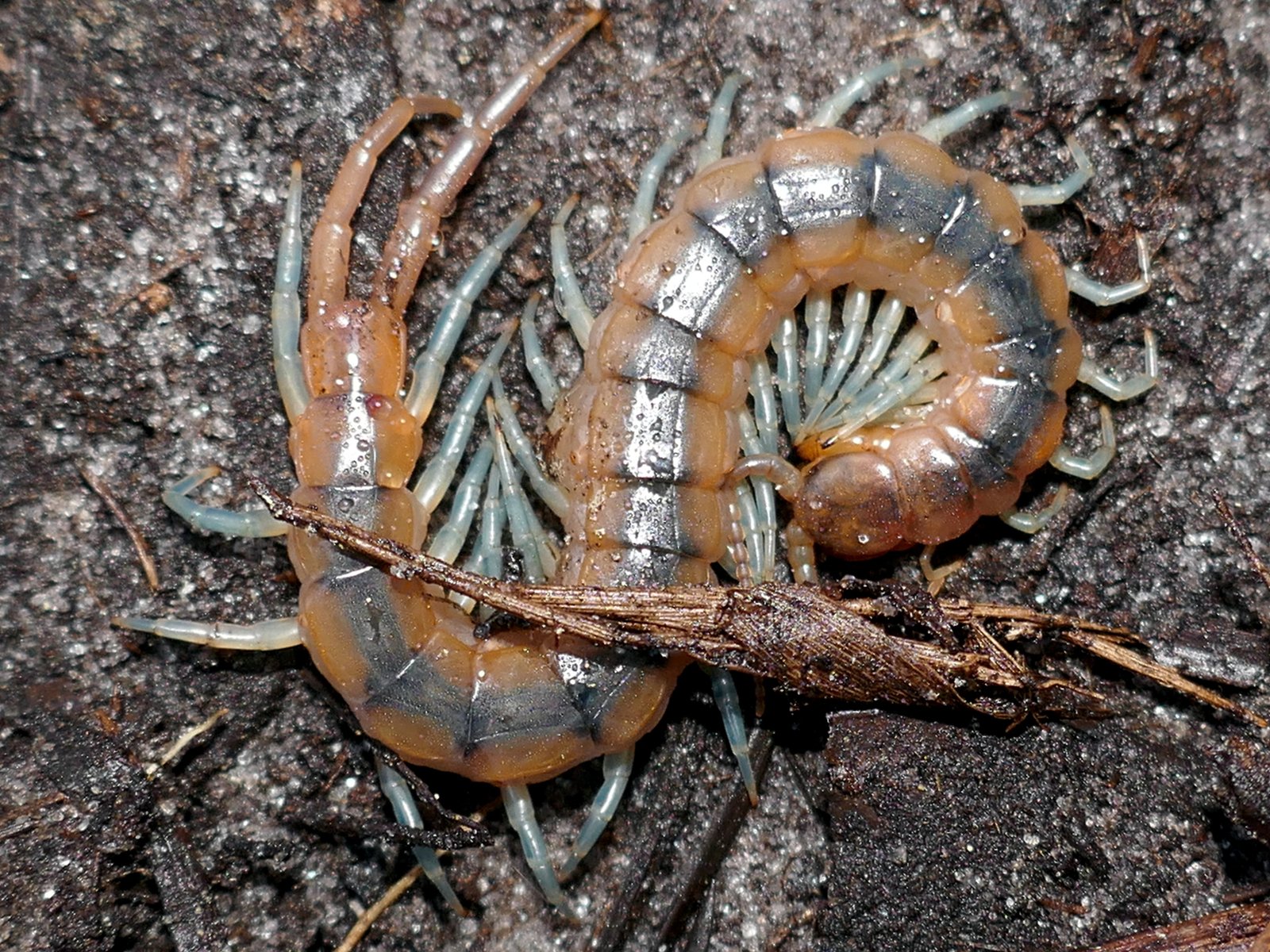
The Florida blue centipede is the one to respect. It is a stout, flat-bodied centipede up to about three inches long, blue-grey or steel-blue on top with orange or golden legs, found under bark, under fallen logs, and in leaf litter — UF/IFAS’s classroom arthropod guide records it from bark under fallen oaks. It is native to the southeastern United States, a true Florida animal, and it is a serious predator: it hunts insects, spiders, and other small animals at night, and it can deliver a painful bite if picked up or cornered. The bite is not dangerous to a healthy adult — it causes pain, redness, and swelling at the site — but it is the one centipede bite in this guide worth avoiding, and the reason to wear gloves when moving logs and to teach children to lift bark with a stick, not a hand.
One honest note about the name: “Florida blue centipede” is also applied in some sources to the eastern bark centipede, Hemiscolopendra marginata, a close relative with the same blue-grey body and orange legs. The two are easily confused and often share the same logs. The advice is the same for both: admire, do not handle, and let them hunt. In the garden, the Florida blue centipede is a helper — a night-shift predator that eats the insects and slugs that eat your plants — and it wants nothing from you except to be left under its log.
Soil centipedes (Geophilomorpha)
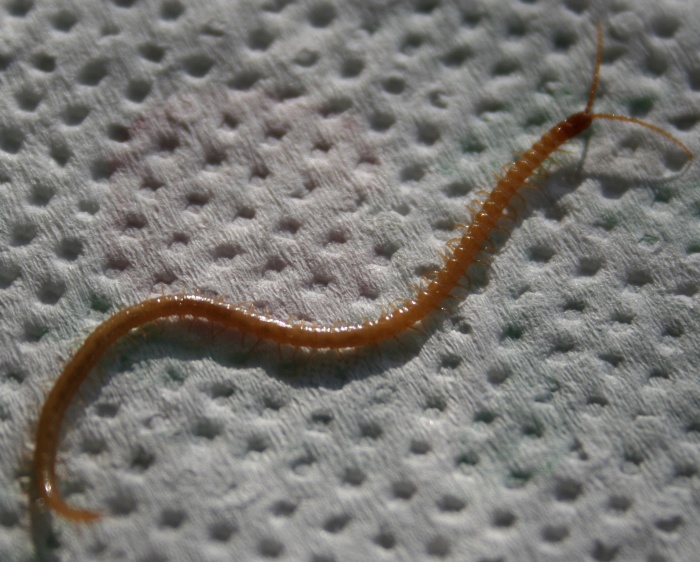
Soil centipedes are the ones you never see — and the ones doing the most work. They are pale, wormlike, and blind, with dozens of pairs of legs — anywhere from 27 to nearly 200 pairs depending on the species — and they live their whole lives underground, in soil and leaf litter, hunting the small animals of the dark: earthworms, insect larvae, and other soil invertebrates. “Soil centipede” is not one species but a whole order, the Geophilomorpha, and a Florida garden bed can hold several species at once, all of them pale, legless-looking, and easy to mistake for a worm until the legs start moving.
They are entirely harmless to people — too small, too slow, and too deep underground to bite — and they are good for the garden in the quiet way soil animals are good: they burrow, they hunt, and they keep the soil food web in balance. If you find one while digging, you have found a healthy soil. Put it back, cover it with soil, and let it get on with its work. The only thing they do not like is being dug up, dried out, and left in the sun, which is fair enough: none of us like that either.
Stone centipedes (Lithobius spp.)
Stone centipedes are the small, fast, reddish-brown centipedes under the rocks and pavers — the ones that dart away when you lift a garden stone. The best-known species, Lithobius forficatus, the brown centipede, is 18 to 30 millimeters long (about three-quarters to an inch and a quarter), chestnut-brown, with fifteen pairs of legs, and it hunts at night for insects, slugs, and worms. It is sometimes called the “gardener’s friend,” and the name is earned: a stone centipede under every other paver is a garden with free slug control.
Stone centipedes were introduced to North America from Europe long ago and are now common in gardens across the continent. In Florida they are less common than further north — the heat suits them less — but they turn up in gardens, compost piles, and under bark, especially in the cooler months. They are harmless to people: too small to break skin, too fast to catch, and too busy eating slugs to care about you. If you lift a stone and one runs, it is doing its job. Put the stone back and let it keep doing it.

What they eat — and what they do not like
Centipedes eat other animals. That is the whole job description: house centipedes eat cockroaches, silverfish, ants, termites, flies, and spiders; Florida blue centipedes eat insects, spiders, and small invertebrates in the leaf litter; soil centipedes eat earthworms and insect larvae underground; stone centipedes eat insects, slugs, and worms under rocks. They do not eat plants. They do not eat dead leaves. They do not eat your house, your clothes, or your food — except, in the house centipede’s case, the insects that do eat those things. A centipede is a predator, and a garden with centipedes is a garden with fewer pests.
What they do not like is just as useful to know. Centipedes do not like dry conditions: like millipedes, they breathe through their skin and dry out fast in open air, which is why they live in damp, dark places and come out at night. They do not like bright, exposed, open ground, and they do not like being handled — a centipede that is picked up will bite, because biting is what its front legs are for. Dry, bright, and exposed is the opposite of everything they want — and that is the whole strategy for keeping them out of the house, and the whole reason to keep them in the garden: give them damp and dark outside, and they will stay outside, hunting.
Are they pests?
Plainly: no — with one exception, and the exception is a matter of manners, not danger. House centipedes, soil centipedes, and stone centipedes are helpers, not pests: they eat the animals that eat your plants and your house, and they do it for free. The Florida blue centipede is a helper too, with a sharper edge: it can deliver a painful bite if handled, so it belongs in the “leave alone” category rather than the “welcome indoors” category.
The exception is the house centipede’s appearance. It is fast, it is leggy, and it shows up in bathrooms at 2 a.m., which is a combination that startles people out of all proportion to the danger. If you cannot live with one, catch it and move it outside — but know that you are evicting your best cockroach hunter, and the cockroaches will notice before you do. The goal is not a centipede-free house. The goal is a house with fewer cockroaches, and the centipede was helping with that.
Effects on the garden
On the plus side, centipedes are one of the best pest-control animals a garden can have. They eat slugs, cutworms, cockroaches, silverfish, ants, and the larvae of insects that eat your plants — and they do it at night, when the pests are out and you are not. Stone centipedes under the pavers eat the slugs that eat your seedlings. Soil centipedes underground eat the larvae that eat your roots. Florida blue centipedes in the leaf litter eat the insects that eat your leaves. A garden with centipedes has fewer pests than a garden without them, all else being equal, and it got that pest control for free.
On the minus side, there is very little. Centipedes do not eat plants, do not damage structures, and do not spread disease. The honest minuses are two: soil centipedes eat earthworms as well as pests, which is a small cost to the soil (and one the earthworm population absorbs easily), and the Florida blue centipede can bite a gardener who lifts a log bare-handed — painful, but not dangerous, and entirely avoidable with gloves. That is the whole minus column. For a predator, it is a remarkably short list.
Effects on other garden animals
Centipedes sit near the top of the small-animal food web, and they pull in both directions. As predators they eat insects, spiders, slugs, worms, and insect larvae — which helps your plants and hurts the pests, and which puts them in competition with other predators: spiders, ground beetles, and toads all hunt the same prey, and a garden can support all of them at once because there are usually enough pests to go around. House centipedes in particular compete with spiders for the same indoor insects, and a house with a house centipede often has fewer spiders — which some people will count as a bonus and some as a loss.
As prey, centipedes are food for birds, toads, lizards, shrews, and other animals that hunt in leaf litter and soil — and their speed is their defense, along with the venom that makes a mouthful of centipede a bad idea. They also help the animals they do not eat: by controlling slugs and insects, they protect the plants that feed caterpillars, bees, and birds, and by burrowing, soil centipedes help aerate the soil that earthworms and microbes depend on. A garden with centipedes is a garden with a working food web, from the soil up.
Look-alikes: the concrete checks
Centipedes and millipedes look alike until you know what to check, and the checks are wonderfully simple — leg count, speed, and reaction. Work through them in order and you will rarely go wrong. The millipedes below are the ones in this library; each one has its own guide, and each one is the animal you are not looking at when you find a centipede.
Portuguese Millipede (Ommatoiulus moreleti) — the smooth black one. Slate-grey to black, smooth and cylindrical, up to about 1.8 inches, with two pairs of legs per segment, moving slowly in a steady wave and curling up when disturbed. If it curls, it is a millipede. If it runs, it is a centipede. Check: two pairs, slow, curls. Read the full guide: Portuguese Millipede.
Rusty Millipede (Trigoniulus corallinus) — the red one. Pinkish-brown to brick red, up to three inches long, smooth and wormlike, so often mistaken for an earthworm that people step on it before they see the legs. Two pairs of legs per segment, slow, curls when disturbed. Check: red, wormlike, two pairs per segment. Read the full guide: Rusty Millipede.
Greenhouse Millipede (Oxidus gracilis) — the small, bumpy one. Under an inch long, dark brown to black with pale, creamy-white legs, bumpy and ridged along its back, slightly flattened. Two pairs of legs per segment, slow, curls when disturbed. Check: under an inch, pale legs, bumpy back. Read the full guide: Greenhouse Millipede.
Cyanide Millipede (Asiomorpha coarctata) — the flat black one with yellow spots. Small, flat-backed, dark brown to black with yellow spots on its flanges, smelling of almonds when disturbed. Two pairs of legs per segment, slow, curls when disturbed. Check: flat with flared edges, yellow spots, almond smell. Read the full guide: Cyanide Millipede.
Black-and-Yellow Flat Millipede (Apheloria virginiensis) — the big, bright one. Black with yellow, orange, or pink spots, up to two inches long, broad and flat with yellow legs, smelling of cherries or almonds when disturbed. Two pairs of legs per segment, slow, curls when disturbed. Check: big, broad, bright spots, slow. Read the full guide: Black-and-Yellow Flat Millipede.
Bumblebee Millipede (Anadenobolus monilicornis) — the yellow-banded one. Black with bright yellow bands and red legs, about 1¾ inches long, common on South Florida patios after rain. Two pairs of legs per segment, slow, curls when disturbed. Check: yellow bands, red legs, two pairs per segment. Read the full guide: Bumblebee Millipede.
Florida Ivory Millipede (Chicobolus spinigerus) — the big native one. Black with pale ivory bands, up to about 3½ inches long, native through Florida and into Georgia, Alabama, and South Carolina. Two pairs of legs per segment, slow, curls when disturbed. Check: big, black-and-ivory bands, two pairs per segment. Read the full guide: Florida Ivory Millipede.
American Giant Millipede (Narceus americanus) — the big grey one. Grey with reddish bands, up to about 4 inches long — the eastern-US reference species, though a Florida ID is uncertain (the complex is unresolved; Florida’s big Narceus is most likely the smokey oak). Two pairs of legs per segment, slow, curls when disturbed. Check: big, grey with red bands, two pairs per segment. Read the full guide: American Giant Millipede.
Smokey Oak Millipede (Narceus gordanus) — the big sandy one. Sandy tan, 60 to 120 millimeters long, living in Florida scrub and oak woods — the large Narceus Florida gardeners actually meet. Two pairs of legs per segment, slow, curls when disturbed. Check: big, sandy-tan, scrub or oak habitat, two pairs per segment. Read the full guide: Smokey Oak Millipede.
Florida Scrub Millipede (Floridobolus penneri) — the rare one. Uniformly slate grey, 60 to 92 millimeters long, found only on the Lake Wales Ridge scrub in Polk and Highlands counties, critically imperiled — not a patio animal, and one to leave alone. Two pairs of legs per segment, slow, curls when disturbed. Check: grey, ridge scrub only, two pairs per segment. Read the full guide: Florida Scrub Millipede.
The split, one more time, because it is the whole point of this guide: one pair of legs per segment, fast, runs away — centipede, can bite. Two pairs of legs per segment, slow, curls up — millipede, cannot bite. Count the legs, watch the speed, watch the reaction. Three checks, three answers, and you will never mix them up again.
How to get rid of them (indoors) — and how to keep them (in the garden)
This guide has two opposite answers, because centipedes are two opposite things depending on where they are. Indoors, you want fewer of them. In the garden, you want more. Here is both.
To get rid of house centipedes indoors: take away what they came for. House centipedes hunt other pests, so a house with centipedes is a house with something for them to eat — seal the gaps that let insects in, fix leaks, and dry out damp basements and bathrooms. Seal the centipedes’ own routes too: door sweeps, weatherstripping, and caulk around windows and pipes, looking low, at ground level. Reduce the damp they need: run a dehumidifier in a damp basement, fix dripping taps, and let bathrooms dry out. And catch the ones you find in a jar and put them outside near the woodpile, where they will keep hunting. Do not spray: the spray kills the centipede and leaves the cockroaches it was eating.
To keep garden centipedes in the garden: give them what they want, which is damp, dark, and full of prey. Leave leaf litter under shrubs. Keep a log pile. Do not pave over every inch of the garden, and leave some stones unturned. Mulch the beds. Water in the evening so the soil surface stays damp overnight, when the centipedes hunt. And lift logs and stones with gloves and a stick, not a bare hand — the Florida blue centipede under the log is doing you a favor, and it would like to keep doing it without being grabbed.
For the Florida blue centipede specifically: leave it alone. Do not pick it up, do not corner it, and teach children the same. Wear gloves when moving logs, rocks, and leaf litter. If one gets indoors, catch it in a large jar — with a lid, and without touching it — and release it outside under a log. Its bite is painful but not dangerous, and it is entirely avoidable.
Frequently asked questions
Are centipedes dangerous?
Almost never. House centipedes, soil centipedes, and stone centipedes are harmless to people. The Florida blue centipede can deliver a painful bite if picked up or cornered, but the bite is not dangerous to a healthy adult — it causes pain, redness, and swelling. Do not pick one up and you will never find out.
Do centipedes bite?
Yes — unlike millipedes, centipedes have venomous front fangs and can bite. They bite prey, not people, unless they are picked up or trapped against skin. If you are bitten, wash the area with soap and water and watch it the way you would a bee sting. Seek medical advice if the pain spreads, if you have an allergic reaction, or if a child or pet is bitten.
There is a centipede in my bathroom — what do I do?
Catch it in a jar and put it outside near the woodpile. It came in hunting other pests, and it will die in a dry house within days if you leave it. Seal the gaps it came through, dry out the damp, and deal with the insects it was hunting — the centipede was a symptom, not the problem.
Are centipedes good for the garden?
Yes. They eat slugs, cutworms, cockroaches, silverfish, ants, and insect larvae — the animals that eat your plants — and they do it at night, for free. A garden with centipedes has fewer pests than a garden without them.
How do I tell a centipede from a millipede?
Count the legs on one segment: one pair means centipede, two pairs means millipede. Then watch the speed: centipedes are fast, millipedes are slow. Then watch the reaction: centipedes run, millipedes curl up. Three checks, three answers.
Do centipedes eat plants?
No. Centipedes are predators — they eat other animals, not plants. If something is eating your plants, it is not a centipede. It may be the slugs the centipedes were trying to eat.
How many legs does a centipede have?
It depends on the kind. House centipedes and stone centipedes have 15 pairs. Florida blue centipedes have 21 pairs. Soil centipedes have anywhere from 27 to nearly 200 pairs, depending on the species. The old saying that a centipede has a hundred legs is wrong in both directions — and a millipede, despite the name, has nowhere near a thousand.
Will centipedes hurt my dog or cat?
A pet that corners a Florida blue centipede may get a painful bite on the nose or paw and will yelp, drool, and learn not to do it again. It is painful, not an emergency — but call a vet if the swelling does not go down or the pet seems distressed. House centipedes and stone centipedes are too small to bother a pet at all.
Why are they so fast?
Because they are hunters, and their prey runs too. Centipedes have long legs, a flat body, and a nervous system built for speed — the house centipede is one of the fastest land animals for its size. Millipedes are slow because they do not need to be fast: nothing chases a dead leaf.
Should I kill the house centipede?
No. It is eating your cockroaches, silverfish, and spiders, and it does not eat your food or damage your house. Catch it and move it outside if you cannot stand it indoors — but know that you are evicting your best pest control, and the pests will notice before you do.
🌱 Keep learning
Three related guides worth reading next:
- Portuguese Millipede — The little black millipede that stopped trains: rain swarms, a staining chemical defense, and the curl that gives it away — Florida patio edition.
- Rusty Millipede — The other patio-swarm millipede: rusty red, up to three inches, and the first millipede ever to have its genome sequenced.
- Soil Food Web Explorer — Meet the whole underground crew, from bacteria to beetles, and see where the millipedes fit in the chain.
🪱 Your Soil Needs This
Reading about healthy soil is great. Growing in it is better. Our small-batch, traceable worm castings are the shortcut your garden deserves.
Shop Worm Castings Subscribe & SaveEvery bag comes with a lot certificate. Know what's in your soil.