
Under a rotting log in an eastern forest, there is an animal the size of a stubby cigar doing a job nobody thanked it for. The American giant millipede, Narceus americanus, is the largest millipede in North America — up to four inches of grey armor banded in red, with more legs than you can count and a chemical defense that can stain your skin brown. It is also, quietly, one of the most confusing animals in the library. Its name covers not one tidy species but a whole complex of look-alike forms that scientists have been arguing about for more than a century. This guide is about the animal, the argument, and the honest answer to whether the one in your Florida garden is really this species at all.
And if you just found a four-inch grey-and-red millipede under a log and want to know whether it is dangerous — it is not. It does not bite or sting, and the worst it can do is stain your hands and make you smell like a chemistry set.
What it looks like
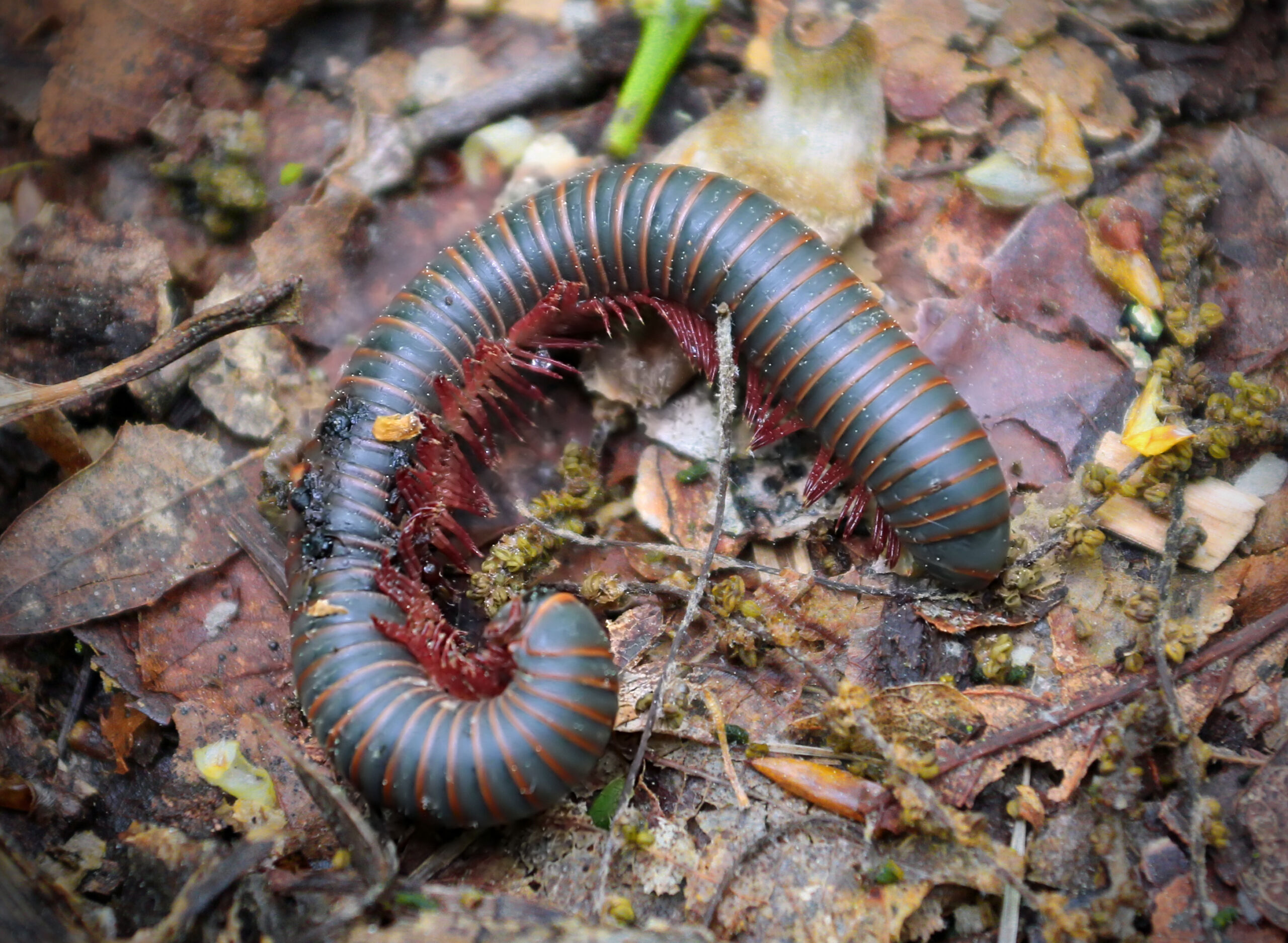
Forget the little millipedes on your patio. The American giant millipede is a different scale of animal altogether. An adult is up to about 4 inches long (100 millimeters, and the largest individuals in the complex reach about 4.5 inches), roughly half an inch thick, and shaped like a length of grey rope with red stitching. The body is nearly cylindrical, dark grey to slate with a thin band of red or pink on the rear edge of each segment, and the legs and antennae are reddish too. Count the segments and you will find 45 to 59 of them on an adult, most carrying two pairs of legs each — the millipede’s defining trick, and the fastest way to tell it from a centipede, which carries only one pair per segment. The head carries a cluster of simple eyes, called ocelli, on each side, and short antennae that wave constantly.
Young ones are smaller and paler than the adults and darken as they grow, adding segments with every molt — a millipede is born with only a few segments and earns the rest over its life, like a train picking up cars at every station. The color is the field mark that matters most: if it is big, grey, and banded in red, and it is in eastern North America, you are in Narceus territory. But “big, grey, and banded in red” describes several Narceus forms that may or may not be the same species, and telling them apart from a photograph is not reliably possible. The size is the thing that gives it away first: at four inches, this is roughly twice as large as any other millipede most North Americans will ever meet, and nothing else in the leaf litter is that big, that grey, and that unbothered.
The name game (giant, iron worm, worm millipede — and one name too many)
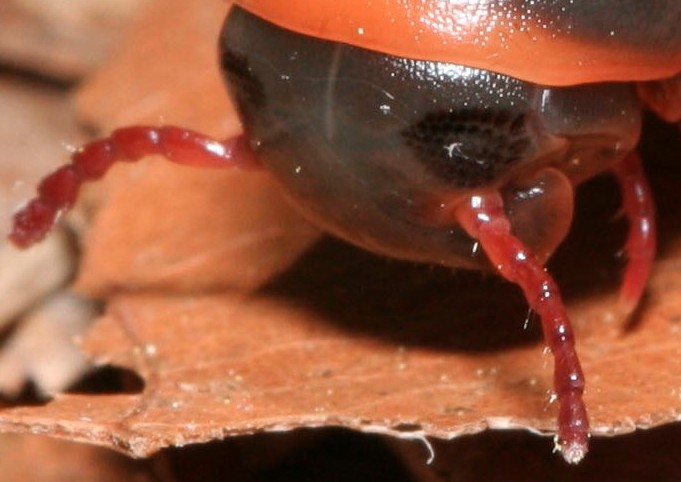
You will see this animal called the American giant millipede, the worm millipede, and the iron worm — “iron worm” for the grey, metallic-looking body, “worm millipede” because at a glance it looks like an enormous worm until the legs start moving. Its scientific name is Narceus americanus (Palisot de Beauvois, 1817). The taxonomy, for the nerds in the back: kingdom Animalia, phylum Arthropoda, class Diplopoda (the millipedes), order Spirobolida, family Spirobolidae, genus Narceus. The Spirobolida are the classic round-backed millipedes, and Narceus is a small North American genus of large cylindrical millipedes.
Here is where the name game stops being a game. For more than a century, naturalists have described at least fourteen different Narceus species, most of which have since been folded together. The two big names were Narceus americanus, the southern form, and Narceus annularis, the northern form — the smaller, darker northern animals were annularis, the larger, more variable southern ones were americanus. The two were merged into one species, then split again, then merged again, and the current expert position — Shelley, McAllister & Medrano, 2006, the most thorough treatment of the genus — is to call the whole tangle the “Narceus americanus/annularis complex”: two taxa of uncertain status, possibly one species, possibly several, with geographic evidence suggesting greater diversity in the south and a second full revision of the genus still owed. A 2009 genetic study (Walker, Stockman, Marek & Bond) found deep genetic structure across the Appalachians and the coastal plain, left over from Pleistocene glacial refugia. There is no published split that cleanly separates a northern N. americanus from a southern one, and no field mark — no color, no size, no segment count — that lets a gardener tell them apart. When this guide says Narceus americanus, it means the complex, the way the experts mean it.
The pet trade’s favorite giant
There is one place where this millipede is famous by name, and it is not the forest floor: it is the pet trade. The American giant millipede is the classic beginner pet millipede — big, slow, hardy, long-lived, and about as dangerous as a cucumber. Hobbyists keep them in terraria of damp leaf litter and rotting wood, and breeders have even isolated an albino strain, pale cream animals with pinkish legs, first established by breeder Orin McMonigle. A well-kept pet can live for many years, and the record for the species is around eleven years, which makes this one of the longest-lived invertebrates you can legally keep in a box in your living room.
That popularity comes with one rule: never release a pet millipede into the wild. A released pet is not “going home” — it may be a different genetic form from the local animals, and it may carry captivity microbes into the wild. If you keep one, keep it.
The burrower: a millipede that digs
Most millipedes are content to live in the leaf litter, on top of the soil. The American giant millipede goes further down. It is a genuine burrower, pushing through damp soil and rotting wood and leaving behind vertical, subvertical, helical, and O-shaped burrows — tunnels that researchers have studied in terraria precisely because burrowing detritivores like this one are part of how soil gets made. Every tunnel mixes organic matter into the soil and opens air channels for water and microbes — the animal is turning the forest floor over from below.
You will find it in and under decaying logs, in deep leaf litter, and in the damp heart of a rotting stump, from March to October and mostly at night; by day and in winter it burrows deep to avoid drying out and to escape the cold.
What it eats: the quiet recycling job
At heart, the American giant millipede is a detritivore — a creature that eats dead things so the rest of the world does not have to wade through them. Its diet is decaying wood and leaf litter: the damp brown layer at the bottom of the world, shredded into smaller pieces, passed through a gut full of microbes, and returned to the soil as droppings that feed the fungi and bacteria that finish the job. It feeds mostly at night, in the damp dark, and it is the cleanup crew — invisible until it stops showing up.
It is not a picky eater within the dead-stuff world. It has also been found feeding on deer scat and on fresh fruit, and given the choice it will pick the fruit over the leaf litter — though the fruit is less nutritious than its regular diet. It does not hunt. It does not eat living plants, living insects, or anything that can run away.
What it does not like is just as useful to know. It does not like dry conditions: its cuticle is somewhat water-permeable, so it loses moisture through its skin and dries out in open air, and it will spend real energy searching for a damper spot before it gives up. It does not like bright, exposed, open ground either: it is a creature of damp, dark places, active mostly at night, which is why you find it under logs and in leaf litter and almost never out in the sunny middle of a dry lawn. Dry, bright, and exposed is the opposite of everything it wants, and that is the whole strategy for keeping it out of places you do not want it, in one sentence.
The curl and the chemistry
Disturb an American giant millipede and it has one famous move: it curls into a tight spiral, head tucked in the center, armored rings facing outward, and plays dead with total commitment. It cannot bite, cannot sting, and cannot run away fast — the curl is the whole defense plan, plus one chemical backup. Along the sides of its body it carries rows of tiny defensive glands, and if you squeeze or crush it, those glands discharge a fluid. The chemistry is built on benzoquinones — sharp-smelling compounds that stain skin and fabric and taste terrible to anything that tries to eat it. The stain, sometimes called millipede burn, is a temporary brownish discoloration of the skin: not a real burn, not dangerous, but it can linger for days, because benzoquinones react with keratin, the protein in your skin and hair, and bind to it.
Here is what that means in practice. The fluid smells bad — sharp, chemical, and memorable. It is extremely irritating if rubbed into the eyes. It is not venom — there is no bite, no injection, nothing that gets it into your bloodstream — and the amount one millipede produces is far too small to be dangerous to a person. But it is a genuine chemical weapon against the animals that would eat millipedes, and it is the reason most predators learn to leave the big grey ones alone after one try. Two things it is worth knowing it does not do: despite claims online, there is no good evidence this species releases hydrogen cyanide — that is a different millipede family’s trick. Wash your hands after handling one, keep it away from your eyes, and admire it with a stick rather than your fingers. The millipede would prefer that too.
The curl does a second job that has nothing to do with predators. When the air dries out, the millipede first spends energy searching for a damper spot, and if that fails it reflexively curls into the same defensive spiral — because the curled position closes the spiracles at the base of its legs, the little breathing holes, and slows further water loss. From a partially dehydrated state it can even reabsorb moisture from humid air. The spiral is not just armor. It is a canteen with the lid screwed on.
Life cycle: born small, earning segments, living long
Like all millipedes, the American giant millipede grows by molting: it sheds its exoskeleton, adds new segments and new pairs of legs, and hardens up again, bigger than before. It hatches from an egg with only a few segments and a handful of legs, and earns the rest over successive molts. Adults emerge in spring to mate and lay eggs — the female lays a single egg in a little cup she forms from regurgitated food, a packed lunch and a nursery in one — and the young grow slowly. Sexual maturity takes one to two years, which is a long childhood for an invertebrate, and the payoff is a long life: the average lifespan is not well known, but individuals can live up to eleven years in captivity or in the wild, which makes this one of the longest-lived millipedes in North America and a genuine elder of the leaf litter.
That slow, long life has a consequence worth stating plainly: this is not an animal that bounces back fast from a bad year. A population is built out of old animals that took years to grow, and a log pile cleared in an afternoon can remove a decade of growth. Damp seasons bring activity and breeding; dry spells and winter send it deep into soil and rotting wood to wait.
The Florida angle: the big grey millipede in Florida is probably not this species — and here is what it is instead
Now the correction, because it matters and because this library is honest about it. The census brief for this guide said “eastern US incl. north FL,” and that is true in the broad sense and misleading in the strict sense. Under the old maps, Narceus americanus in the strict sense was the southern form, occupying South Carolina, Georgia, Florida, Alabama, Mississippi, Louisiana, Arkansas, Oklahoma, and Texas — and the genus as a whole reaches Key West, the southern extreme of its range. But the current expert position is that americanus and annularis are a complex of uncertain status, with greater diversity suspected in the south and no published revision that says which form lives where in Florida. A big grey-and-red Narceus in a Florida garden cannot be confidently called Narceus americanus from a photo.
What Florida definitely has is its own large Narceus: the smokey oak millipede, Narceus gordanus, a valid species in its own right, found from Florida to South Carolina and possibly Tennessee, large (60 to 120 millimeters) and thick-bodied, sandy-colored and highly variable, with color forms running from yellow to grey to brown and red-striped. It is the large Narceus most likely to be under a Florida log. Florida also has a second endemic, Narceus woodruffi, a small north-Florida species separable only under a microscope. Telling them apart takes a microscope and a specialist, and for a gardener it does not change the advice: do not handle it, wash your hands, admire it with your eyes, and let it do its recycling job. The name on the label matters to science. The behavior in your garden is the same either way.
So why is it in a Florida library? Because it is the reference species for the whole big-grey-millipede look — the one every field guide and photo-ID tool points to — and Florida gardeners meet its cousins constantly. Know this animal, and you will recognize its Florida relatives on sight.
Is it a pest?
Plainly: no. The American giant millipede is not a pest. It does not bite, sting, or spread disease. It does not eat your house, your clothes, or your stored food. It does not damage structures. It does not eat living plants — its food is dead leaves and rotting wood — and it does not show up in swarms on patios the way the small introduced millipedes do. What it does is live quietly under logs, shred dead leaves, dig burrows, and mind its own business for up to eleven years.
The only “problem” it causes is when someone picks it up and gets stained hands and a bad smell. That is a wild animal defending itself, not a pest — the fix is to leave it alone. A big grey millipede in the garden is a sign of healthy, organic-rich soil with deep leaf litter and rotting wood — the kind of garden that has been left alone long enough to grow something worth eating. The goal is not to get rid of it. The goal is to keep it, and to keep the log pile it lives in.
Effects on the garden
On the plus side — and with this animal, it is nearly all plus side — the American giant millipede is a genuine soil builder. It eats dead leaves and rotting wood, breaks them into smaller pieces, and its droppings feed the microbes that finish the job — fungi and bacteria that turn leaf litter into plant food. Its burrows mix organic matter into the mineral soil, open air channels, and let water reach deeper, the same work earthworms do, from a different branch of the family tree. In a compost pile it is a volunteer worker, and gardens with large millipedes have faster litter turnover and richer surface soil.
On the minus side, there is very little to list, and honesty requires saying so. In theory it may nibble soft fallen fruit — it will choose fresh fruit over leaf litter when offered — so a windfall strawberry or tomato resting on the soil may get a visit. That is the whole charge sheet. It does not eat seedlings, roots, or living stems, and it does not damage potted plants. If you find one in the garden, the correct response is gratitude, not pest control.
Effects on other garden animals
The American giant millipede sits in the middle of the garden food web, and it pulls in both directions. As a detritivore it eats only dead plant matter — it does not hunt other animals, does not eat living insects, and does not compete with predators for prey. Its competition is with the other recyclers: earthworms, woodlice, and springtails all eat the same dead leaves, and in a rich leaf-litter bed there is usually enough dead matter for all of them. Its droppings feed the fungi and bacteria that finish the job, which in turn feed the whole underground web.
As prey, it is a large, defended meal, and most predators learn to leave it alone — but some take it anyway. Raccoons, skunks, opossums, moles, toads, lizards, and turtles are all recorded taking large millipedes. For pets, the risk is small but real: a dog that crunches one will get a mouthful of foul-tasting fluid and may drool, paw at its mouth, or vomit, then learn not to do it again. It is unpleasant, not an emergency — but keep an eye on any pet that eats a lot of them, and call a vet if the drooling does not stop.
And it carries its own ecosystem. The gut of the American giant millipede hosts pinworm nematodes found nowhere else — a new species, Thelastoma variabile, was described in 2025 from 82 specimens of the complex collected in Oklahoma A single millipede is a habitat: a burrower, a shredder, a food source, and a transport service, all in four inches of grey armor.
Look-alikes: the concrete checks
Big millipedes all look alike until you know what to check, and the checks are wonderfully simple — size, color, texture, shape, speed, and a leg count. Work through them in order and you will rarely go wrong.
Smokey Oak Millipede (Narceus gordanus) — the one you probably actually found in Florida. This is the hardest look-alike in the library, because it may be indistinguishable from the American giant millipede in a photograph: large, thick-bodied, 60 to 120 millimeters, highly variable in color from yellow to grey to brown and red-striped. It is a valid species in its own right, found from Florida to South Carolina, and the large Narceus most likely to be under a Florida log. Check: if you are in Florida and it is a big grey-red Narceus, assume smokey oak first — a certain identification takes a specialist with a microscope. Read the full guide: Smokey Oak Millipede.
Florida Ivory Millipede (Chicobolus spinigerus) — the black-and-white one. Florida’s other big native millipede is black-and-white banded, not grey-and-red, and that is the whole check: bands of ivory white on a black body mean ivory, grey with red edges means Narceus. It is native from Florida to South Carolina. Check: white bands, not red ones. Read the full guide: Florida Ivory Millipede.
Florida Scrub Millipede (Floridobolus penneri) — the other Florida giant. Also large, up to about 9 centimeters, but a scrub specialist: it lives in the dry, sandy, infertile soils of the Lake Wales Ridge and other Florida scrub, not in damp garden leaf litter. Check: dry sand and scrub means scrub millipede; damp log and leaf litter means Narceus. Read the full guide: Florida Scrub Millipede.
Portuguese Millipede (Ommatoiulus moreleti) — the black cousin. Much smaller, up to about 1.8 inches, slate-grey to black, smooth and cylindrical, and a famous Florida patio swarmer after rain. Check: black, smooth, small, and in a crowd means Portuguese; big, grey-red, and alone under a log means Narceus. Read the full guide: Portuguese Millipede.
Rusty Millipede (Trigoniulus corallinus) — the small red one. At 2 to 3 inches it is shorter than an adult American giant, and it is rusty red all over rather than grey with red edges. Check: rusty red and two inches means rusty; grey with red edges and four inches means Narceus. Read the full guide: Rusty Millipede.
Bumblebee Millipede (Anadenobolus monilicornis) — the yellow-banded one. A South Florida patio millipede with bold yellow bands on a dark body, smaller than Narceus. Check: yellow bands mean bumblebee; red edges mean Narceus. Read the full guide: Bumblebee Millipede.
Greenhouse Millipede (Oxidus gracilis) — the small, bumpy one. At under an inch long it is much shorter than an adult American giant, and its body is dark brown to black on top with pale, creamy-white legs — the pale legs are the giveaway. It is also bumpy and ridged where Narceus is smooth, and slightly flattened rather than round. Check: under an inch, pale legs, bumpy back. Read the full guide: Greenhouse Millipede.
Flat-backed millipedes (including Asiomorpha coarctata and Apheloria virginiensis) — the ones that look like centipedes. Flat-backed millipedes belong to the order Polydesmida, and they are flattened top-to-bottom with wide lateral keels on each segment called paranota — little flanges that make the animal look wide and flat instead of round. Many are brown or black, sometimes with bright yellow, orange, or red markings. Check: flat, not round; flared edges on every segment; often brightly marked. Some flat-backed species defend themselves with cyanide compounds rather than benzoquinones, which is a different chemistry set and a good reason to admire them with your eyes rather than your hands. Read the full guides: Cyanide Millipede and Black-and-Yellow Flat Millipede.
Centipedes — the one that actually matters, because this is the split with consequences. Centipedes have one pair of legs per segment, not two, and they move fast — darting, flickering, gone under the baseboard before you have finished the sentence. Millipedes move slowly and curl up when disturbed; centipedes run. Centipedes are also flattened, with long legs that stick out sideways and a pair of venomous front fangs, and they can bite. Millipedes have short legs tucked under a round body and no bite at all. Check: count the legs per segment (one pair means centipede, two pairs means millipede), then watch the speed (fast means centipede, slow means millipede), then watch what it does when poked (runs means centipede, curls means millipede). Three checks, three answers, and you will never mix them up again. Read the full guide: Garden Centipedes.
How to attract them
This is a helper, not a pest, so the question is not how to get rid of it — it is how to keep it. The answer is to keep the habitat it needs, which is the opposite of a tidy garden:
Keep a log pile. A pile of rotting logs and branches in a damp, shady corner is the single best thing you can do. The millipedes live in and under decaying wood, feed on it, burrow in it, and overwinter in it.
Leave the leaf litter. Let fallen leaves lie in the beds and under the trees, at least in the back corners. Leaf litter is food, shelter, and nursery.
Keep it damp and dark. A shady, moist corner with mulch, leaf litter, and logs is home; a dry, sunny, bare lawn is a desert. Water the shady beds, mulch them, and let the soil surface stay damp underneath.
Keep a compost pile. A compost heap is a millipede restaurant, and the animals working it speed up your compost for free.
Do not spray. Broad-spectrum insecticides kill millipedes along with everything else in the leaf litter, and there is no reason to spray for an animal that eats dead leaves and does not touch your plants. If you must deal with a genuine pest, use a targeted treatment and keep it away from the log pile and the leaf litter.
Do not tidy the wild corner. The weedy, log-filled, leaf-deep corner of the garden is not neglect. It is habitat. The American giant millipede takes one to two years to reach maturity and can live eleven — a tidy-up that clears the log pile removes a decade of growth in an afternoon. Leave the wild corner wild, and the giants will stay.
Frequently asked questions
Is the American giant millipede dangerous?
No. It does not bite, sting, or spread disease, and the amount of defensive fluid one millipede produces is far too small to harm a person. It can stain skin a temporary brown and irritate eyes, so wash your hands after handling one and keep it away from your face.
Does it bite?
No. Millipedes have no venom, no fangs, and no bite at all. Their defenses are curling up and a bad-tasting chemical fluid. If it has fangs and it bit you, it was a centipede.
How big does it get?
Adults reach about 4 inches long (100 millimeters), and the largest individuals in the complex reach about 4.5 inches — about half an inch thick.
Is it a worm?
No, and the legs give it away. It is an arthropod — a relative of lobsters, crabs, and insects — with a hard segmented exoskeleton, 45 to 59 segments, and hundreds of legs. Worms have no legs at all.
What does it eat?
Dead plant matter: decaying wood and leaf litter, mostly at night. It has also been found eating deer scat and fresh fruit, and it will choose fruit over leaf litter when offered — though the fruit is less nutritious for it than its regular diet. It does not eat living plants, living insects, or your house.
I found one in Florida — is it this species?
Maybe, and maybe not — and a photograph cannot settle it. The Narceus americanus/annularis complex is of uncertain status, with greater diversity suspected in the south, and Florida has its own large Narceus, the smokey oak millipede (N. gordanus), plus the small north-Florida endemic N. woodruffi. A big grey-and-red Narceus in a Florida garden is most likely the smokey oak millipede. The behavior and the advice are the same either way: look, don’t touch, wash your hands, and let it work.
Will it hurt my plants?
No. It eats dead leaves and rotting wood, not living plants. The only thing it may nibble is soft fallen fruit resting on the soil. A big grey millipede in a bed is a helper, shredding leaf litter, digging burrows, and feeding the soil.
Will it hurt my dog or cat?
A pet that crunches one will get a mouthful of foul-tasting fluid and may drool, paw at its mouth, or vomit once, then learn not to do it again. It is unpleasant, not an emergency — but call a vet if the drooling does not stop or the pet eats a lot of them.
How do I attract them?
Keep a rotting log pile in a damp, shady corner, leave the leaf litter in the beds, keep a compost pile, mulch the shady beds, and do not spray broad-spectrum insecticides. Do not tidy the wild corner — a log pile cleared in an afternoon removes animals that took years to grow.
Why is it called the iron worm — and what is the species complex?
Iron worm for its grey, metallic-looking body; worm millipede because it looks like an enormous worm until the legs move. The species complex is the honest part: Narceus americanus and N. annularis were split, merged, and split again over a century, and the current expert position (Shelley et al., 2006) treats them as a complex of uncertain status — possibly one species, possibly several — with deep genetic structure left over from the Ice Ages (Walker et al., 2009).
🌱 Keep learning
Three related guides worth reading next:
- Portuguese Millipede — The little black millipede that stopped trains: rain swarms, a staining chemical defense, and the curl that gives it away — Florida patio edition.
- Garden Centipedes — The fast, flat, one-pair-per-segment look-alike that can actually bite — how to tell it from every millipede in this library in three checks.
- Compost Accelerators — Twelve things that actually wake up a lazy pile, and the microbes behind all of it, Florida edition.
🪱 Your Soil Needs This
Reading about healthy soil is great. Growing in it is better. Our small-batch, traceable worm castings are the shortcut your garden deserves.
Shop Worm Castings Subscribe & SaveEvery bag comes with a lot certificate. Know what's in your soil.