
Under a sand live oak on the Lake Wales Ridge, in leaf litter so dry it crunches, there lives an animal the exact color of the sand it walks on. The smokey oak millipede, Narceus gordanus, is one of the biggest millipedes in eastern North America — up to nearly five inches of slow, armored, sandy-tan legs — and it is a Florida native doing a job the scrub cannot do without. It eats dead oak leaves and rotting wood in some of the poorest soil in the state, and turns them into the stuff the next generation of scrub plants grows in. A ghost-colored giant in a ghost-colored landscape, hiding in plain sight by matching the ground beneath it.
And if you are reading this in Florida because you just found a millipede the size of a cigar in your garden and want to know whether to panic — stay with us. It is not a pest, it does not bite, and it is probably the most interesting animal in your leaf litter.
What it looks like
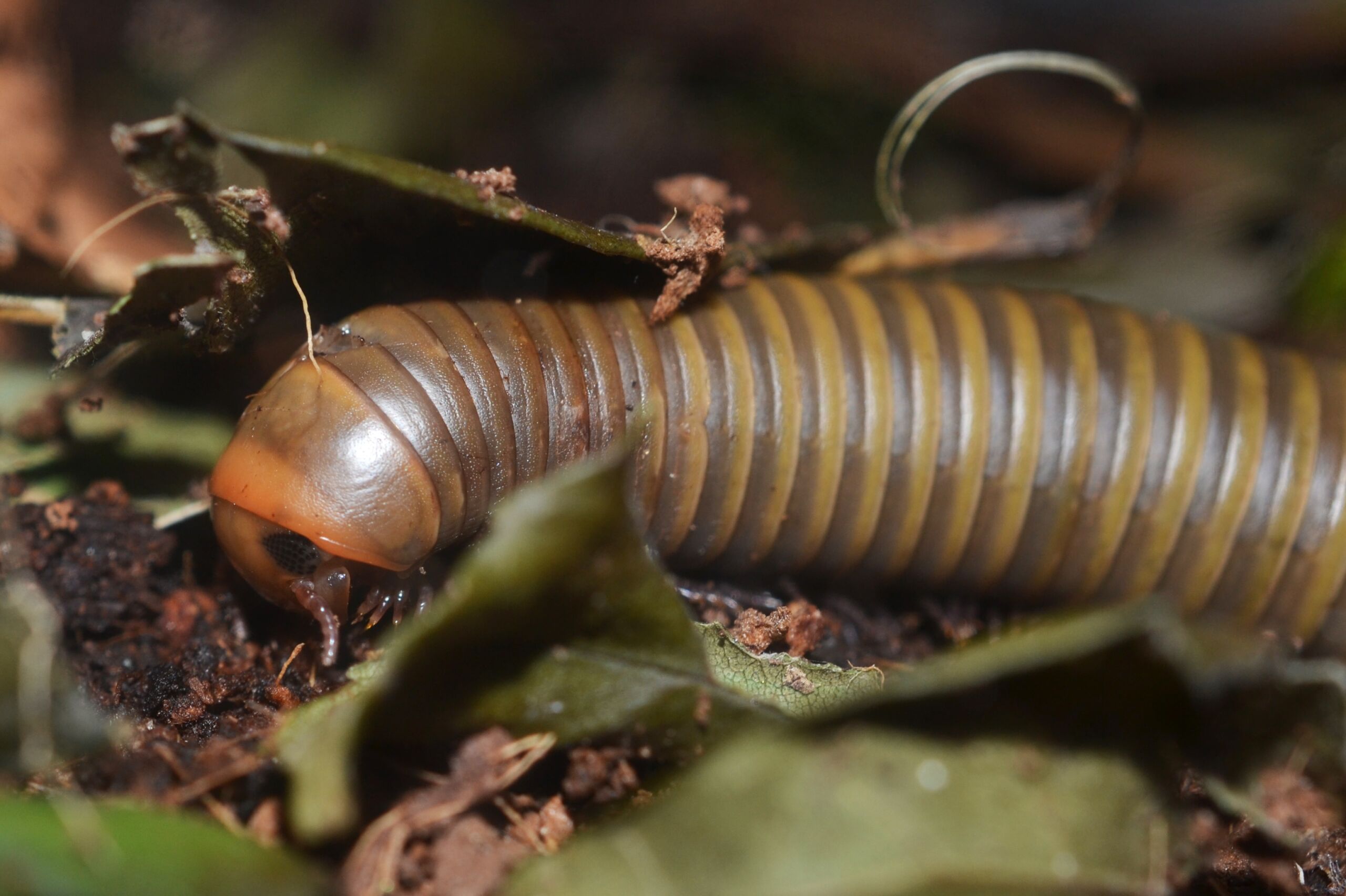
Start with the size, because the size is the first thing anyone notices. An adult smokey oak millipede is 60 to 120 millimeters long — about 2.4 to 4.7 inches, roughly the length of your index finger and then some — and up to 13 millimeters wide, about as thick as a pencil (Keeton, 1960). It carries 45 to 65 body segments, each one bearing two pairs of legs, which is the millipede’s defining trick and the fastest way to tell it from a centipede, which carries only one pair per segment.
The color is the field mark that matters most, and it is a strange one: each body ring is a light greenish tan followed by a band of darker tan, so the whole animal reads as sandy beige with smoky brown striping — the color of dry sand with shadows in it. It is lighter than the other species in its genus, and that lightness is diagnostic. The great entomologist Thomas Eisner, who spent years studying this animal’s chemistry, noted that N. gordanus matches the color of sand in some Florida habitats — which is odd, because it is mainly active at night, when camouflage should not matter. A ghost that dresses for a daytime it never sees. Two more details separate it from its cousins if you look closely: its legs are shorter than other Narceus species, and the groove on its head where the antennae rest is deeper (Keeton, 1960). Short legs, deep grooves, sandy rings — that is the smokey oak in one line.
The name game (smokey, smoky, ghost — pick one)
You will see this animal called the smokey oak millipede, the smoky oak millipede, and sometimes the smokey ghost millipede — the “ghost” for its pale, washed-out color, and the “oak” for where it lives. All of those names refer to the same animal, Narceus gordanus (Chamberlin, 1943). The taxonomy, for the nerds in the back: kingdom Animalia, phylum Arthropoda, class Diplopoda (the millipedes), order Spirobolida, family Spirobolidae, genus Narceus. The Spirobolida are the classic round-backed millipedes, and Narceus is their big American genus.
The genus is a taxonomic tangle, and it is worth saying so plainly, because the tangle is the reason this guide has a whole look-alikes section. Narceus holds two species centered on Florida — N. gordanus and the elusive N. woodruffi — plus the N. americanus/annularis complex, a widespread group of large grey millipedes whose members may be one species, two species, or several, depending on which paper you believe (Shelley, McAllister & Medrano, 2006). The complex is recorded across the eastern United States, including Florida, with records running as far south as Key West — so a big grey Narceus in Florida is not automatically a smokey oak, and telling the two apart takes the concrete checks in the look-alikes section below. The species was first described as Spirobolus gordanus by Chamberlin in 1943, and older literature may call it Narceus keysi — same animal, older name, filed under history.
The scrub specialist: a giant built for poor soil
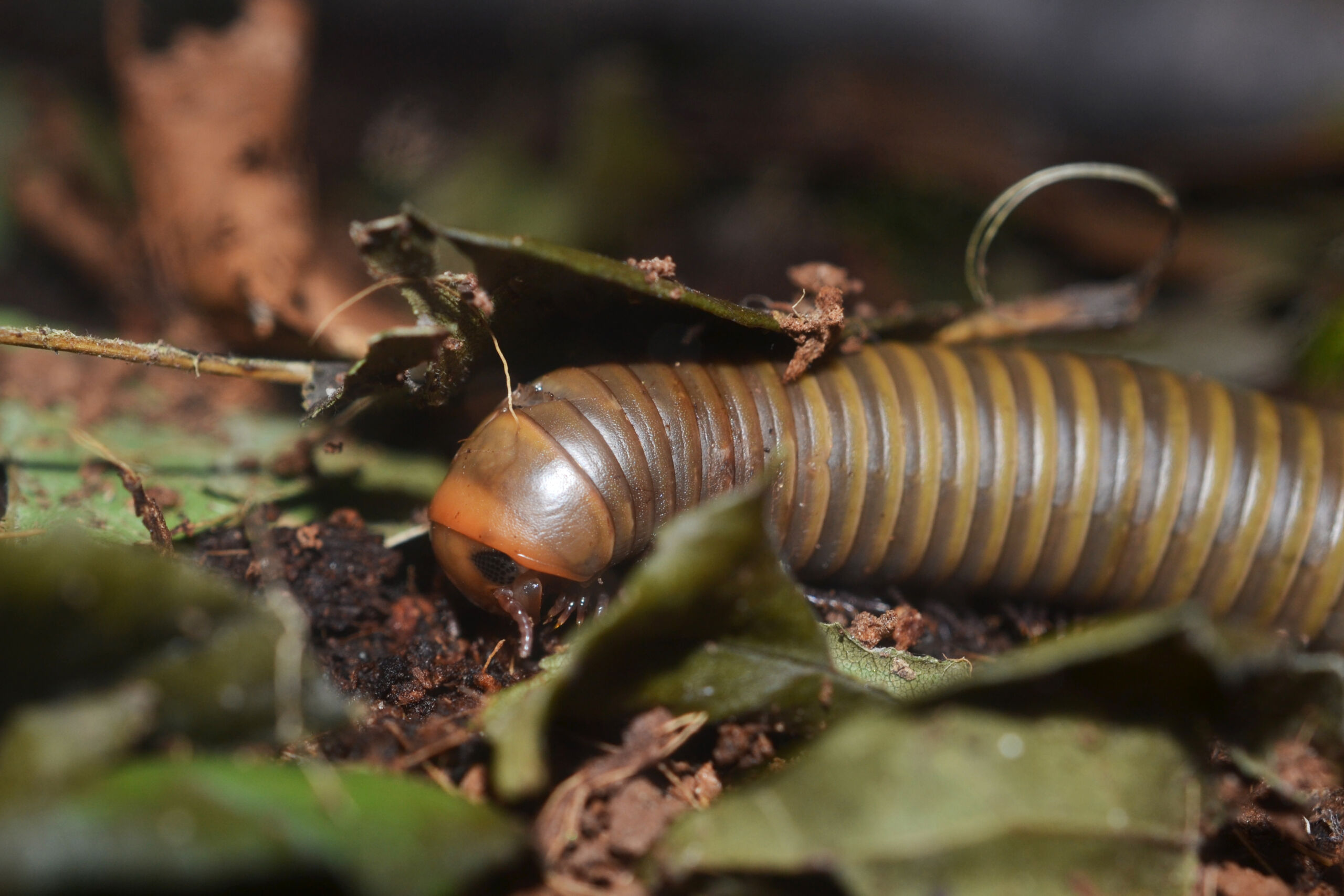
Here is what makes the smokey oak different from every other millipede in this library: it is a scrub animal. It occurs in Florida scrub habitat on peninsular Florida, and its range runs north as far as South Carolina, with possible records in Tennessee (Keeton, 1960). Scrub is Florida’s driest, poorest, strangest habitat — ancient quartz sand dunes left behind by long-gone seas, now covered in sand live oak, scrub oak, and rosemary, on soil so nutrient-poor that most plants cannot grow there at all.
The connection is the leaf litter. Scrub oaks drop tough, leathery leaves that rot slowly, and the smokey oak millipede is one of the few animals big enough and tough enough to process them. In these sandy upland systems, millipedes are major detrital processors: they shred leaf litter, drag organic matter down into the sand, and their droppings feed the microbes that turn dead leaves into the thin, precious layer of fertility the scrub runs on. Without the recyclers, the scrub would drown in its own dead leaves and starve at the same time. The smokey oak is not a visitor to the scrub. It is part of the machinery that keeps the scrub working — a five-inch piece of infrastructure with legs.
Sand-colored in a sand-colored habitat is camouflage, even on moonlit nights when a hungry bird is watching.
The mite passengers
Look closely at a smokey oak millipede — really closely, with a hand lens — and you may find it is not traveling alone. The mite Narceolaelaps gordanus rides on this species, living under the edges of its body segments. A recent study on the Lake Wales Ridge sampled both the smokey oak and its scrub neighbor, the Florida scrub millipede, across 20 sites — and found the same mite on both species, with the smokey oak carrying more mites per individual, and no visible damage to any millipede’s exoskeleton over three months of observation.
The researchers’ conclusion, published as a preprint in 2026 and not yet peer-reviewed, is that the association looks less like parasitism and more like commensalism or phoresy: the mite is hitching a ride, using the millipede as transport between patchily distributed piles of leaf litter in a landscape where the next meal might be a long crawl away. The millipede is a bus, and the mite is a passenger who never pays fare and never damages the seats.
What it eats: the quiet recycling job
At heart, the smokey oak millipede is a detritivore — a creature that eats dead things so the rest of the world does not have to wade through them. Its diet is decaying leaves, rotting wood, and other detritus: fallen oak leaves, the soft punky wood of a log that has been down for a year or two, the damp brown layer at the bottom of the world. In the scrub it works the oak litter that nothing else wants; in a garden it works the same way, shredding dead leaves into smaller pieces so fungi and bacteria can finish the job, its droppings feeding the microbes that turn leaf litter into plant food.
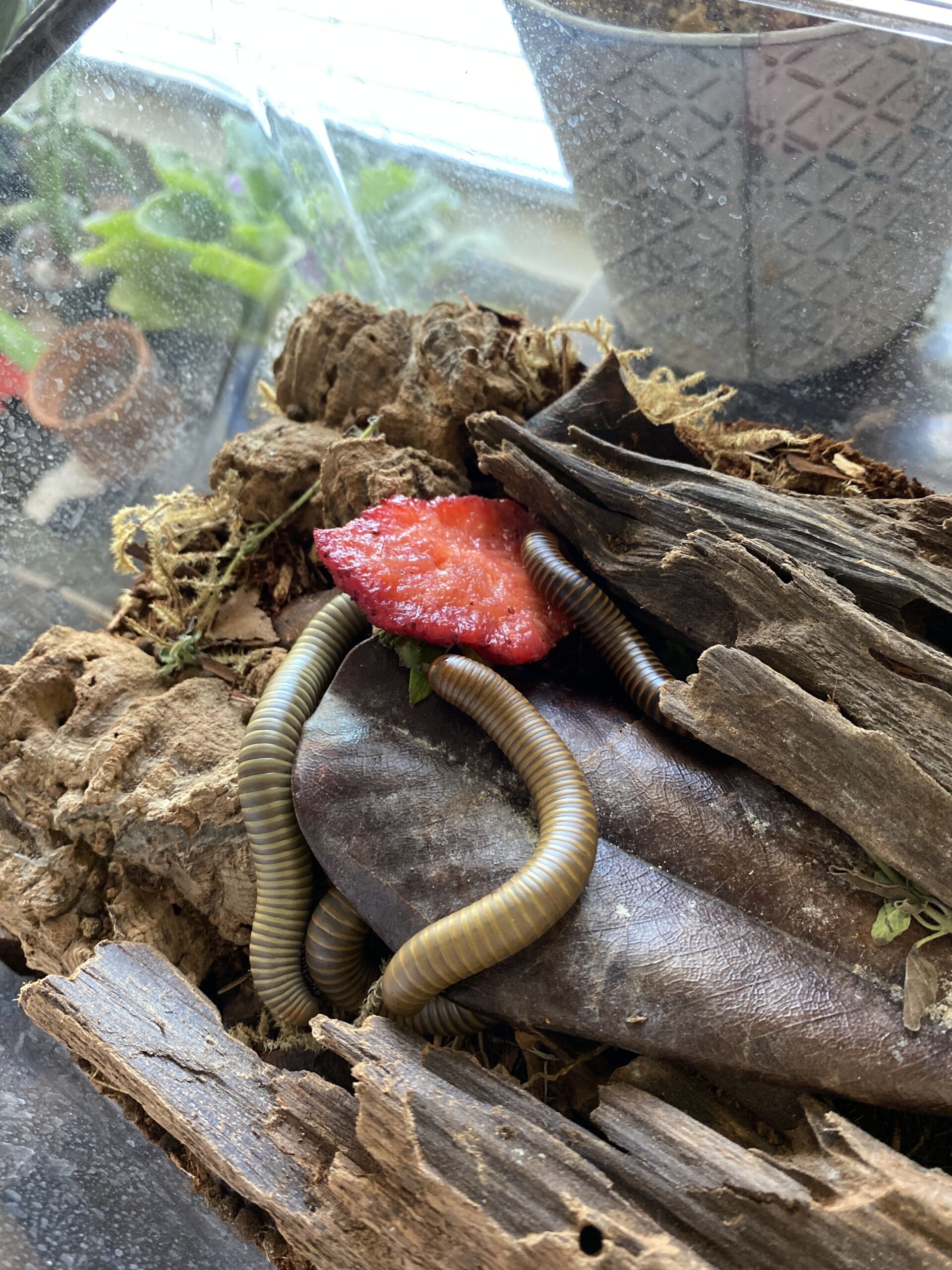
It is not a predator. It does not hunt. It is the cleanup crew, and like most cleanup crews it is invisible until it stops showing up. Every handful of healthy soil is full of animals doing exactly this job, and a garden with smokey oak millipedes has faster litter turnover and richer surface soil than a garden without them, all else being equal. In captivity, keepers find they will also nibble soft fruit and vegetables — the photo below shows a smokey oak and an American giant sharing a strawberry — but in the wild, dead leaves and rotting wood are the meal, and anything fresher is a bonus, not the plan.
What it does not like is just as useful to know. It does not like dry, exposed conditions: like other Narceus, its cuticle lets water through, so it dries out in open air and seeks damp, humid shelter, curling up to close the breathing holes at the bases of its legs when desiccation threatens. It does not like bright, open ground either: it is a creature of damp, dark places, active mostly at night, which is why you find it under logs, under leaf litter, and in the shaded, mulched corners of a garden, and almost never out in the sunny middle of a dry lawn. And it does not eat living plants: a smokey oak millipede has never been documented damaging a crop, a seedling, or a living stem.
The curl and the chemistry
Disturb a smokey oak millipede and it has one famous move: it coils into a tight defensive spiral, head tucked in the center, armored rings facing outward, and plays dead with total commitment. It cannot bite, cannot sting, and cannot run away fast — the curl is the whole defense plan, plus one chemical backup that scientists have studied more carefully in this species than in almost any other millipede on Earth.
Along the sides of its body it carries rows of tiny defensive glands, opening through pores called ozopores, and if you squeeze or crush it, those glands discharge a fluid. For N. gordanus specifically, the chemistry has been pinned down: the secretion is built on benzoquinones, chiefly 2-methyl-1,4-benzoquinone and 2-methyl-3-methoxy-1,4-benzoquinone (Eisner et al., 1978). These are sharp-smelling compounds that stain skin and fabric and taste terrible to anything that tries to eat it. The stain can linger on skin for days, because benzoquinones bind to keratin — the brownish discoloration is sometimes called “millipede burn,” though it is a stain, not a burn.
Eisner’s team discovered something elegant about how the defense works in this very species: a poke in one spot first triggers secretion from the glands in that spot alone, and the response then spreads along the body as the disturbance continues — a local alarm that becomes a general one. In his classic experiments, birds, ants, spiders, and mice all rejected millipedes after contact with the secretion, and frogs that seized one spat it out. The fluid smells bad — sharp, chemical, and memorable. It is extremely irritating if rubbed into the eyes. It is not venom — there is no bite, no injection, nothing that gets it into your bloodstream — and the amount one millipede produces is far too small to be dangerous to a person. Wash your hands after handling one, keep it away from your eyes, and admire it with your eyes rather than your fingers. The millipede would prefer that too.
Life cycle: born small, earning segments
Like all millipedes, the smokey oak millipede grows by molting: it sheds its exoskeleton, adds new segments and new pairs of legs, and hardens up again, bigger than before. It hatches from an egg laid in soil or leaf litter with only a few segments and a handful of legs, and earns the rest over successive molts, reaching its full 45 to 65 segments as an adult. The details — exactly how long it lives in the wild, how many eggs a female lays, how many years it takes to reach full size — are thinly studied for N. gordanus specifically, and this guide will not invent them. Researchers sampling the Lake Wales Ridge worked through May to August, the breeding season, when adults are most active.
What is certain is the rhythm: damp seasons bring activity and breeding, dry spells send it deep into the soil and leaf litter to wait, and in Florida the same rhythm follows rain at any time of year. If your garden suddenly has a smokey oak millipede, it rained recently, or the leaf litter is deep and damp.
The Florida angle: the native giant most gardeners never meet
Here is the honest Florida story, and it is different from the patio-swarm stories of the other millipedes in this library. The smokey oak millipede is a native, not an invader — it belongs here, in the scrub, in a way the Portuguese and rusty millipedes never will. But most Florida gardeners will never meet it, because most Florida gardens are not scrub. It lives in peninsular Florida scrub habitat, in sandy uplands and oak litter, and it is most at home on the Lake Wales Ridge, the ancient dune spine down the middle of the peninsula where the scrub is oldest and the endemics are thickest. A suburban lawn in Jacksonville or Miami is not its world. A garden that backs onto scrub, a yard with mature oaks and deep leaf litter in central Florida, a property near a scrub preserve — that is where it shows up.
That scarcity is the point: the smokey oak is a specialist in a habitat that has shrunk. Florida scrub has been cleared for citrus, for housing, for roads, for just about everything, and every acre of scrub lost is an acre of smokey oak habitat lost with it. Finding one in your garden is not a problem to solve. It is a sign that a piece of old Florida is still functioning under your oak trees. If you do, you are lucky — leave the leaf litter alone.
Is it a pest?
Plainly: no. The smokey oak millipede is not a pest. It does not bite, sting, or spread disease. It does not eat your house, your clothes, or your stored food. It does not damage structures, and it does not eat living plants — no crop damage, no seedling nibbling, no fallen-fruit raiding has ever been documented for this species. What it does is show up occasionally, usually one at a time, and stain things if crushed.
Against that, weigh the day job: it shreds oak leaf litter, speeds up decomposition in some of the poorest soil in Florida, and returns nutrients to the ground A smokey oak millipede in the garden is a sign of healthy, organic-rich, undisturbed leaf litter. The goal is not to get rid of it. The goal is to keep it — and to keep the leaf litter it needs.
Effects on the garden
On the plus side, the smokey oak millipede is a genuine soil helper, and in scrub and sandy soils its help matters more than it would in rich loam. It eats dead oak leaves and rotting wood, breaks them into smaller pieces, and its droppings feed the microbes that finish the job — fungi and bacteria that turn leaf litter into plant food. In sandy soil, where organic matter is scarce and washes away fast, that processing is the difference between a living soil and dead sand.
On the minus side, there is very little to list, and honesty demands saying so. It does not eat living plants, so there is no seedling damage to warn about. The only genuine nuisance is the one shared by all large millipedes: an individual that wanders indoors after heavy rain will die in a dry house within a few days, and a crushed one stains floors and patios with its defensive fluid.
Effects on other garden animals
The smokey oak millipede sits in the middle of the garden food web, and it pulls in both directions. As a detritivore it eats only dead plant matter — it does not hunt other animals, does not eat living insects, and does not compete with predators for prey. Its competition is with the other recyclers: earthworms, woodlice, and springtails all eat the same dead leaves, and in a rich leaf-litter bed there is usually enough dead matter for all of them. It helps the soil microbes by shredding litter into bite-size pieces, and its droppings are food for fungi and bacteria, which in turn feed the whole underground web.
As prey, it is a defended meal. Its curl-and-chemical defense puts off most predators: in Eisner’s classic experiments, birds, ants, spiders, and mice all rejected millipedes after contact with the benzoquinone secretion, and frogs spat them out after seizing them. Some animals eat millipedes anyway — toads, lizards, and ground beetles all take them, and some ant species specialize in overpowering them. For pets, the risk is small but real: a dog or cat that crunches a smokey oak millipede will get a mouthful of foul-tasting fluid and may drool, paw at its mouth, or vomit, then learn not to do it again. It is unpleasant, not an emergency — but keep an eye on any pet that eats a lot of them, and call a vet if the drooling does not stop.
Look-alikes: the concrete checks
Large millipedes all look alike until you know what to check, and the checks are wonderfully simple — color, size, texture, shape, speed, and a leg count. Work through them in order and you will rarely go wrong. The hard one in this guide is the first cousin, so start there.
American Giant Millipede (Narceus americanus / N. annularis complex) — the near-twin, and the hardest check in this library. The complex is recorded across the eastern United States including Florida, with records as far south as Key West (Shelley et al., 2006), so a big grey Narceus in Florida is not automatically a smokey oak. Check the color first: the complex is typically slate grey to dark grey, often with pink to red bands, legs, and antennae, while the smokey oak is sandy tan — light greenish-tan rings with darker tan bands, paler overall than any other Narceus. Check the legs: the smokey oak’s legs are shorter than other Narceus species. Check the head: the smokey oak has a deeper groove where the antennae rest. In adult males, the complex often shows an enlarged seventh body segment, about one and a half times the size of the others, which the smokey oak lacks. And check the habitat: the smokey oak is a scrub and sandy-upland animal, while the complex is a generalist of forests, leaf litter, and rotting logs. No single check is certain — the complex is variable — and a definitive identification sometimes needs an expert. If you are unsure, “big Narceus” is an honest answer. Read the full guide: American Giant Millipede.
Florida Ivory Millipede (Chicobolus spinigerus) — the black-and-white native. The Florida ivory is another large native, and it is the one most Florida gardeners actually meet — but it is dark on top and pale ivory underneath, a black-and-white animal, where the smokey oak is sandy tan all over. Check: dark top, pale underside means ivory; sandy tan all over means smokey oak. The ivory is also a generalist of gardens and leaf litter across Florida, not a scrub specialist. Read the full guide: Florida Ivory Millipede.
Florida Scrub Millipede (Floridobolus penneri) — the scrub roommate. This one shares the smokey oak’s exact habitat: the two are sympatric on the Lake Wales Ridge, living in the same sandy scrub and carrying the same mite passengers. It is a Florida endemic, found nowhere else on Earth, and it is a scrub specialist through and through. Check: on the Lake Wales Ridge, a large millipede in scrub could be either species — the smokey oak is the sandy-tan one, and separating the two with certainty takes an expert. Read the full guide: Florida Scrub Millipede.
Bumblebee Millipede (Anadenobolus monilicornis) — the yellow-banded one. The bumblebee is one of the most common millipedes in Florida, but it is a much smaller, banded animal — yellow and olive bands ringing a dark body, like a bumblebee in millipede form — where the smokey oak is a large, unbanded, sandy-tan cylinder. Check: yellow bands and a much smaller body means bumblebee; sandy tan and five inches means smokey oak. Read the full guide: Bumblebee Millipede.
Portuguese Millipede (Ommatoiulus moreleti) — the black cousin. If it is black, it is not a smokey oak. The Portuguese millipede is slate-grey to black, smooth and cylindrical, but darker, slightly smaller at up to about 1.8 inches, and famous for swarming Florida patios after rain. Check: black and smooth and small means Portuguese; sandy tan and huge means smokey oak. Read the full guide: Portuguese Millipede.
Rusty Millipede (Trigoniulus corallinus) — the red one. The rusty millipede is reddish-brown to brick red, 2 to 3 inches long, smooth and cylindrical — and it is one of the most common millipedes on Florida patios, showing up in numbers after rain. Check: rusty red and two inches means rusty; sandy tan and up to five inches means smokey oak. Size alone settles most cases: a full-grown smokey oak is twice the length of a rusty millipede. Read the full guide: Rusty Millipede.
Greenhouse Millipede (Oxidus gracilis) — the small, bumpy one. At under an inch long it is a fraction of an adult smokey oak’s size, and its body is dark brown to black on top with pale, creamy-white legs — the pale legs are the giveaway. The second giveaway is texture: where the smokey oak is smooth, the greenhouse millipede is visibly bumpy and ridged along its back, and slightly flattened rather than round. Check: under an inch, pale legs, bumpy back. Read the full guide: Greenhouse Millipede.
Flat-backed millipedes (including Asiomorpha coarctata and Apheloria virginiensis) — the ones that look like centipedes. Flat-backed millipedes belong to the order Polydesmida, and they are flattened top-to-bottom with wide lateral keels on each segment called paranota — little flanges that make the animal look wide and flat instead of round. Adults usually have around 20 segments, and many are brown or black, sometimes with bright yellow, orange, or red markings. Check: flat, not round; flared edges on every segment; often brightly marked; and far smaller than a smokey oak. Read the full guides: Cyanide Millipede and Black-and-Yellow Flat Millipede.
Centipedes — the one that actually matters, because this is the split with consequences. Centipedes have one pair of legs per segment, not two, and they move fast — darting, flickering, gone under the baseboard before you have finished the sentence. Millipedes move slowly, in a steady wave, and curl up when disturbed; centipedes run. Centipedes are also flattened, with long legs that stick out sideways and a pair of venomous front fangs, and they can bite. Millipedes have short legs tucked under a round body and no bite at all. Check: count the legs per segment (one pair means centipede, two pairs means millipede), then watch the speed (fast means centipede, slow means millipede), then watch what it does when poked (runs means centipede, curls means millipede). Read the full guide: Garden Centipedes.
How to attract them
This is a helper, not a pest, so the question is not how to get rid of it — it is how to keep it. The smokey oak millipede needs exactly three things, and all three are things a good garden already has:
Leave the leaf litter. Deep oak leaf litter is its home, its food, and its shelter all at once. Rake the leaves off the paths and the lawn if you must, but leave a thick layer under the oaks and in the back corners of the garden, and let it rot in place. A garden that is raked bare every week is a garden with no millipedes in it.
Leave the logs. A rotting oak log, a fallen branch left to punk down, a pile of hardwood offcuts in a shady corner — these are smokey oak restaurants. The softer and older the wood, the better. If the log is too soft to sit on, it is just right for a millipede.
Keep it damp and dark. Millipedes breathe through their skin and dry out fast in open air, so the shady, mulched, watered corners are where they live. Mulch your beds, water the soil rather than the leaves, and keep a few undisturbed corners where nobody digs, nobody sprays, and nobody tidies. Dry, bright, and exposed is the opposite of everything they want
Do not spray. Insecticides do not distinguish between a pest and a recycler, and a sprayed leaf pile is a dead leaf pile. UF/IFAS recommends no chemical treatment for millipedes outdoors, and for this species there is no reason to treat at all.
If one wanders indoors, sweep it out. Heavy rain can push a smokey oak toward the house the same way it pushes every millipede toward high, dry ground. It cannot breed indoors and will die within a few days in a dry house. A soft broom and a dustpan, tipped outside into the leaf litter away from the house, is the whole fix — do not crush it on the floor if you can avoid it, because the stain is the point of the defense, and it works on tile too. Then seal the gaps it came through: door sweeps, weatherstripping, and caulk around windows and pipes, looking low, at ground level, where the wall meets the patio.
Frequently asked questions
Is the smokey oak millipede dangerous?
No. It does not bite, sting, or spread disease, and the amount of defensive fluid one millipede produces is far too small to harm a person. It can stain skin and irritate eyes, so wash your hands after handling one and keep it away from your face.
Does it bite?
No. Millipedes have no venom, no fangs, and no bite at all. Their defenses are curling up and a bad-tasting benzoquinone fluid. If it has fangs and it bit you, it was a centipede.
How big does it get?
Adults are 60 to 120 millimeters long — about 2.4 to 4.7 inches — and up to 13 millimeters wide, with 45 to 65 body segments (Keeton, 1960).
Why is it called the smokey oak millipede?
Smokey for its pale, smoky, sandy-tan coloration, and oak for its habitat: it lives in oak leaf litter in Florida scrub and southeastern forests. It is also called the smokey ghost millipede, for the same pale, washed-out color.
Is it a worm?
No, and the legs give it away. It is an arthropod — a relative of lobsters, crabs, and insects — with a hard segmented exoskeleton and hundreds of legs. Worms have no legs at all. If it has legs, it is not a worm, no matter how wormlike it looks.
What does it eat?
Dead plant matter: decaying oak leaves, rotting wood, and other detritus. It does not eat living plants, and no crop or seedling damage has ever been documented for this species. In captivity it will also nibble soft fruit and vegetables, but dead leaves are the real diet.
Will it hurt my plants?
No. It eats only dead plant matter, and its shredding and droppings feed the soil microbes that turn leaf litter into plant food. In sandy soils its work matters even more, because organic matter is scarce there. A smokey oak millipede in a bed is a helper, not a threat.
Will it hurt my dog or cat?
A pet that crunches one will get a mouthful of foul-tasting benzoquinone fluid and may drool, paw at its mouth, or vomit once, then learn not to do it again. It is unpleasant, not an emergency — but call a vet if the drooling does not stop or the pet eats a lot of them.
How do I tell it from the American giant millipede?
Color first: the smokey oak is sandy tan with greenish-tan rings and darker tan bands, paler than any other Narceus; the American giant complex is typically slate grey, often with pink to red bands, legs, and antennae. Then the legs (shorter in the smokey oak), the head groove (deeper in the smokey oak), and the habitat (scrub and sandy uplands for the smokey oak). Adult males of the complex often have an enlarged seventh segment, which the smokey oak lacks. If you are still unsure, “big Narceus” is an honest answer — a definitive identification sometimes needs an expert.
Why is it in my garden — and should I keep it?
Because your garden has what it needs: deep oak leaf litter, rotting wood, damp shade, and undisturbed ground — and probably because you are near scrub or mature oaks. Yes, keep it. It is a native specialist in a shrinking habitat, it eats only dead leaves, and its work feeds your soil. Leave the leaf litter, leave the logs, and let it get on with the job.
🌱 Keep learning
Three related guides worth reading next:
- Portuguese Millipede — The little black millipede that stopped trains: rain swarms, a staining chemical defense, and the curl that gives it away — Florida patio edition.
- Compost Accelerators — Twelve things that actually wake up a lazy pile, and the microbes behind all of it, Florida edition.
- Soil Food Web Explorer — Meet the whole underground crew, from bacteria to beetles, and see where the millipedes fit in the chain.
🪱 Your Soil Needs This
Reading about healthy soil is great. Growing in it is better. Our small-batch, traceable worm castings are the shortcut your garden deserves.
Shop Worm Castings Subscribe & SaveEvery bag comes with a lot certificate. Know what's in your soil.