
🌿 Wavyleaf Aster
What it looks like
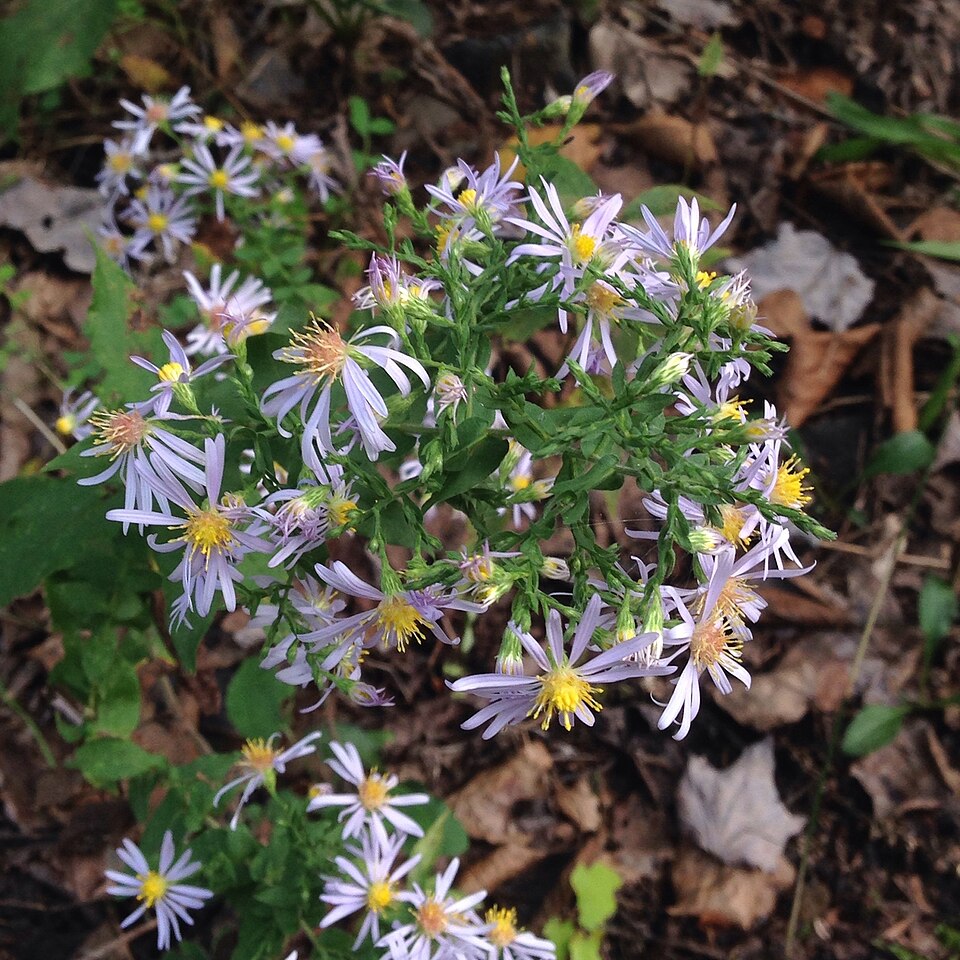
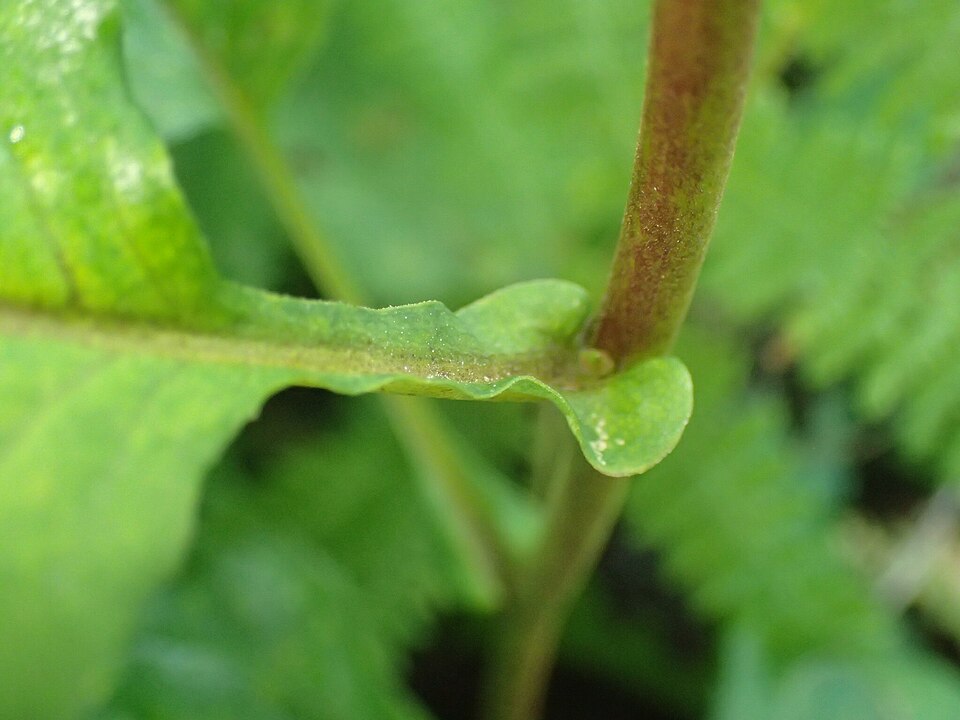
Wavyleaf aster is an aster you identify with your eyes on the leaves, not the flowers. The plant is a perennial, one to five feet tall, with one to three erect, rather brittle stems that are hairy toward the top. The basal leaves are heart-shaped or rounded, on purplish, narrowly winged stalks. But the stem leaves are the giveaway, and Flora of North America describes them with the kind of precision that only exists because the difference matters: they are winged-petiolate, the wings wider toward the base, the leaves nearly stalkless, and the wings widening abruptly at strongly auriculate-clasping petiolar bases. In plain English: the leaf stalk has green wings, the wings flare out suddenly at the bottom, and the flared wings wrap the stem like little ears. If you can see that flare, you have wavyleaf aster. If the wings do not flare, you have something else — and that something else is usually white arrowleaf aster, below.
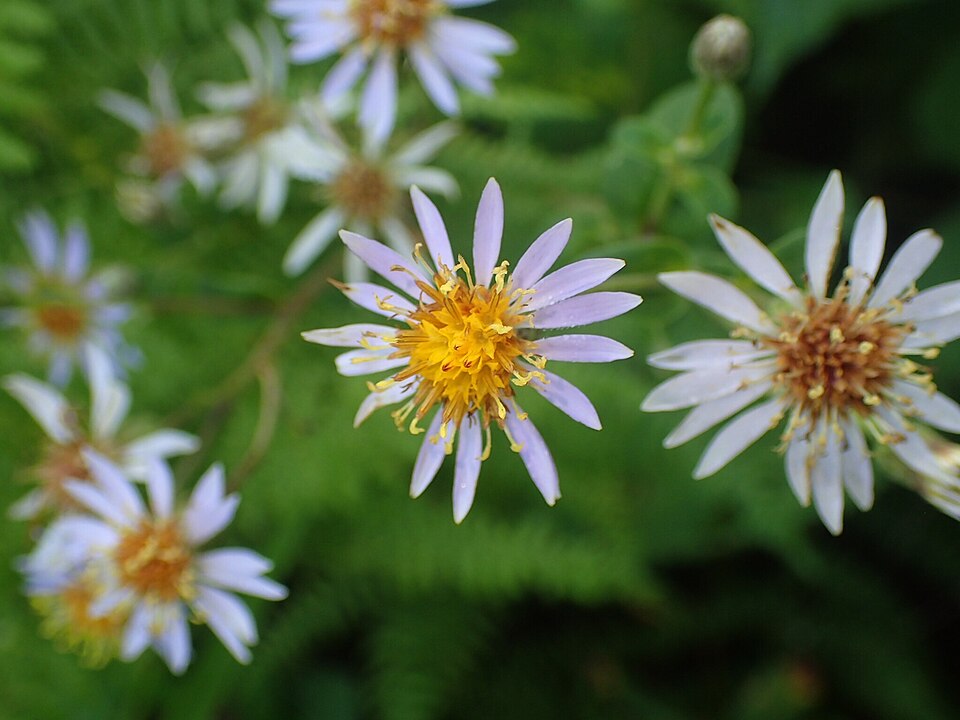
The flowers are the reward for getting the leaves right. Each head carries 12 to 16 (sometimes up to 25) rays, usually blue to purple and sometimes lilac, around 15 to 22 disk florets that open cream or light yellow and age purple. The heads sit in open, spreading, rather leafy arrays, and the plant blooms from August to October. The leaf edges are wavy — shallowly toothed, rippled, never flat — which is where the common name comes from, though the wavy margin is the least reliable field mark on the plant. Trust the clasping wings, not the wave.
The leaves themselves are thin and rough to the touch, scabrous on top and hairy underneath, especially along the midvein. The lower stem leaves wither by flowering time, the upper ones shrink as they climb, and the branch leaves can be so small they look like a different plant. It is, as the floras warn, an extremely variable species across its range — but the winged, abruptly flaring, ear-clasping leaf stalk holds steady through all of it, which is why the keys lean on it so hard.
How to grow
The honest answer: admire it where it grows, and think twice before moving it. Wavyleaf aster is a plant of dry or well-drained, loamy or rocky soils — open deciduous woods, woodland borders and clearings, dry hammocks, sandhills, and open-wooded bluffs. In Florida that means the dry upland woods and sandhills where the soil drains fast and the canopy lets the light through. It is not a plant of wet ground, rich beds, or irrigated borders, and a wet, rich, heavily watered garden is the opposite of its home.
It is also not a plant you will find at a nursery. No Florida nursery availability was verified for this species, and it is uncommon enough in the state that most Florida gardeners will meet it on a trail rather than in a pot. If you are lucky enough to have it on your land, the best care is benign neglect: keep the canopy open, keep the leaf litter, do not irrigate it, do not fertilize it, and do not mow it in late summer when it is setting up to bloom. A dry-woods aster wants to be left alone in a dry wood, and it will repay that neglect with blue flowers in October.
If you garden on dry, sandy, well-drained ground and want the same late-season blue, the practical move is a Florida-native aster that is actually in the trade and built for your site — not a wild wavyleaf dug out of a hammock. Wild plants stay wild; garden plants come from nurseries. That rule protects both.
Water & feeding
Water: little, and only until established if you ever plant a nursery-grown one. This is a dry-soil plant — dry or well-drained loamy or rocky ground, in woods and sandhills that drain fast after rain. Overwatering, especially in heavy soil that stays wet, is the fastest way to kill it; wet feet rot the crown, while dry feet merely make it tougher. In a rainy climate, the only honest site for it is a slope or a raised bed with gritty, fast-draining soil.
Feeding: essentially none. It grows in lean, dry, rocky or sandy soils, and rich soil plus fertilizer mostly produces floppy stems that fall over in the first autumn rain. If your soil is decent garden loam, that is already more than it asks for. A thin mulch of leaves in winter is plenty, and the soil science here is the dry-woods bargain: the plant spends the whole summer building a rough, wiry scaffold on almost nothing, then spends it all at once on blue flowers in October, because in a dry wood the pollinators that matter in fall are generalists, and a spray of small flowers beats one big one when your customers are small, cold, and in a hurry.
Common problems
- Confusing it with late purple aster. Flora of North America warns that wavyleaf aster is sometimes confused with members of the late purple aster (S. patens) complex, because both have auriculate-clasping, somewhat fiddle-shaped stem leaves. The split: late purple aster has leaf bases that broaden just before a constriction and are strongly cordate-clasping, with larger involucres (5.5–12 mm) and longer rays (14–24 mm); wavyleaf aster has the winged petiole that flares abruptly at the clasping base, and smaller involucres (3.8–5.5 mm).
- Confusing it with white arrowleaf aster. White arrowleaf aster (S. urophyllum) is also winged-petiolate with clasping bases — but its wings do not widen abruptly at the base, and its rays are white to pale pink, not blue to purple. Flared wings plus blue-purple rays: wavyleaf. Narrow wings plus white rays: white arrowleaf.
- Confusing it with Short’s aster. Short’s aster (S. shortii), a Panhandle-only Florida species, has deeply cordate basal leaves and sits in the same clasping-leaf branch of the key. Check the basal leaves and the range before you decide.
- Planting it wet. The most common garden failure is not identification — it is irrigation. A dry-hammock aster in a wet, rich, irrigated bed will rot or flop, and no amount of goodwill fixes a wrong site.
- Assuming every wavy leaf is wavyleaf. The wavy margin is variable and shared with other asters. The diagnostic character is the winged petiole flaring at the auriculate-clasping base — look at the leaf stalk, not the leaf edge.
Harvest
There is no crop here, and the harvest is the bloom season itself: a spray of blue-purple flowers in a dry wood in October, when most of the woods has already gone quiet. Cut stems only from garden-grown plants, if you ever have one — the tiny flowers hold in water and make a loose, airy filler — and leave wild plants standing for seed and shelter. The seeds feed birds through winter, the standing stems shelter insects, and the rootstock comes back every spring without asking. The simplest harvest is an October walk in a dry hammock with no agenda: blue flowers, bees working them in the slanting light, and the knowledge that the garden’s last act is also one of its best.
Saving seeds
Do not collect seed from wild populations — this is an uncommon Florida wildflower of dry woods and sandhills, and its seed belongs where it falls. The general aster rules, for any nursery-grown material, are the same as for other asters: wait until the heads turn brown and fluffy and the seeds separate easily when brushed, cut them into a paper bag on a calm day, dry them thoroughly before any sealed container, and sow in fall so winter settles the dormancy question. No species-specific germination protocol was verified for wavyleaf aster, so fall sowing outdoors — pressing the seed lightly into the soil and letting the season do the work — is the honest recommendation. In Florida, dry seed thoroughly before airtight storage and add a desiccant, because Florida humidity will quietly spoil a paper envelope of aster seed long before spring.
Species
Wavyleaf aster (Symphyotrichum undulatum (L.) G.L. Nesom; basionym Aster undulatus Linnaeus 1753; also called wavy-leaved aster) is the species this guide covers. No varieties are recognized — the species is variable across its range, and some specimens annotated as hybrids with S. drummondii or S. oolentangiense are now thought to represent phenotypic variation within S. undulatum itself. Late purple aster (S. patens), white arrowleaf aster (S. urophyllum), and Short’s aster (S. shortii) are different species and none is covered here. No named garden varieties of the wild species were verified, and none is claimed here. This guide covers Symphyotrichum undulatum only. Vouchered Florida distribution and status: Atlas of Florida Plants species page; full technical treatment: Flora of North America.
Frequently asked questions
What makes the leaves wavy?
The leaf margins are shallowly toothed and rippled rather than flat — that is the “wavy” in wavyleaf. But the wavy edge is the least reliable field mark on the plant. The diagnostic character is the leaf stalk: a winged petiole that widens abruptly at a strongly auriculate-clasping base, wrapping the stem like little ears.
How do I tell wavyleaf aster from late purple aster?
Look at the leaf base and measure the head. Wavyleaf aster has a winged petiole that flares abruptly where it clasps the stem, and small involucres (3.8–5.5 mm). Late purple aster (S. patens) has leaf bases that broaden just before a constriction and are strongly cordate-clasping, with larger involucres (5.5–12 mm) and longer rays (14–24 mm). Flora of North America warns the two are commonly confused.
Are the flowers blue or purple?
Usually blue to purple, sometimes lilac. The disk florets open cream or light yellow and age purple, so a head can show yellow, purple, and blue all at once. White-rayed plants are not typical for this species — if the rays are white, check white arrowleaf aster instead.
Can I grow wavyleaf aster in my garden?
Honestly, probably not — and you should not dig one up. It wants dry, well-drained, loamy or rocky soil in open woods, dry hammocks, or sandhills, it is not verified as available from Florida nurseries, and it is uncommon in the state. If you have it on your land, leave it alone and let it bloom. If you want late blue flowers in a dry yard, plant a Florida-native aster that is actually in the trade.
Is wavyleaf aster rare in Florida?
It is recorded in Florida but uncommon, and it is a species of conservation concern in Illinois and Nova Scotia. In Florida it is a dry-woods plant of hammocks and sandhills — present, but not something you will trip over. Treat any population you find as a treasure, not a transplant.
Does it hybridize with other asters?
Hybridization with S. drummondii and S. oolentangiense has been reported, but Flora of North America notes that some specimens so annotated represent phenotypic variation of S. undulatum itself — the species is extremely variable, and not every odd plant is a hybrid.
What soil does it want?
Dry or well-drained, loamy or rocky soil — the soils of open woods, borders, clearings, dry hammocks, and sandhills. It will not tolerate wet feet or rich, heavily irrigated beds. Drainage matters more than fertility.
When does it bloom in Florida?
August to October, per Flora of North America — a fall bloomer, right when the dry woods are otherwise going quiet and the pollinators are fueling up for the lean season.
Will it spread in my yard?
It is cespitose — clump-forming — with short rhizomes or branched woody rootstocks, not a runner. It will not take over a bed. The bigger risk is the opposite: planted in the wrong (wet, rich) site, it will simply decline.
🌱 Keep learning
Three related guides worth reading next:
- Aster: Growing Guide — The genus guide: asters as a group, how the old genus Aster became Symphyotrichum, and where this dry-woods species fits.
- Georgia Aster (Symphyotrichum georgianum) — Another clasping-leaf aster from the same branch of the key — a big, showy purple fall flower of dry woods.
- Calico Aster (Symphyotrichum lateriflorum) — A small white-to-pink aster of open woods and edges — the other end of the fall-aster spectrum from wavyleaf’s blue.