
🌿 Fern
What it looks like

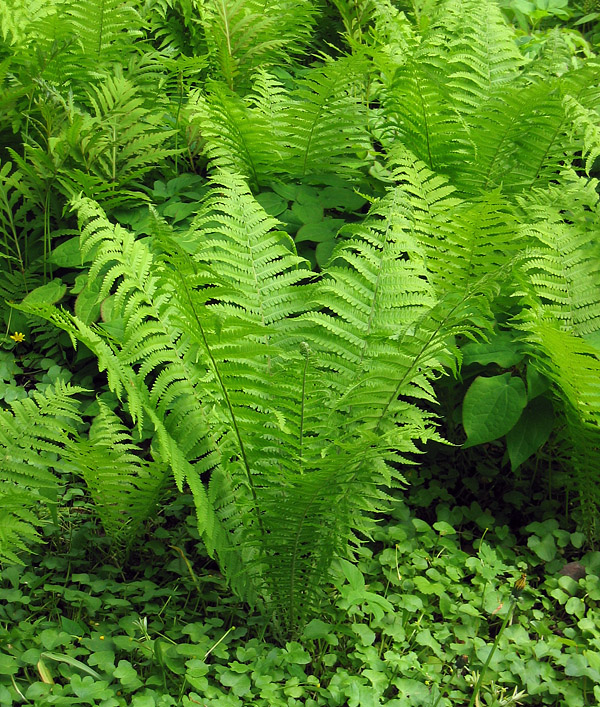

How to grow
Plant in spring in rich, moisture-holding, humus-rich soil in shade — ferns are the backbone of the shade garden, and there is a fern for nearly every shady situation. Ostrich fern (Matteuccia) gives tall, vase-shaped fronds for moist shade; cinnamon fern (Osmunda) tolerates wet soil and sun with moisture; autumn fern (Dryopteris erythrosora) adds copper new growth and tolerates drier shade; Christmas fern (Polystichum) is evergreen. Match the fern to your moisture: most want consistent moisture, but few tolerate standing water or bone-dry shade.
Water & feeding
Water consistently, especially the first year — most garden ferns are moisture-lovers and crisp in drought. Mulch with leaf mold or compost to hold moisture and mimic the forest floor.
Common problems
- Drought stress and frond scorch — the main complaint, and a siting problem
- Slugs on young fiddleheads in wet springs
- Few diseases; crown rot in waterlogged soil
Harvest
Cut back deciduous ferns in late winter before fiddleheads emerge; leave evergreen types alone except to remove tattered fronds in spring. Divide large clumps in spring every few years if desired.
Browse all plant & pest guides
Propagation
First, the fact that makes this section different from every seed-saving section on this site: ferns do not make seeds at all. No flowers, no pods, no seed packet to save. What looks like a seed strategy is something older and stranger — ferns reproduce by spores, microscopic dust-like particles produced in tiny capsules called sporangia, clustered in dots called sori on the undersides of fertile fronds. That is a lineage that predates flowering plants by hundreds of millions of years, and it runs on a two-act life cycle that still feels like science fiction: a spore germinates into a tiny, heart-shaped, free-living plant called a prothallus (the gametophyte), which makes eggs and swimming sperm — swimming, because this is a plant that still needs a film of water for fertilisation, a souvenir of its aquatic ancestry — and only then does the familiar leafy fern (the sporophyte) grow. This section is written at a general level, because this is a generic fern guide, and spore timing, sori colour, and patience required all vary by species.
Division is the honest shortcut, and for most gardeners it is the method to use. In spring, as new fiddleheads appear, lift a mature clump and cut or tease the rhizome apart so each division carries both roots and fronds, then replant each piece at the same depth it was growing, in moist, humus-rich soil, and water it in well. Divisions are clones — genetically identical to the parent — so a division of a named fern stays that named fern, which spore-grown plants cannot promise. Keep divisions shaded and consistently moist until they establish, and do not divide a struggling plant into confetti: a few strong pieces beat a dozen weak ones.
Spores are the slow, marvellous, many-plants method. Cut a fertile frond once the sori have darkened — brown or black in most species, gold or green in some — lay it sporangia-side down on white paper, cover it with another sheet, and leave it a day or two until a fine dust of spores has fallen. Sow that dust thinly on the surface of sterile, moist mix in a covered tray or jar — do not bury it, because spores need light — and keep the container covered, warm, and bright but out of direct sun, with the mix consistently moist, never soggy. Sterility matters here in a way it does not for beans: a dirty tray grows mould faster than it grows prothalli. Germination into prothalli takes weeks, and the step from prothallus to baby fern, which needs that film of water for sperm to swim, takes longer still — months, not days, and sometimes the better part of a year before you have a plant worth potting on. Store spores you are not sowing at once in a paper envelope, cool and dark, and sow the freshest first, because no reliable multi-year storage figure applies across all garden ferns. If that timeline sounds like a hobby in itself, it is — and that is the point. Division gives you next spring’s fern; spores give you a windowsill full of tiny green hearts and a story about how plants reproduced before flowers were invented.