
In a moist forest west of the Cascades, under a log that has been down for a decade, there is a millipede the size of a finger, greyish-brown, cylindrical, and unhurried — the only spirobolid in the whole Pacific Northwest, and the northernmost member of its genus. The black round millipede, Tylobolus uncigerus, ranges from just north of the Columbia River in Washington south through Oregon and into northern California, and it is the millipede a hiker in a west-coast forest is most likely to meet: large, slow, armored, and entirely harmless, eating rotting leaves in the damp dark and curling into a spiral when disturbed. This guide is about the gentle giant of the western woods, and about the groove in its forehead that gives it away.
And if you are reading this because you just found a large grey-brown cylindrical millipede under a log in western Oregon or Washington — stay with us. It is not dangerous, it is not a pest, it is not going to eat your garden, and everything in the “what to do” section works for yours too.
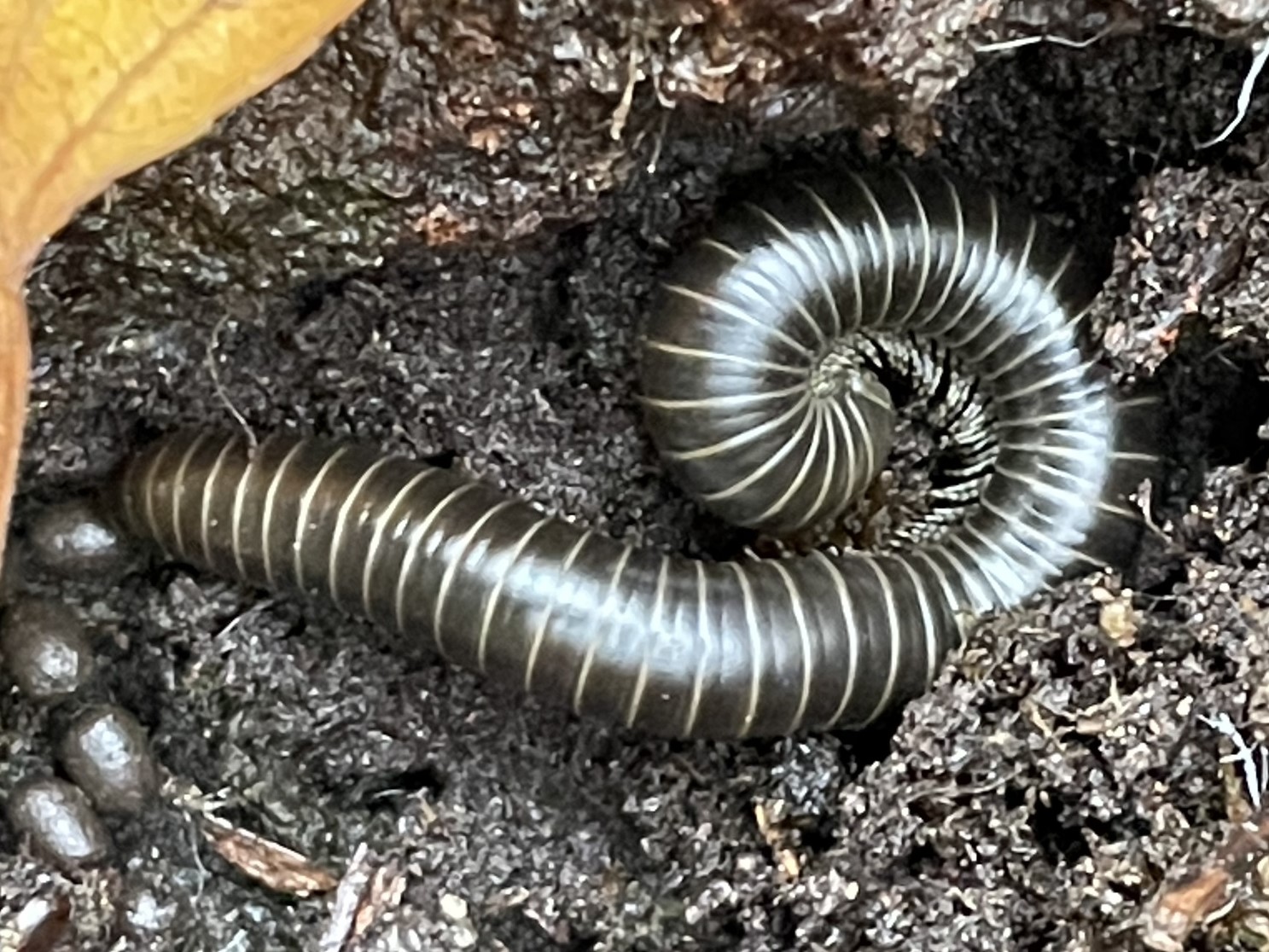
A note on photos: Only one verified photograph of Tylobolus uncigerus exists on Wikimedia Commons — a single live animal, shown below. Rather than substitute a photo of a different species and pretend it is this one, this guide runs with that one photograph. If more verified photos appear, they will be added here.
What it looks like
The black round millipede is a large, cylindrical millipede: 52 to 86 millimeters long (about 2 to 3.4 inches) and 5 to 8 millimeters wide, with at least 46 segments and 89 pairs of legs at sexual maturity. The color is greyish brown, sometimes greenish in southern populations, with a lighter brown rear margin on each segment — a subtle banding that gives the animal a ringed look in good light. The body rings are mostly smooth, or with a very fine texture, and striations, if present, are only on the lower portion of the segments. Females attain larger sizes than males, as in most spirobolids.
The diagnostic field mark is on the face, and it is worth learning: a suture — a groove — in the center of the frons, the forehead between the eyes, extending down to the labrum. That suture is diagnostic for the order Spirobolida, and Tylobolus uncigerus is the only member of that order in the Pacific Northwest — so a large cylindrical millipede with a grooved forehead, west of the Cascades, is this species. The two eyes are patches of ocelli, 27 to 50 per patch in the genus, set wide on the head. The legs are short, tucked under the round body, and the animal moves slowly, in a steady wave, the way millipedes do.
Young animals are smaller versions of the same cylinder, starting out at only a few millimeters long, and they add rings and legs with every molt, the way all millipedes do. The hobby trade sells this species as the “olive millipede,” and some sellers claim adults of 120 millimeters — nearly five inches. That figure is not supported by the formal literature, which gives 52 to 86 millimeters, and this guide uses the formal figure: a large millipede, but not a five-inch one, and a claim of 120 millimeters most likely belongs to a different animal or a different measurement.
The name game
The name is a small lesson in millipede taxonomy. Tylobolus is the genus — a group of medium to large cylindrical millipedes of the Pacific Slope — and uncigerus means “hook-bearing,” for the hooked shape of the male gonopods. The species was described by Wood in 1864. The common names tell the story of how people meet it: the black round millipede, for the dark, cylindrical body; the olive millipede, for the greenish tinge of southern populations, in the hobby trade.
The taxonomy, for the nerds in the back: kingdom Animalia, phylum Arthropoda, class Diplopoda (the millipedes), order Spirobolida, family Spirobolidae, genus Tylobolus, species uncigerus (Wood, 1864). The genus contains seven known species, all on the Pacific Slope of North America, from Washington state to Baja California, Mexico, with only one species occurring east of the Sierra Nevada. T. uncigerus is the northernmost species, ranging to just north of the Columbia River in Washington; the southernmost, T. claremontus, ranges from Los Angeles and western Riverside County to northern Baja California. Its closest look-alikes in the field are the Californiulus species — the only other millipedes this large in the Pacific Northwest — which are more slender and have a light-colored band down the length of the body.
Where it lives
The black round millipede lives in moist to mesic forests and woodlands, usually under logs, rocks, and leaf litter, and in other high-humidity locations. It is a creature of the damp dark: a log that has been down for years, a rock pile in a shady hollow, a deep leaf litter that never quite dries out. It is the only spirobolid in the Pacific Northwest, and its range is the western one: west of the Cascades from southwestern Washington south through Oregon, and into northern California — southern Washington (Klickitat County) south to Santa Cruz County and inland to Mariposa County, California.
The range does not include Florida, or the eastern United States at all. A large grey-brown cylindrical millipede found in Florida would be something else — most likely the American giant millipede or the smokey oak millipede, in the same order — and this guide says so plainly, because western field guides are so often read as if they applied everywhere. Nor does it extend east of the Cascades in the north: it is a west-slope animal, of the wet side of the mountains, and the dry interior is not its habitat. Within its range it is common, and it is most often met the way millipedes usually are: under a log, after rain, in the damp season.
What it eats: the quiet recycling job
Like every millipede in this library, the black round millipede is a detritivore — it eats rotting leaves, humus, and other decaying organic matter, in the leaf litter and the rotting wood of the forest floor. Its work is the quiet recycling job: shredding dead leaves into smaller pieces, and returning them to the soil as droppings that feed the fungi and bacteria. In a west-coast forest it is one of the main recyclers of the litter layer, and its size is the measure of its importance — a large animal eating a large amount of dead leaves, a few mouthfuls at a time, for years.
There is one dietary detail worth naming, because it is odd and it is documented: this species may also eat its own feces — coprophagy — although that is to replenish gut bacteria rather than for extracting more nutrition. The millipede gut is a fermentation chamber, and the bacteria in it do much of the digesting; eating the droppings re-seeds the gut with the microbes it needs. It is not a habit to be embarrassed about — it is a habit that keeps the animal alive — and it is a reminder that a millipede is less an animal than a walking compost heap with legs.
What it does not like is equally clear. It does not eat living plants. It does not eat your vegetables, your seedlings, your fruit, or your house. It wants damp, rotting leaves and humus, and it does not want dry, sunny, bare ground. A black round millipede in a garden is there for the leaf litter under the trees, and if there is no leaf litter, it is not there at all.
The curl and the chemistry
Disturb a black round millipede and it does what its relatives do: it curls into a tight spiral, head tucked in the center, armored rings facing outward, and plays dead with total commitment. It cannot bite, cannot sting, and cannot run away fast — the curl is the whole defense plan, plus one chemical backup. Along the sides of its body it carries rows of tiny defensive glands, opening through pores called ozopores, and if you squeeze or crush it, those glands discharge a fluid.
What exactly is in that fluid? Here the honest answer is: the order Spirobolida defends itself with benzoquinones — sharp-smelling, staining compounds — and the standard review of millipede chemical defenses notes benzoquinone-related compounds across the order, but no published chemical assay of this exact species exists, and this guide will not present an order-level recipe as a species-level fact. What is certain is that the fluid is a deterrent to predators, that it can stain skin, that it would be extremely irritating in the eyes, and that it is not venom — there is no bite, no injection, nothing that gets it into your bloodstream. Wash your hands after handling one and keep it away from your eyes. For a person, the defense is a non-event; for a ground beetle, it is a reason to look elsewhere.
Life cycle
Like all millipedes, the black round millipede grows by molting: it hatches from an egg laid in soil or leaf litter with only a few segments and a handful of legs, and earns the rest over successive molts, adding rings and legs each time it sheds its exoskeleton. Adults have at least 46 segments and 89 pairs of legs, and reach 52 to 86 millimeters long. The hobby trade reports that this species is slower growing than familiar millipedes such as the ivory millipede and the American giant, and respectively long-lived — a slow, long life in the damp dark, which fits everything else known about it.
Beyond that basic pattern, the details of this species’ life cycle are thinly known, and the gaps are worth naming honestly rather than papering over. No published study follows a black round millipede from egg to adult, and there is no species-specific account of its mating season, its egg-laying, or its lifespan in the wild. What can be said is what is true of spirobolids generally: the animals are most active in the damp seasons, they shelter under logs and in leaf litter through dry spells, and the females lay their eggs in the soil or litter, where the young hatch and begin the slow climb through the molts. A millipede this common, in forests across three states, still keeps its private life private — and the slow growth reported by keepers is the most visible part of that life, and the reason a large adult under a log is likely an old animal.
The only spirobolid in the Northwest
The black round millipede’s claim to fame is a negative one: it is the only member of its order in the Pacific Northwest. The order Spirobolida — the round-backed, cylindrical millipedes with the grooved forehead — is a large and widespread group in the eastern and southern United States, but west of the Cascades it is represented by a single species, this one. That makes the identification unusually easy for a millipede: a large, cylindrical, greyish-brown millipede with a suture in the middle of its forehead, found west of the Cascades from southwestern Washington south through Oregon, is Tylobolus uncigerus, because there is nothing else it could be. The only other millipedes this large in the region are the Californiulus species, and they are more slender, with a light-colored band down the length of the body — a different animal at a glance.
The genus Tylobolus is a Pacific Slope genus through and through: seven known species, all on the Pacific Slope from Washington to Baja California, with only one occurring east of the Sierra Nevada. T. uncigerus is the northernmost, ranging to just north of the Columbia River in Washington; the southernmost, T. claremontus, ranges from Los Angeles and western Riverside County to northern Baja California. The hobby trade knows this species as the “olive millipede,” and keepers report that it is slower growing than familiar millipedes such as the ivory millipede and the American giant, and respectively long-lived — a slow, long life in the damp dark, which fits everything else known about it. It is tolerant of a wide range of temperatures and conditions in captivity, as long as rotting wood or very high quality rotted leaves are provided, and it is described as an excellent beginner species — a gentle giant, in the trade’s words, for a keeper who is willing to wait.
Is it a pest?
Plainly: no. It is not a pest in any sense of the word. It does not bite, sting, or spread disease. It does not eat living plants, seedlings, fruit, or crops. It does not eat your house, your clothes, or your stored food. It does not swarm patios after rain, it does not invade houses, and it does not show up in numbers anywhere a gardener would notice it — because it lives in moist west-coast forests, under logs, and a garden would have to back onto that forest to meet it at all. A gardener in western Oregon or Washington who finds one under a log has found a neighbor, not a problem.
The only sense in which it could ever be called a problem is no sense at all — there is not even a nuisance version of this story. It is too large, too slow, too forest-bound, and too harmless to matter as a pest, and this guide keeps it that way.
How to get rid of it — or how to attract it
There is nothing to get rid of, so this section is about the opposite: how to keep the conditions that let this animal exist, if you are lucky enough to have it on your land. The answer is the same as for every forest millipede in this library, and it is gloriously lazy: leave the leaf litter and the logs alone. A black round millipede needs a deep, damp leaf litter under trees, and logs left to rot where they fell, for years. If you have a wooded corner, leave the fallen logs where they fell, do not rake the litter to bare soil, and do not roll the same log every weekend to see what is underneath.
If you do roll a log and find one, put the log back exactly as it was, gently, the same side down, and walk away. Do not collect the animals: they are forest-litter specialists that need damp wood and humus, and a millipede removed from its log is a dead millipede. Do not spray anywhere near them — broad-spectrum insecticides will kill them just as dead as they kill anything else. What they do not like is the opposite of all this: dry, sunny, bare ground with nothing rotting in it. A yard that is too tidy for millipedes is too tidy for soil life generally.
Effects on the garden
On the plus side, everything this animal does is helpful, in the quiet way detritivores always are. It eats rotting leaves and humus, shreds them into smaller pieces, and its droppings feed the fungi and bacteria that turn dead leaves into soil nutrients. In a wooded garden it is one of the main recyclers of the litter layer, and a garden with a healthy black round millipede population is a garden whose leaf litter is being processed, not piling up into a sodden mat. It does not compete with your plants for anything, because it does not eat plants.
On the minus side, there is nothing to list. It does not eat garden plants, it does not nibble seedlings, it does not hide in potted plants or drainage holes, and it does not stain patios, because it never visits one. The honest effect on a garden is: none, unless your garden backs onto moist west-coast woods — in which case the effect is the good kind, and the sign of it is a large grey-brown millipede under a log, which is a gift, not a problem.
Effects on other garden animals
The black round millipede sits in the middle of the forest food web. As a detritivore it eats only dead plant matter — it does not hunt other animals, does not eat living insects, and does not compete with predators for prey. Its competition is with the other recyclers: the beetles, the woodlice, the springtails, and the fungi that all eat the same dead leaves. It helps the soil microbes by shredding litter into bite-size pieces, and its droppings are food for fungi and bacteria, which in turn feed the whole underground web — and its habit of eating its own droppings, to re-seed its gut bacteria, is a small, circular version of the same recycling, inside a single animal.
As prey, it is a defended meal — and a valuable one, because it is big. Most predators learn to leave it alone after one taste of the benzoquinone defense, but some animals eat millipedes anyway, and birds, toads, lizards, shrews, and ground beetles take millipedes generally. Its closest look-alike in the field, the Californiulus species, are the only other millipedes this large in the Pacific Northwest, and they share the same predators. For pets, the risk is small: a dog that crunches one will get a mouthful of foul-tasting fluid and learn not to do it again. Unpleasant, not an emergency.
Look-alikes: the concrete checks
Large cylindrical millipedes of the west coast all look alike until you know what to check, and with this species the first check is the forehead: a groove down the middle means spirobolid, and west of the Cascades a spirobolid is this one. Work through these in order and you will rarely go wrong.
Western giant millipede, Hiltonius pulchrus — the closest look-alike, and the hardest one, because it is a genuine western giant in the same family, also large, also cylindrical, also brown with reddish bands, and it co-occurs with Tylobolus in southern California. Check: the range. Hiltonius pulchrus lives from Kern County to San Diego County in southern California, while T. uncigerus ranges from southwestern Washington through Oregon to northern California — the two meet only in the middle of the state, and in the Pacific Northwest it cannot be Hiltonius. Check also the build: Hiltonius is shorter and thicker, and olive-green with red or orange bands where Tylobolus is greyish-brown. Read the full guide: Hiltonius Pulchrus Millipede.
American Giant Millipede (Narceus americanus) — the large round-backed millipede of the eastern United States. Also very large, also cylindrical, but dark-bodied with reddish-pink banding between the segments, and widespread across the eastern United States — it does not occur in the west at all. Check: banding and geography. If it has obvious reddish bands and you are east of the Rockies, it is not a black round millipede. Read the full guide: American Giant Millipede.
Smokey Oak Millipede (Narceus gordanus) — the other large eastern Narceus. Also large, also greyish-brown, also a round-backed spirobolidan — but a southeastern animal, as far north as the Carolinas, and it does not occur in the west. Check: the map. If you are west of the Cascades, it is not a smokey oak. Read the full guide: Smokey Oak Millipede.
Florida Ivory Millipede (Chicobolus spinigerus) — the big pale millipede of the Southeast. Also large, also a spirobolid, but pale ivory to cream-colored, not grey-brown — the color gives it away at a glance — and far more widespread in Florida and the Southeast, where the black round millipede does not occur. Check: pale ivory means ivory millipede; greyish-brown in a west-coast forest means black round. Read the full guide: Florida Ivory Millipede.
Centipedes — the one that actually matters, because this is the split with consequences. Centipedes have one pair of legs per segment, not two, and they move fast — darting, flickering, gone under the log before you have finished the sentence. Millipedes move slowly, in a steady wave, and curl up when disturbed; centipedes run. Centipedes are also flattened, with long legs that stick out sideways and a pair of venomous front fangs, and they can bite. Millipedes have short legs tucked under a round or flat body and no bite at all. Check: count the legs per segment (one pair means centipede, two pairs means millipede), then watch the speed (fast means centipede, slow means millipede), then watch what it does when poked (runs means centipede, curls means millipede). Read the full guide: Garden Centipedes.
Frequently asked questions
Is the black round millipede dangerous?
No. It does not bite, sting, or spread disease. Its only defense is curling into a spiral and a bad-tasting benzoquinone fluid that can stain skin and would be very irritating in the eyes. Wash your hands after handling one, as with any millipede.
Is it a pest?
No — plainly and completely no. It does not eat living plants, seedlings, fruit, or crops, it does not invade houses, and it does not swarm patios. It lives in moist west-coast forests under logs, and a garden would have to back onto that forest to meet it at all.
How big does it get?
Adults are 52 to 86 millimeters long (about 2 to 3.4 inches) and 5 to 8 millimeters wide, with at least 46 segments and 89 pairs of legs. Hobby sellers sometimes claim 120 millimeters, but that figure is not supported by the formal literature, and this guide uses the formal range.
Where does it live?
West of the Cascades from southwestern Washington south through Oregon, and into northern California — southern Washington (Klickitat County) south to Santa Cruz County and inland to Mariposa County. It lives in moist to mesic forests and woodlands, under logs, rocks, and leaf litter. It does not occur in the eastern United States or in Florida.
What is the groove on its forehead?
A suture in the center of the frons — the forehead between the eyes — extending down to the labrum. It is diagnostic for the order Spirobolida, and this species is the only spirobolid in the Pacific Northwest, so the groove plus the location is a confident ID.
What does it eat?
Rotting leaves, humus, and other decaying organic matter. It may also eat its own feces, to replenish the gut bacteria that do much of its digesting. It does not eat living plants.
How do I tell it from a Californiulus?
Californiulus species are the only other millipedes this large in the Pacific Northwest, but they are more slender and have a light-colored band down the length of the body. The black round millipede is stouter, greyish-brown, and has the forehead suture of a spirobolid.
Will it hurt my plants or my pets?
No to both. It does not eat living plants, and it does not live in gardens. A pet that crunched one would get a mouthful of foul-tasting fluid and learn not to do it again. Unpleasant, not an emergency.
How long does it live?
No published lifespan exists for this species in the wild. Keepers report that it is slower growing than familiar millipedes such as the ivory millipede and the American giant, and respectively long-lived — a slow, long life in the damp dark.
What should I do if I find one?
Admire it, and put the log back exactly as it was. Do not collect it, and do not spray near it. A large adult under a log is likely an old animal, and the log is its home.
🌱 Keep learning
Three related guides worth reading next:
- American Giant Millipede — The large round-backed millipede of the eastern United States — dark-bodied with reddish-pink banding, and a species complex, not a settled name.
- Smokey Oak Millipede — The other large eastern Narceus — greyish-brown, southeastern, and the millipede most likely under a Florida log.
- Soil Food Web Explorer — Meet the whole underground crew, from bacteria to beetles, and see where the millipedes fit in the chain.
🪱 Your Soil Needs This
Reading about healthy soil is great. Growing in it is better. Our small-batch, traceable worm castings are the shortcut your garden deserves.
Shop Worm Castings Subscribe & SaveEvery bag comes with a lot certificate. Know what's in your soil.