
Most millipedes are creatures of damp leaf litter, and the desert is supposed to be the last place you would look for one. The desert millipede, Orthoporus ornatus, did not get that message. It is a big, slow, dark millipede — four inches long on an ordinary day, seven at the outside — that lives in the Sonoran and Chihuahuan deserts of Arizona, New Mexico, and Texas, spends most of its life in burrows in deep, damp soil, and then, after the summer rains, comes to the surface in numbers so large that early naturalists wrote about swarms. It climbs shrubs. It eats dead creosote bush and cholla. It can live more than ten years. And it does all of this in a landscape where a millipede, by every rule in the book, should dry out and die.
This guide is the desert entry in the Living Root millipede library, and it is also the first half of a pair. Its closest relative is the Texas striped millipede, Orthoporus texicolens, a Gulf Coastal Plain animal that the pet trade constantly confuses with this one — and the two guides are written to be read together, with a full section in each on how to tell them apart. The short version is geography: a fault line in Texas, the Balcones Fault, separates them, and this species does not occur on the Gulf Coastal Plain at all. If you found yours in South Texas low country, it is almost certainly not this animal.
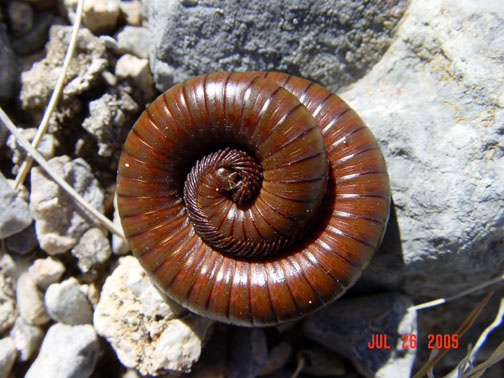
A note on photos: only one species-verified photograph of Orthoporus ornatus could be found on Wikimedia Commons — the U.S. Fish and Wildlife Service image above. Several other Commons images show Orthoporus at genus level only, or carry captions that admit the species identification is a guess (“supposedly Orthoporus ornatus, but they all look alike”), and those were not used. This library does not substitute a maybe-photo for a verified one.
What it looks like
Start with the size, because it is the first thing that makes people stop and look. BugGuide puts the desert millipede at up to 10 centimeters — about 4 inches — and that is the honest everyday figure: individuals average around 4 inches long. Causey’s 1975 monograph, the formal treatment of the desert millipedes, says some of the family stretch to a length of seven inches, and the pet trade lists animals at 4 to 9 inches. The spread is real, and it is worth stating plainly rather than picking the biggest number: a typical adult is about 10 centimeters, a large one is considerably longer, and the seven-inch figure belongs to the exceptional end of the family, not to the animal you are most likely to meet. It is, by any measure, one of the largest millipedes in North America.
The color is the second field mark, and it is less tidy than the name suggests. The body is brown to reddish-brown, sometimes dark chocolate, sometimes banded in gold and brown, sometimes nearly uniform — the pet trade sells a “chocolate phase” and a “gold phase,” and both are the same species. The body is smooth and round in cross-section, with no ridges, keels, or flanges — that smoothness matters in the look-alikes section below, because it rules out every flat-backed millipede at a glance. Like all millipedes, each body segment carries two pairs of legs, which is the fastest way to tell it from a centipede (one pair per segment, and in a hurry). The head carries a pair of short antennae and simple eyes that detect light and shadow rather than forming detailed images, and a specialized sensory structure called the organ of Tömösváry sits at the base of each antenna, helping the millipede detect humidity and chemical signals — a useful piece of equipment for an animal that lives by finding damp soil in a dry land.
The exoskeleton carries a waxy coating that helps reduce water loss, which is one of the small adaptations that lets a moisture-loving animal survive in a desert. It is not armor against the sun — the animal still hides from it — but it buys time. Everything about this millipede is a compromise between a body plan built for damp leaf litter and a habitat built for drought, and the compromise works well enough that the species is abundant across two deserts.
The name game (desert, Sonoran, and a 1954 cleanup)
The common names are straightforward: desert millipede, Sonoran desert millipede, giant desert millipede. The scientific name is Orthoporus ornatus (Girard, 1853), first described by Girard in 1853. The taxonomy, for the nerds in the back: kingdom Animalia, phylum Arthropoda, class Diplopoda (the millipedes), order Spirostreptida, family Spirostreptidae, genus Orthoporus. The Spirostreptida are the long, round-backed millipedes of warm places — the same order that holds the Texas striped millipede and the Florida ivory millipede’s distant cousins — and Orthoporus is a genus of about eighty species distributed from the southern United States to Brazil and Argentina.
The name has a history worth knowing, because it explains some of the confusion in older books. Causey’s 1954 and 1975 revisions sorted out a tangle of names described from the Southwest, restricting the type locality to Palo Duro Canyon State Park in Randall County, Texas, and sinking several supposed species into O. ornatus as synonyms — Orthoporus entomacis and Orthoporus vallicolens, among others, are now accepted as O. ornatus. If an old field guide lists a different Orthoporus name for your part of Arizona or New Mexico, there is a good chance Causey already folded it into this species. The genus is still debated — hobby literature lists more species than the formal literature confirms — but O. ornatus itself is one of the three species Causey said were “known with certainty” in Arizona, New Mexico, Texas, and Oklahoma.
Where it lives — and where it does not
The formal range comes from Causey’s 1975 monograph, and it is worth quoting closely, because it is the line that separates this species from its Texas cousin. Orthoporus ornatus ranges from western Arizona and the eastern shore of the Gulf of California eastward to the edge of the Balcones Fault in Texas, and south through Mexico to 20.3° north latitude — as far south as the Mexican state of San Luis Potosí. In the United States that means Arizona, New Mexico, and Texas — specifically the western half of Texas, up to the Balcones Fault — and BugGuide states it the same way: “sw. US (AZ to w. half of Texas) through Mexico to n. San Luis Potosí.” It lives in the Sonoran Desert of western North America and the Chihuahuan Desert to the east, and it has been recorded from the eastern city limits of Phoenix and Papago Park in Phoenix, Arizona, from Albuquerque, New Mexico, and from sites across West Texas.
Two things the range is not. First, it does not occur on the Gulf Coastal Plain — Causey says so explicitly, and the Balcones Fault is the barrier. The Gulf Coastal Plain belongs to O. texicolens, and the two species meet at the fault and do not cross it. Second, it does not occur in Florida, or anywhere in the eastern United States. It is a southwestern desert animal, full stop. A big brown millipede in a Florida garden is a Florida ivory millipede or an American giant millipede, not a desert millipede that wandered two thousand miles.
Within that range, the habitat is the desert itself — but not the postcard version of it. The animal inhabits deep, damp soil, living in small channels and voids underground, and the soil is both its pantry and its shelter: it contains abundant food, and it protects the millipede from predation, weather, and ultraviolet radiation. Above ground it is found under rocks, in desert scrub, and — famously — on the aerial parts of shrubs. Causey watched specimens in San Luis Potosí crawl up into shoulder-height shrubs on a bright July day, and the thermoregulation studies found animals on shrubs when the air temperature hit 35.5°C. It is a millipede that climbs to escape the ground heat, which is not something you expect from an animal with a hundred legs and no wings.
A year underground, a morning on the surface
The desert millipede’s life is ruled by two things: moisture and temperature. It is a slow-moving organism, mostly nocturnal, and it spends most of its time in self-dug burrows in the deep soil. It emerges after rainy periods in the early mornings when the soil is moist, and once the desert sun dries the soil it goes back down into the deep soil. Above-ground feeding is not year-round: the animal comes to the surface seasonally, after rain, and when it emerges it feeds voraciously, storing enough energy for the long stretch back underground. The research literature describes this as a strongly seasonal pattern — most of the year below, a burst of feeding above — and the behavior is thought to contribute to desert nutrient cycling, moving nutrients from dead shrubs on the surface down into the soil in the form of millipede droppings.
The temperature rules are precise, and they were measured, not guessed. In Wooten, Crawford, and Riddle’s 1975 study of behavioral thermoregulation in three desert habitats, soil-surface activity stopped before the surface temperature reached 35 degrees Celsius and began again when the ground cooled back to 35 degrees. During high-temperature periods the animals sheltered under rocks and, sometimes, on the aerial portions of shrubs — the climbing behavior again, used as a way to get off ground that is literally too hot to walk on. Movement peaks in the early mornings, with some nocturnal activity as well. It is a commuter animal: up at dawn when the ground is cool and damp, down before the heat, out again at night.
That schedule is also why people see it in numbers. BugGuide notes that the species is “known to mass aggregate,” and Causey’s field notes describe swarming — animals out in daylight in numbers, mating and moving together after rain. A desert millipede on its own is a curiosity. A hundred of them crossing a trail after a storm is a spectacle, and it is the spectacle that gets photographed, posted, and misidentified — which is why the range section above matters. A swarm in South Texas is O. texicolens. A swarm in Arizona is O. ornatus. The animals look alike. The map does not.
What it eats: the desert’s recycling crew
At heart, the desert millipede is a detritivore — a creature that eats dead things so the rest of the world does not have to wade through them. Its main food source is bacteria and dead plant material: the tissues of dead shrubs such as cholla, creosote bush, and ocotillo, surface litter, and the bark of Mormon tea (Ephedra, in the Jornada del Muerto) and mesquite, and Salsola (Russian thistle) around Albuquerque. It also eats tiny pieces of sand, rock, and other invertebrate animals along the way — grit that may help grind food in the gut, as it does in earthworms. The species is reported to feed on both living and dead organic material, which is worth stating honestly: it is primarily a dead-matter feeder, but it is not a strict one, and it will nibble living plant tissue. It is incapable of feeding in the absence of moist soil — the food has to be damp enough to process, which is one more reason the animal’s life is tied to rain.
What it does not like is just as useful to know. It does not like dry surface conditions: like all millipedes, it breathes through its skin and dries out fast in open air, which is why it lives underground and comes out only when the soil is moist. It does not like bright, hot, exposed ground either: surface activity stops at 35°C, and the animal climbs or burrows rather than endure it. And it does not like living plants as a staple — dead shrubs are its food; a living seedling is an occasional nibble, not a meal. Dry, hot, exposed, and alive is the opposite of most of what it wants — and that is the whole strategy for both attracting it and moving it along, in one sentence.
The ecological payoff is real. In the desert, dead plant matter breaks down slowly — there is too little moisture for fungi and bacteria to work fast — and the millipede is one of the few animals that can process it. It eats the dead shrubs, its gut bacteria help break them down, and its droppings return the nutrients to the soil in a form the desert’s microbes and plants can use. Crawford’s Desert Biome work in the 1970s framed the species as a measurable part of the desert ecosystem’s nutrient cycle, not a curiosity in it. A desert without millipedes would hold onto its dead shrubs longer, and its soil would be poorer for it.
The curl and the chemistry
Disturb a desert millipede and it has one famous move: it curls into a tight coil, head tucked in the center, armored rings facing outward, and plays dead with total commitment. It cannot bite, cannot sting, and cannot run away fast — the curl is the whole defense plan, plus one chemical backup. Along the sides of its body segments it carries defensive glands, and a disturbed animal may release a toxic, irritating substance from them. The secretion is foul-tasting and staining, and it is the reason most predators learn to leave the animal alone after one try.
Here is what that means in practice, and what it does not. The fluid smells bad and tastes worse. It is irritating if rubbed into the eyes. It is not venom — there is no bite, no injection, nothing that gets it into your bloodstream — and the amount one millipede produces is far too small to be dangerous to a person. But it is a genuine chemical weapon, and the animal’s willingness to use it is part of why it can afford to walk around in daylight after rain, in a desert full of hungry animals. Wash your hands after handling one and keep it away from your eyes. The millipede would prefer that too.
One thing this guide will not do is name the exact defensive compounds for this species, because no species-specific assay was found in the published literature. Its Florida cousins in the Spirobolida defend themselves with benzoquinones, measured in their own secretions — but the desert millipede’s secretion has not been analyzed the same way, and this library does not borrow one species’ chemistry to fill another species’ gap. What is documented is the behavior — the coil and the discharge — and the effect: about thirteen species have been observed feeding on the millipedes anyway, which means the defense works on most predators and not on all of them.
Life cycle: slow, long, and mostly out of sight
Like all millipedes, the desert millipede grows by molting: it sheds its exoskeleton, adds new segments and new pairs of legs, and hardens up again, bigger than before. It hatches from an egg laid in soil with only a few segments and a handful of legs, and earns the rest over successive molts, burrowing deep to molt in safety. Adults molt infrequently — keepers report once or twice a year — and juveniles molt more often as they grow.
The headline number is the lifespan: the species can live more than ten years. That is a long life for an invertebrate, and it is a long life that is mostly spent underground, in the dark, eating dead shrubs and waiting for rain. It is also a number with a conservation implication that the pet trade rarely mentions: an animal that takes years to reach its full size and lives for a decade cannot be collected heavily without consequence, and wild populations in accessible desert sites are the ones that pay for the trade. Buy captive-bred animals from a reputable seller, and leave the wild ones in their burrows.
The pet-trade star
Here is the strangest thing about this animal: it is a wild desert native, and it is also a pet-shop staple. The desert millipede became very popular in the pet trade, and many were exported to Western Europe — Brian Van Der Kieft and Max Prins were the first breeders of the species in Europe. Keepers call it docile, slow-moving, and easily handled, a good beginner invertebrate, and describe a setup that is really just a slice of its wild home in a box: deep substrate, decaying leaves and soft rotting wood, a moisture gradient with one side damp, warm room temperature, a calcium source kept in permanently, fruit and vegetables as extras.
What keepers report is a long-lived, undemanding animal that spends much of its time burrowed — do not disturb a burrowed millipede, because it is likely molting and extremely fragile during the molt. By every keeper account it is a calm animal: slow-moving, predictable, and unbothered by gentle handling (washed hands afterwards, as always). It is also, by keeper accounts, one of the few millipedes that tolerates drier conditions than its tropical cousins — though “drier” is relative, and a bone-dry setup will still kill it. The desert millipede needs moisture. It just needs it underground.
Is it a pest?
Plainly: no, not in any sense that matters to a gardener. The desert millipede is a helper, not a pest. It does not bite, sting, or spread disease. It does not eat your house, your clothes, or your stored food. It does not damage structures. It is not recorded as a pest of crops, seedlings, or ornamentals — its food is dead shrubs and surface litter, and the occasional nibble on living tissue is not crop damage. What it does is eat dead plant matter, shred it into smaller pieces, and return its nutrients to the soil — the same work earthworms do, from a different branch of the family tree, in a place where earthworms mostly cannot live.
The only nuisance it causes is the one every millipede causes: after rain it may appear in numbers, and a swarm crossing a patio or a pool deck is startling even when it is harmless. That is a visitor problem, not a pest problem, and the fix is a broom and patience, not a pesticide. No chemical treatment is recommended for millipedes outdoors, and it would not work anyway — the millipedes live in the soil, not on a surface you can treat, and they will be back after the next rain regardless. Do not spray the helper. Sweep the wanderers back to the scrub and let the rest keep working.
Effects on the garden
On the plus side, the desert millipede is a genuine soil helper, and in a desert garden it is one of the only ones of its kind. It eats dead leaves, dead shrubs, and surface litter, breaks them into smaller pieces, and its droppings feed the microbes that finish the job: fungi and bacteria that turn litter into plant food. Its burrowing moves through the soil, opening it up and keeping it aerated. In a desert garden with native shrubs — creosote, mesquite, ocotillo, cholla — it is part of the crew that keeps the litter from piling up and the soil alive underneath. Gardens with millipedes have faster litter turnover and richer surface soil than gardens without them, all else being equal, and in the desert that difference matters more, because the breakdown crew is small.
On the minus side, there is almost nothing to list: it does not eat living plants as a staple, damage seedlings, chew roots, or infest stored food or timber — the worst it does is appear in numbers after rain and stain the concrete if stepped on. In a Florida garden, its effect is precisely nothing, because it does not live there. In a desert garden, its effect is the quiet one: dead shrubs become soil, a little faster, every year.
Effects on other garden animals
The desert millipede sits in the middle of the desert food web, and it pulls in both directions. As a detritivore it eats mainly dead plant matter — it does not hunt other animals, does not eat living insects, and does not compete with predators for prey. Its competition is with the other recyclers: termites, woodlice, springtails, and the desert’s fungi all eat the same dead shrubs, and in a rich patch of litter there is usually enough dead matter for all of them. It helps the soil microbes by shredding litter into bite-size pieces, and its droppings are food for fungi and bacteria, which in turn feed the whole underground web.
As prey, it is a defended meal with a dozen determined customers. About thirteen species have been observed feeding on desert millipedes — the defense works on most predators, and the ones that persist have learned to get past the coil and the chemistry. Birds, toads, lizards, and ground beetles all take millipedes when they can, and the desert millipede’s size makes it a substantial meal for any of them. For pets, the risk is small but real: a dog or cat that crunches a desert millipede will get a mouthful of foul-tasting fluid and may drool, paw at its mouth, or vomit, then learn not to do it again. It is unpleasant, not an emergency — but call a vet if the drooling does not stop.
Look-alikes: the concrete checks
Big brown millipedes all look alike until you know what to check — color, size, texture, and above all range. Work through them in order and you will rarely go wrong.
Texas Striped Millipede (Orthoporus texicolens) — the sibling species, and the one most often confused with this animal. It is also a large, smooth, round-backed Orthoporus, also brown, also a swarmer — and the pet trade sells both under overlapping names, which is how the confusion spreads. The differences are real but subtle in the hand: O. texicolens is typically darker, dark brown to red-brown with red line segments, 6 to 9 millimeters wide with 67 to 79 segments, and Causey’s formal range is the Gulf Coastal Plain of South Texas and Tamaulipas — it does not occur in Arizona or New Mexico, whatever the hobby literature says. The decisive check is the map: the Balcones Fault separates them, with O. ornatus to the west of it and O. texicolens to the east and south of it, on the coastal plain. West of the fault means desert millipede; Gulf Coastal Plain means Texas striped. Read the full guide: Texas Striped Millipede.
Orthoporus flavior — the third species Causey confirmed for the Southwest, and the one with no guide in this library yet. It occurs in the same desert region as O. ornatus, and it is separated from it by details of the male gonopods, not by anything you can see in the field. Check: if you are in the Southwest and the animal is a large brown Orthoporus, O. flavior is a real possibility that only a specialist can rule out. It is named here so that nobody mistakes a confident field ID for a certain one.
American Giant Millipede (Narceus americanus) — the other big native, and the hardest call in this list for anyone who has seen both. It is also large (up to about 4 inches), also smooth and cylindrical, and also in the same order — a genuine close cousin in the round-backed millipede family. The difference is color and range: the American giant is grey to dark brown with reddish bands, not brown to gold, and it is an eastern animal of the eastern United States, not a desert one. Check: reddish bands on grey in the east means American giant; brown to gold in the desert Southwest means desert millipede. Read the full guide: American Giant Millipede.
Florida Ivory Millipede (Chicobolus spinigerus) — the southeastern giant. Also large, also smooth and cylindrical, also a spirobolid — but black with ivory-white bands, and a creature of Florida and the Southeast, not of the desert. Check: black with ivory bands in Florida means ivory millipede; brown and unbanded in the desert means desert millipede. Read the full guide: Florida Ivory Millipede.
Centipedes — the one that actually matters, because this is the split with consequences. Centipedes have one pair of legs per segment, not two, and they move fast — darting, flickering, gone under the baseboard before you have finished the sentence. Millipedes move slowly, in a steady wave, and curl up when disturbed; centipedes run. Centipedes are also flattened, with long legs that stick out sideways and a pair of venomous front fangs, and they can bite. Millipedes have short legs tucked under a round body and no bite at all. Check: count the legs per segment (one pair means centipede, two pairs means millipede), then watch the speed (fast means centipede, slow means millipede), then watch what it does when poked (runs means centipede, curls means millipede). Three checks, three answers. Read the full guide: Garden Centipedes.
How to attract them (and how to move one along)
This is a helper, so the question is not how to get rid of it — it is how to keep it. If you garden in the desert Southwest and you want desert millipedes in your garden, give them what they want, which is the same thing every decomposer wants, adapted for the desert: damp soil underneath, and dead shrubs on top.
Leave the leaf litter and the dead wood. A layer of fallen leaves under shrubs and at the back of beds is a millipede hotel, restaurant, and nursery in one. Leave prunings from native shrubs — creosote, mesquite, ocotillo — to break down where they fall instead of hauling them away.
Keep the soil damp underneath. A mulched bed that stays moist in the lower layers is millipede country, even in the desert; a bare, dry, sun-baked bed is a desert inside a desert. Water deeply and mulch thickly, and the crew will come — from below.
Keep rocks and logs in place. A rock or a rotting log at the back of the garden, left alone, is shelter from the 35-degree ground and a damp refuge underneath. Do not “tidy” it away.
Do not spray. A broad-spectrum insecticide in the soil kills the helpers along with anything else, and in the desert the helper crew is small enough already. The desert millipede is the good news, not the problem.
And if a swarm wanders onto the patio after rain, the move-along is simple. Sweep them up with a soft broom and a dustpan and tip them outside into the scrub — do not crush them on the patio if you can avoid it, because the stain is the point of the defense and it works on concrete too. Seal the gaps with door sweeps, weatherstripping, and caulk around windows and pipes, looking low, at ground level, where the wall meets the patio. Fix the water: dripping taps and sprinklers that soak the foundation beds pull millipedes toward the house. The goal is not a millipede-free garden — it is a millipede-free house, with the garden crew still on the payroll.
Frequently asked questions
Is the desert millipede dangerous?
No. It does not bite, sting, or spread disease, and the amount of defensive fluid one millipede produces is far too small to harm a person. It can stain skin and irritate eyes, so wash your hands after handling one and keep it away from your face.
Does it bite?
No. Millipedes have no venom, no fangs, and no bite at all. Their defenses are curling up and a bad-tasting chemical fluid. If it has fangs and it bit you, it was a centipede.
Why are there suddenly hundreds of them?
It rained. The species is known to mass aggregate, and after summer rain the animals come to the surface together to feed and mate. A swarm is a seasonal event, not an infestation, and it will disperse on its own as the soil dries.
How big does it get?
A typical adult is about 10 centimeters, or 4 inches, long. Large individuals are longer, and Causey’s monograph says some members of the family stretch to seven inches — but the seven-inch figure is the exceptional end, not the everyday animal.
What does it eat?
Dead plant matter: dead cholla, creosote bush, and ocotillo, surface litter, and the bark of Mormon tea and mesquite, plus bacteria and the occasional nibble of living tissue. It cannot feed without moist soil. It does not eat living plants as a staple, and it is not a crop pest.
How long does it live?
More than ten years — a long life for an invertebrate, and a long life mostly spent underground. That slow life is also why wild collection matters: an animal that takes years to grow cannot be collected heavily without consequence.
Will it hurt my dog or cat?
A pet that crunches one will get a mouthful of foul-tasting fluid and may drool, paw at its mouth, or vomit once, then learn not to do it again. It is unpleasant, not an emergency — but call a vet if the drooling does not stop or the pet eats a lot of them.
Can I keep one as a pet?
Yes — it is one of the most popular pet millipedes in the world, hardy and docile. Buy captive-bred animals from a reputable seller, give them deep substrate with a moisture gradient, decaying leaves and soft rotting wood, and a calcium source kept in permanently. Do not collect wild ones, and never disturb a burrowed animal that is likely molting.
How do I tell it from the Texas striped millipede?
Check the map first, then the animal. The Balcones Fault in Texas separates them: O. ornatus lives west of it, in Arizona, New Mexico, and West Texas deserts; O. texicolens lives east and south of it, on the Gulf Coastal Plain of South Texas. In the hand, texicolens is typically darker, dark brown to red-brown with red line segments. If you found yours in South Texas low country, it is the Texas striped millipede.
Does it live in Florida?
No. It is a southwestern desert animal — Arizona, New Mexico, and West Texas, south into Mexico. A big brown millipede in a Florida garden is a Florida ivory millipede or an American giant millipede, not a desert millipede.
🌱 Keep learning
Three related guides worth reading next:
- Texas Striped Millipede — The sibling species across the Balcones Fault: the Gulf Coastal Plain animal the pet trade keeps confusing with this one, and the full guide to telling them apart.
- Compost Accelerators — Twelve things that actually wake up a lazy pile, and the microbes behind all of it, Florida edition.
- Soil Food Web Explorer — Meet the whole underground crew, from bacteria to beetles, and see where the millipedes fit in the chain.
🪱 Your Soil Needs This
Reading about healthy soil is great. Growing in it is better. Our small-batch, traceable worm castings are the shortcut your garden deserves.
Shop Worm Castings Subscribe & SaveEvery bag comes with a lot certificate. Know what's in your soil.