
Your plant is turning yellow, or spotting, or browning at the edges, and it is doing it in a pattern. That pattern is the plant trying to tell you something — specifically, that it cannot get enough of one of the nutrients it needs to build chlorophyll, run photosynthesis, and generally be a plant. The good news: leaf patterns are readable. The honest news up front: a leaf pattern is a clue, not a lab result. This guide will teach you to read the clues, narrow the suspects, and stop guessing — and it will tell you exactly when to stop reading leaves and get a soil test instead.
If you got here from a photo diagnosis, welcome: the tool’s guess was an educated one from a single image, not a verdict. Everything below will help you check that guess against the actual plant in front of you.
What it looks like: the pattern gallery
Deficiency does not look like one thing. It looks like several things, and which thing it looks like is the first clue. Here are the usual suspects, in plain language:
Uniform yellowing. The whole leaf fades to pale green or yellow, evenly, veins and all. No stripes, no spots, just a plant slowly turning the color of old paper. This is the classic nitrogen look, and it usually starts on the older, lower leaves.
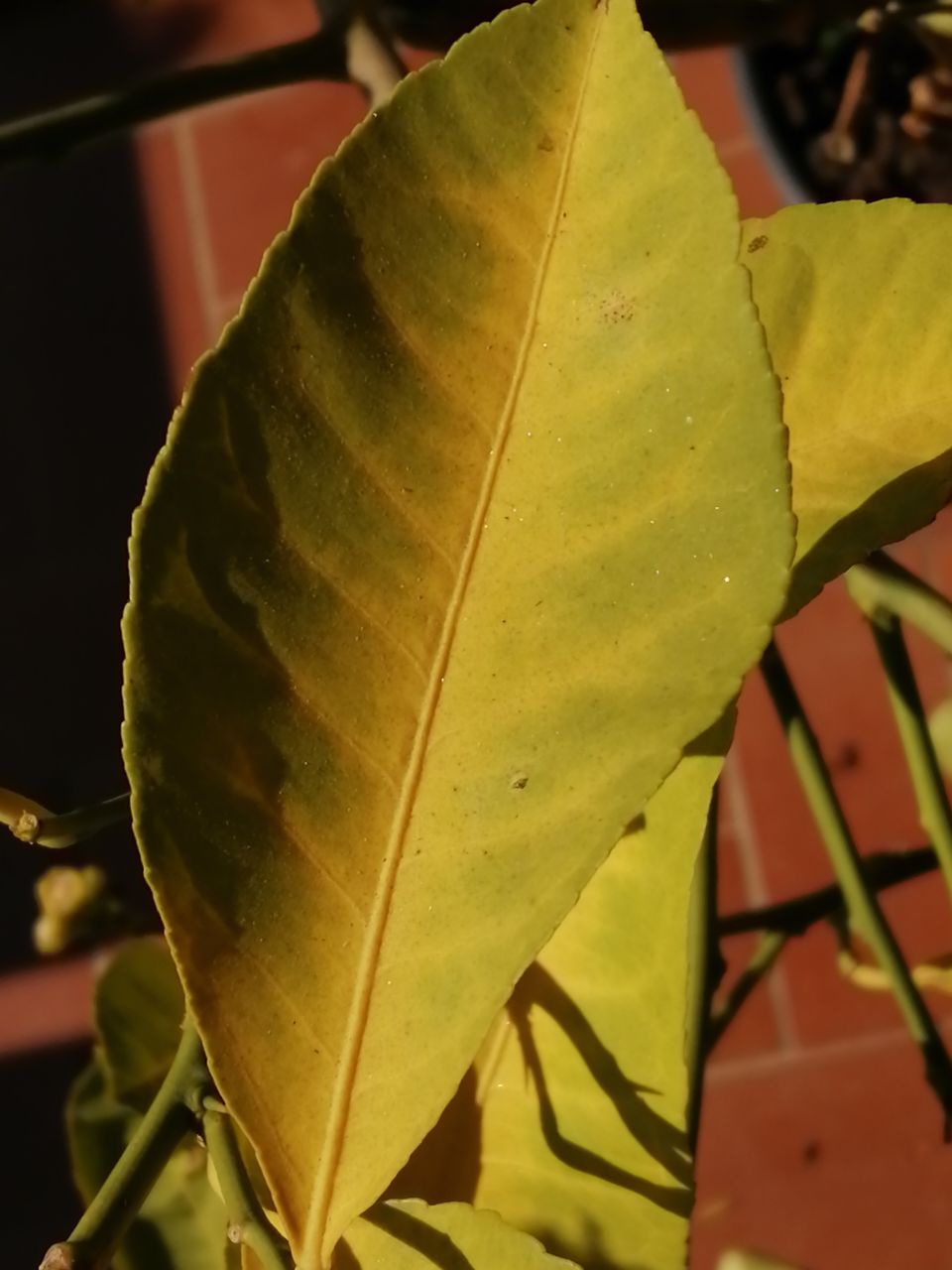
Interveinal chlorosis. The tissue between the veins turns yellow while the veins themselves stay green, so the leaf looks striped or marbled. “Chlorosis” is just the technical word for “lost its green” — chlorophyll is the green pigment, and when the plant cannot make enough of it, the green drains away in patterns. Interveinal chlorosis is the single most useful pattern in this whole guide, because it points at a short list: iron, magnesium, or manganese. Which one depends on where on the plant it shows up, which brings us to the detective trick below.
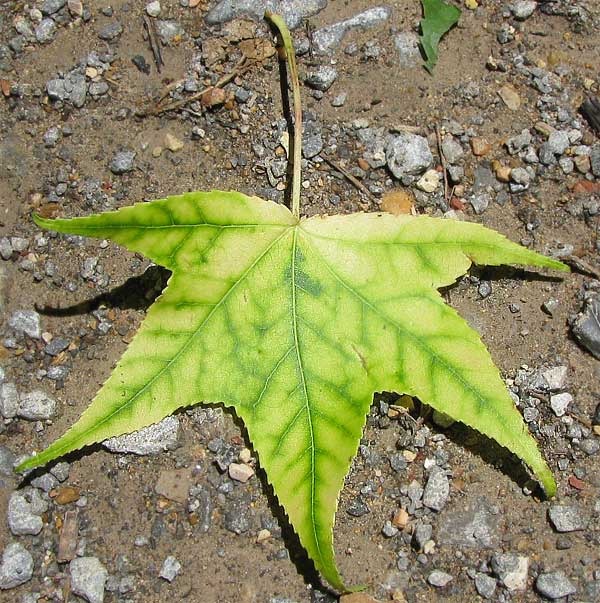
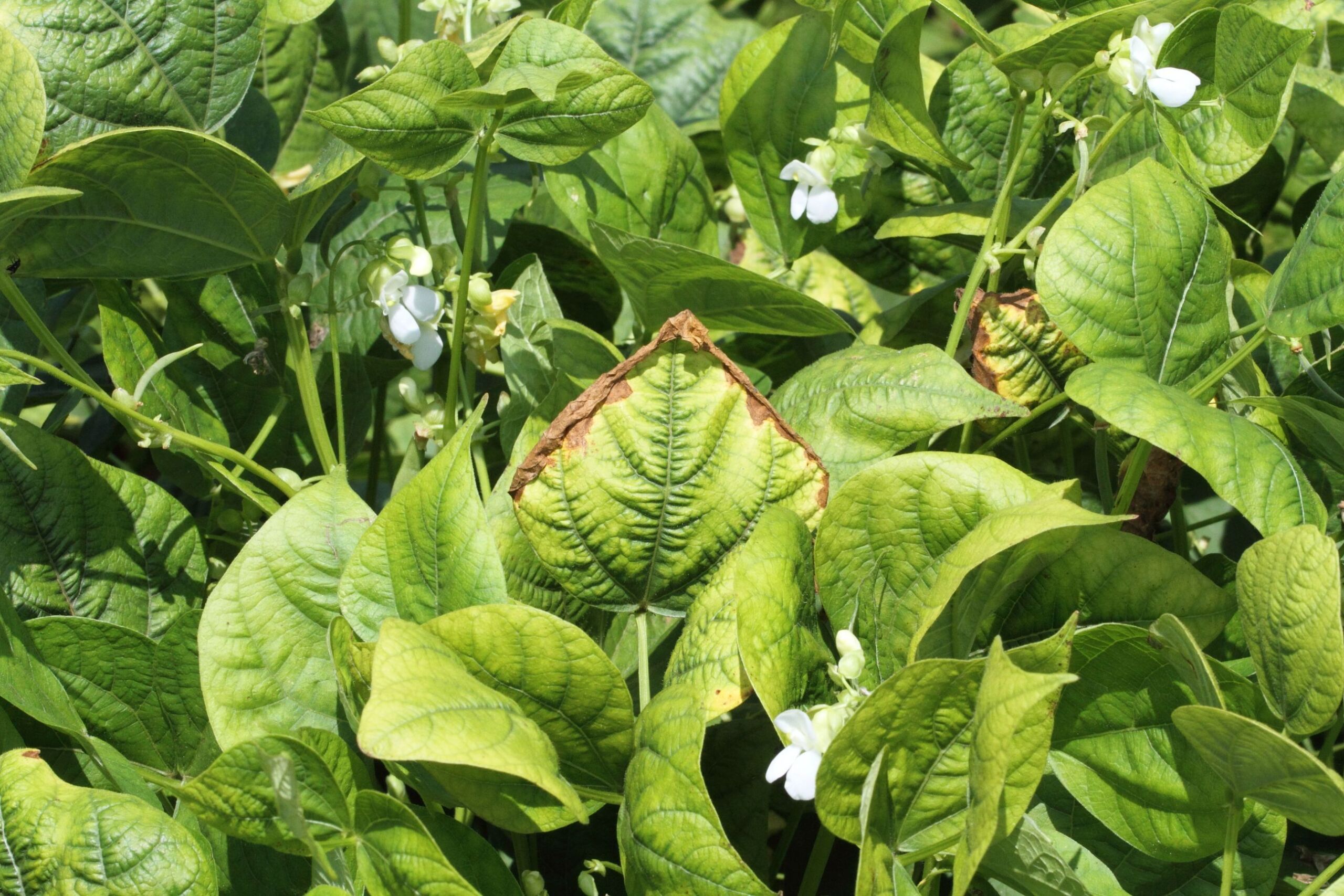
Marginal browning, or leaf scorch. The edges of the leaf yellow, then brown, then go crispy, while the middle hangs on a little longer. Potassium shortage is the usual suspect here, again starting on older leaves. It looks like the leaf got sunburned from the outside in, which is why people constantly mistake it for sun damage.
Spotting and necrosis. As a deficiency advances, yellow areas can die outright, turning brown or tan spots or patches. This is where deficiency starts impersonating disease, and it is the reason the “is it something else?” section below exists. Dead tissue is dead tissue — the pattern around it is what tells you the cause.
Purpling. Leaves — especially older ones — take on a dull purple or reddish tint, and growth stalls. Phosphorus is the usual suspect, and it loves to show up when soils are cool, because cold soil slows phosphorus uptake even when phosphorus is present. A purple plant in a cold snap is not necessarily a starving plant; sometimes it is just a chilly one.
Distorted new growth. Young leaves come out twisted, hooked, crinkled, or stunted, and growing tips may die back. Calcium is the classic cause, and it also causes blossom end rot on tomatoes and peppers — that sunken black patch on the bottom of the fruit. Here is the twist that surprises most gardeners: blossom end rot is usually not a lack of calcium in the soil. It is usually inconsistent watering, which stops the plant from transporting the calcium it already has. Pouring more calcium on a watering problem fixes nothing, which is a theme of this guide.
The detective trick: old leaves or new leaves?
Here is the trick that turns a yellow plant from a mystery into a shortlist. Nutrients fall into two groups based on whether the plant can move them around inside itself:
Mobile nutrients — nitrogen, phosphorus, potassium, and magnesium — can be relocated from older tissue to support new growth. When the plant runs low, it quietly sacrifices its oldest leaves first, pulling their nutrients upward to feed the new shoots. So a mobile-nutrient deficiency shows up on the older, lower leaves first and works its way up.
Immobile nutrients — calcium, iron, manganese, zinc, copper, and boron — cannot be moved once they are built into plant tissue. When the plant runs out, the newest growth suffers first, because there is nothing to reallocate. So an immobile-nutrient deficiency shows up on the youngest leaves and growing tips first, while the older leaves still look fine.
Put the two ideas together and you get a genuine diagnostic tool. Interveinal chlorosis on older leaves? Magnesium is your prime suspect. The same pattern on brand-new leaves? Iron. Uniform yellowing on lower leaves? Nitrogen. Twisted new growth? Calcium. It is not magic, and it is not certain — but it turns “my plant is yellow” into “my plant is yellow here, which means these two or three things.”
The honesty notes, because this guide refuses to oversell: patterns overlap. More than one deficiency can show up at once, especially in poor soil. Sulfur shortage looks almost exactly like nitrogen shortage, except it starts on newer growth — and sources disagree about how mobile sulfur really is, so trust the leaf position, not the label. And a plant can be short of a nutrient that is sitting right there in the soil, if something (usually pH, sometimes water) is stopping it from taking it up. Which brings us to Florida.
Why Florida sandy soils are prone to this
Florida sand is, nutritionally speaking, a sieve with ambitions. Sandy soil has little organic matter and little ability to hold onto nutrients — scientists call that holding ability cation exchange capacity, or CEC, and sand has almost none. Heavy rain washes dissolved nutrients, especially nitrogen and potassium, straight down past the roots before the plant can use them. This is called leaching, and in a Florida summer it happens fast.
Then there is pH, the quiet puppet-master of this whole story. Soil pH controls whether nutrients that are present can actually be absorbed. When pH climbs too high — common in limestone areas and places irrigated with alkaline water — iron and manganese get chemically locked up and become unavailable, even though they are right there in the soil. Iron availability drops off noticeably as pH rises past roughly 6.5. When pH drops too low, other nutrients get locked out instead. Either way, the plant looks starved while standing in a pantry it cannot open. That is why “fix the pH first” appears in every sensible deficiency guide, including this one.
One Florida-specific fact worth knowing: the standard soil test through the UF/IFAS Extension system does not even report nitrogen, because nitrogen leaches so readily in Florida soils that a reading would be meaningless by the time you got it. That tells you everything about how fast nitrogen moves here. A soil test still tells you pH, organic matter, phosphorus, potassium, calcium, magnesium, and micronutrients — which is plenty to stop guessing. Your county Extension office can set you up with an affordable test, and retesting every year or two is a reasonable rhythm for a home garden.
The long-game fix for sandy soil is organic matter: compost, mulch that breaks down, worm castings. Organic matter raises CEC — it gives the soil more little parking spots to hold nutrients instead of letting rain carry them away. If you want the full science of how that works, the guides on CEC, your soil’s nutrient pantry and roots and nutrient uptake go deep. Short version: feed the soil, and the soil holds lunch for the plant.
Deficiency or something else? The checks you can do
Before you feed anything, run through the impersonators. Yellow and spotted leaves have many causes, and feeding a diseased plant does not cure it:
Disease. Leaf-spot diseases make lesions with structure — defined edges, sometimes rings or centers, often spreading from leaf to leaf in wet weather. Deficiency patterns are usually more symmetrical and tied to leaf age. If the spots have a pattern of their own, or the problem is racing through the plant in days, think disease first. The guide on localized leaf spot or mechanical damage will help you sort spots from accidents.
Pests. Sucking insects leave stippling — tiny pale dots where they pierced the leaf — plus curling, stickiness, or visible insects on the undersides. If you see stipples rather than smooth yellowing, check the guide on sucking insect feeding injury before you reach for fertilizer.
Sun and water stress. Scorched margins can be sunburn or wind, not potassium. Wilting plus yellowing can be overwatering (roots drowning) or underwatering (roots dry). Ask: did this start after a heat wave, a storm, or a change in watering? Deficiency creeps; stress often arrives with an event.
Natural aging. Lower leaves yellow and drop as plants grow — that is normal senescence, the plant retiring old solar panels. One or two yellowing bottom leaves on an otherwise vigorous plant is not a crisis. A whole plant fading from the bottom up is.
Herbicide drift. Twisted, distorted new growth after a neighbor sprayed on a windy day is not calcium deficiency. Timing and neighborhood context matter.
Your five-minute checklist: (1) old leaves or new leaves? (2) veins, margins, or whole leaf? (3) one plant or every plant? (4) spreading fast or creeping? (5) what changed recently — weather, watering, feeding? If you are still unsure what plant you are even looking at, the What’s This? photo tool can identify it, and the Plant Doctor photo tool can give you a ranked second opinion. Both are educated guesses from images, same as this guide — the soil test is the lab result.
What to do, gentlest first
Work this list in order. Each step is cheaper and safer than the next, and most gardeners can stop at step two.
1. Get a soil test. Through your county UF/IFAS Extension office — affordable, and it reports pH, organic matter, and the nutrients that actually test meaningfully in Florida soil. This is the single highest-value move in this guide. Everything after this is guessing; the test is knowing.
2. Fix pH before you add anything. If pH is locking nutrients out, adding more nutrients is like pouring water into a locked pantry. Lime raises pH; sulfur lowers it gradually. Either way, follow the test’s recommendation and the product label, and retest rather than assuming.
3. Feed only the suspected nutrient. If the pattern points at magnesium, a magnesium source makes sense. If it points at iron, an iron source makes sense. A targeted feeding beats a blind one every time, because excess of one nutrient can lock out another — too much of one thing creates the next deficiency.
4. Build organic matter for the long game. Compost, mulch, worm castings. This does not fix today’s yellow leaf, but it is what stops next year’s yellow leaf, because organic matter holds nutrients in sandy soil instead of letting rain steal them.
5. Foliar spray only as a bridge. Spraying a diluted nutrient solution on the leaves can green a plant up fast, because leaves absorb directly. Treat it as a bridge while the soil fix catches up, not as the fix itself — and follow the label strictly, since foliar sprays can burn leaves in hot sun.
One more thing about recovery: leaves that are already badly yellowed or dead often do not re-green. That is normal and not a sign your fix failed. Judge recovery by the new growth — if the next flush of leaves comes out green, you fixed it. If the new growth comes out yellow too, your diagnosis was wrong or incomplete, and it is time for that soil test.
Citrus in Florida: a special case worth its own section
Citrus trees are heavy feeders, and in Florida they are heavy feeders standing in sand. Iron, manganese, and zinc chlorosis are common on Florida citrus, especially where soils are alkaline or the tree is pushing a big flush of new growth. A citrus tree with yellow new leaves and green veins is very often telling you about iron or manganese, not about nitrogen — and dumping a balanced fertilizer on it may not touch the actual shortage if pH is the lock on the door.
Two citrus-specific tools: citrus fertilizer formulations, which are blended with the micronutrients citrus actually uses, and leaf tissue testing, which measures what is actually inside the leaf rather than what is sitting in the soil. For citrus, tissue testing is genuinely useful in a way soil nitrogen testing is not — the leaf tells you what the tree managed to absorb, which is the number that matters. Your Extension office can advise on both.
And one important distinction, because it worries every Florida citrus grower: nutrient deficiency is not citrus greening disease. Greening is a bacterial disease spread by an insect, and it is a different problem with a different response. If your citrus has blotchy, asymmetric mottling plus lopsided fruit and dying twigs, read the citrus greening guide instead — do not try to fertilize your way out of a disease.
What NOT to do
Do not dump balanced fertilizer blindly. More is not better. Excess fertilizer burns roots, throws other nutrients out of balance, and washes into Florida waterways, where it feeds algae instead of your garden. If you do not know what is missing, a soil test costs less than a bag of the wrong thing.
Do not foliar-spray everything. A spray is a bridge, not a diet. Spraying every nutrient at once, especially in hot sun, burns leaves and tells you nothing about what actually worked.
Do not fertilize before heavy rain. In sandy soil, that is just donating nutrients to the aquifer. Feed when the plant can use it, not when the sky is about to take it.
Do not chase every yellow leaf. Old leaves age, plants shed, and a single yellow leaf is not a diagnosis. Treat the pattern, not the leaf.
Do not assume the soil is empty. Sometimes the nutrient is there and pH, water, or damaged roots are keeping it from the plant. Fix the door before you buy more groceries.
Frequently asked questions
Can you diagnose a deficiency from a photo alone?
No — and any guide that says otherwise is selling something. A photo gives you a pattern and a shortlist. A soil test (or, for citrus, a leaf tissue test) gives you the answer. Use photos and patterns to decide what to test for, not to skip testing.
Old leaves or new leaves — why does that matter so much?
Because it is the one observation that cuts the suspect list in half. Mobile nutrients (nitrogen, phosphorus, potassium, magnesium) show on older leaves first, because the plant moves them upward to new growth. Immobile nutrients (calcium, iron, manganese, zinc, copper, boron) show on new growth first, because they cannot be moved. Same yellow, different half of the plant, different suspects.
Is every yellow leaf a deficiency?
Not even close. Old leaves age out, overwatering drowns roots, sun scorches margins, diseases spot, insects stipple, and herbicide twists new growth. Yellowing is a symptom with many causes. The pattern, the leaf position, and the timing narrow it down — and the soil test settles it.
Will Epsom salts fix yellow leaves?
Only if magnesium is the actual shortage. Epsom salts are magnesium sulfate, and magnesium deficiency does cause interveinal chlorosis on older leaves — so sometimes, yes. But if the problem is iron, nitrogen, or pH, Epsom salts do nothing, and excess magnesium can even lock out calcium. It is a targeted tool, not a cure-all, despite its reputation.
My plant is yellow but I fertilize all the time — why?
Because presence is not availability. High pH can lock iron and manganese away. Overwatering can drown roots so they cannot absorb anything. Damaged roots cannot take up what is there. And feeding the wrong nutrient does not fix the missing one. This is the “locked pantry” problem, and pH and water are the usual keys.
How fast will leaves green up after I feed?
Badly yellowed or dead leaves often never re-green — do not judge by them. Judge by the new growth: if the next flush comes out green, the fix worked. Expect days to weeks for new growth to show it, not hours. If new growth comes out yellow too, the diagnosis was wrong or incomplete.
Should I pull off yellow leaves?
Usually, leave them. The plant may still be reclaiming mobile nutrients from them, and pulling leaves off a stressed plant adds stress. Remove leaves only if they are dead, crispy, or diseased — diseased leaves should come off so the problem does not spread. Otherwise, let the plant retire them on its own schedule.
Do I really need a soil test?
Yes, and it is the cheapest advice in this guide. A test through your county UF/IFAS Extension office costs less than one bag of the wrong fertilizer, and it replaces guessing with numbers: pH, organic matter, and the nutrients that test meaningfully in Florida soil. Retest every year or two and you will stop playing nutrient roulette.
Is this the same as citrus greening disease?
No. Nutrient deficiency is a feeding problem; citrus greening is a bacterial disease spread by an insect. Greening shows blotchy, asymmetric mottling plus lopsided fruit and twig dieback, and fertilizer will not fix it. If that picture matches your tree better than anything in this guide, read the citrus greening guide linked above instead.
Disclaimer: this guide is an educated guess from leaf patterns, not a lab result. Patterns overlap, deficiencies combine, and pH or water problems can mimic a shortage. A soil test through your county UF/IFAS Extension office — or a leaf tissue test for citrus — is the step that turns a good guess into a diagnosis. Follow the label on any product you use, and when in doubt, test before you treat.
🌱 Keep learning
Three related guides worth reading next:
- The Lazy Gardener's Guide to Starting a Garden — A low-drama first garden built around fewer chores and better decisions.
- I Have a Vegetable Garden. Now What? — Watering, feeding, scouting, harvesting — the routine that keeps it alive.
- What to Plant and When? — Zone-by-zone planting guides: find your USDA zone and your planting calendar.
Got a sick plant? Plant Doctor ranks the most likely causes from your symptoms.
🪱 Your Soil Needs This
Reading about healthy soil is great. Growing in it is better. Our small-batch, traceable worm castings are the shortcut your garden deserves.
Shop Worm Castings Subscribe & SaveEvery bag comes with a lot certificate. Know what's in your soil.