
Somewhere in an eastern forest, six thousand millipedes are crossing a bridge. Not fleeing, not swarming a food source — just walking, all of them, in the same direction, like a slow brown river with yellow legs. The wandering cherry millipede, Pleuroloma flavipes, is the most widely distributed flat-backed millipede in North America, a blind, yellow-legged recycler that ranges from North Dakota to Connecticut and south to Texas — and every so often, for reasons nobody fully understands, it gathers in its thousands and marches. One aggregation counted about 6,000 individuals on a single bridge at McCormick’s Creek State Park in Indiana in 1950. This guide is about the millipede that wanders, the cherry smell that warns you off, and the glow you can only see with a blacklight.
And if you are reading this because you just found a crowd of flat, dark millipedes with yellow legs moving across your yard or your driveway in one determined direction — stay with us. They are not dangerous, they are not a pest, they are not marching on your house, and everything in the “what to do” section works for yours too.
What it looks like
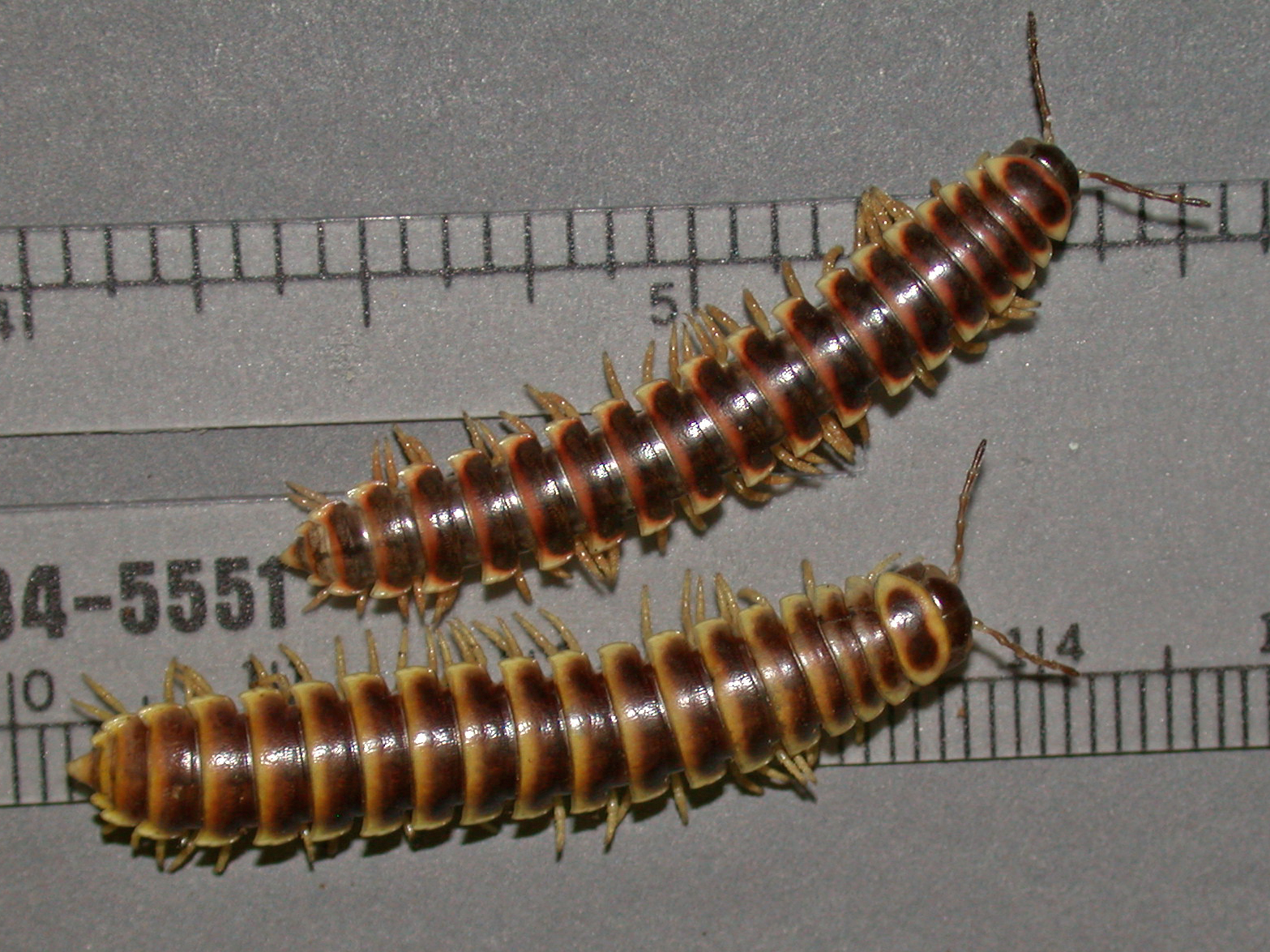
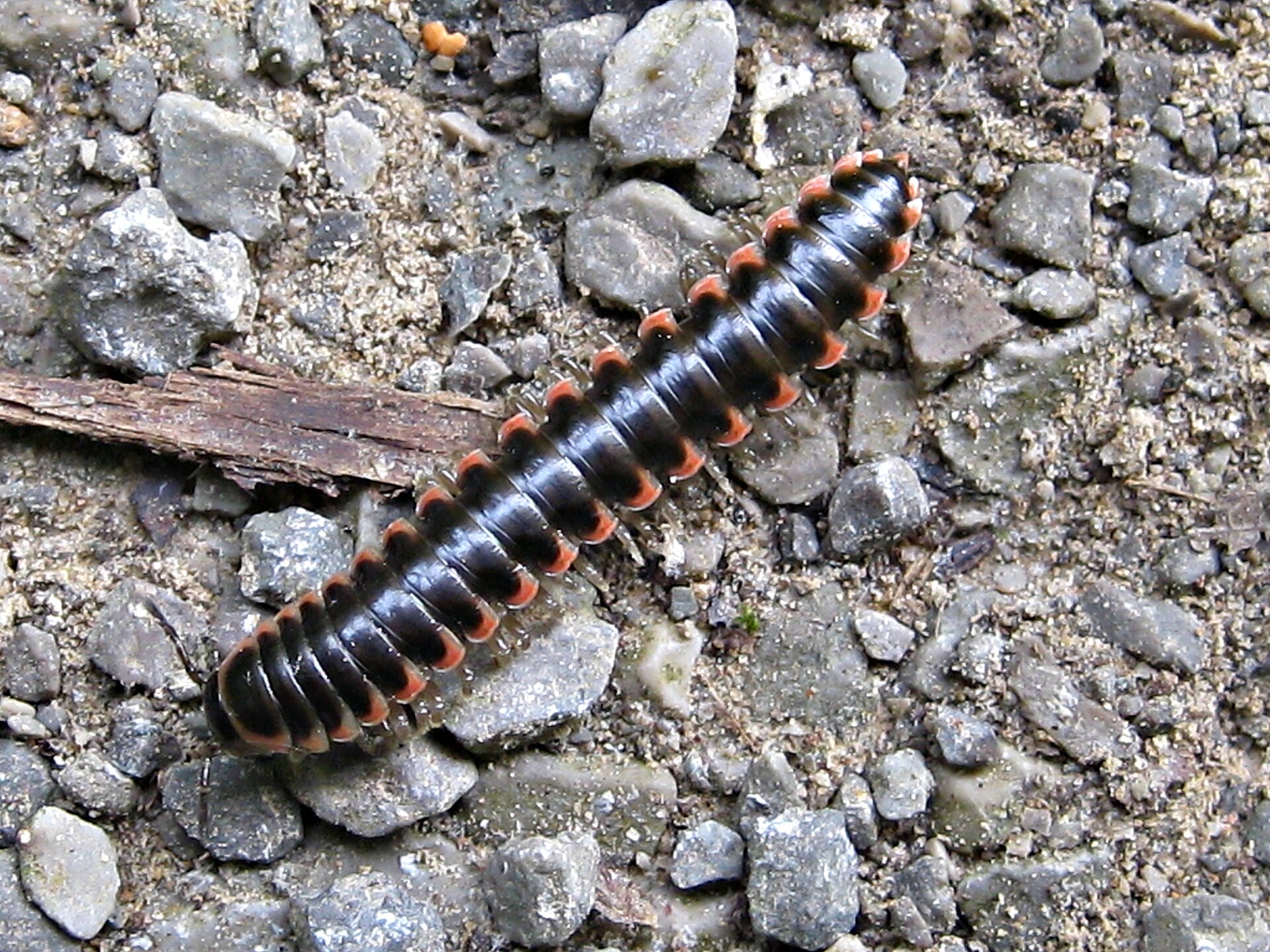
The wandering cherry millipede is a flat-backed millipede, and it looks it: flattened top-to-bottom, wide rather than round, with a hard plate called a tergite covering each body segment and a distinct horizontal ridge — a keel — on each side. Adults are 10 to 40 millimeters long (about 3/8 of an inch to just over 1.5 inches) and appear flattened when viewed from the side. There are 20 body rings. The head is large and round, and the animal is blind — it has no eyes at all, navigating by touch and by chemical senses, like all flat-backed millipedes of its family.
The color is where this species becomes a puzzle. Each tergite is blackish-brown with yellow or yellowish markings, a wrinkled or roughened surface, and the legs are bright yellow — hence the other common name, the yellow-legged millipede. But the color pattern is extremely variable: common throughout a single population but differing between neighboring populations, so that two colonies a few miles apart can look like different animals. Some are dark brown, some black, some reddish brown, with yellow, orange, or ivory edges. That variability is not random decoration. This species converges in appearance with several species of Apheloria and Brachoria — the brightly colored cherry millipedes — as a result of mimicry: it wears the warning colors of its more toxic neighbors, and predators that have learned to avoid the genuinely poisonous ones leave it alone too. Whether it is a true mimic with the chemistry to back it up, or a bluff, is a question for the look-alikes section — and the honest answer is that the mimicry rings of Appalachia are still being worked out, species by species.
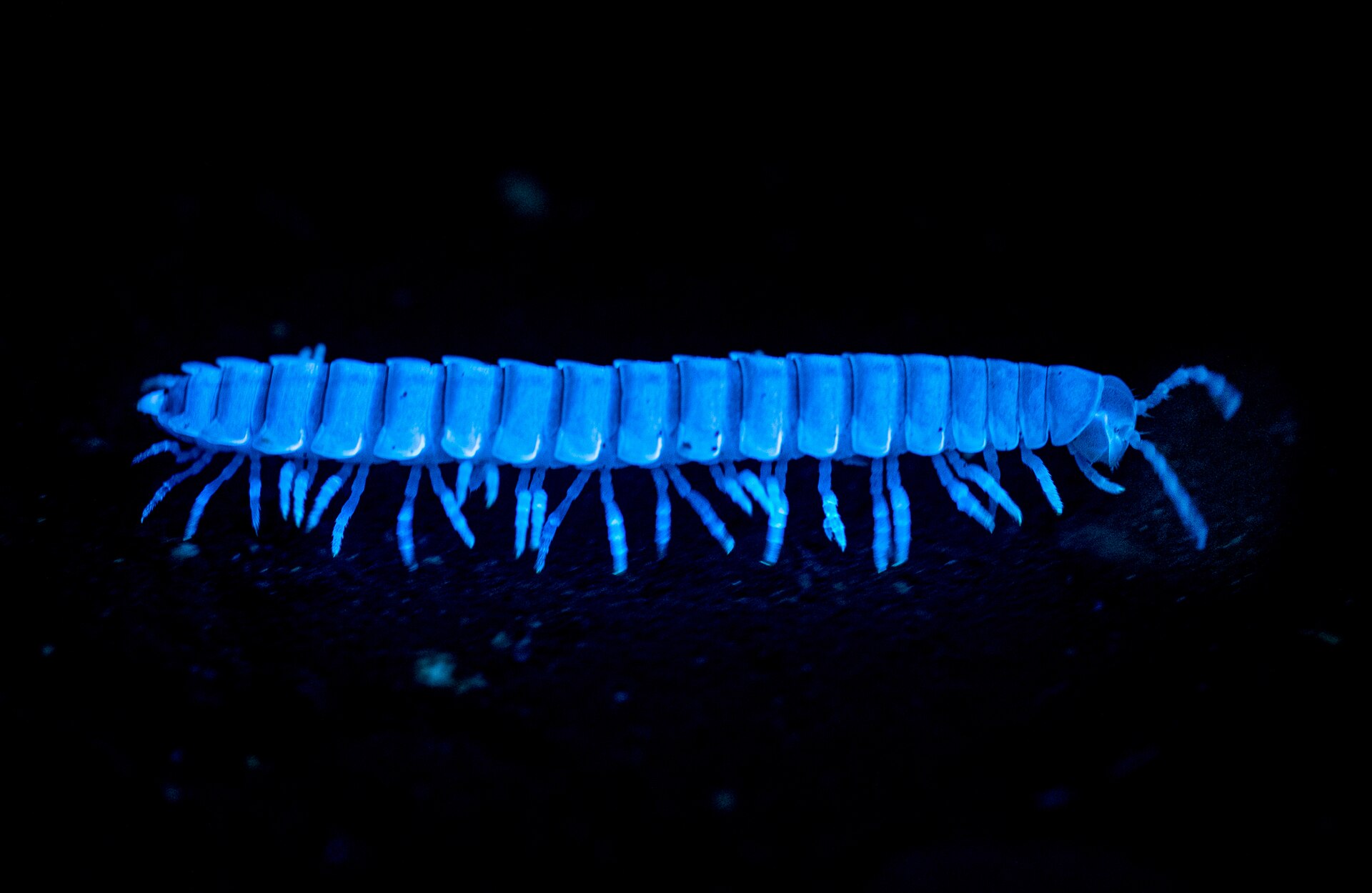
There is one more trick up its sleeve, and you need a blacklight to see it. Under 365-nanometer ultraviolet light, Pleuroloma flavipes fluoresces — it glows. The fluorescence is visible in the third photograph in this guide. Why a blind, leaf-litter millipede glows under UV light is not known; it may be a side effect of compounds in the exoskeleton, or it may be a signal visible to animals that can see ultraviolet. What is known is that it is real, it is striking, and it is one more reason this unassuming brown millipede is more interesting than it looks.
The name game
The name is a small history lesson. Pleuroloma is the genus — a name that refers to the side margins of the body — and flavipes means “yellow-footed,” for those bright yellow legs. The species was described by Constantine Rafinesque in 1820, one of the earliest North American millipedes to receive a scientific name. The common names tell the story of how people actually meet it: the wandering cherry millipede, or traveling cherry millipede, for the mass movements and the cherry-almond smell of its defense; the yellow-legged millipede, for the legs. “Cherry” here does not mean the color — it means the smell, as we will see in the defense section.
The taxonomy, for the nerds in the back: kingdom Animalia, phylum Arthropoda, class Diplopoda (the millipedes), order Polydesmida, family Xystodesmidae, genus Pleuroloma, species flavipes Rafinesque, 1820. The genus was revised by Rowland Shelley in 1980: four species are recognized, and of the twelve nominal species once placed in Pleuroloma, ten are synonyms of flavipes — a century and a half of naturalists naming the same variable animal over and over again, once for each color pattern. Two close relatives were described in that revision: Pleuroloma pinicola, in coastal North and South Carolina, and Pleuroloma plana, ranging from the Piedmont of South Carolina to the Gulf Coast of north Florida. P. plana is the one that reaches Florida; flavipes itself, despite its enormous range, is a more northern and interior animal, and its southern limit runs through North Carolina, northern Louisiana, and southern Texas — not Florida. If you find a Pleuroloma in Florida, it is plana, not this species, and the distinction needs a specialist’s eye on the gonopods.
Where it lives
The wandering cherry millipede has the widest distribution of any species of xystodesmid millipede — the widest range in the whole flat-backed family in eastern North America. It is found in eastern North America from southeastern North Dakota, eastward to Connecticut, and southward to North Carolina, northern Louisiana, and southern Texas. The contiguous range spans some 1,130 miles east to west and, in the west, about 985 miles north to south. The northernmost localities are in Cass County, North Dakota, Ingham County, Michigan, Essex County, Ontario, and Franklin County, Massachusetts; the southernmost are in Cleveland County, North Carolina, and Madison Parish, Louisiana; and it reaches the western shore of Chesapeake Bay in Virginia. A disjunct population in Lafayette Parish, Louisiana, sits about 200 miles south of the contiguous range and is believed to represent an isolated, allopatric population. It was first recorded in Texas in Bowie County, in the northeast corner of the state.
Within that vast range it is a common, widespread, and well-known animal of the ground and the leaf litter. It is found on the ground and under logs in deciduous and mixed woodlands and in adjacent fields and other open areas — more adventurous than most millipedes, often venturing into open land and fields, and avoiding coniferous trees. It eats rotting vegetation and fungi, and where there is detritus to be consumed, it will be there. It is not uncommon, and in the right season it is one of the millipedes a gardener in the eastern United States is most likely to meet — under a log, under a board, or on the march across a lawn.
And then there are the marches. Occasionally large numbers appear in mass aggregations, sometimes migrating across a field or forest floor, all moving in the same direction. The 1950 bridge aggregation — about 6,000 individuals on one bridge at McCormick’s Creek State Park, Indiana — is the most famous, but smaller marches are reported regularly. Nobody knows why they do it. The leading ideas are that the animals are dispersing to new habitat, or responding to crowding, or following a moisture gradient — but no study has settled it, and this guide will not pretend otherwise. What is known is that the marches are not an invasion and not a plague: the animals are moving through, they are not eating anything on the way, and they will be gone as suddenly as they arrived.
What it eats: the quiet recycling job
Like every millipede in this library, the wandering cherry millipede is a detritivore — a creature that eats dead things so the rest of the world does not have to wade through them. Its food is rotting vegetation and fungi: dead leaves, rotting wood, the soft, half-rotted litter of the forest floor and the garden bed. It grazes the litter layer, shredding dead leaves into smaller pieces, and its droppings feed the fungi and bacteria that turn dead leaves into soil nutrients. In a woodland, it is one of the many small mouths that keep the recycling running; in a garden, it does the same job in the leaf litter under the shrubs.
What it does not like is just as important. It does not eat living plants. It does not eat your vegetables, your seedlings, your fruit, or your house. It avoids coniferous trees — pine and spruce litter is not its food — and it wants its litter damp and rotting, not fresh and green. A wandering cherry millipede in your garden is there for the dead leaves, and if you take the dead leaves away, it goes away too. The marches, dramatic as they look, are not feeding frenzies: the animals are traveling, not eating, and they do not stop to strip a garden on the way.
The curl and the chemistry
Disturb a wandering cherry millipede and it does what flat-backed millipedes do: it curls — not into a tight ball like a round millipede, but into a flat coil — and its defense glands go to work. The family Xystodesmidae defends itself with a two-chambered gland system that is one of the neatest pieces of chemistry in the invertebrate world. In one chamber the animal stores mandelonitrile, a stable precursor; in the other, an enzyme waits. When the animal is threatened, the two are mixed, and the reaction produces hydrogen cyanide and benzaldehyde — a potent poison and the compound that smells like cherries or bitter almonds. That is the cherry in “cherry millipede”: not the color, but the smell, sweet and almond-like, that rises from a disturbed animal.
How much cyanide is in one wandering cherry millipede has not been measured for this exact species — the famous figures (one millipede carrying enough cyanide to kill six mice) belong to its relative Apheloria corrugata, and this guide will not borrow them. What is safe to say, from the family-level evidence, is that the secretion is a genuine deterrent to predators, that the bright yellow markings are aposematic — warning coloration, advertising the chemistry — and that the amount is far too small to harm a person. The recommendation is the same as for every millipede in this library: wash your hands with soap and water after handling one, keep it away from your eyes, and do not eat it. The fluorescence under ultraviolet light may be connected to these same compounds, or it may not be; nobody has shown the link, and this guide says so rather than inventing one.
Life cycle
Like all millipedes, the wandering cherry millipede grows by molting: it hatches from an egg laid in soil or leaf litter with only a few segments and a handful of legs, and earns the rest over successive molts, adding rings and legs each time it sheds its exoskeleton. Adults have 20 body rings, the standard count for flat-backed millipedes, and reach 10 to 40 millimeters long — a wide spread, because the species is so variable in size as well as in color, and because a population’s adults can differ noticeably from the next population’s.
Beyond that basic pattern, the details of this species’ life cycle are thinly known, and the gaps are worth naming honestly rather than papering over. No published study follows a wandering cherry millipede from egg to adult, and there is no species-specific account of its mating, its egg-laying season, or its lifespan. What can be said is what is true of flat-backed millipedes generally: the animals are most active in the damp seasons, they shelter under logs and in leaf litter through dry spells, and the mass aggregations — the marches — are the most visible part of their lives, and the least understood. A millipede this common, with a range this large, still keeps its private life private. That is not a failure of this guide; it is the state of the science, and the guide would rather say “we do not know” than invent a life cycle.
The mimicry rings
The wandering cherry millipede does not live alone in its warning colors — it lives in a mimicry ring. The Appalachian Mountains harbor a xystodesmid fauna of more than a hundred aposematically colored species-group taxa, and they form mimetic communities: groups of species, often in different genera, that share the same warning colors — banded, bimaculate (two spots), or trimaculate (three spots) — so that a predator that learns to avoid one of them avoids all of them. The boundaries of these communities appear to be set by the distribution limits of mid-size species, and Pleuroloma flavipes is a regular member: it converges in appearance with several species of Apheloria and Brachoria, and in the Cumberland Plateau of Tennessee it occurs sympatrically with Brachoria and Sigmoria forms wearing the same colors.
The mimicry is not a free ride. In the best-studied Appalachian system, the model species Apheloria polychroma was measured to be more toxic than the Brachoria species that mimic it, with larger chemical glands — the mimics are less poisonous than the model, and they borrow its warning. Whether Pleuroloma flavipes is a model or a mimic in its own rings has not been measured species by species, and the gland volumes that would settle it have not been published for this species. What is known is that the color pattern is variable within a population and different between neighboring populations, that the variation does not track simple geography, and that the animals are common enough, and widespread enough, to be a major member of whatever ring they join. A millipede that wears another species’ warning colors is a millipede that has outsourced its defense to its neighbors — and it works, as long as the neighbors stay toxic.
Is it a pest?
Plainly: not a plant pest, and only a nuisance in the narrowest sense. It does not bite, sting, or spread disease. It does not eat living plants, seedlings, fruit, or crops. It does not eat your house, your clothes, or your stored food. What it does do, occasionally, is show up in very large numbers — a march across a lawn, a driveway, a patio, or, rarely, into a house through a gap under a door — and a thousand millipedes on a patio feels like a problem even when it is not one. The animals are not eating anything, they are not breeding in your walls, and they will be gone on their own, usually within a day or two. The “pest” label belongs to the spectacle, not to the damage, and this guide keeps the two separate.
The honest version is: this is a beneficial recycler that sometimes arrives in inconvenient numbers, in the same way a flock of birds is not a pest for flying over your garden. If a march crosses your yard, the right response is patience, not poison — and the section below says how to handle the rare case where they come indoors.
How to get rid of it — or how to attract it
If they are outdoors, the best management is none at all. A march across the lawn is a natural event, and it will pass. Do not spray: broad-spectrum insecticides will kill the millipedes, and they will also kill the ground beetles, the spiders, and the other predators that eat millipedes, leaving the next march with fewer enemies. Do not rake up every leaf in sight in a panic — the animals are traveling, not feeding, and removing the litter will not stop a march that is already moving.
If they come indoors, the fix is mechanical, not chemical. Sweep them up — or better, scoop them into a dustpan — and put them back outside under leaf litter, away from the house. Then find the gap: seal the cracks under doors, the gaps around windows, the holes where pipes enter, and the space under the garage door. Reduce the damp leaf litter piled against the foundation, and keep mulch a few inches away from the walls. A dry, sealed house is not a millipede habitat, and they will not stay in one. Do not use indoor insecticide sprays for millipedes: the animals die inside the walls and the spray does nothing about the next march. The animals do not breed indoors, they do not eat the house, and they do not carry disease — they are lost, and the kindest and most effective thing is to put them back outside.
If you want to attract them — and there are good reasons to, because a garden with wandering cherry millipedes is a garden with a working litter layer — the recipe is the same as for every detritivore in this library: leave the leaves. A deep, damp leaf litter under shrubs and trees, a log or two left to rot in a shady corner, and no raking to bare soil will bring them, and the fungi and the beetles and the springtails with them. What they do not like is the opposite: bare, dry, sun-baked soil with nothing rotting in it. A garden that is too tidy for millipedes is too tidy for soil life generally.
Effects on the garden
On the plus side, everything this animal does in a garden is helpful. It eats dead leaves and rotting vegetation, shreds them into smaller pieces, and its droppings feed the fungi and bacteria that turn dead leaves into soil nutrients. In a woodland-edge garden it is one of the main recyclers of the litter layer, and a garden with a healthy wandering cherry population is a garden whose leaf litter is being processed, not piling up into a sodden mat. It does not compete with your plants for anything, because it does not eat plants.
On the minus side, there is one entry, and it is the march. A mass aggregation crossing a patio, a driveway, or a lawn is startling, and a few hundred millipedes on a patio will stain it if they are crushed underfoot — the cyanide defense does not stain the way a spirobolid benzoquinone does, but a crushed millipede is still a mess to clean up. The animals do not nibble seedlings, do not hide in potted plants in numbers, and do not damage anything they cross. The effect on the garden is, on balance, strongly positive, with one dramatic, harmless, and temporary exception.
Effects on other garden animals
The wandering cherry millipede sits in the middle of the garden food web. As a detritivore it eats only dead plant matter and fungi — it does not hunt other animals, does not eat living insects, and does not compete with predators for prey. Its competition is with the other recyclers: the beetles, the woodlice, the springtails, and the fungi that all eat the same dead leaves. It helps the soil microbes by shredding litter into bite-size pieces, and its droppings are food for fungi and bacteria, which in turn feed the whole underground web.
As prey, it is a defended meal — and a valuable one, because it is common. Most predators learn to leave it alone after one taste of the cyanide defense, but some animals eat millipedes anyway: ground beetles of the genus Promecognathus are famously tolerant of cyanide and lop the heads off flat-backed millipedes with their mandibles, and birds, toads, lizards, and shrews take millipedes generally. The mimicry story cuts both ways here: this species wears the warning colors of its more toxic neighbors, and predators that have learned the lesson from an Apheloria will spare a Pleuroloma too. For pets, the risk is small but real enough to name: a dog that crunches a mouthful of marching millipedes will get a mouthful of foul-tasting, cherry-smelling fluid, and will very likely vomit and learn not to do it again. Unpleasant, not an emergency — but keep dogs away from a march if you can, and wash your hands after handling the animals yourself.
Look-alikes: the concrete checks
Flat-backed millipedes all look alike until you know what to check, and with this species the first check is the legs: bright yellow, on a dark, flat, wrinkled body. Work through these in order and you will rarely go wrong.
Feather Millipede (Brachycybe lecontii) — the other small flat millipede of eastern forests. Also flattened with wide paranota, but pink, feathery, blind in a different way — no eyes at all — and found in pinwheel colonies on fungus-covered logs, not marching across open ground. Check: pink and feathery and in a pinwheel means feather millipede; dark and flat with yellow legs means wandering cherry. Read the full guide: Feather Millipede.
Black-and-Yellow Flat Millipede (Apheloria virginiensis) — the cherry millipede this species mimics. Also flat-backed, also black with yellow markings, also cyanide-defended — and the mimicry is the point: the two are genuinely hard to tell apart by color alone. Check: Apheloria virginiensis lives only in Virginia and North Carolina, while the wandering cherry ranges from North Dakota to Texas; and Apheloria is usually more boldly and cleanly marked, where Pleuroloma is wrinkled and variable. In the overlap zone, a confident field ID may need a specialist. Read the full guide: Black-and-Yellow Flat Millipede.
Cyanide Millipede (Asiomorpha coarctata) — the small flat-backed millipede of gardens and greenhouses. Also dark with pale paranota, but much smaller, smoother, and a common garden and greenhouse animal — the wandering cherry is larger, wrinkled, and a woodland and field animal that marches in numbers. Check: small and smooth and in a pot means cyanide millipede; larger and wrinkled with yellow legs means wandering cherry. Read the full guide: Cyanide Millipede.
Greenhouse Millipede (Oxidus gracilis) — the small, bumpy one. Under an inch long, dark brown to black on top with pale, creamy-white legs, and visibly bumpy and ridged along its back. Check: under an inch, pale legs, bumpy back — and in a greenhouse or garden bed, not marching across a field. Read the full guide: Greenhouse Millipede.
Centipedes — the one that actually matters, because this is the split with consequences. Centipedes have one pair of legs per segment, not two, and they move fast — darting, flickering, gone under the log before you have finished the sentence. Millipedes move slowly, in a steady wave, and curl up when disturbed; centipedes run. Centipedes are also flattened, with long legs that stick out sideways and a pair of venomous front fangs, and they can bite. Millipedes have short legs tucked under a round or flat body and no bite at all. Check: count the legs per segment (one pair means centipede, two pairs means millipede), then watch the speed (fast means centipede, slow means millipede), then watch what it does when poked (runs means centipede, curls means millipede). Read the full guide: Garden Centipedes.
Frequently asked questions
Is the wandering cherry millipede dangerous?
No. It does not bite, sting, or spread disease. Its defense is a cyanide-and-benzaldehyde secretion that smells like cherries or almonds, and the amount in one millipede is far too small to harm a person. Wash your hands with soap and water after handling one, and keep it away from your eyes.
Is it a pest?
Not a plant pest. It does not eat living plants, seedlings, fruit, or crops, and it does not eat houses. It can be a nuisance when a mass aggregation marches across a patio or into a house — startling, and messy if crushed — but the animals are traveling, not feeding, and they leave on their own.
Why are thousands of them marching in one direction?
Nobody knows for certain. Mass aggregations of about 6,000 individuals have been documented — the most famous on a bridge at McCormick’s Creek State Park, Indiana, in 1950 — but no study has settled whether the marches are dispersal, a response to crowding, or a search for moisture. This guide reports the marches and says plainly that the reason is unknown.
How big does it get?
Adults are 10 to 40 millimeters long (about 3/8 of an inch to just over 1.5 inches), with 20 body rings. The wide size range reflects how variable this species is, from population to population.
Where does it live?
Across eastern North America, from southeastern North Dakota east to Connecticut and south to North Carolina, northern Louisiana, and southern Texas — the widest range of any xystodesmid millipede. It lives on the ground and under logs in deciduous and mixed woodlands and adjacent fields. It does not occur in Florida; the Pleuroloma in Florida is its relative P. plana.
Does it really glow under a blacklight?
Yes. Under 365-nanometer ultraviolet light, Pleuroloma flavipes fluoresces. Why it does so is not known — it may be a side effect of compounds in the exoskeleton. The fluorescence is real and striking, and this guide shows it in the third photograph.
What does it eat?
Rotting vegetation and fungi — dead leaves, rotting wood, the soft half-rotted litter of the forest floor. It does not eat living plants, and it avoids coniferous litter.
Will it hurt my plants or my pets?
No to plants, and almost certainly no to pets beyond a bad taste. A dog that eats a mouthful of them will get cherry-smelling defensive fluid and will very likely vomit and learn not to do it again. Keep dogs away from a march if you can; it is unpleasant, not an emergency.
How do I tell it from a black-and-yellow flat millipede?
With difficulty, honestly — the mimicry is the point. Apheloria virginiensis lives only in Virginia and North Carolina, while the wandering cherry ranges from North Dakota to Texas, so outside Virginia and North Carolina it is not Apheloria virginiensis. In the overlap zone, Apheloria is usually more boldly and cleanly marked; Pleuroloma is wrinkled and variable. A certain ID may need a specialist.
What should I do if they march into my house?
Sweep them up and put them back outside under leaf litter, then seal the gaps they came through — under doors, around windows, where pipes enter. Reduce damp leaf litter against the foundation. Do not spray indoors: they do not breed inside, they do not eat the house, and the spray does nothing about the next march.
🌱 Keep learning
Three related guides worth reading next:
- Cyanide Millipede — The small flat-backed millipede of gardens and greenhouses — and the cherry-almond chemistry, explained in full.
- Compost Accelerators — Twelve things that actually wake up a lazy pile, and the microbes behind all of it, Florida edition.
- Soil Food Web Explorer — Meet the whole underground crew, from bacteria to beetles, and see where the millipedes fit in the chain.
🪱 Your Soil Needs This
Reading about healthy soil is great. Growing in it is better. Our small-batch, traceable worm castings are the shortcut your garden deserves.
Shop Worm Castings Subscribe & SaveEvery bag comes with a lot certificate. Know what's in your soil.