
🌿 Chamber Bitter
This is an identification and control guide, not a planting recommendation. Nobody in their right mind plants chamber bitter on purpose. It plants itself.
What it looks like
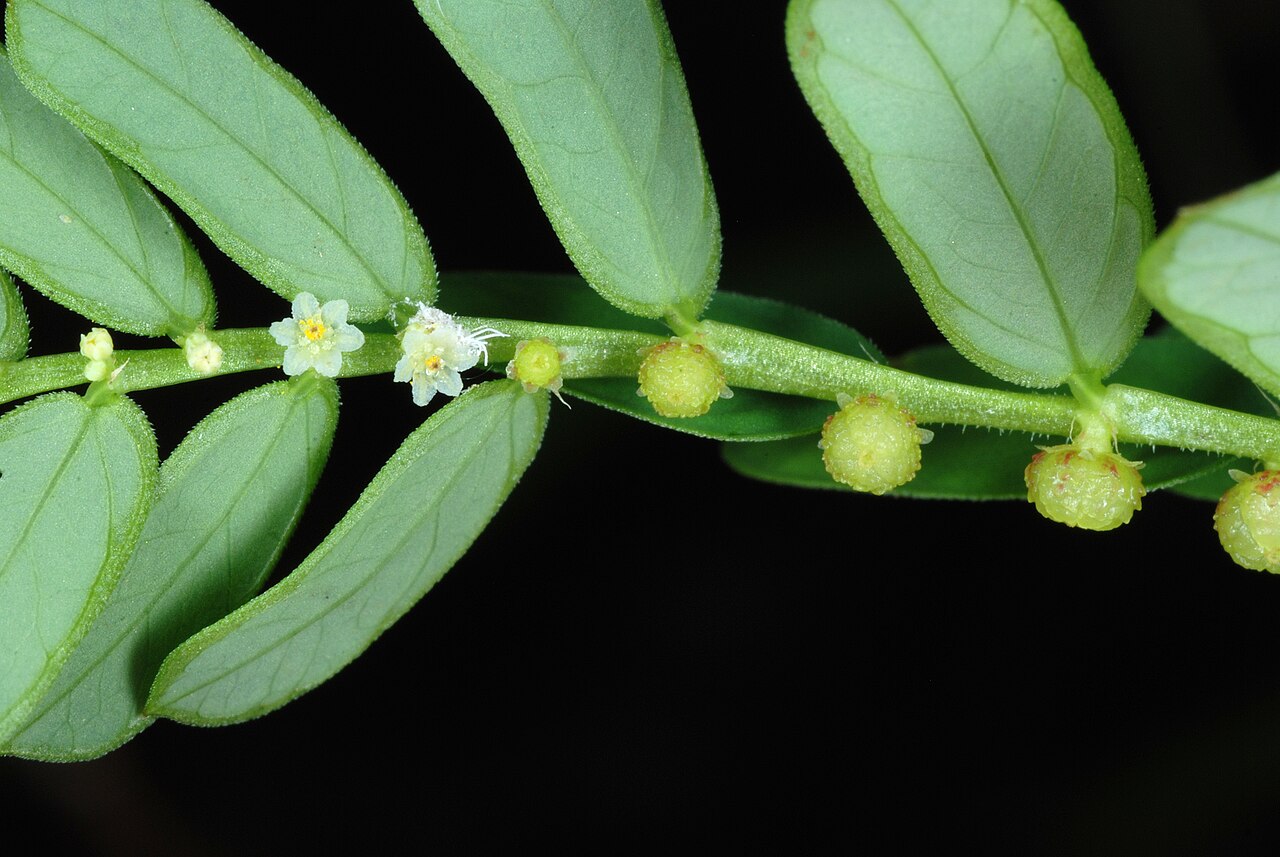

Chamber bitter is a small summer annual with a talent for looking harmless. Slender, often reddish stems carry many small paired leaflets in two neat ranks, giving the whole plant a ferny, almost mimosa-like look — which is why people call it little mimosa and gripeweed, and why it fools gardeners into leaving it alone until it is too late. The giveaway is underneath: tiny flowers and fruits line up along the underside of the leaf stems, as if the plant were wearing its seeds on the bottom of its sleeves. Look closely and you will see small, round, smooth fruits, green turning reddish, tucked right against the stem.
Here is where identification gets interesting, and where most guides wave their hands. “Chamberbitter” in Florida is actually two weeds wearing one name. Phyllanthus urinaria is the shorter, more compact one, rarely above 12 inches, with fruits attached directly to the stem — no stalk. Its cousin, long-stalked chamberbitter (Phyllanthus tenellus), grows up to 2 feet tall, and its fruits dangle on stalks roughly half a centimeter to a centimeter long. That stalk is the tell. If the fruits sit flush against the stem, you are looking at urinaria. If they hang on little stalks, you are looking at tenellus. Both are aggressive. Both want your garden beds. Knowing which one you have matters mostly because tenellus has a party trick: its fruits split open explosively, flinging seeds more than 3 feet away. Yes, your weed can throw its own babies across the bed.
Do not confuse chamber bitter with native sunshine mimosa (Mimosa strigillosa). They share the feathery, mimosa-like look, and that is exactly how good natives get ripped out by accident. Sunshine mimosa is a groundcover with pink powder-puff flowers, and it belongs in your yard. Chamber bitter has no powder-puffs, just that sneaky line of fruits under the leaf stems. If you are unsure, snap a photo or take a sample to your county Extension office before you pull anything. Pulling the wrong plant is the one mistake in this guide that actually costs you something good.
What it likes
Chamber bitter loves exactly what vegetable gardeners love: warm soil, moisture, and freshly disturbed ground. It is a warm-season annual that germinates in summer, and its seeds can lie dormant in the soil for years, waiting for the one thing that wakes them up — light. Every time you till, dig, or turn a bed, you flash a little sunlight onto seeds that have been sleeping, and they sprout. That is why it shows up in beds and not in undisturbed lawn soil: the lawn never gives it the light it needs. In turf, a dense, healthy stand of grass is its worst enemy, because shade and competition keep the seeds asleep.
It is also a common nursery weed, which means it can arrive in your yard riding along in a pot with a plant you actually wanted. Check new nursery plants for tiny mimosa-like seedlings before you set them in a bed, and do not be shy about picking them out. One hitchhiker this year is a thousand plants next year.
Control challenges
Chamber bitter is hard to beat for three reasons, and understanding all three saves you a season of frustration. First, the seed bank: seeds stay viable for years and germinate the moment light reaches them, so every disturbance is a fresh crop. Second, the plant cheats at mowing: it flowers and sets seed even when kept at 2 inches tall, below mower height, so mowing a lawn will not stop it from reproducing. Third, timing: once a chamber bitter plant develops a woody base, it becomes very difficult to control even with herbicides. The window for easy control is while it is young and tender. Miss that window and you are fighting a shrub.
Getting rid of it, for good
Pull before seeding. That is the whole sermon, and the rest is footnotes. Scout your beds often in summer, pull plants the moment you spot them, and bag seed-bearing plants and trash them — do not toss them in the compost and do not leave them on the ground, where the fruits can finish ripening and drop their seeds anyway. Repeat, because the seed bank guarantees a second and third wave. This is a marathon, not a sprint, and the gardeners who win are the ones who pull a little, often, all season.
Mulch thick. This is the part people get wrong. A thin scatter of wood chips does nothing — light still reaches the soil and the seeds wake up anyway. Extension guidance calls for 2 to 3 inches of mulch over cleared beds, and that depth is what actually smothers germination. After you pull a patch clean, mulch it deep, right away, before the next wave sprouts.
Replace cleared space with competitive plantings. Bare soil is an invitation, and chamber bitter accepts every invitation it gets. Fill the gap with something that holds its ground. Muhly grass (Muhlenbergia capillaris) is the documented example: a native ornamental grass that never outgrows its space, and once it is established, it shades the soil and crowds out seedlings. A bed full of plants you chose is a bed chamber bitter cannot colonize.
In lawns, the strategy is turf health: dense grass, mowed at the right height, watered only as needed. Seedlings do best in moist conditions, so reducing irrigation where you can helps, and a thick lawn shades the soil the way mulch shades a bed. For larger infestations, herbicides exist and Extension lists them — a pre-emergent applied around April for the coming season, and post-emergent products used in cooler temperatures, on consecutive days under 90 degrees Fahrenheit, before plants develop that woody base. If you go that route, the label is the law, and your county Extension office can tell you what is currently labeled for your lawn grass and your situation. Hand-pulling, thick mulch, and competitive plantings are the site’s first recommendation, and they work. Herbicides are the backup plan, not the opening move.
Seed prevention, not seed saving
Let’s be blunt up front: this is not a seed-saving section, because chamber bitter is one plant you should never deliberately sow. It is a prolific, weedy summer annual that makes its living by out-seeding everything around it — a single plant can produce thousands of seeds, and those seeds can sit in the soil seed bank and keep sprouting for seasons after the parent plant is gone. Saving its seed on purpose is like bottling a weed invasion and handing it to your future self.
The trick to its success is written under its leaves. Chamber bitter lines the undersides of its branches with tiny round capsules, each holding a few seeds, and as the capsules dry they burst open and fling their seeds outward — botanists call it explosive dehiscence, gardeners call it “how did it get over there.” The seeds need warm soil, roughly above 75°F, and light to germinate, which is why they explode into life in Florida’s long, hot, bright summers and keep coming in waves until a killing frost. It is listed as invasive in Alabama and is a serious nursery and landscape weed across the Southeast, so this is not a plant to give a helping hand.
Prevention is a timing game, and the winning move is pulling plants while they are young and tender, before a single capsule ripens. Check nursery pots before you plant anything new — chamber bitter is a notorious nursery hitchhiker, and one contaminated pot can seed a whole bed. When you pull a plant that has already set seed, bag it and trash it: do not shake the soil off the roots over the bed, do not leave pulled plants lying on the ground where capsules can finish ripening, and do not compost them — home compost rarely gets hot enough, for long enough, to kill this seed.
A thick mulch layer, a couple of inches or more, helps by shading the soil surface, since these seeds want light to sprout — but mulch is a delay, not a cure, because the seed bank guarantees a second and third wave. Scout often all summer, pull a little every time, and expect the job to take more than one season. The gardeners who beat chamber bitter are not the ones with the strongest spray; they are the ones who never let a plant finish making seed.
The name game, and the status question
Let us be precise about what chamber bitter is and is not, because the internet is not. It is an aggressive garden weed from Asia, with a long medicinal history in traditional practice — urinary complaints and kidney stones, which is where the names stonebreaker and shatterstone come from, and where the species name urinaria points, too. It may have arrived here through medicinal use, or as dormant seeds riding along in nursery stock, or both. That history is background, not advice: this guide makes no medicinal claims and no recommendations about using this plant. Talk to a clinician before putting any weed in your body, including this one.
Now the status question, stated sharply. Chamber bitter is not on the Florida Invasive Species Council’s list of invasive plants. That list is about damage to natural areas — wild lands, preserves, native ecosystems — and chamber bitter has not caused significant damage there. It is an aggressive garden weed, not a listed invasive, and those are different categories. But do not read that as harmless. It is recognized as invasive in Alabama and appears on the Southeast Exotic Pest Plant Council’s list, which covers both urinaria and tenellus. “Not listed in Florida” means its damage here is to gardens and beds, not to wild lands. It does not mean your vegetable patch is safe.
And one more honest distinction: Florida has native leafflowers too, like Carolina leafflower (Phyllanthus caroliniensis) and Florida leafflower (Phyllanthus liebmannianus), plus several nonnative ones besides chamber bitter. Not every tiny leafflower in your yard is chamber bitter, and telling them apart takes a key. The fruits-under-the-stem trick identifies the genus. The stalk tells you which chamberbitter. The rest takes a closer look — and when in doubt, Extension exists for exactly this question.
🌱 Nerdy fact: the genus name Phyllanthus means “leaf-flower,” because the flowers and fruits appear to grow straight out of the leaves — really they sit on flattened stems that mimic leaves, with the fruits tucked underneath. The genus holds roughly 800 species worldwide, mostly tropical, and chamber bitter is the one that learned to live in your raised bed. Its cousin tenellus does not just drop seeds. It fires them, explosively, more than 3 feet from the parent plant. Your weed has a catapult. Pull it before it loads.
🌿 Its partner in this pair: Sandspur (Cenchrus spp.) — the native weed that proves “native” and “welcome” are not the same word.