
🌿 Florida Water Aster
What it looks like
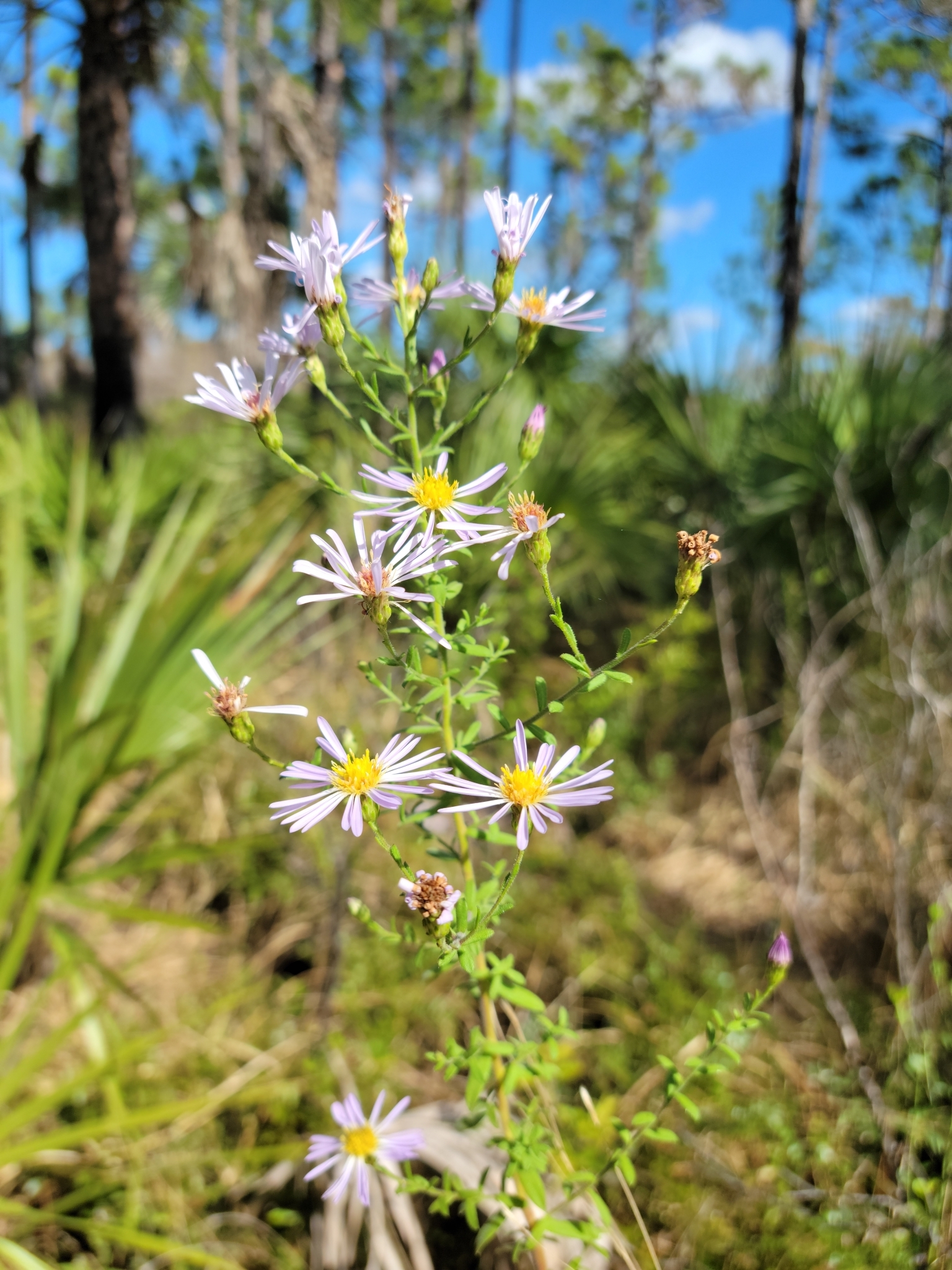
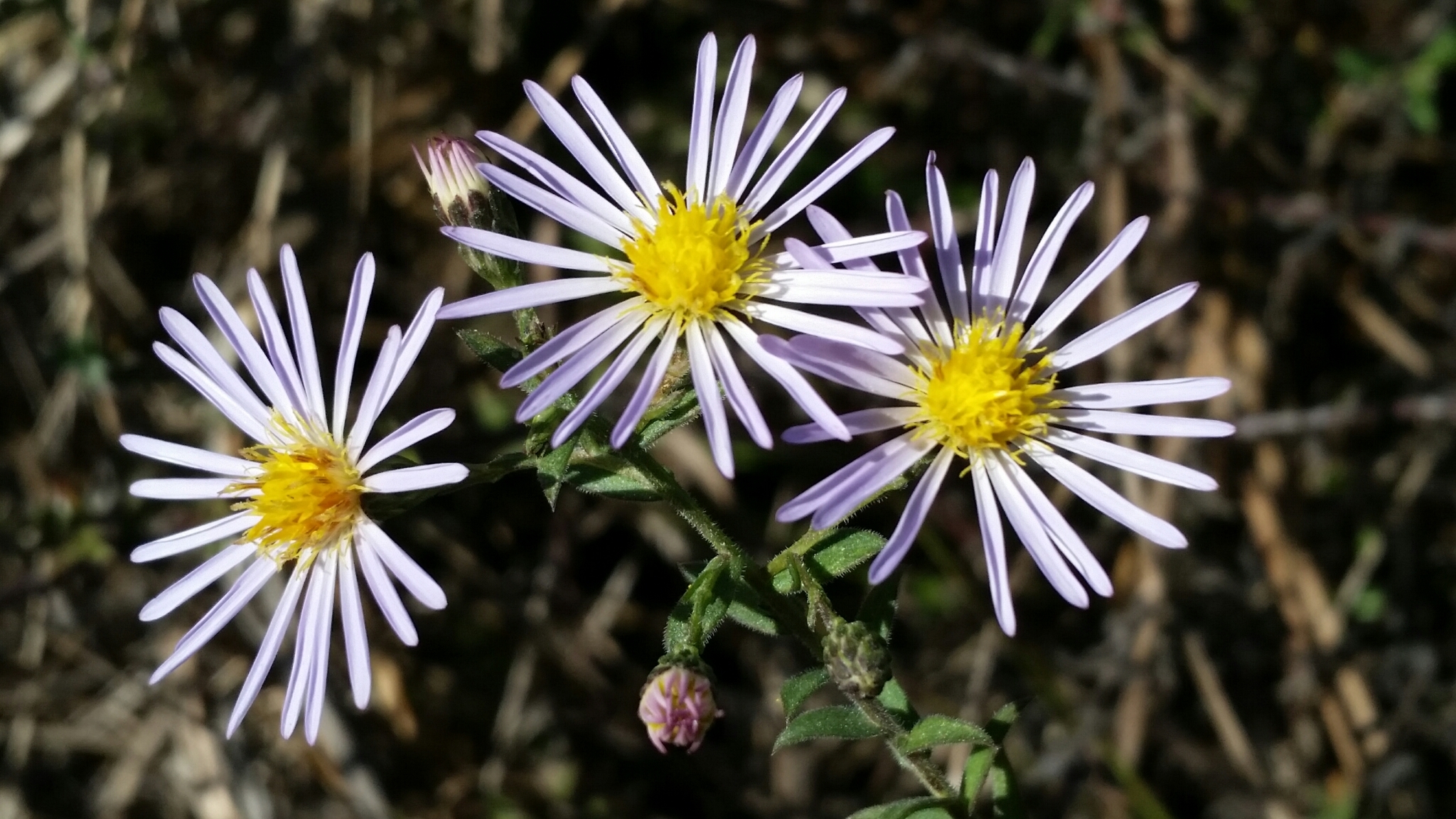
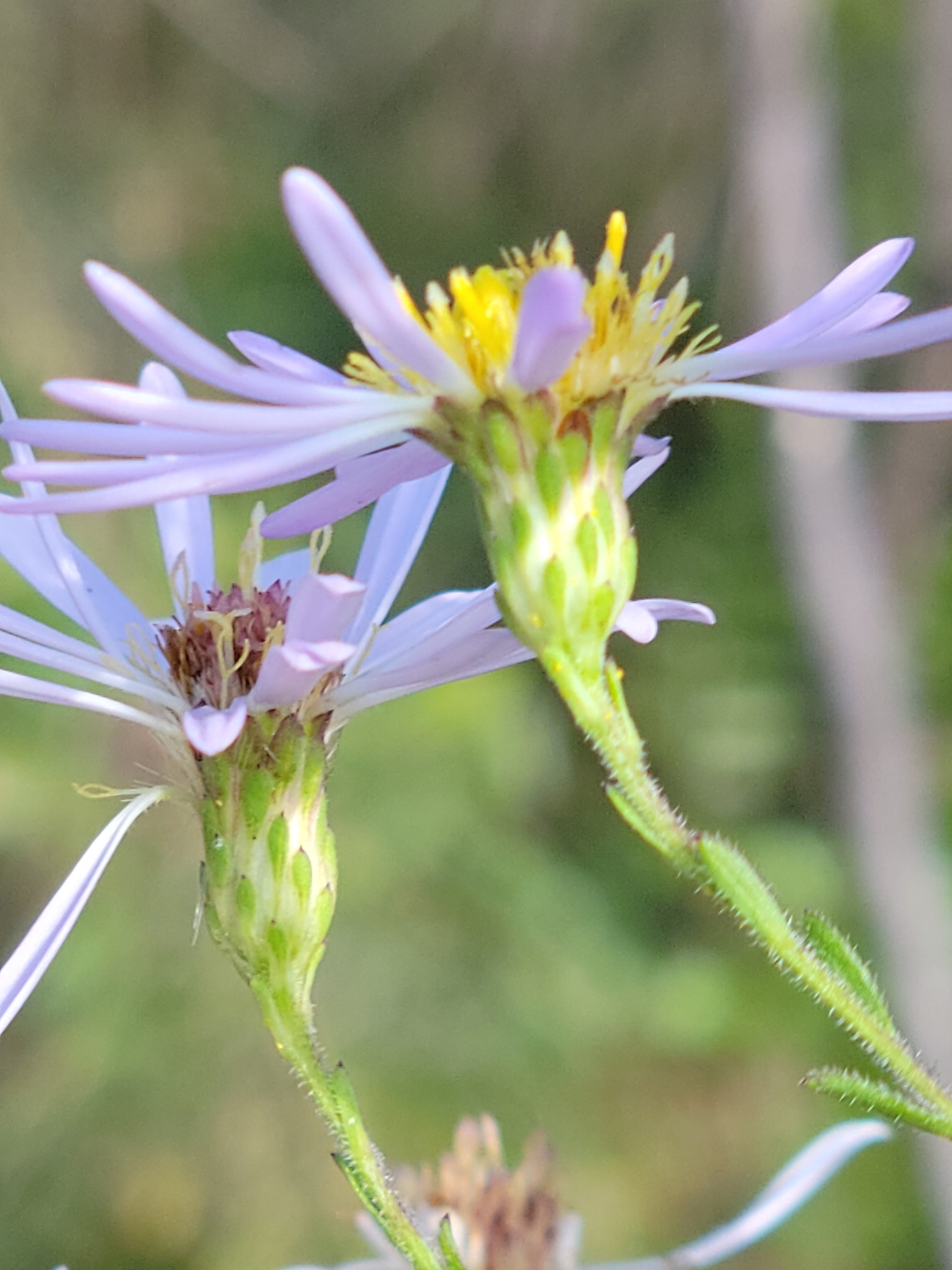
Florida water aster is a perennial, one to three feet tall, that grows in colonies from long underground rhizomes — a plant that spreads sideways through wet soil the way a rumor spreads through a small town. The stems stand straight, light to reddish brown, and feel slightly rough to the touch, covered in tiny stiff hairs. The leaves are firm and dark green, with entire margins and faces that are sparsely to moderately rough-scabrous, like fine sandpaper. The basal leaves are gone by flowering time, which is normal for this plant, not a sign of trouble.
The leaves are where the identification lives. The lower stem leaves are obovate to oblanceolate — widest above the middle, tapering toward the base — with bases that are rounded or narrowly clasping, and their bases are not constricted just above where they meet the stem. That unconstricted base is the single most useful field mark, and it is the one that separates this plant from its closest Florida relative, late purple aster. The upper leaves get smaller as they climb the stem, turning lance-shaped to oblong-lance-shaped, with bases that clasp the stem loosely and tips that end in a tiny white point. Toward the top the leaves shrink into bracts along the flowering branches.
The flowers are the reward for wading into a marsh in November. Each head carries 15 to 30 ray florets in purplish-blue to lavender, each ray about a third to a half inch long, around a center of 19 to 25 disc florets that open cream to pale yellow and age reddish-purple — so a single plant carries both fresh yellow centers and older wine-colored ones at once, like a bouquet that is two ages at the same time. The heads sit in wide to narrow branching panicles, 4 to 400 of them on a well-grown plant, and the cup beneath each head — the involucre — is cylinder- to bell-shaped and 6 to 7.6 millimeters long, with four to five overlapping series of bracts whose green zones are elliptical to lance-shaped and often flushed red or purple at the tips. The seeds are small, tan, slightly flattened, and wear a dingy tuft of bristles for wind travel.
The name is a small geography lesson. Fontinale comes from the Latin fons, a spring or fountain: this is the aster of springs and wet ground. It was first described as Aster fontinalis by Alexander in 1933, from a specimen collected south of Deep Lake in Collier County in December 1925, and moved into Symphyotrichum by Nesom in 1995 — the same genus reshuffle that moved every North American aster out of the Old World genus Aster once DNA showed they were a different lineage entirely.
How to tell it from its lookalikes
Asters are famously hard to tell apart, and Florida water aster has been mistaken for its relatives more than once — the Flora of North America notes it has been treated as the same plant as late purple aster and even as rice button aster. Here is the field test, straight from the Flora of Florida key.
- Late purple aster (Symphyotrichum patens). The closest lookalike and the one that matters most. In late purple aster the lower stem-leaf bases are broadened just above a constriction — the leaf pinches in, then flares — and the upper leaves are narrowly to broadly egg-shaped with strongly heart-shaped, clasping bases. In Florida water aster the lower leaf bases are not constricted at all, and the upper leaves are lance-shaped with wedge-shaped to rounded, loosely clasping bases. If the leaf base pinches and flares, it is not this plant.
- Georgia aster (Symphyotrichum georgianum). Georgia aster’s flower bracts, stems, and leaves are stipitate-glandular — covered in tiny stalked glands — its leaf margins roll under, and its rays are much longer, 14 to 24 millimeters. Florida water aster is essentially glandless, its leaf margins lie flat, and its rays top out around 13 millimeters.
- Rice button aster (Symphyotrichum dumosum). A much smaller-headed aster of drier ground, with heads in the rice-button range and leaves that spread or hang downward rather than clasping. Florida water aster’s heads are larger, its leaves clasp, and it grows with its feet wet.
- Climbing aster (Symphyotrichum carolinianum). A sprawling, scrambling vine-like aster of wet places that can share the same marsh edge — but it climbs and sprawls where Florida water aster stands upright, and its heads are larger still.
When in doubt, the checklist is: wet ground, November bloom, lower leaves unconstricted at the base, upper leaves lance-shaped and loosely clasping, involucre 6 to 7.6 millimeters. Three out of four is a strong hint; all four is a confident identification.
Where it grows in Florida
Florida water aster is a Florida endemic — the Flora of Florida marks it with the endemic symbol, and the Flora of North America lists its range as Florida alone. (One Georgia record, from Grady County, appears in some databases, but the Floras treat this as a Florida plant.) Vouchered specimens come from Alachua, Citrus, Collier, Dixie, Lee, Liberty, Marion, Miami-Dade, Monroe, Pasco, and Taylor counties — a scattered distribution across the peninsula and the eastern panhandle, from the Big Bend to the Everglades fringe.
It grows in moist, sometimes peaty soils: marshes, sandhills, hammocks, floodplains, ditch banks, and rocky bluffs along streams, from sea level to about 50 meters. That list is a good summary of the plant’s personality — it wants its feet damp, but it is not a plant of standing deep water. It is a plant of edges: the marsh edge, the floodplain edge, the damp hammock where the ground stays moist long after the rain stops. It is listed as a species of conservation concern, ranked G3 (vulnerable) by NatureServe, which means it is uncommon enough that losing its wet places would cost Florida a plant that exists nowhere else on Earth.
How to grow it — or leave it
Here is the honest answer: there is no verified cultivation guidance for Florida water aster. It is not in the nursery trade, no garden trial has documented how it behaves in a bed, and the sources that describe it are floras and herbarium records, not growing guides. So this section is a “leave it” section, and that is the right call for a rare endemic.
If you find it in the wild, enjoy it where it stands, photograph it, and leave the plant and its rhizomes exactly where they are. Do not dig it, do not collect seed from wild plants, and do not try to move it to a garden — a G3 endemic with a scattered distribution does not need enthusiastic gardeners as an additional pressure. Its wet habitat is also the reason it is vulnerable: marshes and floodplains are drained, filled, and ditched faster than almost any other Florida habitat, and a plant that only lives in wet ground has nowhere to retreat to.
If you have a genuinely wet spot in your yard — a rain garden, a pond margin, a low place that holds water after storms — and you want a native aster there, the honest recommendation is to plant one of Florida’s common wet-ground asters instead, such as climbing aster or Elliott’s aster, both of which are available from native-plant nurseries and documented as garden plants. Florida water aster’s job is to be wild, in the marshes that still exist, blooming in November for the pollinators that are still working.
Pollinators & wildlife
Florida water aster blooms in November and December, which is late — very late — for a Florida wildflower, and that timing is its ecological gift. By November most of the summer flowers are finished, but bees, butterflies, and other pollinators are still active in Florida’s mild autumn, and a colony of water aster in full bloom is a late-season nectar and pollen bar. The small, open, daisy-like heads are the right shape for generalist pollinators: small native bees, syrphid flies, skippers, and butterflies that cannot work a deep tubular flower.
Two honest caveats. First, no published study has documented exactly which pollinators visit this species — the claim here is the general aster one, not a species-specific observation, and it is stated that way on purpose. Second, asters as a group are caterpillar host plants — the site’s heath aster guide notes that Pearl Crescent caterpillars feed on true asters — but no source ties Pearl Crescent or any other caterpillar specifically to Florida water aster, so this guide does not claim it. The seeds, like other aster seeds, are eaten by small birds through the winter, and the standing stems shelter overwintering insects. A late-blooming native aster in a wet place is doing real work even when nobody is watching it do it.
Varieties
None. Symphyotrichum fontinale has no recognized varieties — the species is the whole story. There is one naming footnote worth knowing: it was once treated as a variety of late purple aster, Aster patens var. floridanus, before botanists recognized it as a species in its own right. If you see that old name on a herbarium label or in an old field guide, it is this plant.
Frequently asked questions
Is Florida water aster really found only in Florida?
Yes, as far as the Floras are concerned. The Flora of Florida marks it endemic, and the Flora of North America lists its range as Florida alone. A single Georgia record from Grady County appears in some databases, but the authoritative Floras treat it as a Florida endemic — a plant that belongs to this state the way the Florida panther belongs to it.
When does it bloom?
November to December, according to the Flora of North America. That is unusually late for an aster and is one of the best field clues: if you are looking at a lavender-blue aster in a Florida marsh in November, Florida water aster should be at the top of your list.
How do I tell it from late purple aster?
Look at the leaf bases. In Florida water aster the lower stem-leaf bases are not constricted where they meet the stem, and the upper leaves are lance-shaped with wedge-shaped to rounded, loosely clasping bases. In late purple aster the lower leaf bases are broadened just above a pinched constriction, and the upper leaves are egg-shaped with strongly heart-shaped, clasping bases. Leaf base first, flower color second — the flowers of the two are similar enough to fool anyone.
Can I grow it in my garden?
Honestly, no — not in any documented way. It is not sold by nurseries, no cultivation guidance exists for it, and it is a rare endemic of conservation concern. If you have a wet spot, plant climbing aster or Elliott’s aster instead, and leave Florida water aster in the wild places where it already grows.
Is it endangered?
It is not federally listed, but it is a species of conservation concern, ranked G3 (vulnerable) by NatureServe. Its scattered distribution and its dependence on wet habitats — marshes and floodplains that are easily drained or developed — are the reasons. The Florida Natural Areas Inventory does not list it as state-endangered, but “not listed” and “not at risk” are different things.
What kind of soil does it need?
Moist, sometimes peaty soil — the kind of ground you find in marshes, floodplains, and damp hammocks. It is not a plant of dry sand or of standing deep water; it is a plant of damp edges, where the soil stays moist long after the rain.
Does it have any other common names?
No — Florida water aster is the only common name in use, and it fits: the plant of Florida’s wet places. Its scientific name has changed, from Aster fontinalis (1933) to Symphyotrichum fontinale (1995), but the common name has stayed put.
What pollinators use it?
No species-specific pollinator study exists for this plant, so the honest answer is the general aster one: its open, daisy-like heads suit small native bees, syrphid flies, skippers, and butterflies, and its November bloom makes it a late-season nectar source when most other flowers are finished. That timing is probably its most important wildlife value.
Why does it bloom so late?
Nobody has published a reason, and this guide will not invent one. What is known is that it flowers in November and December, in wet habitats, at low elevation, across a scattered Florida range — and that a late bloom in a wet place is a strategy that works, because the pollinators are still out and the competition has gone home.
Can I collect seeds from a wild plant?
Please do not. It is a rare endemic of conservation concern, and wild collection — even of seed — is an additional pressure on scattered populations. Photograph it, record where you saw it, and leave the seeds for the birds and the marsh.
🌱 Keep learning
Three related guides worth reading next:
- Aster: Growing Guide — Asters as a group — how the genus works, and where Florida water aster fits inside it.
- Elliott’s Aster (Symphyotrichum elliottii) — Another wet-ground Florida aster, and one you actually can grow — the garden-friendly cousin of this wild marsh plant.
- Climbing Aster (Symphyotrichum carolinianum) — The sprawling vine-like aster that shares Florida water aster’s marsh edges — and the best wet-spot aster for a real garden.