
🏛️ London Planetree
What it looks like

Quick facts
- Sun: Full sun to partial shade
- Soil: Tolerates sand, loam, and clay; wide pH tolerance (about 3.7 to 8.2 per Virginia Tech); prefers moist, well-drained soil but handles dry sites
- Spacing: 50 to 70 feet from other large trees and structures — this is a very large tree
- Height: 70 to 100 feet tall, 60 to 80 feet wide at maturity
- Life cycle: Long-lived deciduous tree, fast to moderate growth
- Zones: Commonly listed zones 5 to 8, with some references stretching to zone 9
- Florida: Marginal in Florida — a temperate-zone city tree; North Florida at best, and even there it is not at its best
What it is — a hybrid, stated plainly
London planetree is a hybrid, and its parentage is the whole story. One parent is the American sycamore (Platanus occidentalis), the great river-bottom tree of eastern North America. The other is the Oriental plane (Platanus orientalis), the Eurasian plane of river valleys from southeastern Europe to western Asia. Cross them — the cross happened in cultivation in Europe centuries ago, and its exact origin is still debated — and you get Platanus × acerifolia, also called Platanus × hispanica. The two names refer to the same hybrid; nurseries use acerifolia most often.
Why plant a hybrid instead of either parent? Because the hybrid inherited the best of both: the American parent’s vigor and cold tolerance, the Oriental parent’s tolerance of pruning, pollution, and dry urban soil, and — crucially — better resistance to anthracnose, the fungal disease that defoliates American sycamores in wet springs. That is why London planetree became the street tree of London, Paris, and a hundred other cities: it survived coal smoke, compacted soil, and hard pruning when its parents struggled.
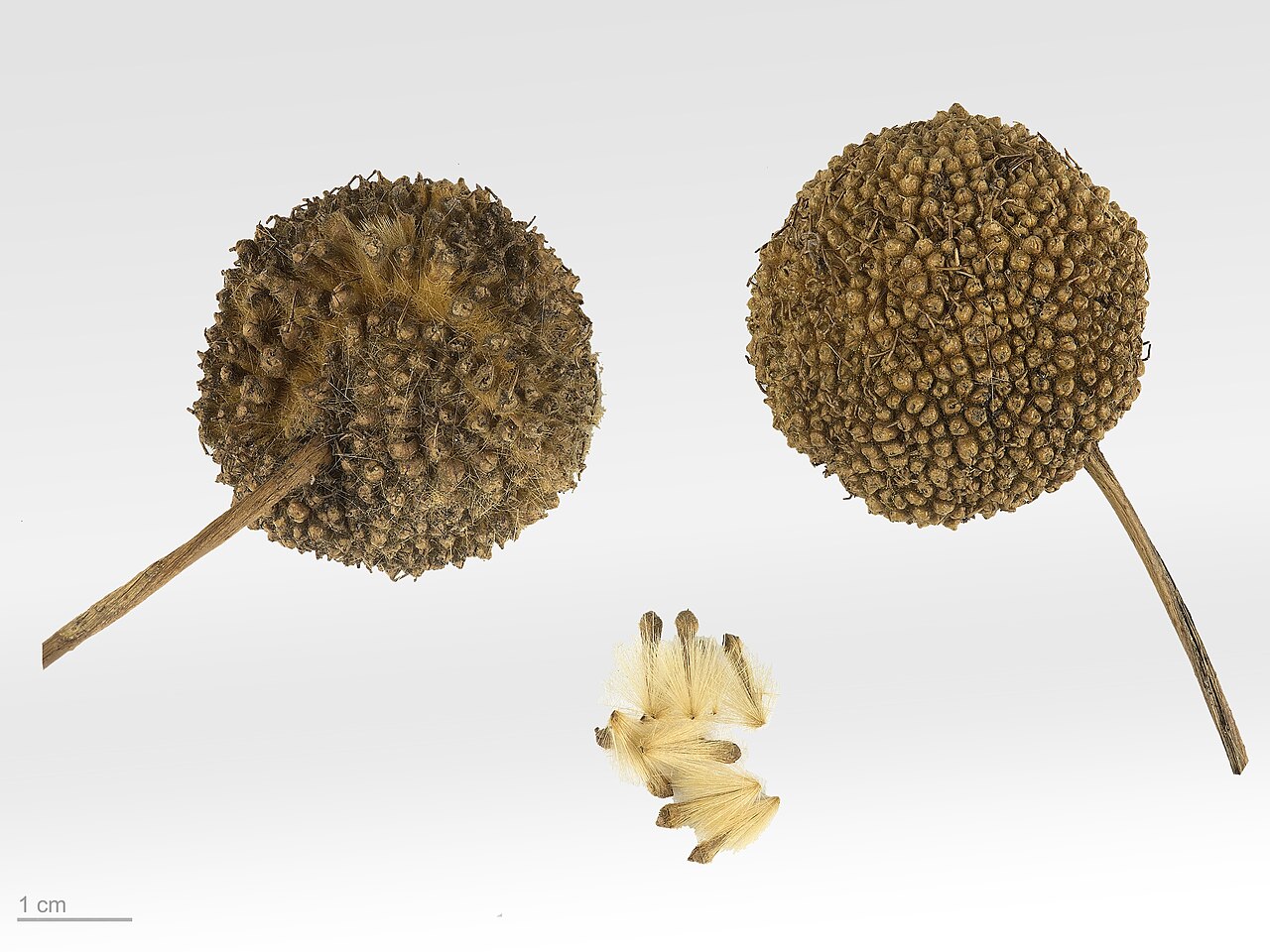
Identification is a satisfying puzzle. The bark flakes off in large patches, exposing a mottled mosaic of cream, olive, tan, and gray — camouflage bark, unmistakable in winter. The leaves are large, maple-like, 3- to 5-lobed, and the fruit hangs in round, spiky balls: usually two (sometimes one to three) per stalk on London planetree, versus a single ball per stalk on American sycamore. That fruit count is the fastest field mark, and it works every time.
Growing London planetree — and the Florida honesty check
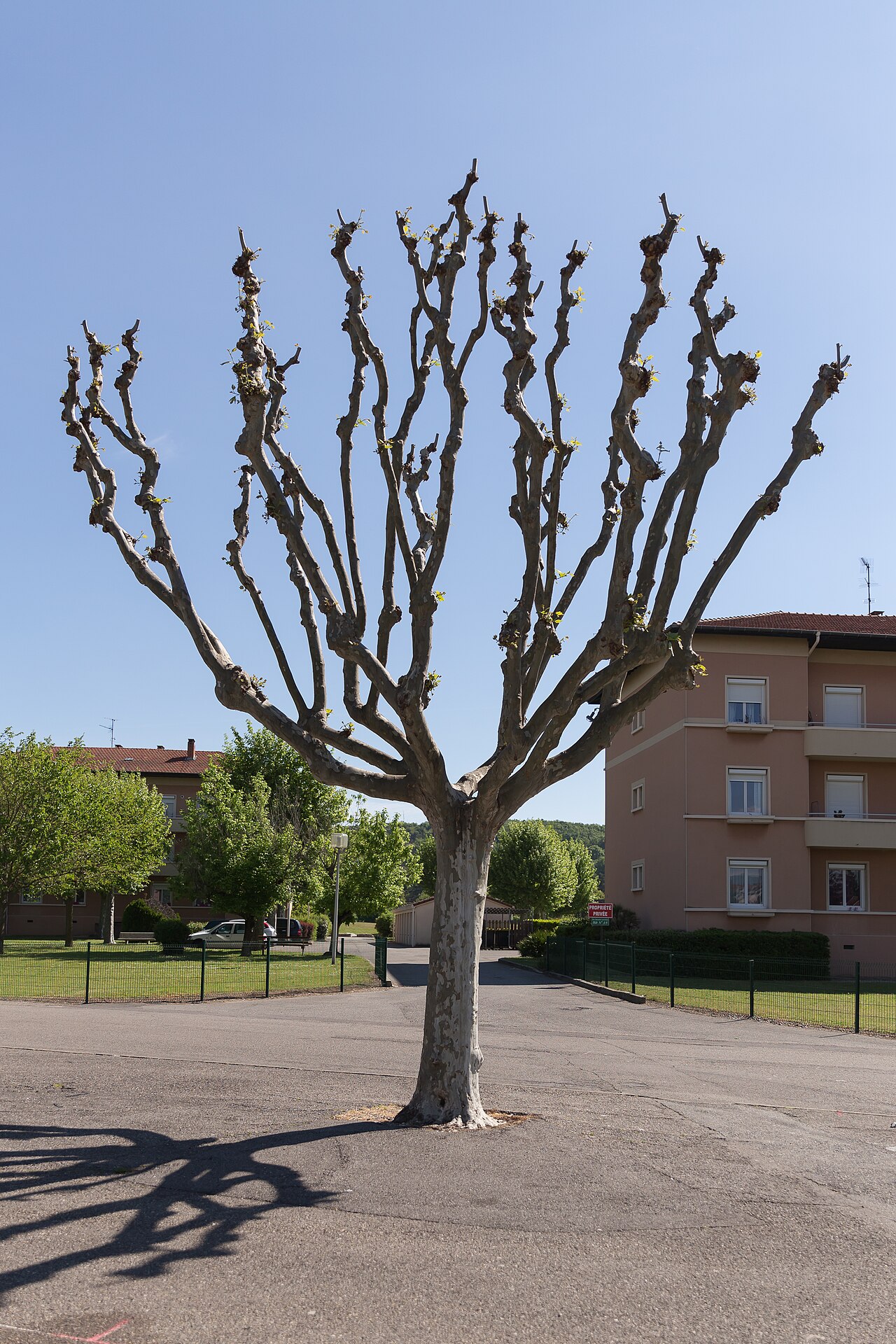
In its proper climate — temperate, with real winters — London planetree is nearly indestructible: full sun, almost any soil, pollution, compaction, drought once established, and hard pruning including pollarding (cutting back to a framework each year, the classic Parisian treatment). Plant it with room, because a 70-to-100-foot tree with a 60-to-80-foot crown and a root system that heaves sidewalks is not a small-yard tree. Water deeply until established, mulch widely, and prune in late fall or winter to avoid the worst of anthracnose season.
The Florida check is honest and short: this is a temperate-zone tree, and Florida is not its climate. References list it to zone 8 or 9 at the warm end, which on paper includes North Florida — but zone numbers only measure winter cold, and London planetree’s problems in Florida are summer heat, humidity, and disease pressure, not winter. In North Florida it may grow, but it will not be the magnificent, trouble-free street tree it is in a temperate city; expect more disease, more stress, and a shorter, harder life. In Central and South Florida, do not plant it. If you want the mottled-bark, big-shade look in Florida, plant a native shade tree built for the climate instead — the sycamore family has given Florida its best tree already, and it is the native one growing by the rivers.
Cultivars and problems
If you are planting London planetree where it belongs, choose a cultivar selected for disease resistance: ‘Bloodgood’ (one of the first anthracnose-resistant selections, large and rounded), ‘Columbia’ (pyramidal, resistant to mildew and anthracnose), and ‘Liberty’ (a U.S. National Arboretum introduction, vigorous, pyramidal, tolerant of mildew, anthracnose, heat, and drought) are the classic trio, with ‘Yarwood’ and ‘Exclamation!’ (sold as ‘Morton Circle’) as further resistant options. Resistance varies by report — anthracnose resistance is real but not absolute, and it depends on the cultivar — so buy the resistance, do not assume it.
Problems, besides anthracnose: powdery mildew, cankerstain (a serious fungal disease spread by pruning tools — disinfect between trees), lace bugs, and frost cracking of bark in harsh winters. The tree is also messy: leaves, twigs, and fruit balls drop through the seasons, and the fine hairs on young leaves and fruit can irritate lungs — one reason street crews wear masks around plane trees in spring. Big tree, big presence, big cleanup. Price it in.
Where this guide came from
London planetree is one of the trees surveyed in the group guide. See also the Sycamore guide, which surveys the whole group this plant belongs to.
Propagation
Do not try to grow a London planetree from seed and expect the same tree back. The London planetree is a hybrid — the American sycamore crossed with the Oriental plane, a cross made in cultivation in Europe centuries ago — and hybrids do not come true from seed. The seed inside those spiky brown balls is a genetic lottery: a seedling might favor either parent, and it will certainly not match a named cultivar like ‘Bloodgood’ or ‘Exclamation’. If you want a particular cultivar, with its particular disease resistance and shape, you need a clone of that cultivar, and clones are made by cuttings and grafting, not by sowing.
The workhorse method is hardwood cuttings, and the tree makes it easy. In late winter, while the tree is still dormant, take pencil-thick cuttings of one-year-old wood, each with several buds, and set them in a gritty, well-drained mix in a sheltered spot. Keep the mix moist but never soggy, and be patient — roots form over weeks, and the cutting leafs out in spring as if it had never been separated from the parent. Named cultivars are also grafted onto seedling rootstocks by nurseries, which is how the trade guarantees you are getting the real ‘Bloodgood’ and not a hopeful lookalike. Either way, the new tree is genetically identical to its parent, bark like camouflage and all.
Seed still has its place, just a humbler one. If you want a seedling rootstock for grafting, or you simply want a plane tree of no particular pedigree, the seed is free and abundant: the balls break apart in late winter into a mass of tiny seed tangled in fine hairs. But handle those balls with respect — the hairs are a famous irritant, scratching skin and catching in throats and lungs, so wear gloves and a mask, work outdoors or in a ventilated space, and do not rub your eyes mid-job. Sow the seed shallowly in spring after the last frost, keep it moist, and thin the seedlings to the strongest. Expect variety: that is the point of seed, and also its limitation.
One honest note about place. London planetree is a temperate-zone city tree, commonly listed for zones 5 to 8 with some references stretching to zone 9, and it is marginal in Florida — North Florida at best, and even there it is not at its best. The propagation advice here is for gardeners inside its range, where a rooted cutting has decades of pavement and pollution ahead of it. Wherever you plant one, give it room: this is a 70- to 100-foot tree, and a cutting planted ten feet from the house is a future argument with the foundation. Label your cuttings with the cultivar and the year, because a row of identical sticks in a nursery bed is a memory test you will fail by spring.
Varieties
Every named variety of London Planetree with its own growing guide:
- Bloodgood London Planetree — The classic city planetree: a large, rounded, fast shade tree selected for anthracnose resistance — the one that built the London street-tree reputation.
- Columbia London Planetree — The pyramidal planetree: a tougher, mildew- and anthracnose-resistant selection with deeply lobed leaves that heals pruning wounds well.
- Exclamation London Planetree — The upright planetree with the punctuation to match: uniform, pyramidal, anthracnose-resistant shade for streets that need a clean line.