
🌿 Perennial Saltmarsh Aster
What it looks like
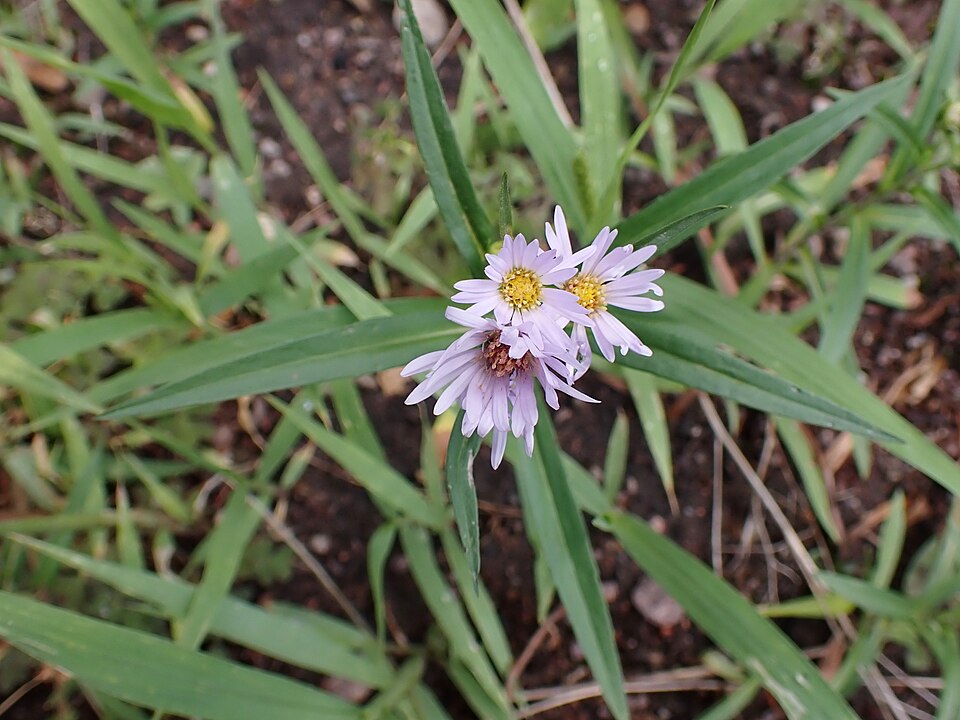
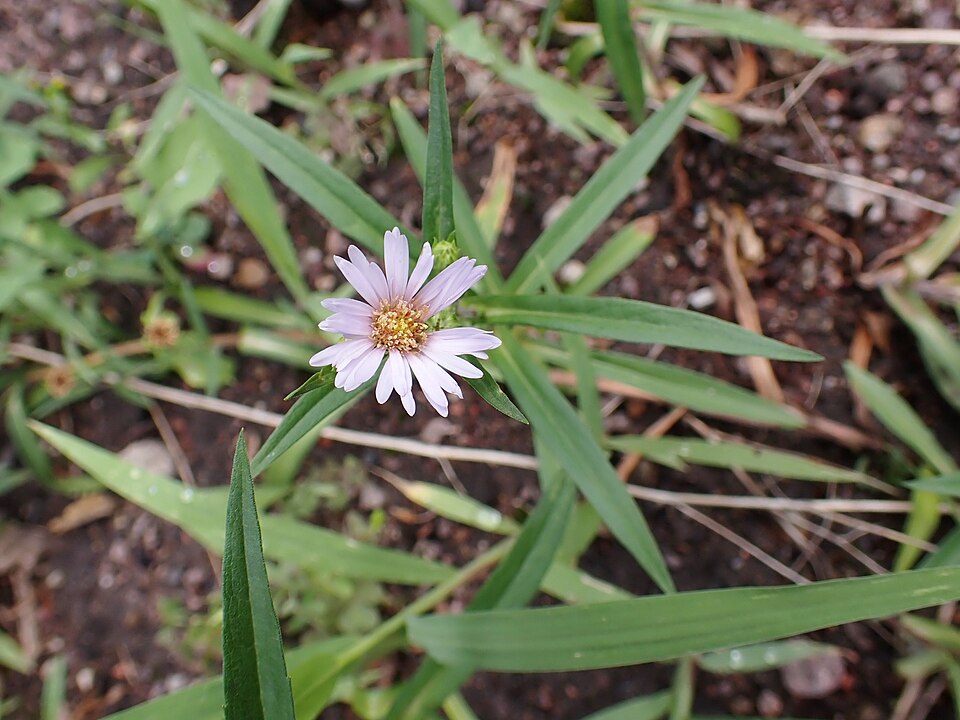
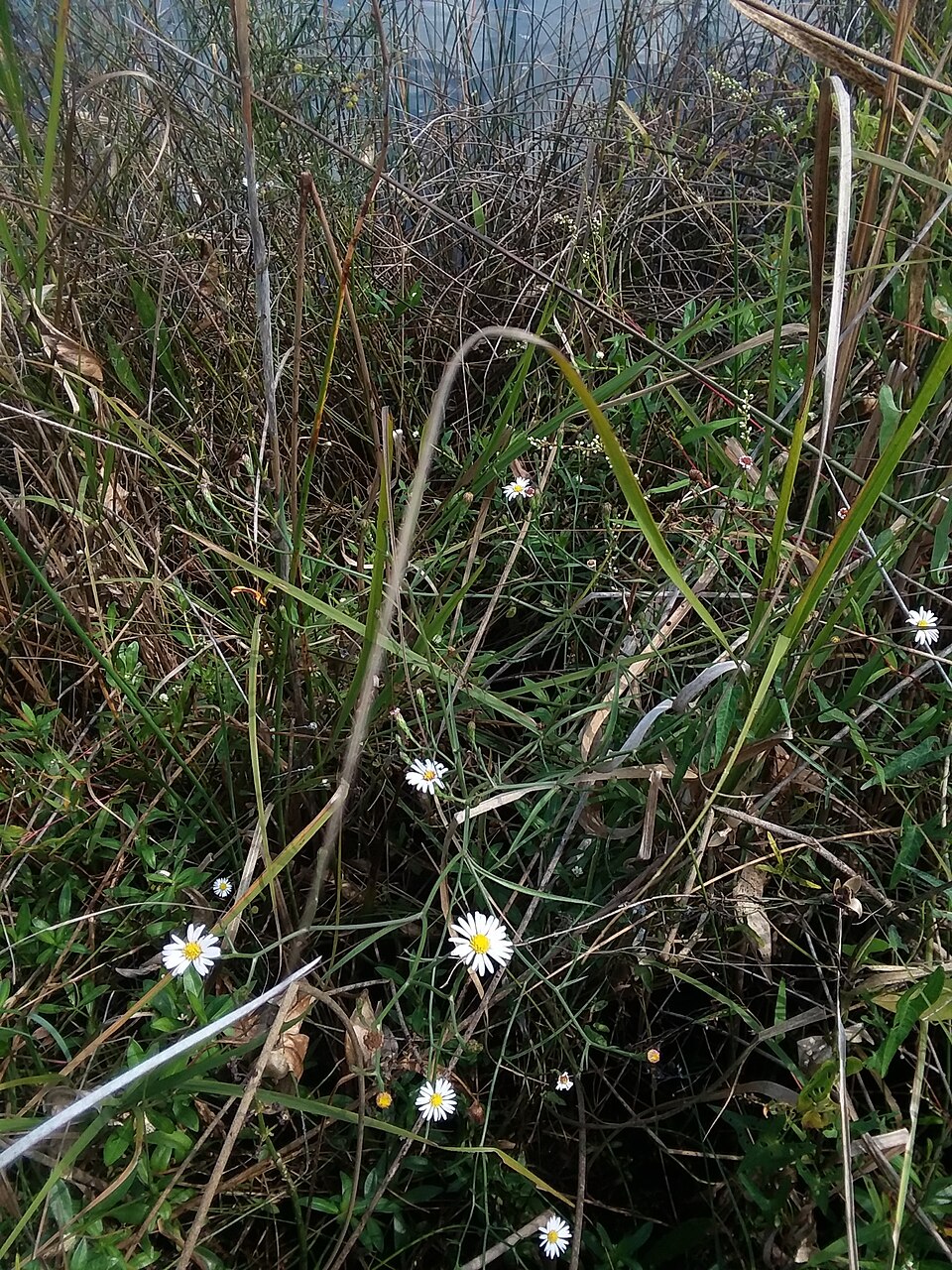
Perennial saltmarsh aster looks like a plant that forgot to finish getting dressed. The stems are wiry and flexuous — they zig-zag rather than growing straight — and they are often tinged purple or purplish brown. The leaves are few, narrow, and thick, almost fleshy, with smooth edges, and the lower ones wither away by the time the plant flowers, so a blooming plant can look like a bare zig-zag stem with a flower stuck on the end. The species name says it plainly: tenuifolium means slender-leaved, from the Latin tenuis, slender, and folium, leaf.
Then the flowers arrive, and the whole joke lands. Each head is large for a salt-marsh plant, with 17 to 25 white or pink rays around a cluster of yellow disk florets that age purplish, and a plant carries a few to a few dozen of them in an open, diffuse spray. The Florida Wildflower Foundation has called it a “weak straggly plant” in the kindest possible way — and then points out the punchline: it is one of the few, often the only, large-flowered species standing among the grasses and rushes of the salt marsh, which makes it disproportionately important for native bees. A straggly plant with the only open bar in town is not a straggly plant. It is the whole pub.
The plant is a perennial, usually 16 to 24 inches tall and sometimes to three feet, growing from long rhizomes that send up single stems — that long-rhizome, single-stem habit is the first thing to check if you are trying to separate it from its closest relative, Brace’s aster, below. New winter rosettes appear at the base even while the plant is still flowering, so it is already building next year while this year is still on the stem. The flower heads sit on slender stalks in an open, spreading array, and the whole plant has the loose, airy look of something that grew up with wind and tide and never saw a reason to be tidy.
One naming tangle to clear up before it bites you, because it bites everyone. The Institute for Regional Conservation lists “Brace’s aster” as a common name for this species, Symphyotrichum tenuifolium — and there is also a separate species called Brace’s aster, Symphyotrichum bracei. Same common name, two different plants (or one plant and its variety, depending on whose taxonomy you follow — see the Varieties section below). If someone tells you they saw Brace’s aster, ask for the Latin name before you believe a word of it.
How to grow
The honest answer first: you almost certainly should not try. Perennial saltmarsh aster is a salt-marsh plant, and the Florida Wildflower Foundation says it plainly — it is not commercially available, and the right way to see it is to visit a natural area. It wants saline, sandy and/or peaty soil in a brackish marsh, with tides, salt spray, and wet feet that would drown nearly everything else in this guide library. A garden bed, even a wet one, is not a salt marsh, and a plant that evolved to drink brackish water does not have a backup plan for a sprinkler.
That is not a failure of the plant. It is the plant doing exactly one job, in exactly one place, better than anything else could. In Florida it is vouchered from coastal counties throughout the state, on both coasts and in the Panhandle, wherever brackish marshes, salt-marsh edges, slough marshes, and glades marshes give it the salty, open ground it wants. The Atlas of Florida Plants lists it as Native with an OBL wetland status — obligate wetland, meaning it essentially never grows anywhere but wet ground. If you live near a salt marsh, the best gardening you can do for this aster is to leave the marsh alone, keep the runoff clean, and let the plant do what it has been doing since long before anyone planted a garden here.
For the garden, the honest translation is a lesson, not a planting. If your yard is salty, low, and wet, the aster to reach for is not this one but a garden-tough Florida native that tolerates those conditions without needing the tide — and if your yard is an ordinary dryish Florida yard, this plant would be miserable there anyway. Admire it where it lives, photograph it, and let the marsh keep it.
Water & feeding
Water: the tide provides it. This is a plant of brackish marshes that floods, drains, floods again, and does it all in water too salty for most plants to drink. Its thick, fleshy leaves are part of the deal — succulence is how a plant stores fresh water while sitting in salt, the same trick its marsh neighbors use. There is no garden watering schedule for a plant like this, because no hose reproduces a tide.
Feeding: none, and do not try. Salt-marsh soils are lean, sandy or peaty, and fertilizing a marsh plant is how you grow algae and weeds, not asters. The plant’s whole strategy is to be frugal with nutrients and generous with flowers, and it has been running that budget successfully without a single bag of fertilizer.
Common problems
- Mistaking it for Brace’s aster. The real split is in the numbers: perennial saltmarsh aster (S. tenuifolium in the strict sense) has long rhizomes and usually single stems, mid-stem leaves (1.5–)3–6 mm wide, involucres 6–9.5(–11) mm, and (12–)17–25 rays. Brace’s aster (S. bracei, treated in Flora of North America as S. tenuifolium var. aphyllum) has short rhizomes and 1 to many clustered stems, leaves only (1–)1.5–2.7 mm wide, involucres 4.1–5.3 mm, and 10–16 rays. Bigger heads, wider leaves, longer rhizomes: perennial saltmarsh aster. Smaller everything, clustered stems: Brace’s.
- Confusing it with the annual saltmarsh asters. Annual saltmarsh aster (S. subulatum) and its relatives are annuals with fibrous taproots, not long-rhizomatous perennials, and their heads are smaller with fewer disk florets. A plant that comes back from rhizomes year after year in the same marsh is not an annual.
- The Gulf-coast intergrade zone. Along the Gulf of Mexico coast in central and northern peninsular Florida, the two varieties intergrade in nearly all characters (Sundberg 2004), so some plants there will not key out cleanly to either side. That is not your failure as an identifier — it is the plants refusing to read their own field guide.
- Trying to grow it in a garden bed. It will sulk, yellow, and die, and the lesson will cost you a plant that was doing fine in the marsh. Leave it where it lives.
- Losing the marsh. The real threat to this aster is not pests — it is hardened shorelines, filled marshes, and runoff. A living marsh is its habitat, its nursery, and its pollinator cafeteria all at once.
Harvest
There is no harvest here, and that is the point. Do not pick perennial saltmarsh aster from the wild, and do not collect its seed from a marsh — the plant is holding a whole food web together in a habitat that is already under pressure, and the seeds it drops are next year’s marsh. The harvest is the sight of it: a white or pink flower standing up out of the cordgrass in late summer, with a native bee working it, in a place that floods twice a day and still grows flowers. Take the photo. Leave the plant.
Saving seeds
Do not collect seed from wild marsh populations — this is a wildflower of a sensitive, pressured habitat, and its seed belongs in the marsh. If you ever encounter nursery-grown material (it is not commercially available as of this writing), the general aster rules apply: wait until the heads turn brown and fluffy and the seeds separate easily when brushed, cut them into a paper bag on a calm day, dry them thoroughly before any sealed container, and sow in fall so winter settles the dormancy question. But the honest seed advice for this species is the same as the growing advice: visit a natural area, and let the marsh do the sowing.
Species
Perennial saltmarsh aster (Symphyotrichum tenuifolium (L.) G.L. Nesom; basionym Aster tenuifolius Linnaeus 1753; also called Brace’s aster by the Institute for Regional Conservation, and formerly Aster flexuosus) is the species this guide covers. Flora of North America recognizes two varieties: var. tenuifolium, the long-rhizomed, single-stemmed, larger-headed form described above, and var. aphyllum, the short-rhizomed, clustered, smaller-headed southern form — which G.L. Nesom has treated as a separate species, Symphyotrichum bracei, the treatment Franck’s Flora of Florida follows. Along the Gulf coast of central and northern peninsular Florida the two intergrade in nearly all characters, so plants there may not fit either description cleanly. Brace’s aster (S. bracei), annual saltmarsh aster (S. subulatum), and the other annual saltmarsh asters are different plants and none is covered here. No named garden varieties of the wild species were verified, and none is claimed here. This guide covers Symphyotrichum tenuifolium only. Vouchered Florida distribution and status: Atlas of Florida Plants species page; full technical treatment: Flora of North America.
Frequently asked questions
Is perennial saltmarsh aster the same plant as Brace’s aster?
It depends on whose taxonomy you ask — which is the honest answer. The Institute for Regional Conservation lists “Brace’s aster” as a common name for Symphyotrichum tenuifolium itself. But there is also a separate species called Brace’s aster, Symphyotrichum bracei, which Flora of North America treats as S. tenuifolium var. aphyllum. Same common name, two different plants (or one plant and its variety). Always check the Latin name.
Can I grow perennial saltmarsh aster in my garden?
Almost certainly not, and you should not try. It needs brackish, tidal salt-marsh conditions — saline sandy or peaty soil, salt spray, and wet feet — and it is not commercially available. The Florida Wildflower Foundation’s advice is to visit a natural area to see it. A garden bed is not a salt marsh.
Why does it have so few leaves?
Because it does not need them. The leaves are narrow, thick, and fleshy — built to store fresh water in salty ground — and the lower ones wither by flowering time. The plant puts its energy into a few big flowers on wiry stems instead of a lot of leaf, which is a perfectly good strategy when you are the only large flower in the marsh.
Are the flowers white or pink?
Both. The rays are white or pink, around yellow disk florets that age purplish. Individual plants and populations vary, and both colors are normal for the species.
When does it bloom?
From summer to early winter in Florida, according to the Florida Wildflower Foundation — a long season that makes it a steady late-season food source for native bees in the marsh.
Does it need salt water?
It lives in brackish marshes, so yes, salt is part of its home — it is listed as an obligate wetland plant. That is exactly why it does not belong in a freshwater garden bed: the conditions that make it thrive would kill most garden plants, and the conditions most garden plants want would leave it sulking.
How does it spread?
By long rhizomes underground, sending up single stems — that is the diagnostic difference from Brace’s aster, which has short rhizomes and clustered stems. It also sets seed with a fluffy pappus that rides the wind, like other asters.
What’s the difference from annual saltmarsh aster?
Annual saltmarsh aster (Symphyotrichum subulatum) is an annual with a fibrous taproot — it lives one season and dies. Perennial saltmarsh aster is a long-rhizomatous perennial that comes back year after year, with larger heads (17–25 rays, 25–45 disk florets) and thicker, fleshier leaves.
What pollinators use it?
Native bees, chiefly. The Florida Wildflower Foundation notes that as one of the few large-flowered species in the salt marsh, it plays an important ecological role for native bees — it is often the only open flower around, which makes every head count.
🌱 Keep learning
Three related guides worth reading next:
- Aster: Growing Guide — The genus guide: asters as a group, how the old genus Aster became Symphyotrichum, and where this marsh species fits.
- Elliott’s Aster (Symphyotrichum elliottii) — Another Florida wetland aster — a tall, climbing-edge plant of wet ground, and the closest thing to a garden-friendly marsh aster.
- Climbing Aster (Symphyotrichum carolinianum) — The aster that climbs: a sprawling wetland vine with big lavender flowers, for wet ground where a marsh aster cannot go.