
🌿 Scaleleaf Aster
What it looks like
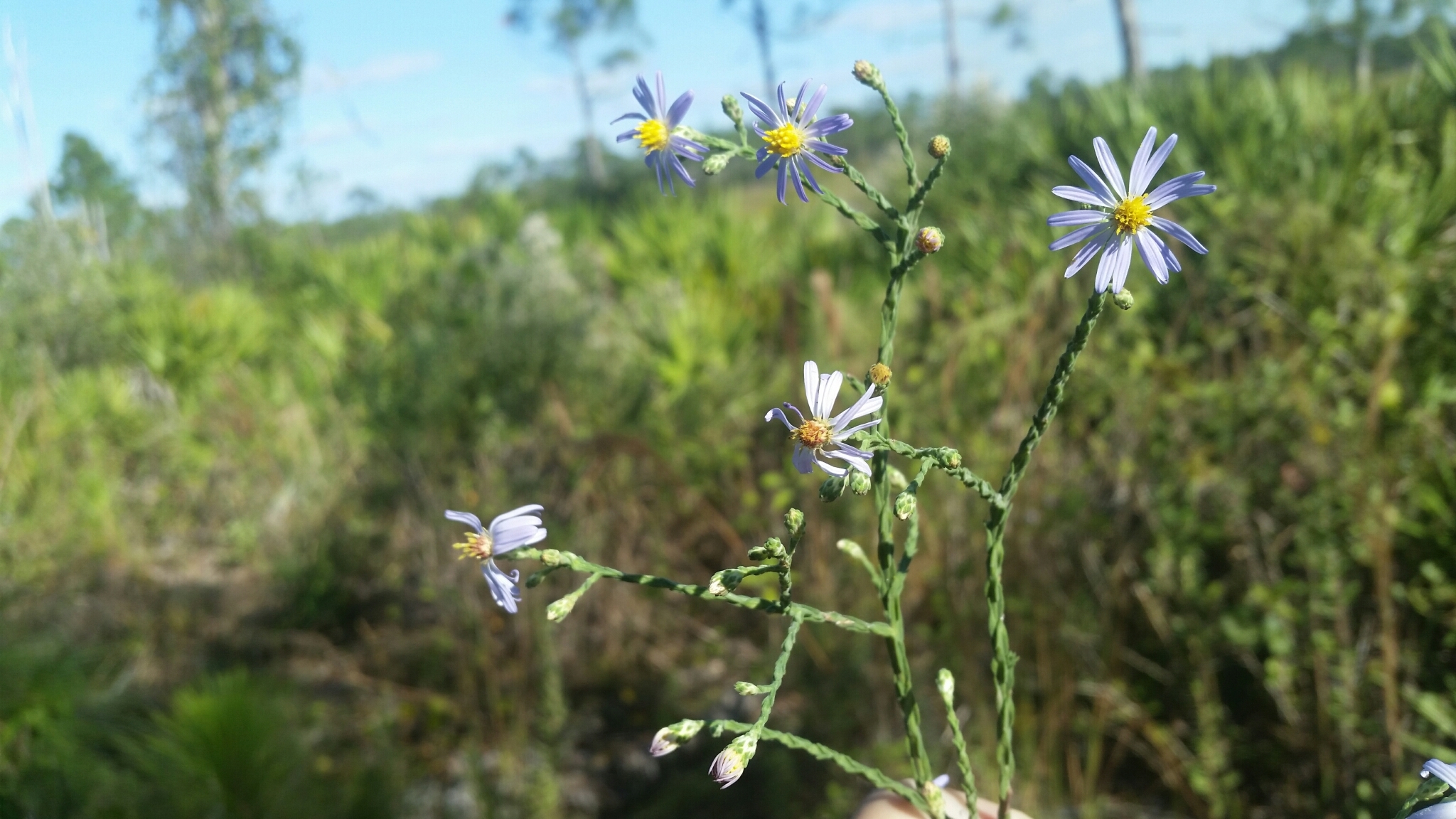
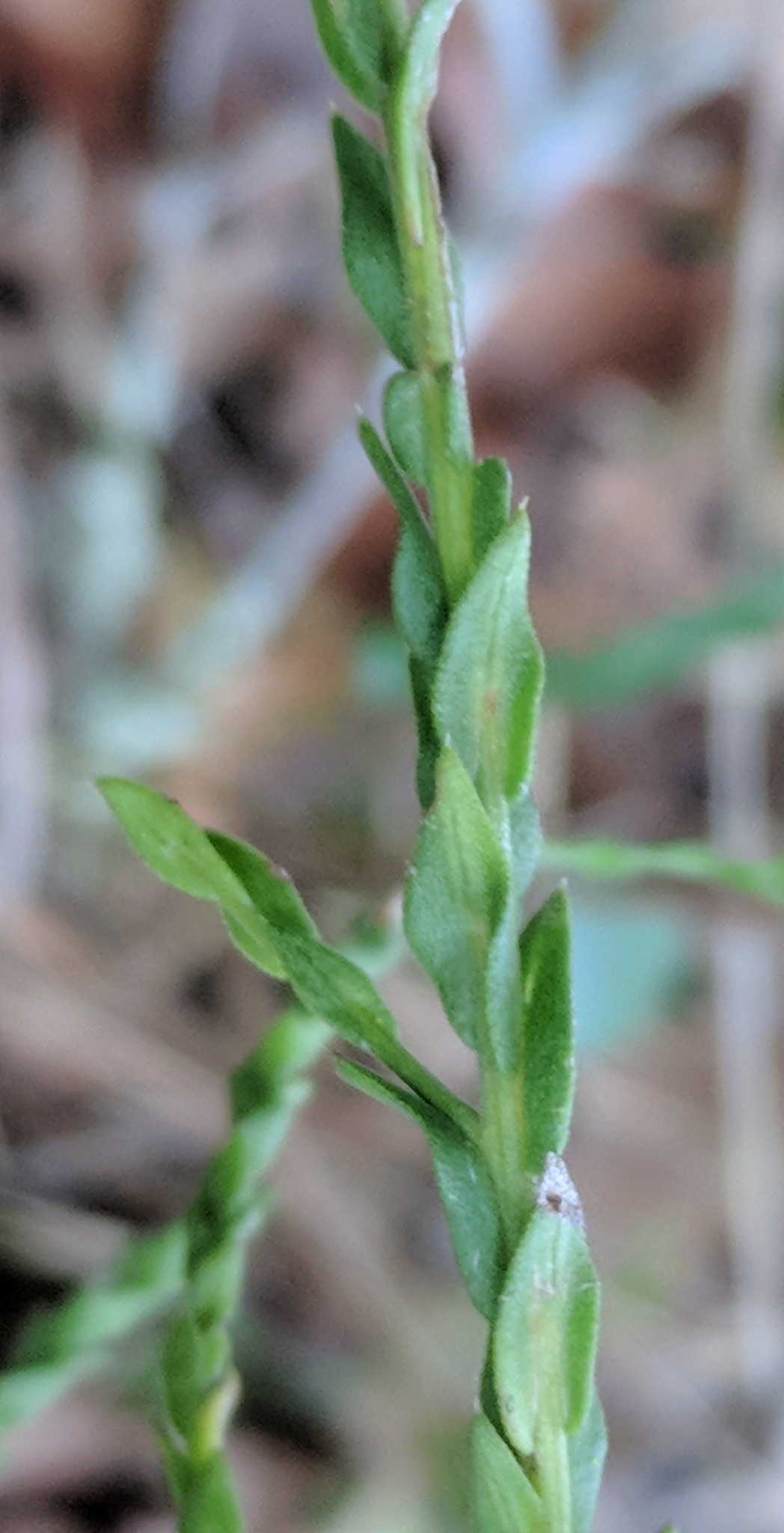
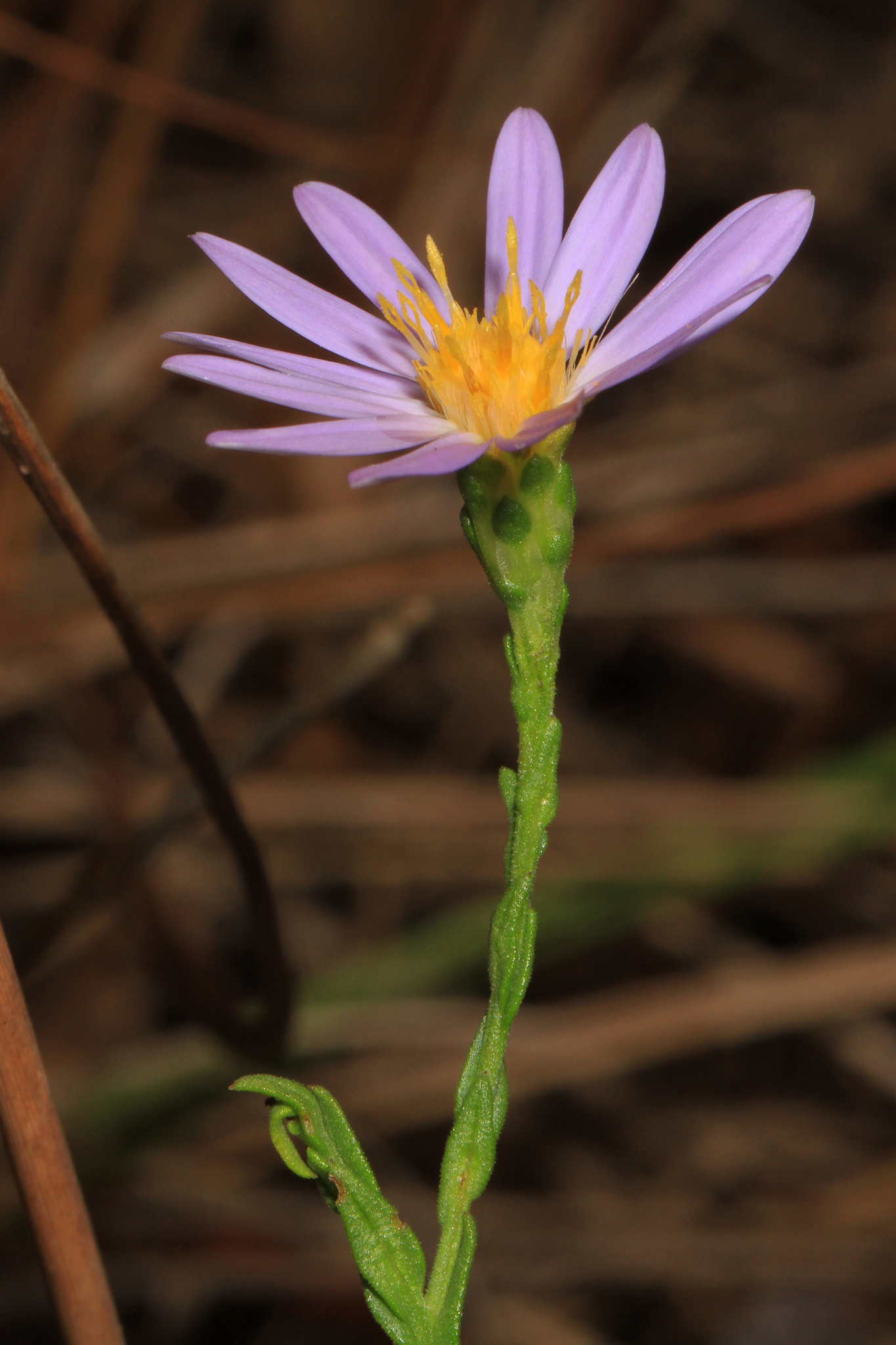
Scaleleaf aster is a master of the long con. For most of the year it is a wiry, sprawling, faintly scruffy stem with leaves so small and so tightly pressed to the stalk that the plant barely looks like a plant at all — more like a piece of brown whipcord somebody dropped in the sandhill. The Florida Wildflower Foundation calls it “hardly noticeable when not in bloom,” which is generous; out of flower, most people walk straight past it. Then late fall arrives, and the same unpromising stick erupts in copious periwinkle blooms — lavender to violet ray florets around bright yellow disc florets, each flower head up to an inch across, carried in open, branching panicles. A plant in full bloom in a pine flatwood understory is a showy display, and the contrast with its eleven months of invisibility is the whole joke.
The botany, for the nerds in the back: a perennial herb, 30–120 cm (roughly 1–4 feet) tall, growing in clumps from a herbaceous or thick, woody, sometimes corm-like base. Stems are numerous, erect to sprawling, brown, branched from the middle, and moderately to densely covered in fine hairs. The leaves are thick, firm, yellowish green, with entire margins and a finely rough (scabrous) surface. The basal leaves fall off early; the lower stem leaves are narrowly obovate to oblanceolate with ear-like clasping bases; and the upper stem leaves are the stars of the show — lanceolate to linear, only 3–10 mm long and 1–4 mm wide, shrinking to bracts toward the top, their bases fused (adnate) to the stem for half their length or more. The flower heads sit in open paniculiform arrays on densely short-hairy, glandular stalks. Each head has a bell-shaped involucre 4–6.5 mm tall, 10–20 light to dark lavender ray florets, and 12–25 yellow disc florets. The seeds are small tan to brown cypselae with a tuft of bristles (a pappus) for wind dispersal. Flowering runs October to December, according to Flora of North America.
Also called clasping aster — and, by the Florida Wildflower Foundation, whipcord aster. The species epithet adnatum refers to those adnate leaves: the leaves are literally grown onto the stem. Buy and plant by the Latin name, Symphyotrichum adnatum (formerly Aster adnatus), because “clasping aster” is the kind of vague common name that gets applied to half the genus.
How to tell it apart
Scaleleaf aster is easily distinguished from other Symphyotrichum species by its scale-like leaves and wiry appearance — that is the Florida Wildflower Foundation’s verdict, and the field mark really is that simple. If the stem looks like it is wearing tiny overlapping scales, and the plant is a wiry sprawler in a sandhill or flatwood, you are most of the way there. But there is one close relative that demands a closer look.
Walter’s aster (Symphyotrichum walteri) is scaleleaf aster’s twin in the key — the two are the only Florida asters with scale-like leaves, and Franck’s 2025 Flora of Florida separates them in a single couplet. The differences are small but decisive, and they are all about texture and posture: scaleleaf aster is scabrous (rough to the touch) with stems moderately to densely finely hairy, and its upper stem leaves are appressed — pressed flat against the stem and fused to it for half their length or more. Walter’s aster is glabrate — essentially smooth and hairless, or very sparsely hairy — with bright green, somewhat succulent-looking leaves that spread outward from the stem and merely clasp it at the base, never fusing along it. Its lower stem leaves even stick out and fold back (patent to reflexed). In the hand: rough + glued-flat = scaleleaf; smooth + sticking-out = Walter’s. Walter’s aster also tends toward sandhills and pine flatwoods, so the two genuinely overlap — check the leaves, not the habitat. Walter’s aster has no guide on this site yet; when it lands, it will be the one to compare side by side.
Heath aster (Symphyotrichum ericoides) can look similar at a glance — another wiry, small-leaved, many-flowered aster — but heath aster is not a Florida native at all, and its leaves, while narrow, are spreading and heath-like rather than scale-like and stem-hugging. If you think you have found heath aster in a Florida sandhill, you almost certainly have scaleleaf aster instead. The site’s heath aster guide covers the northern plant for comparison.
Where it grows in Florida
Scaleleaf aster is a southeastern Coastal Plain native: Alabama, Florida, Georgia, Louisiana, and Mississippi. In Florida the Florida Wildflower Foundation records it from the Panhandle, West Central and Southwest Florida, Columbia and Nassau counties, and the Keys — widespread but patchy, and notably missing from much of eastern peninsular Florida, according to the Institute for Regional Conservation. Its habitats are sandy, clayey soils in sandhills, oak-pine scrub, open pine flatwoods, and roadsides, from sea level to just over 100 meters. It is a plant of sunny, open, well-drained ground — the understory of a pine flatwood or a sandhill, not a shady hammock and never a wetland. It blooms late, October to December, when most of the flatwood has already called it a year.
Grow it or leave it
Grow it — with the right expectations. Scaleleaf aster is one of the few Florida asters with genuine garden credentials: the Florida Wildflower Foundation lists it as suitable for North, Central, and South Florida landscapes, it is occasionally available from nurseries that specialize in Florida native plants, and it propagates from cuttings and seed. Give it full sun to light shade and moist, well-drained sandy or calcareous soil, and let it sprawl — it grows 1–2 feet tall and equally wide or wider in a garden setting, and it is best suited to naturalistic and restoration landscapes where it can sprawl freely. It is drought tolerant but does best with consistent moisture. Two hard limits: it does not tolerate prolonged flooding or salt water, so keep it out of the wet swale and away from the beach. And do not expect a tidy border plant. This is a sprawler that looks like a stick for most of the year and then throws a late-fall party; plant it at the edge of a meadow or a naturalized bed, water it until established, and then mostly leave it alone. No fertilizer — lean sandy soil is what it evolved for, and rich soil mostly makes asters floppy.
Pollinators & wildlife
The flowers are attractive to many pollinators, especially bees, according to the Florida Wildflower Foundation — and the timing is the point. Scaleleaf aster blooms in late fall and early winter, when floral resources are thinning out, so its periwinkle heads are working the late shift: native bees, syrphid flies, skippers, and late-season butterflies all work small aster flowers that bigger pollinators ignore. The tiny flowers are exactly the right size for small native bees. No caterpillar host record specific to scaleleaf aster was found in the sources consulted — asters as a group host Pearl Crescent caterpillars, but this guide claims no host relationship for this species that the sources do not support. Leave the seed heads standing after bloom: the seeds feed birds, and the wiry stems shelter overwintering insects.
Varieties
None documented. No varieties of Symphyotrichum adnatum are recognized in Flora of North America or in Franck’s 2025 Flora of Florida, and no named garden varieties of the wild species were verified — none is claimed here. The only name confusion to watch for is the synonym Aster adnatus, the name this plant carried before DNA work moved the North American asters into Symphyotrichum. Old nursery tags and older field guides may still say Aster adnatus; it is the same plant.
Frequently asked questions
Is scaleleaf aster the same as clasping aster?
Yes — clasping aster is another common name for Symphyotrichum adnatum, along with whipcord aster. All three names describe the same plant. Buy by the Latin name, since “clasping” gets used loosely for other asters with clasping leaf bases.
How do I tell scaleleaf aster from Walter’s aster?
Feel the stem and look at the upper leaves. Scaleleaf aster is rough and hairy, with tiny upper leaves pressed flat and fused to the stem for half their length or more. Walter’s aster is smooth and nearly hairless, with leaves that spread outward and only clasp the stem at the base. Rough + glued-flat = scaleleaf; smooth + sticking-out = Walter’s.
When does it bloom?
October to December, in late fall and early winter — one of the last wildflowers blooming in the flatwoods. A plant in full bloom is showy; the same plant in July looks like a brown stick.
Where in Florida does it grow wild?
The Panhandle, West Central and Southwest Florida, Columbia and Nassau counties, and the Keys — in sandhills, oak-pine scrub, open pine flatwoods, and roadsides. It is missing from much of eastern peninsular Florida.
Can I grow it in my yard?
Yes, if you have the right spot: full sun to light shade, moist but well-drained sandy or calcareous soil, and room for it to sprawl. It suits naturalistic and restoration plantings better than a tidy border. It is occasionally available from Florida native plant nurseries.
Does it need watering?
Water until established, then mostly leave it alone. It is drought tolerant but does best with consistent moisture. It does not tolerate prolonged flooding or salt water.
What pollinators visit it?
Many pollinators, especially bees. Its late fall bloom feeds native bees, syrphid flies, skippers, and late butterflies when few other flowers are open.
Is it a Florida native?
Yes — native to Florida and the southeastern Coastal Plain (Alabama, Florida, Georgia, Louisiana, Mississippi). It is not endemic to Florida; it just happens to be very much at home here.
Why does it look dead most of the year?
Because its whole strategy is to be unnoticeable until bloom. The wiry stems and tiny scale-like leaves lose little water and attract little attention, and then the plant spends its entire budget at once on a late-fall flower show. It is not dead. It is waiting.
🌱 Keep learning
Three related guides worth reading next:
- Aster: The Genus Guide — Asters as a group: how the genus works, why the name moved from Aster to Symphyotrichum, and which Florida species to know.
- Heath Aster — The northern lookalike with the same wiry, small-leaved habit — and why a plant that looks like this in a Florida sandhill is almost certainly scaleleaf instead.
- Habitat Gardening in Florida: One Tree, One Thicket — Turn a sunny, sandy corner into habitat that feeds something — the kind of planting scaleleaf aster was made for.
Sources: Flora of North America, vol. 20 (Symphyotrichum adnatum; S. walteri); Franck 2025, Flora of Florida; Florida Wildflower Foundation, Scaleleaf Aster; Institute for Regional Conservation, Plants of South Florida.