
🌿 Southwestern Annual Saltmarsh Aster
What it looks like
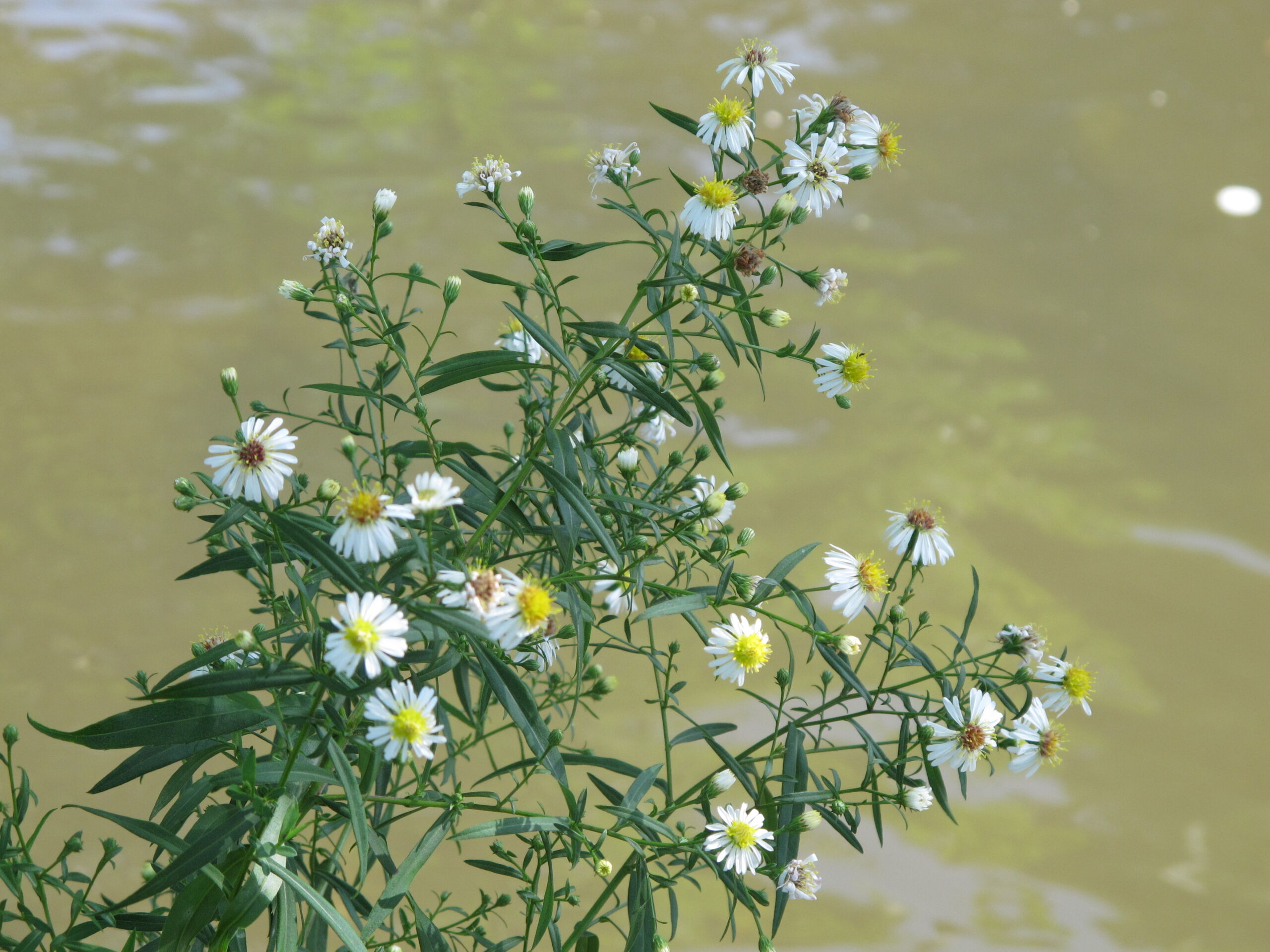
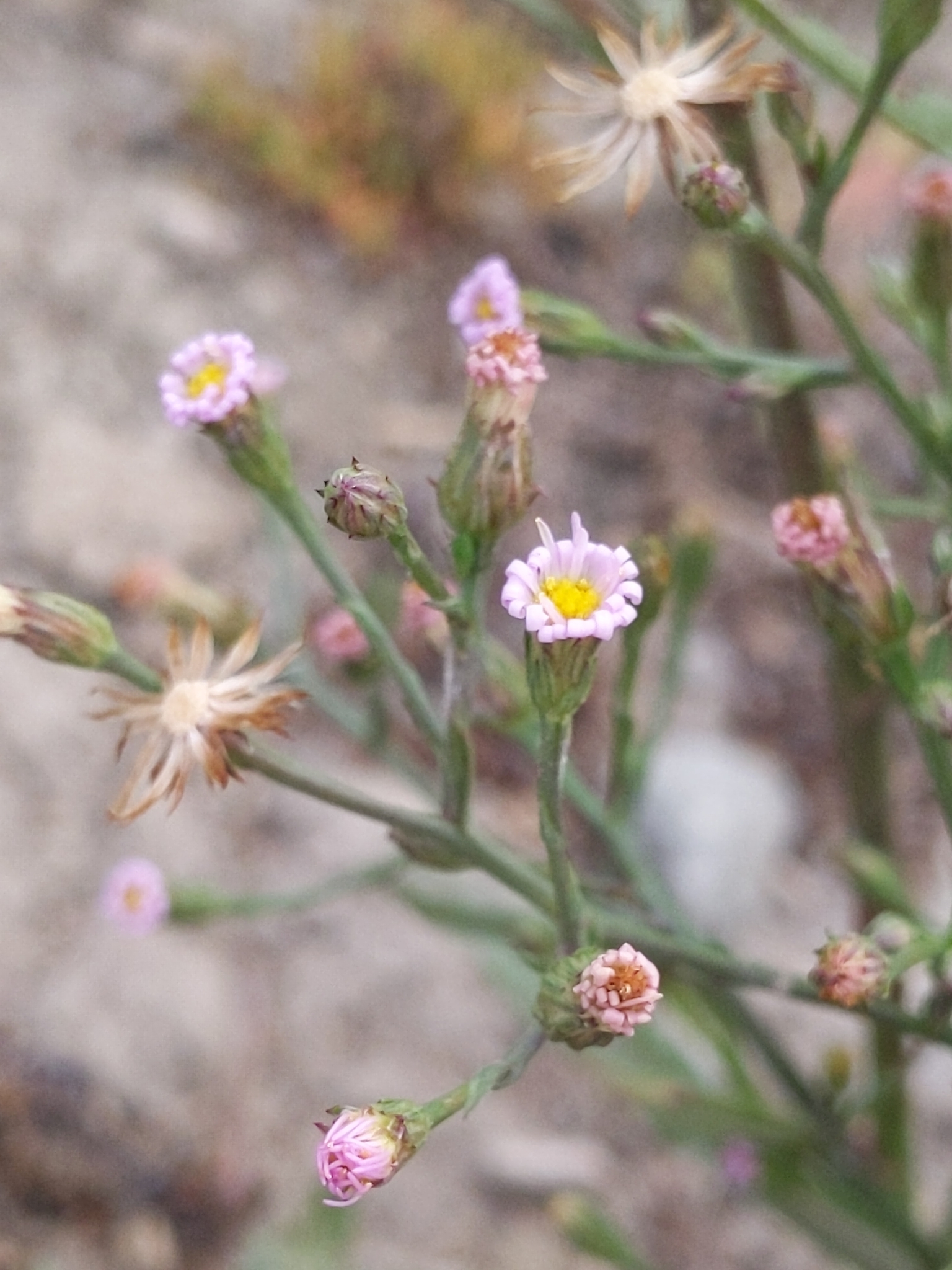
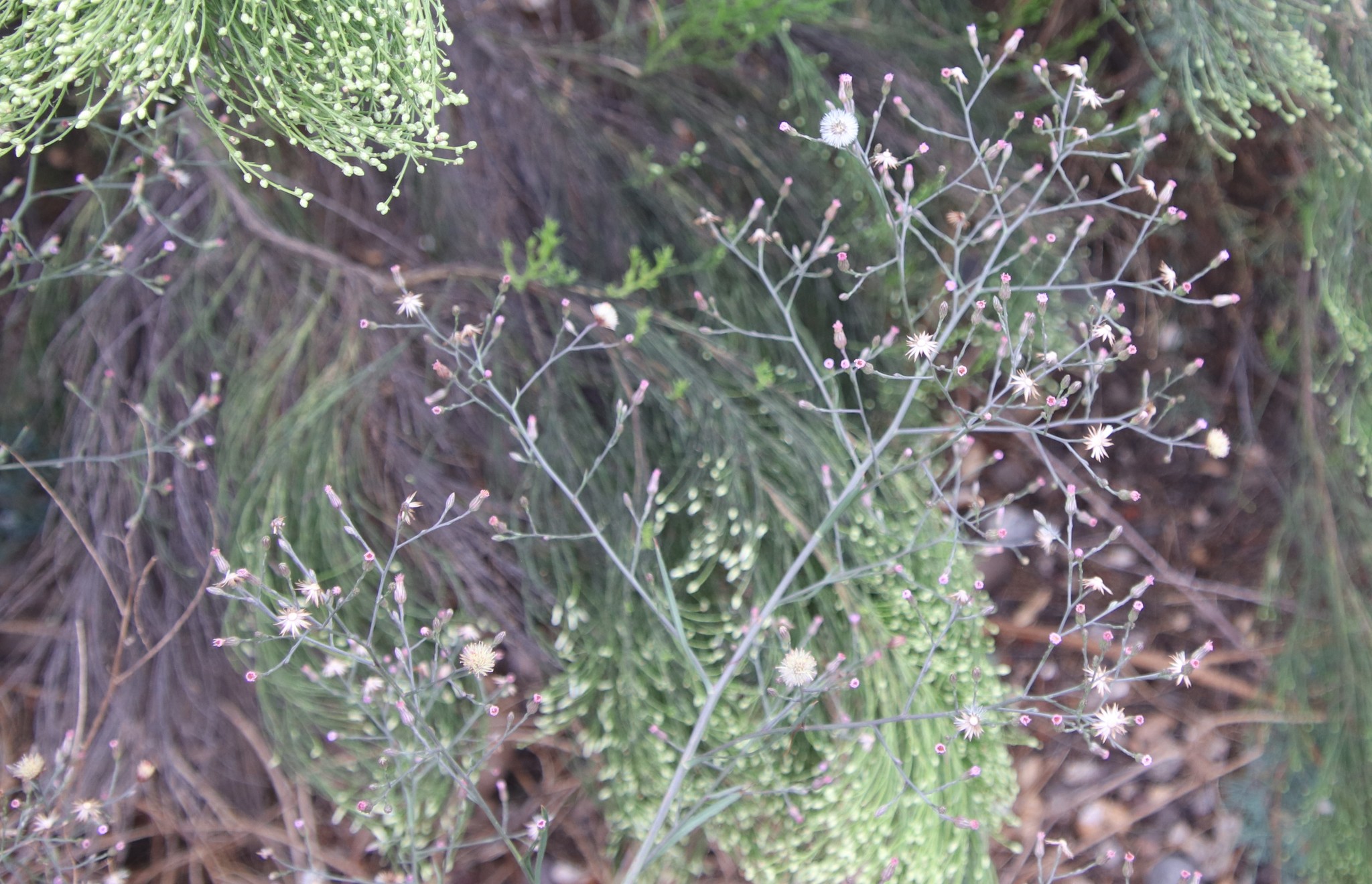
Southwestern annual saltmarsh aster is an annual herb with a fibrous taproot — the first thing Franck’s key to the Florida asters asks about, because it sorts the saltmarsh asters into annuals and perennials before anything else. It grows fast, branches a lot, and can reach about five feet tall in good conditions, though most plants you meet will be smaller and scruffier: a wiry, airy plant with small heads scattered along long stalks, looking less like a garden aster and more like a weed that learned to flower. Which, to be fair, is exactly what it is.
The flower heads are small and modest. The involucre carries 30–42 phyllaries — count them if you have a hand lens and a patient afternoon, because that number is one of the characters that separates this species from its annual cousins. The rays are usually white (sometimes pinkish), and the ray laminae are longer than the pappus — the tuft of bristles on the seed. That last detail sounds like trivia until you are staring at two near-identical saltmarsh asters in a ditch in the Keys, at which point it is the difference between an identification and a shrug. It flowers from July through November, sometimes into January, which is a long season for a plant that only lives one year: it germinates, grows, flowers, sets seed, and dies, all inside a single warm season.
The name situation deserves a paragraph of its own, because this plant has been renamed more often than most. It was first described as Erigeron expansus in 1826, then spent time as Aster inconspicuus, Aster parviflorus, and Symphyotrichum subulatum var. parviflorum before Guy Nesom’s 2005 revision of the saltmarsh aster group settled it as Symphyotrichum expansum. Many photographs — including two of the three in this guide — are still filed under the synonym Symphyotrichum parviflorum, so if you go looking for pictures and find that name, you have found the same plant. It is also worth saying plainly that the common name is a geography lesson gone wrong: as naturalist Jim Conrad put it, it is called southwestern annual saltmarsh aster “despite most of its distribution being very far from salt marshes, and not being southwestern to anything.” It grows from the southwestern United States through Mexico, Central America, the Caribbean, and Ecuador — and, at the far eastern edge of that range, in South Florida.
Where it grows in Florida
In Florida, southwestern annual saltmarsh aster is a South Florida plant. The Institute for Regional Conservation records it as present in South Florida — in the Keys and the Miami area — in disturbed ground and marshy places: it has been found at Dagny Johnson Key Largo Hammock Botanical State Park, at Tropical Park, and at West Lake Park and the Anne Kolb Nature Center. It was reported for Key West as early as 1913, collected there as a weed in 1971, collected on Big Pine Key in 1981, and photographed on North Key Largo in 2020. The IRC’s own assessment says it is “very likely more common than records indicate” and “almost certainly more common and overlooked” — a small white-flowered annual in a weedy ditch is easy to walk past, and most people do.
Its habitat, across its whole range, is marshy ground and roadsides, from sea level to about 1,100 meters — though from Central America to Florida it rarely grows above 10 meters. The Atlas of Florida Plants lists it as Native, with an obligate wetland indicator status. The IRC lists its South Florida native status as “assumed to be native” (elsewhere phrased “presumed to be native”), and that qualifier is carried here exactly as the IRC states it: the plant is native throughout the West Indies, including Cuba and the Bahamas, and the IRC treats it as assumed native in South Florida, while other authorities have treated it as introduced or as a waif there. It is a weedy plant at the edge of its range, and the honest status is “assumed native,” not a confident “native.” NatureServe gives it no global status rank.
How to tell it from its lookalikes
The annual saltmarsh asters are a famously difficult group — small white heads, wiry stems, and differences you mostly need a hand lens to see. Franck’s key separates the Florida annuals on phyllary and ray characters, and those are the characters that work:
- Annual saltmarsh aster (Symphyotrichum subulatum) is the closest lookalike and the one you are most likely to confuse it with. The split: in subulatum the green zones run throughout the phyllary and the rays sit in two series. In expansum there are 30–42 phyllaries and the ray laminae are longer than the pappi. In the field, subulatum is the commoner plant of Florida salt marshes; expansum is the South Florida plant of disturbed wet ground.
- Bahama aster (Symphyotrichum bahamense) — also an annual — has pink-lavender rays that dry in two to three coils, and only 11–23 disk florets. Expansum’s rays are usually white and do not dry into tight coils.
- South American saltmarsh aster (Symphyotrichum squamatum), naturalized in Florida, has green zones on its phyllaries nearly absent toward the base, and its rays in two to three series. Expansum’s phyllary green zones are more evident, and its rays are usually white.
- The honest field note: these four are separated by characters — phyllary counts, green-zone patterns, and ray series — that are hard to check without a specimen in hand. If you find a small white annual saltmarsh aster in South Florida, photograph the heads close up, note the exact habitat, and key it at home. Do not guess from the common name: “saltmarsh aster” is shared by several of these species, and the name on a plant tag is not an identification.
Grow it or leave it?
Leave it — or rather, let it do what it already does. Southwestern annual saltmarsh aster is a weedy annual of wet, disturbed ground, not a garden plant. There is no nursery trade for it, no published cultivation guidance, and no reason to plant it on purpose: it is the kind of plant that shows up on its own in a damp ditch, a weedy roadside, or a low corner that stays wet after rain, flowers for months, sets seed, and dies. If it volunteers in a damp spot on your land in South Florida, the best response is to leave it alone and let it finish its season — it is a native (assumed native, per the IRC) annual doing exactly the job annuals do, holding bare wet ground and feeding late-season insects while it lasts.
Do not try to grow it from seed collected in the wild, do not transplant it, and do not mistake it for a plant that needs your help. It needs wet ground and being left alone, and it has managed both without gardeners for a very long time. One caution for the Keys and the Miami area: because it is weedy and easily overlooked, it is also easily destroyed by ditch-cleaning and mowing — if you manage land where it grows, letting a wet weedy edge stand through the fall costs nothing and gives the plant its season.
Pollinators and wildlife
No published pollinator records specific to southwestern annual saltmarsh aster were found — it is a small, weedy, easily overlooked plant, and nobody has published a visitor list for it. What can be said honestly is the general aster story: small white fall-blooming asters offer nectar and pollen to generalist bees, small flies, and butterflies, and this species flowers from July through November, sometimes into January, a long season for a plant that lives one year. Its seeds are small wind-dispersed cypselae with a pappus, built to travel on a breeze to the next damp ditch. Anything more specific than that would be guessing, and a plant this obscure deserves the truth: it is probably useful to small pollinators, and nobody has measured how useful.
Frequently asked questions
Is it the same plant as Symphyotrichum parviflorum?
Yes. Symphyotrichum parviflorum is a synonym of S. expansum, and many photographs — including two in this guide — are filed under that name. It was also called Aster parviflorus and Symphyotrichum subulatum var. parviflorum before Nesom’s 2005 revision settled the name as S. expansum.
Is it native to Florida?
Assumed to be, in South Florida — that is the Institute for Regional Conservation’s exact wording (“assumed to be native,” also phrased “presumed to be native”). It is native throughout the West Indies, and the Atlas of Florida Plants lists it as Native. Other authorities have treated it as introduced or as a waif in South Florida, so the honest answer carries the qualifier.
Where in Florida does it grow?
South Florida — the Keys and the Miami area — in marshy and disturbed wet ground: roadsides, ditches, abandoned road beds, and the edges of hammocks. It has been recorded at Key West, Big Pine Key, North Key Largo, Tropical Park, and West Lake Park/Anne Kolb Nature Center. It is probably more common than the records show, because it is small and easily overlooked.
Is it a perennial or an annual?
An annual, according to the Flora of North America and Nesom’s revision — it grows from a fibrous taproot, flowers in one season, and dies. Some databases list it as annual or biennial, and the IRC’s database lists it as perennial; the FNA treatment is the authority followed here, and the disagreement is worth knowing about rather than hiding.
How do I tell it from annual saltmarsh aster?
With a hand lens and the key: expansum has 30–42 phyllaries and ray laminae longer than the pappi; subulatum has green zones throughout the phyllary and rays in two series. In the field, habitat helps — subulatum is the commoner plant of Florida salt marshes generally, while expansum is the South Florida plant of disturbed wet ground.
Why is it called “southwestern” if it grows in Florida?
Because the common name was coined for the western part of its range, and it stuck. As naturalist Jim Conrad wrote, it is called southwestern annual saltmarsh aster “despite most of its distribution being very far from salt marshes, and not being southwestern to anything.” Common names are not range maps.
Can I grow it in my garden?
There is no reason to, and no guidance for it — it is a weedy annual that shows up on its own in wet disturbed ground. If it volunteers in a damp spot, leave it to finish its season. It is not a plant you buy, and no nursery sells it.
Is it invasive?
No. It is a weedy native (assumed native in South Florida) annual, not an invasive species. It is “often considered weedy” in the literature, which means it colonizes disturbed ground readily — the job description of an annual, not a threat to natural areas.
When does it bloom?
July through November, sometimes into January. That long season is typical of a South Florida annual: it keeps flowering as long as it stays warm and wet.
Does it have any conservation status?
No. NatureServe gives it no global status rank, and it is not listed as rare or imperiled in Florida. It is a widespread, weedy plant — the opposite end of the aster spectrum from its rare Panhandle cousin, savanna aster.
Species
Southwestern annual saltmarsh aster (Symphyotrichum expansum (Poepp. ex Spreng.) G.L. Nesom; basionym Erigeron expansus; synonyms include Aster inconspicuus, Aster parviflorus, Symphyotrichum parviflorum, and Symphyotrichum subulatum var. parviflorum) is the species this guide covers. No varieties are recognized. Annual saltmarsh aster (S. subulatum), Bahama aster (S. bahamense), and South American saltmarsh aster (S. squamatum) are different species and none is covered here. No named garden varieties of the wild species were verified, and none is claimed here. This guide covers Symphyotrichum expansum only.
Keep learning 🌱
Where to go next: