
🌿 White Arrowleaf Aster
What it looks like
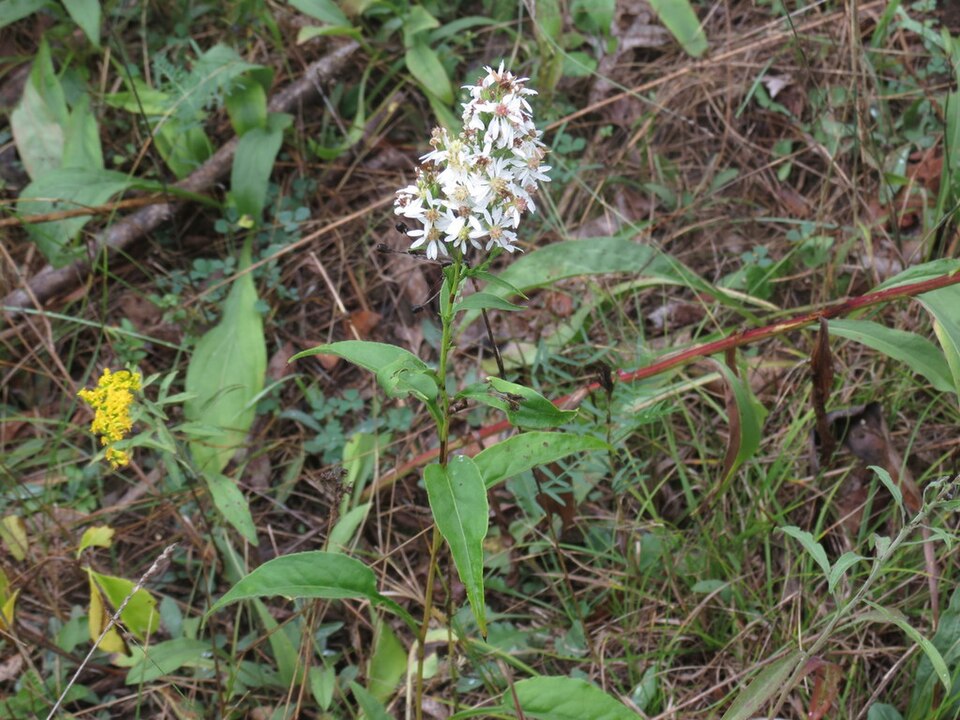
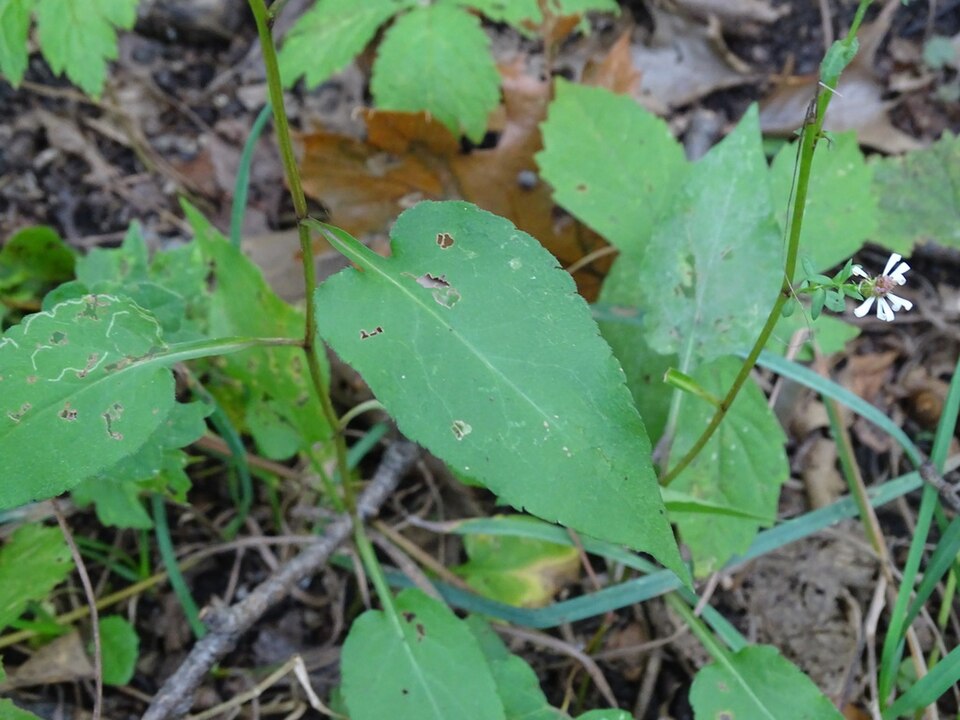
White arrowleaf aster is the aster that tells you its name if you look at the leaves first. The plant is a perennial, one to three feet tall (sometimes to four), growing in a clump of one to five erect stems from short rhizomes or stout, branched rootstocks. The leaves are broad and thin, shallowly to deeply toothed, with a pointed tip that tails off — the specific name urophyllum means tail-leaf, and the Flora of the Southeastern United States notes that it refers to the larger leaves having a tail-like tip. The lower leaves are arrow-shaped, on broadly winged stalks whose bases clasp the stem.
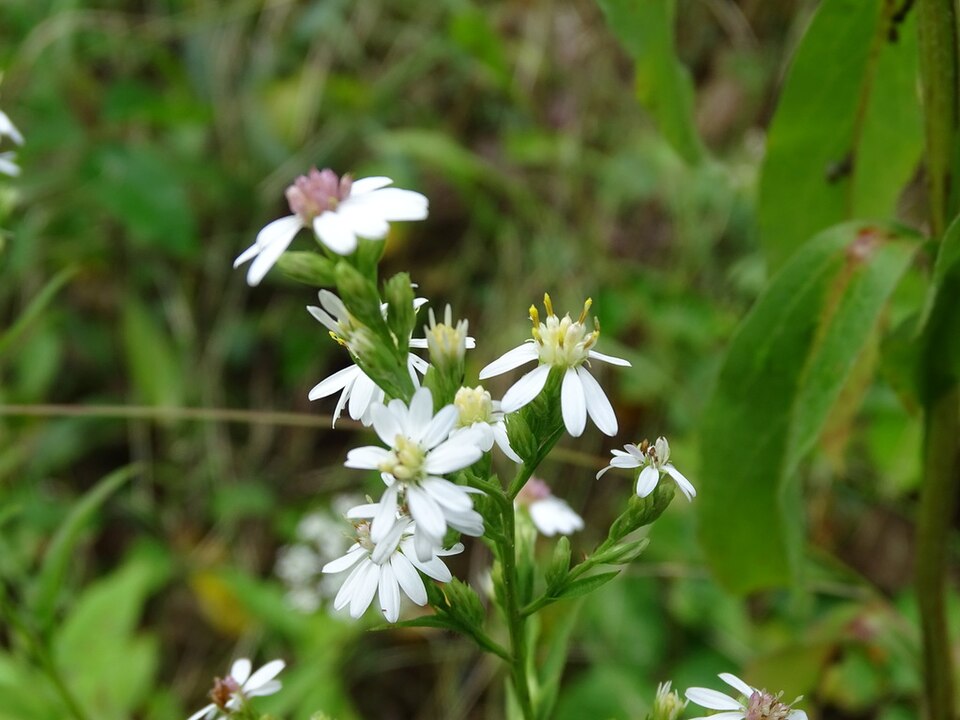
Above the leaves, the flowers do the rest of the identification. The plant bears many small heads in upright panicles, forming a dense, showy cluster — white ray florets, 8 to 15 (sometimes up to 20) per head, around yellow disk florets that later turn purplish. The disk florets open white to cream and become pink as they age, so a single cluster can show white, yellow, and pink all at once. The whole effect is a white pyramid on a leafy stem, blooming from late August to October, and it is unmistakable once you have seen it — provided you check the rays first, because the white is the character that separates this species from every blue and purple aster in its branch of the key.
The leaves are worth a second look, because they are the reason the plant has been misidentified for over a century. They are thin, with ciliate to scabrous margins, hairy underneath (densely so on the midveins), and nearly smooth on top. The stem leaves are winged-petiolate with clasping bases — like wavyleaf aster, its closest lookalike — but the wings do not widen abruptly at the base, and the rays are white to pale pink instead of blue to purple. That pair of differences — narrow wings plus white rays — is the whole identification, and it is enough.
How to grow
Here is the good news, with a catch. White arrowleaf aster is, by aster standards, an easygoing plant: the Flora of the Southeastern United States calls it adaptable as far as soil type, and Tennessee garden sources grow it in full sun to full shade, in medium to moderately dry moisture, in sandy or loamy soil, at about three feet tall. It is a plant of open, dry or mesic woods, edges of woods, fields, and roadsides — the kind of plant that colonizes a woodland edge and asks for nothing more than to be left there.
The catch is Florida. In this state, white arrowleaf aster reaches only the eastern Panhandle — it is a plant at the southern edge of its range here, recorded from Maine west to Minnesota and south to eastern Panhandle Florida. For most Florida gardeners, from the Big Bend south, this is not a plant you will ever meet in the wild, and it is not a plant to import: a species at the edge of its range belongs where the range put it, and a Panhandle woodland edge is not a Central Florida backyard. If you garden in the eastern Panhandle and have it on your land, the care is benign neglect — keep the woodland edge open, do not mow it in late summer, and let it bloom. Everywhere else in Florida, admire it in photographs and plant a Florida-native aster that belongs to your county instead.
For the garden, the honest translation is a lesson in edges. This aster lives where woods meet fields, where shade meets sun, where dry meets moist — and it is the edge that makes it. A garden that keeps a shady, leaf-littered, unmowed edge will feed more wildlife than a garden that mows to the fence, whether or not this particular aster ever grows there.
Water & feeding
Water: medium to moderately dry, and no more. This is an upland species of fields and woodland edges, not a wetland plant — it wants soil that drains, in sun to shade, and it will not thank you for irrigation. Water a new planting until established, then leave it alone; in a rainy climate, plant it where the ground drains and the air moves.
Feeding: none. It grows in sandy or loamy soils of ordinary fertility, and rich soil plus fertilizer mostly produces floppy stems that need staking and fall over in the first autumn rain. A thin mulch of leaves in winter is plenty. The soil science here is the woodland-edge bargain: the plant spends the summer building a leafy scaffold on lean ground, then spends it all at once on a dense white pyramid of flowers in the fall, because at a woodland edge the pollinators that matter in October are generalists, and a hundred small white flowers beat ten big ones when your customers are small, cold, and in a hurry.
Common problems
- Confusing it with wavyleaf aster. The two share winged petioles and clasping leaf bases, and they sit side by side in the key. The split is two characters together: wavyleaf aster has wings that widen abruptly at the strongly auriculate-clasping base and rays that are usually blue to purple; white arrowleaf aster has wings that do not widen abruptly and rays that are white to pale pink. Blue plus flared wings: wavyleaf. White plus narrow wings: white arrowleaf.
- Confusing it with Short’s aster. Short’s aster (S. shortii), another Panhandle species in the same key branch, has deeply cordate basal leaves and blue to purple rays. White rays rule Short’s out at a glance.
- The Aster sagittifolius name trap. This plant was long called Aster sagittifolius, but Flora of North America explains that the name was misapplied: its type is actually the same as heartleaf aster (Symphyotrichum cordifolium) or a garden hybrid involving it. Old books, old labels, and old nursery tags that say sagittifolius may mean this plant — or may mean heartleaf aster, which has no Florida record per Franck’s Flora of Florida. Buy and identify by the current name, S. urophyllum.
- Planting it outside its Florida range. It reaches only the eastern Panhandle in Florida. Planting it in Central or South Florida is planting a plant outside its climate, and it will tell you so by declining.
- Mowing the woodland edge in late summer. The plant sets up to bloom in August and flowers into October. A late-summer mow takes the whole show — and the pollinators’ fall pantry — in one pass.
Harvest
There is no crop here, and the harvest is the bloom season itself: a dense white pyramid of flowers on a woodland edge in October, with bees and butterflies working it while the rest of the woods goes quiet. Cut stems only from garden-grown plants — the small white flowers hold in water and make a bright, airy filler — and leave wild plants standing for seed and shelter. The seeds feed birds through winter, the standing stems shelter insects, and the rootstock comes back every spring without asking. The simplest harvest is an October walk along a Panhandle woodland edge with no agenda: white flowers, bees working them in the slanting light, and the knowledge that the garden’s last act is also one of its best.
Saving seeds
Do not collect seed from wild populations — in Florida this is a Panhandle-edge species, and its seed belongs where it falls. The general aster rules, for any nursery-grown material, are the same as for other asters: wait until the heads turn brown and fluffy and the seeds separate easily when brushed, cut them into a paper bag on a calm day, dry them thoroughly before any sealed container, and sow in fall so winter settles the dormancy question. No species-specific germination protocol was verified for white arrowleaf aster, so fall sowing outdoors — pressing the seed lightly into the soil and letting the season do the work — is the honest recommendation. In Florida, dry seed thoroughly before airtight storage and add a desiccant, because Florida humidity will quietly spoil a paper envelope of aster seed long before spring.
Species
White arrowleaf aster (Symphyotrichum urophyllum (Lindl. ex DC.) G.L. Nesom; basionym Aster urophyllus Lindley ex de Candolle 1836; also called arrowleaf aster and white arrow-leaved aster) is the species this guide covers. The name Aster sagittifolius was long misapplied to this taxon; its type is conspecific with heartleaf aster (Symphyotrichum cordifolium) or a garden hybrid involving it, and S. cordifolium has no Florida record per Franck’s Flora of Florida. No varieties are recognized. Wavyleaf aster (S. undulatum), Short’s aster (S. shortii), and heartleaf aster (S. cordifolium) are different species and none is covered here. No named garden varieties of the wild species were verified, and none is claimed here. This guide covers Symphyotrichum urophyllum only. Vouchered Florida distribution and status: Atlas of Florida Plants species page; full technical treatment: Flora of North America.
Frequently asked questions
Why is it called arrowleaf?
Because of the leaves. The larger lower leaves are broad and arrow-shaped, with a pointed tip that tails off — the specific name urophyllum means tail-leaf. The “white” in the common name is the flower color, which is the character that separates it from its blue and purple cousins.
Are the flowers white or pink?
Mostly white, sometimes pale pink or lilac. The disk florets open white to cream and become pink as they age, so a cluster in late bloom can show white rays, yellow centers, and pink disks all at once.
How is it different from wavyleaf aster?
Two characters together. White arrowleaf aster has winged petioles whose wings do not widen abruptly at the clasping base, and white to pale pink rays. Wavyleaf aster has wings that widen abruptly at a strongly auriculate-clasping base, and rays that are usually blue to purple. Narrow wings plus white rays: white arrowleaf. Flared wings plus blue-purple rays: wavyleaf.
Is white arrowleaf aster native to all of Florida?
No — in Florida it reaches only the eastern Panhandle, at the southern edge of a range that runs from Maine west to Minnesota. Most Florida gardeners will never meet it in the wild, and it should not be planted outside its range.
Can I grow it in Central or South Florida?
You should not try. It is a Panhandle-edge plant, and planting it far outside its range is planting a plant outside its climate. Plant a Florida-native aster that belongs to your county instead — the pollinators will not know the difference, and the plant will actually live.
What soil does it want?
Sandy or loamy soil, medium to moderately dry moisture — and it is adaptable as far as soil type, per the Flora of the Southeastern United States. Drainage matters more than fertility; it is an upland woodland-edge plant, not a wetland plant.
Sun or shade?
Both, honestly. Tennessee garden sources list full sun to full shade for this species, which matches its habitat: open woods, woodland edges, fields, and roadsides. It is one of the more shade-tolerant asters, which is part of what makes it useful at a woodland edge.
Is it the same plant as Aster sagittifolius?
No — and yes, depending on the age of the book. The name Aster sagittifolius was applied to this plant for over a century, but its type specimen actually belongs to heartleaf aster (Symphyotrichum cordifolium). Modern floras use Symphyotrichum urophyllum. Old labels saying sagittifolius may mean either plant.
Does it spread?
Modestly. It is cespitose — clump-forming — with short rhizomes or stout, branched rootstocks, producing one to five stems from the same point. It will form a clump, not a colony, and it will not take over a bed.
🌱 Keep learning
Three related guides worth reading next:
- Aster: Growing Guide — The genus guide: asters as a group, how the old genus Aster became Symphyotrichum, and where this white-rayed species fits.
- Heath Aster: Growing Guide — Another white-rayed aster — a thousand tiny white stars on wiry stems, and the classic late-season pollinator bank.
- Calico Aster (Symphyotrichum lateriflorum) — A small white-to-pink aster of open woods and edges — the other white-rayed fall aster you are most likely to meet.