
Somewhere in a South Florida garden, under a damp pile of leaves, there is an animal the color of a rusted nail doing a job nobody thanked it for. The rusty millipede, Trigoniulus corallinus, is a reddish-brown cylinder of legs about as long as your thumb, and it has two claims to fame that have nothing to do with each other. The first is that it is one of the most common millipedes on Florida patios, showing up in numbers after rain like a tiny rust-colored tide. The second is that in 2015 it became the first millipede in history to have its entire genome sequenced — the first time science had read a millipede from cover to cover. A patio pest and a scientific pioneer, in the same three inches. This guide is about both halves of that résumé.
And if you are reading this in Florida because you just found a pile of rusty-red worms on your patio after a rainstorm — stay with us. They are not worms, they are not dangerous, and everything in the “what to do” section works for yours too.
What it looks like
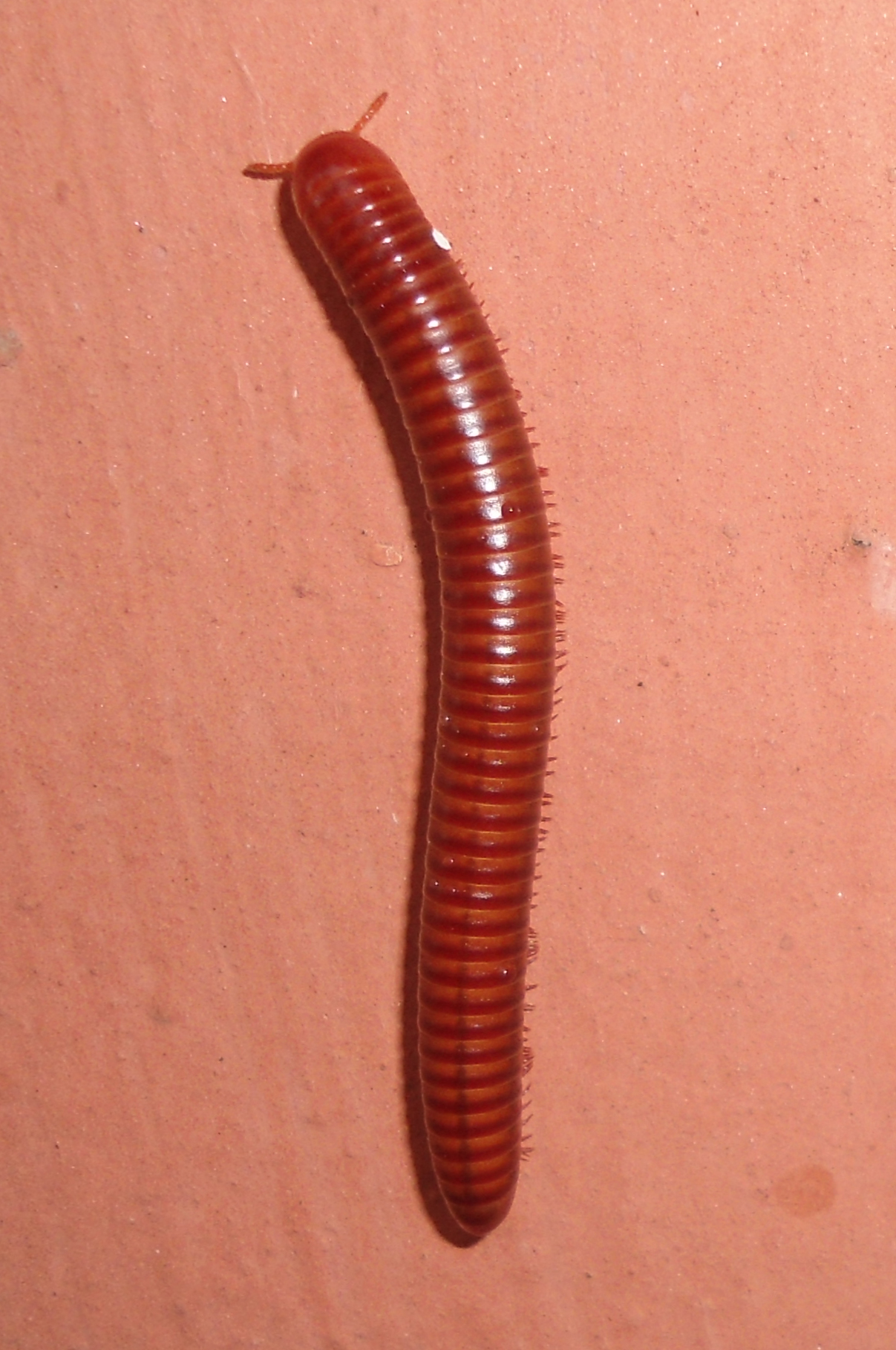
Forget the armored, tropical monster from nature documentaries. The rusty millipede is small, smooth, and wormlike enough that most people mistake it for an earthworm until the legs start moving. An adult is 2 to 3 inches long (50 to 75 millimeters, usually around 2 inches), reddish-brown to brick red, and shaped like a tiny length of rusty wire. Run your eyes along it and you will count dozens of body segments, each one carrying two pairs of legs — that is the millipede’s defining trick, and the fastest way to tell it from a centipede, which carries only one pair per segment. The body is smooth and cylindrical, with no ridges, keels, or bumps, and the segments often carry faint dark striping down the sides that looks like shadows. That smoothness matters in the look-alikes section below.
Young ones are paler and smaller than the adults and darken as they grow, adding segments with every molt — a millipede is born with only a few segments and earns the rest over its life, like a train picking up cars at every station. The color is the field mark that matters most: if it is rusty red, it is not the black Portuguese millipede, and it is not the dark, flat-backed greenhouse millipede. Red means rusty. It really is that simple, which is rare in millipede identification and should be celebrated.
The name game (rusty, coral, amber — pick one)
You will see this animal called the rusty millipede, the common Asian millipede, and sometimes the amber or coral millipede — corallinus is Latin for coral-colored, which is a fancier way of saying rusty. All of those names refer to the same animal, Trigoniulus corallinus (Gervais, 1847). The taxonomy, for the nerds in the back: kingdom Animalia, phylum Arthropoda, class Diplopoda (the millipedes), order Spirobolida, family Trigoniulidae, genus Trigoniulus. The Spirobolida are the classic round-backed millipedes — the “snake millipedes” of the old field guides — and Trigoniulus is a mostly Asian genus of around 60 described species. This one is the overachiever that left home.
Home, originally, is Southeast Asia, from Myanmar to Taiwan, across the Indo-Malayan region. From there it has hitchhiked — in soil, in potted plants, in the damp corners of cargo — to the Caribbean, Central and South America, islands around the Pacific, and, most recently, to the southern United States. It was first reported in Florida in South Miami, in Miami-Dade County, where it was collected under tree bark and in leaf litter, and the formal announcement of its Florida arrival came in 2006 (Shelley, Carmany & Burgess, Entomological News). As of 2022 it is well distributed through South and Central Florida, with only limited sightings so far in the Northeast and the Panhandle. It arrived the way most Florida millipedes arrive: quietly, damp, and in a pot.
The first millipede genome
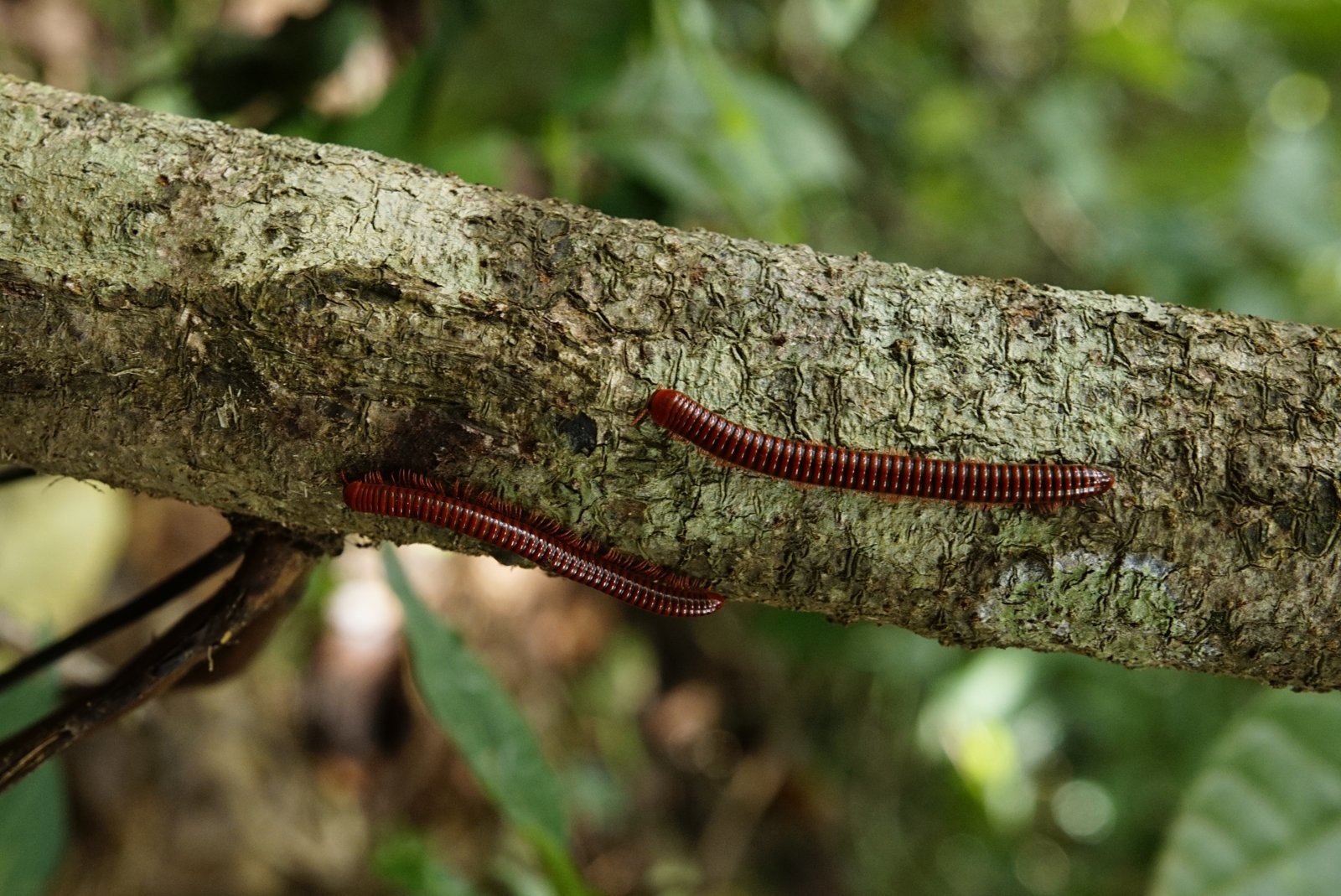
In 2015, a team led by Nathan Kenny published the genome of the rusty millipede in Genome Biology and Evolution — the first diplopod genome ever published, and only the second myriapod genome of any kind. Before that, the genetic instruction manual of an entire class of animals, one with around 12,000 described species, was a blank page. The rusty millipede got picked because it was handy, hardy, and cosmopolitan — the same traits that make it a successful invader made it a convenient lab animal — and the result turned out to be genuinely strange and interesting: the genome held onto core genes and transcription-factor families that other arthropods had lost, a reminder that millipedes are not primitive leftovers but a lineage that went its own way for a very long time and kept receipts.
That is the fun fact to deploy at parties, but it is also the reason this animal matters beyond your patio. Every millipede genome sequenced since — and there are more now — stands on the shoulders of this rusty little pioneer. You are looking at the lab rat of the millipede world, except the lab rat is in your flower bed and has about 200 legs.
What it eats: the quiet recycling job
At heart, the rusty millipede is a detritivore — a creature that eats dead things so the rest of the world does not have to wade through them. Its diet is dead plant litter: fallen leaves, rotting wood, the damp brown layer at the bottom of the world, and the rich organic matter of a compost pile. In its home range it is most active in moist places, especially rotten wood and compost during the monsoon season, and the Florida version behaves the same way: damp, dark, and full of dead leaves is home, and a dry sunny lawn is a desert it wants nothing to do with. It is not a predator. It does not hunt. It is the cleanup crew, and like most cleanup crews it is invisible until it stops showing up — or until it shows up ten thousand at a time.
That is the honest ecological story, and it is worth saying out loud before the pest section: this animal shreds dead leaves into smaller pieces, its droppings feed microbes, and the nutrients cycle back into the soil. Every handful of healthy soil is full of animals doing exactly this job. The rusty millipede only becomes a problem when it leaves home, loses its predators, and discovers that a suburban garden is an all-you-can-eat buffet with no closing time.
What it does not like is just as useful to know, because the dislikes are the levers you pull to get rid of it. It does not like dry conditions: it breathes through its skin and dries out fast in open air, and indoors, in a dry house, it dies within a few days. It does not like bright, exposed, open ground either: it is a creature of damp, dark places, active mostly at night, which is why you find it under leaf litter, under pots, and along the damp shaded side of the house, and almost never out in the sunny middle of a dry lawn. Dry, bright, and exposed is the opposite of everything it wants — and that is the whole strategy in the “how to get rid of them” section, in one sentence.
The curl and the chemistry
Disturb a rusty millipede and it has one famous move: it curls into a tight spiral, head tucked in the center, armored rings facing outward, and plays dead with total commitment. It cannot bite, cannot sting, and cannot run away fast — the curl is the whole defense plan, plus one chemical backup. Along the sides of its body it carries rows of tiny defensive glands, and if you squeeze or crush it, those glands discharge a fluid. Like its fellow round-backed millipedes, the rusty millipede’s defensive chemistry is built on benzoquinones — sharp-smelling compounds that stain skin and fabric and taste terrible to anything that tries to eat it. The stain can linger on skin for days and on clothes longer, because benzoquinones react with keratin, the protein in your skin and hair, and bind to it.
Here is what that means in practice. The fluid smells bad — sharp, chemical, and memorable. It is extremely irritating if rubbed into the eyes. It is not venom — there is no bite, no injection, nothing that gets it into your bloodstream — and the amount one millipede produces is far too small to be dangerous to a person. But it is a genuine chemical weapon against the animals that would eat millipedes, and it is the reason most predators learn to leave the rusty ones alone after one try. Wash your hands after handling one, keep it away from your eyes, and admire it with the broom rather than your fingers. The millipede would prefer that too.
Life cycle: born small, earning segments
Like all millipedes, the rusty millipede grows by molting: it sheds its exoskeleton, adds new segments and new pairs of legs, and hardens up again, bigger than before. It hatches from an egg laid in soil or leaf litter with only a few segments and a handful of legs, and earns the rest over successive molts. Adults reach their full 2 to 3 inches with dozens of segments and roughly 200 legs — which sounds like a lot until you remember the animal is named for having a thousand and delivers roughly a fifth of that. False advertising, but make an exception: it is still a lot of legs.
The details of this species’ life cycle — exactly how long it lives, how many eggs a female lays — are thinly studied compared with its famous genome. What is certain is the pattern: damp seasons bring activity and breeding, dry spells send it deep into the soil and leaf litter to wait, and in Florida the same rhythm follows heavy rain at any time of year. If your patio suddenly has rusty millipedes, it rained recently. It almost always rained recently.
The Florida angle: the other patio swarm
If the Portuguese millipede is Florida’s most famous patio invader, the rusty millipede is the runner-up — and in South and Central Florida it may be the one you actually meet. UF/IFAS Extension lists the rusty millipede among the most common millipedes in Florida, alongside the bumblebee millipede and the native Florida ivory millipede. The pattern is the same as its black cousin’s: heavy rain floods the leaf litter, the millipedes come out in numbers looking for higher, drier ground, and the nearest high dry ground is your patio, your pool deck, and the gap under your front door.
They do not want to be in your house. They cannot breed indoors and they die within a few days in a dry house — they are built for damp leaf litter, not living rooms. What you find indoors is a temporary invasion, not a colony. Sweep them out and seal the gaps they came through. And unlike the Portuguese millipede, which is black and easy to spot on a light floor, the rusty millipede is the color of a dead leaf, which is why people step on them before they see them. Check the color before you panic: red means rusty, black means Portuguese, and the fix is the same either way.
Is it a pest?
Plainly: it is a nuisance pest, not a dangerous one. It does not bite, sting, or spread disease. It does not eat your house, your clothes, or your stored food. It does not damage structures. What it does is show up in large numbers, stain things when crushed, and smell bad when disturbed — and in a garden, in very large numbers, it may nibble tender seedlings and soft fallen fruit alongside the dead stuff it prefers. That last point is worth the qualifier: dead plant matter is its food, and living plants are a fallback it reaches for only when the crowd is huge and the dead leaves run short.
Against that, weigh the day job: it shreds leaf litter, speeds up decomposition, and returns nutrients to the soil — the same work earthworms do, from a different branch of the family tree. A few rusty millipedes in the garden are a sign of healthy, organic-rich soil. A few thousand on the patio are a sign that it rained and the leaf litter is too close to the house. Both things can be true. The goal is not to exterminate them — it is to move the party from the patio back to the leaf litter where it belongs.
Effects on the garden
On the plus side, the rusty millipede is a genuine soil helper. It eats dead leaves and rotting wood, breaks them into smaller pieces, and its droppings feed the microbes that finish the job — fungi and bacteria that turn leaf litter into plant food. In a compost pile it is a volunteer worker, and in a mulched bed it is part of the crew that keeps the mulch from becoming a matted, airless blanket. Gardens with millipedes have faster litter turnover and richer surface soil than gardens without them, all else being equal.
On the minus side, numbers change the story. In very large populations, rusty millipedes can nibble seedlings, soft stems, and fallen fruit — strawberries, tomatoes resting on the soil, and tender new sprouts are the usual victims — and they can be a nuisance in greenhouses and around potted plants, where they hide in the drainage holes and under the pots. They also stain patios and pool decks when crushed underfoot, and a mass die-off after a swarm leaves a carpet of little red bodies to sweep up. None of this makes them a serious garden pest — they are not in the same league as the insects that actually eat your crops — but it does make them a creature to manage, not ignore.
Effects on other garden animals
The rusty millipede sits in the middle of the garden food web, and it pulls in both directions. As a detritivore it eats only dead plant matter — it does not hunt other animals, does not eat living insects, and does not compete with predators for prey. Its competition is with the other recyclers: earthworms, woodlice, and springtails all eat the same dead leaves, and in a rich leaf-litter bed there is usually enough dead matter for all of them. It helps the soil microbes by shredding litter into bite-size pieces, and its droppings are food for fungi and bacteria, which in turn feed the whole underground web.
As prey, it is a defended meal. Its curl-and-chemical defense puts off most predators, but some animals eat millipedes anyway: birds, toads, lizards, and ground beetles all take them, and some ant species specialize in overpowering them. In Florida, the millipedes that survive are the ones predators learned to leave alone — the bright rusty color is itself a warning flag, advertising the bad taste inside. For pets, the risk is small but real: a dog or cat that crunches a rusty millipede will get a mouthful of foul-tasting fluid and may drool, paw at its mouth, or vomit, then learn not to do it again. It is unpleasant, not an emergency — but keep an eye on any pet that eats a lot of them, and call a vet if the drooling does not stop.
Look-alikes: the concrete checks
Small millipedes all look alike until you know what to check, and the checks are wonderfully simple — color, texture, shape, speed, and a leg count. Work through them in order and you will rarely go wrong.
Portuguese Millipede (Ommatoiulus moreleti) — the black cousin. If it is black, it is not rusty. The Portuguese millipede is slate-grey to black, smooth and cylindrical like the rusty one, but darker, slightly smaller at up to about 1.8 inches, and famous for stopping trains in Australia and swarming Florida patios after rain. Check: black and smooth means Portuguese; rusty red and smooth means rusty. Both are harmless detritivores, both swarm after rain, and the fix for both is the same. Read the full guide: Portuguese Millipede.
Greenhouse Millipede (Oxidus gracilis) — the small, bumpy one. At under an inch long it is much shorter than an adult rusty millipede, and its body is dark brown to black on top with pale, creamy-white legs — the pale legs are the giveaway. The second giveaway is texture: where the rusty millipede is smooth as polished plastic, the greenhouse millipede is visibly bumpy and ridged along its back, and slightly flattened rather than round. Check: under an inch, pale legs, bumpy back. Read the full guide: Greenhouse Millipede.
Flat-backed millipedes (including Asiomorpha coarctata and Apheloria virginiensis) — the ones that look like centipedes. Flat-backed millipedes belong to the order Polydesmida, and they are flattened top-to-bottom with wide lateral keels on each segment called paranota — little flanges that make the animal look wide and flat instead of round. Adults usually have around 20 segments, and many are brown or black, sometimes with bright yellow, orange, or red markings. Check: flat, not round; flared edges on every segment; often brightly marked. Some flat-backed species defend themselves with cyanide compounds rather than benzoquinones, which is a different chemistry set and a good reason to admire them with your eyes rather than your hands. Read the full guides: Cyanide Millipede and Black-and-Yellow Flat Millipede.
Bumblebee Millipede (Anadenobolus monilicornis) — the one dressed like a bumblebee. Black with bright yellow bands, about 1¾ inches long, with red legs and red antennae — the red legs are the giveaway. A Caribbean immigrant, first found in Florida in Monroe County in 2001, now one of the most common millipedes on South Florida patios, showing up in numbers after rain. Check: yellow bands plus red legs, South Florida, after rain. A harmless detritivore, same as the rest of the round-backed crew. Read the full guide: Bumblebee Millipede.
Florida Ivory Millipede (Chicobolus spinigerus) — the big native one. Black with pale ivory bands, up to about 3½ inches long — one of the largest millipedes in Florida, and the only native among the three most common patio millipedes (the other two, rusty and bumblebee, are immigrants). Found through the Florida Peninsula and Panhandle and up into Georgia, Alabama, and South Carolina, and popular enough in the pet trade that you may meet one in a terrarium before you meet one in the garden. Check: big, black-and-ivory bands, Florida native. Read the full guide: Florida Ivory Millipede.
American Giant Millipede (Narceus americanus) — the big grey one, with an asterisk. Up to about 4 inches long, grey with reddish bands, and the largest millipede most eastern-US gardeners will ever see — but a Florida photo ID cannot be confidently called this species. The Narceus americanus/annularis complex is taxonomically unresolved, and Florida’s big Narceus is most likely the smokey oak below. Check: big, grey with red bands — then check the smokey oak entry before you name it. Read the full guide: American Giant Millipede.
Smokey Oak Millipede (Narceus gordanus) — the big sandy one, and the one Florida gardeners actually meet. Sixty to 120 millimeters long, sandy tan in color, living in Florida scrub and oak woods — this is the large Narceus under a Florida log, where the American giant’s name gets used by mistake. Check: big, sandy-tan, scrub or oak habitat, Florida. Read the full guide: Smokey Oak Millipede.
Florida Scrub Millipede (Floridobolus penneri) — the rare one, and the one to leave alone. Uniformly slate grey, 60 to 92 millimeters long, and found nowhere on Earth except the Lake Wales Ridge scrub in Polk and Highlands counties. It is critically imperiled (G1G2/S1S2) and not a patio animal at all — if you ever meet one, you are standing in rare scrub, and the right move is to admire it and leave it exactly where it is. Check: grey, ridge scrub only, and rarer than everything else on this page. Read the full guide: Florida Scrub Millipede.
Centipedes — the one that actually matters, because this is the split with consequences. Centipedes have one pair of legs per segment, not two, and they move fast — darting, flickering, gone under the baseboard before you have finished the sentence. Millipedes move slowly, in a steady wave, and curl up when disturbed; centipedes run. Centipedes are also flattened, with long legs that stick out sideways and a pair of venomous front fangs, and they can bite. Millipedes have short legs tucked under a round body and no bite at all. Check: count the legs per segment (one pair means centipede, two pairs means millipede), then watch the speed (fast means centipede, slow means millipede), then watch what it does when poked (runs means centipede, curls means millipede). Three checks, three answers, and you will never mix them up again. Read the full guide: Garden Centipedes.
How to get rid of them
Do not spray. UF/IFAS recommends no chemical treatment for millipedes outdoors, and it would not work anyway — the millipedes live in the leaf litter, not on a surface you can treat, and killing the ones on the patio does nothing about the thousands still in the mulch. The fix is boring, cheap, and effective, and it works for every millipede on your patio:
Sweep them up. A soft broom and a dustpan, tipped outside into the leaf litter away from the house. Do not crush them on the patio if you can avoid it — the stain is the point of the defense, and it works on concrete too.
Pull the buffet back from the house. Rake leaf litter and mulch back from the foundation by a foot or two, clear the gutters, and pick up fallen fruit. The millipedes live where the food is; move the food and they follow it.
Dry the edges out. Millipedes need damp. Fix dripping taps and sprinklers that soak the foundation beds, let the soil surface dry between waterings, and keep potted plants off the patio or on saucers that drain. Dry, bright, and exposed is the opposite of everything they want.
Seal the gaps. Door sweeps, weatherstripping, and caulk around windows and pipes close the routes indoors. They come in through gaps you can barely see, so look low — at ground level, where the wall meets the patio.
Turn the lights off. Outdoor lights attract millipedes on swarm nights, especially after rain. Switch them off during swarm season, or swap to motion sensors and yellow bulbs that draw fewer night-flying insects — and fewer of the animals that follow them.
Leave the compost pile alone. If you have a compost pile or a leaf-mold corner away from the house, let the millipedes work there. They are doing you a favor in the pile, and a busy pile keeps them out of your living room. The goal is not a millipede-free garden — it is a millipede-free house, with the garden crew still on the payroll.
Frequently asked questions
Is the rusty millipede dangerous?
No. It does not bite, sting, or spread disease, and the amount of defensive fluid one millipede produces is far too small to harm a person. It can stain skin and irritate eyes, so wash your hands after handling one and keep it away from your face.
Does it bite?
No. Millipedes have no venom, no fangs, and no bite at all. Their defenses are curling up and a bad-tasting chemical fluid. If it has fangs and it bit you, it was a centipede.
Why is it in my house?
It rained, and your house is the nearest high, dry ground. Millipedes cannot breed indoors and die within a few days in a dry house — what you found is a temporary invasion, not a colony. Sweep them out and seal the gaps they came through.
How big does it get?
Adults are 2 to 3 inches long (50 to 75 millimeters), usually around 2 inches. That makes it one of the larger small millipedes on a Florida patio — bigger than the greenhouse millipede, smaller than the native Florida ivory millipede.
Is it a worm?
No, and the legs give it away. It is an arthropod — a relative of lobsters, crabs, and insects — with a hard segmented exoskeleton and roughly 200 legs. Worms have no legs at all. If it has legs, it is not a worm, no matter how wormlike it looks.
What does it eat?
Dead plant matter: fallen leaves, rotting wood, and compost. It does not eat living plants as a rule, though in very large numbers it may nibble seedlings and soft fallen fruit. It does not eat your house, your clothes, or your food.
Will it hurt my plants?
Almost never. A few millipedes in a bed are helpers, shredding leaf litter and feeding the soil. Only in huge numbers do they nibble seedlings and soft fruit — and at that point the fix is the same as for the patio: pull the mulch back, dry the edges, and let the population settle.
Will it hurt my dog or cat?
A pet that crunches one will get a mouthful of foul-tasting fluid and may drool, paw at its mouth, or vomit once, then learn not to do it again. It is unpleasant, not an emergency — but call a vet if the drooling does not stop or the pet eats a lot of them.
How do I get rid of them?
Sweep them up with a soft broom and tip them outside. Then fix the causes: pull leaf litter and mulch back from the foundation, seal gaps around doors and windows, dry out damp foundation beds, and turn off outdoor lights at night during swarm season. Do not spray — UF/IFAS recommends no chemical treatment for millipedes outdoors.
Why is it called the rusty millipede — and what is the genome thing?
Rusty for its reddish-brown, rust-colored body; its scientific name corallinus means coral-colored, same idea in Latin. The genome thing is real: in 2015 its genome was the first millipede genome ever sequenced (Kenny et al., Genome Biology and Evolution), making this patio animal a scientific pioneer as well as a nuisance.
Is it invasive in Florida?
Yes. It is native to Southeast Asia and was first reported in Florida in South Miami, with its Florida arrival formally published in 2006. It is now well distributed through South and Central Florida. It is a nuisance invader, not an ecological disaster — it eats dead leaves, not living plants, and it has not displaced Florida’s native millipedes the way some invaders displace natives.
🌱 Keep learning
Three related guides worth reading next:
- Portuguese Millipede — The little black millipede that stopped trains: rain swarms, a staining chemical defense, and the curl that gives it away — Florida patio edition.
- Compost Accelerators — Twelve things that actually wake up a lazy pile, and the microbes behind all of it, Florida edition.
- Soil Food Web Explorer — Meet the whole underground crew, from bacteria to beetles, and see where the millipedes fit in the chain.
🪱 Your Soil Needs This
Reading about healthy soil is great. Growing in it is better. Our small-batch, traceable worm castings are the shortcut your garden deserves.
Shop Worm Castings Subscribe & SaveEvery bag comes with a lot certificate. Know what's in your soil.