
In the damp leaf litter of a Southern Appalachian cove forest, there is a millipede that looks like it has been left out in the rain and shrunk in the wash: wrinkled all over, dark as wet bark, with three yellow spots on every segment like a row of tiny headlights. The wrinkled flat-backed millipede, Cherokia georgiana, is one of the most conspicuous millipedes in the southeastern United States — and one of the most confusing, because almost no two of them look alike. It can be yellow-spotted or red-spotted or striped, big in the lowlands and small on the mountaintops, and for more than sixty years naturalists divided it into three subspecies before DNA showed it was one species all along, wearing different outfits in different places. This guide is about a millipede that is a whole field guide by itself.
And if you are reading this because you just found a wrinkly, dark, yellow-spotted millipede under a log in the southern Appalachians — stay with us. It is not dangerous, it is not a pest, the spots are a warning, not a decoration, and everything in the “what to do” section works for yours too.

What it looks like
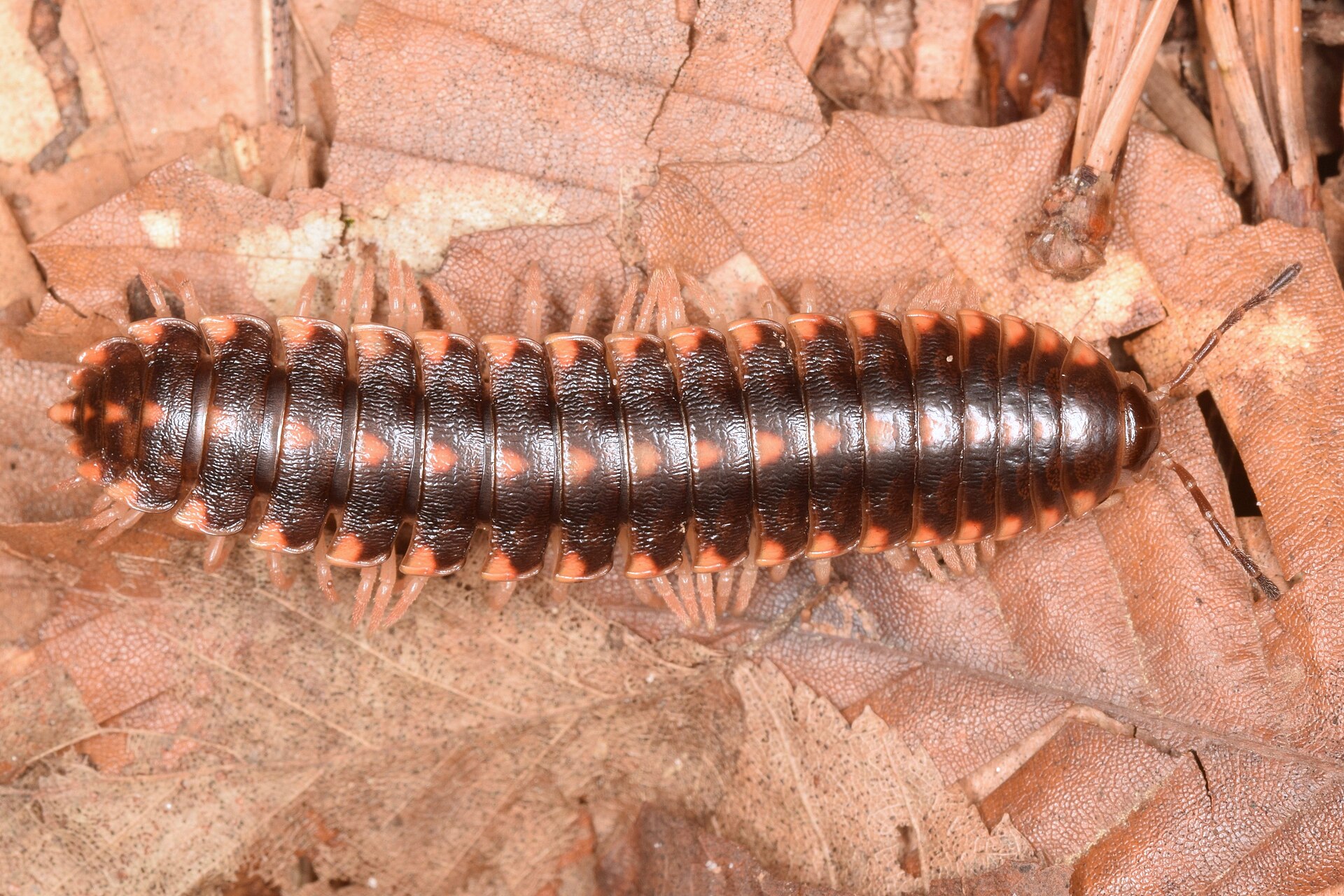
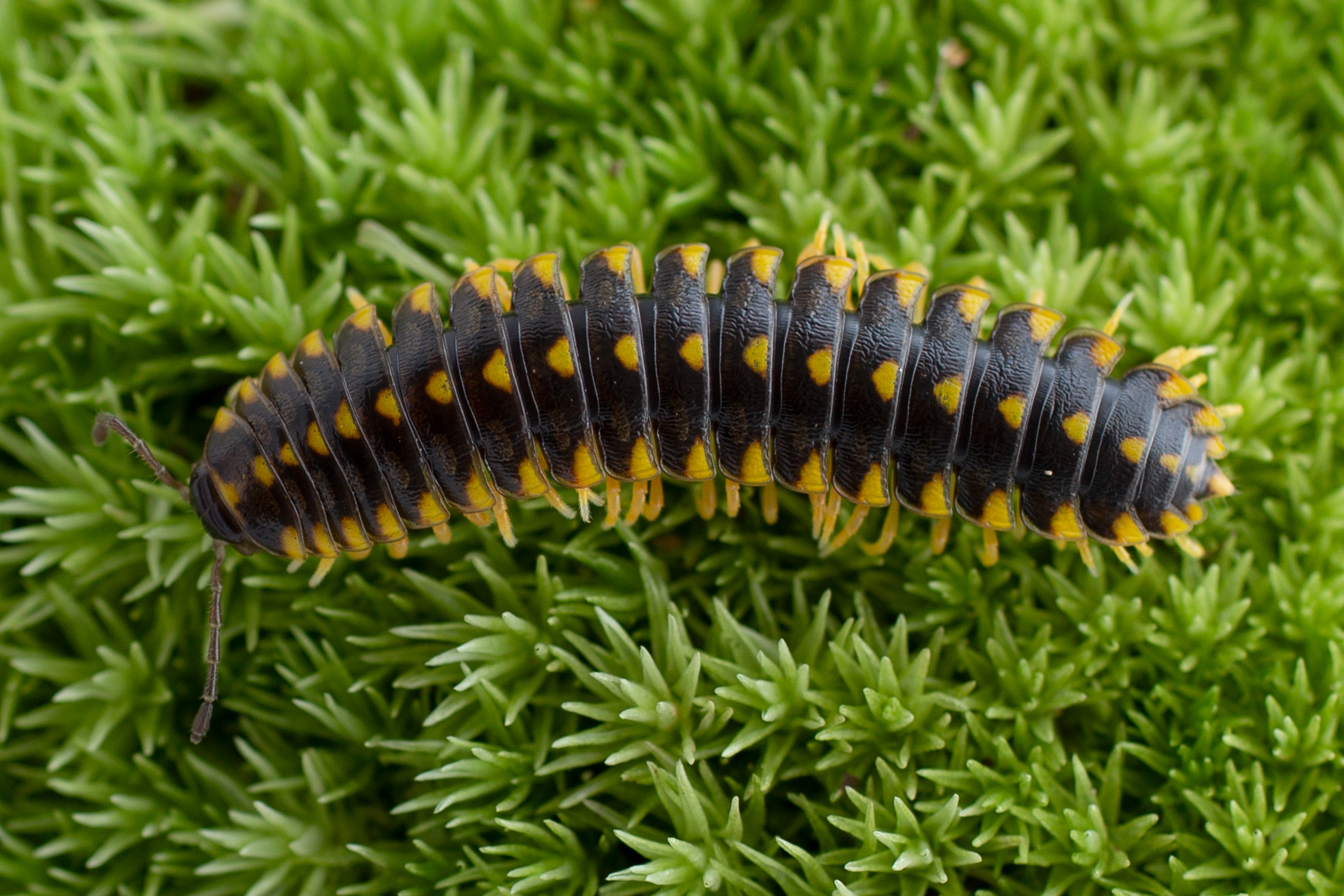
The wrinkled flat-backed millipede is a flat-backed millipede of the family Xystodesmidae, and its first field mark is in the name: the dorsal surface is wrinkly, roughened and creased all over, like crumpled paper, where its relatives are smooth. The paranota — the wide, flat side flanges on each segment — are horizontally wide with minimal downward curvature, sticking out sideways like little shelves. Adults are 1.5 to 3.5 inches long (roughly 38 to 89 millimeters), a large millipede by eastern standards, and the size varies with elevation in a way that fooled naturalists for decades: smaller animals live at higher altitudes, and larger specimens live closer to sea level.
The color is where this species becomes genuinely difficult. The base color is dark brown to black, and the markings range from yellow to red, in patterns described as two-spotted, three-spotted, and striped — with the three-spotted yellow pattern being the most common. A typical animal is black with three yellow dots on each segment and yellow legs, and antennae about twice as long as the legs. But in some localities several color patterns coexist, and the coloration does not align with geography or with phylogeny: two animals from the same log can wear different patterns, and animals from mountains a hundred miles apart can match. That variability is the reason for the long taxonomic confusion described below, and it is also the reason this guide will not give you a single “typical” photograph and call the job done: the three photographs here show the range, and the range is the point.
There are structural marks for the patient observer, too. The genus stands apart from other Xystodesmidae by its wrinkly dorsal surface, its wide, flat paranota, a straight telopodite on the male gonopod (where its relatives have curved or twisted ones), a long, icepick-like prefemoral process, and the absence of a receptacle in the female’s cyphopods. You will not be checking gonopods in your garden — those are the modified legs on the seventh segment of a male, visible only under magnification — but the wrinkle plus the wide flat paranota plus the spots will get you there in the field, in its range, almost every time.
The name game
The name is a geography lesson and a history lesson at once. Cherokia is the genus, named for the Cherokee — the animal’s heartland is the southern Appalachian Mountains, the Cherokee homeland — and georgiana means “of Georgia,” where the first specimens were collected in 1887 by L. M. Underwood at Macon, Lookout Mountain, Indian Springs, and Tallulah. Charles H. Bollman described it in 1889 as Fontaria georgiana, from Piedmont localities, and in the same paper described a second species, Fontaria tallulah, from two immature females at Tallulah Falls — separated mostly by color pattern. In 1949, Ralph Vary Chamberlin set up the new genus Cherokia and designated Fontaria georgiana as its type species. The common name, the wrinkled flat-backed millipede, is the honest one: it describes the animal you see, not the animal’s history.
The taxonomy, for the nerds in the back: kingdom Animalia, phylum Arthropoda, class Diplopoda (the millipedes), order Polydesmida, family Xystodesmidae, genus Cherokia, species georgiana (Bollman, 1889). The genus is monotypic — it contains a single species, this one. The last full revision was Richard Hoffman’s in 1960, which recognized three subspecies, divided mostly by body shape, size, and color. That stood for over sixty years, until a 2022 molecular phylogenetic study by Vasquez-Valverde and Marek tested the subspecies with DNA and morphology and found no evidence for them: the characters that defined the subspecies — paranota shape, body size, coloration — vary with geography and elevation (clinal variation) but not with phylogeny, and the species-delimitation test supports a single species. The subspecies have been synonymized with Cherokia georgiana, and this guide uses the single name throughout. The same study expanded the known range with a newly reported state, Virginia, and about 160 new localities — a citizen-science campaign on social media helped locate specimens in new areas, and the range turned out to be broader than anyone had thought.
Where it lives
The wrinkled flat-backed millipede inhabits forests in the southeastern United States, particularly those with hemlock, maple, tulip poplar, rhododendron, cedar, and spruce-fir trees — the cool, damp, hardwood and mixed forests of the Southern Appalachians and their foothills. It lives in the leaf litter and under logs and rocks, in the humus layer where dead leaves are turning into soil. In North Carolina it has been recorded from 14 counties, in the mountains and the high mountains, and it is one of the most conspicuous elements of the diplopod fauna in the circum-Appalachian region — in Hoffman’s words, a millipede that any student of the humus fauna “cannot help but be impressed” by, for its abundance and variability.
The range, as currently understood, runs from western Virginia and eastern Kentucky, through Tennessee, southwest North Carolina and northwest South Carolina, and into Alabama and Georgia. The 2022 revision added Virginia as a newly reported state and roughly 160 new localities, so the map is still being drawn — and the citizen-science campaign that helped draw it is a standing invitation: if you photograph one outside the known range, with a location, that record matters. The range does not include Florida. A wrinkled, spotted, flat-backed millipede found in Florida would be something else — most likely the cyanide millipede or a relative in the same family — and this guide says so plainly, because the Appalachian flat-backed fauna is so often misattributed southward.
Elevation shapes this animal more than almost any other millipede in this library. Body size decreases with altitude — the small mountaintop animals and the large lowland animals are the same species, wearing the size their elevation gives them — and paranota shape varies with geography in the same clinal way. A millipede that changes size with altitude is a millipede that is exquisitely tuned to its mountain, and it is why the old subspecies, drawn on size and shape, collapsed when the DNA was read: the differences were the mountain’s doing, not the millipede’s.
What it eats: the quiet recycling job
Like every millipede in this library, the wrinkled flat-backed millipede is a detritivore — it eats dead leaves, and the fungi and microbes that grow on them, in the leaf litter of the forest floor. It is a creature of the humus fauna, the community of animals that lives in the half-rotted layer between fresh-fallen leaves and soil, and its work is the quiet recycling job: shredding dead leaves into smaller pieces, and returning them to the soil as droppings that feed the fungi and bacteria. In a cove forest, where the leaf litter is deep and the canopy is closed, it is one of the most conspicuous recyclers — not because it is the most numerous, but because it is large, dark, and spotted, and hard to miss when you roll a log.
What it does not like is equally clear. It does not eat living plants. It does not eat your vegetables, your seedlings, your fruit, or your house. It wants damp, shady, deciduous leaf litter — hemlock, maple, tulip poplar, rhododendron — and it does not want dry, sunny, bare ground. A wrinkled flat-backed millipede in a garden is there for the leaf litter under the trees, and if there is no leaf litter, it is not there at all.
The curl and the chemistry
Disturb a wrinkled flat-backed millipede and it does what its family does: it curls into a flat coil, and its defense glands go to work. The family Xystodesmidae — and the tribe Apheloriini, to which Cherokia belongs — defends itself with hydrogen cyanide and benzaldehyde, produced by a two-chambered gland that mixes a stored precursor, mandelonitrile, with an enzyme when the animal is threatened. The benzaldehyde is what smells like cherries or bitter almonds, and the cyanide is what makes the smell a warning rather than a perfume. The bright yellow, orange, or red spots on a black body are aposematic coloration — warning colors, advertising the chemistry to any predator that can see.
Has the cyanide content of this exact species been measured? No — no published assay of Cherokia georgiana‘s secretion exists, and this guide will not borrow the famous figures from its relative Apheloria corrugata (one animal carrying enough cyanide to kill six mice) and pretend they belong here. What is safe to say, from the family-level evidence, is that the secretion is a genuine deterrent, that the spots are a genuine warning, and that the amount is far too small to harm a person. Wash your hands with soap and water after handling one, keep it away from your eyes, and do not eat it. The mimicry story matters here too: the Appalachian xystodesmids form mimicry rings, groups of species that share warning colors so predators learn the lesson once and apply it to all of them, and Cherokia‘s variable colors are part of that shared language — which is another reason its coloration does not map neatly onto geography or family tree.
Life cycle
Like all millipedes, the wrinkled flat-backed millipede grows by molting: it hatches from an egg laid in soil or leaf litter with only a few segments and a handful of legs, and earns the rest over successive molts, adding rings and legs each time it sheds its exoskeleton. Adults have 20 body rings, the standard count for flat-backed millipedes, and reach 1.5 to 3.5 inches long — with the size depending on elevation, as described above, so that a mountaintop adult can be half the length of a lowland adult of the same species.
Beyond that basic pattern, the details of this species’ life cycle are thinly known, and the gaps are worth naming honestly rather than papering over. No published study follows a wrinkled flat-backed millipede from egg to adult, and there is no species-specific account of its mating season, its egg-laying, or its lifespan. What can be said is what is true of Appalachian xystodesmids generally: the animals are most active in the damp seasons, they shelter under logs and in leaf litter through dry spells, and the females lay their eggs in the soil or litter, where the young hatch and begin the slow climb through the molts. A millipede this conspicuous, with a range this well mapped, still keeps its private life private — and the 160 new localities found in 2022 are a reminder that the mapping, at least, is still moving.
How the subspecies fell
The story of how Cherokia georgiana lost its subspecies is worth telling in full, because it is a model of how taxonomy corrects itself. The last revision before the DNA era was Richard Hoffman’s 1960 monograph, based on more than 105 lots and well over 400 individuals from a large number of localities. Hoffman recognized three subspecies, divided mostly by body form, color pattern, and the shape of the paranota, and he was candid about the difficulty: the genus showed “a bewildering variety of forms with little but the sigmoid curvature in common,” and the geographic variation in color pattern “imposes a higher premium on knowledge of the living colors in this genus than in most.” He collected living specimens at more than thirty localities, chiefly in the southern Appalachians, and his monograph stood for over sixty years.
What changed the picture was a molecular phylogenetic analysis by Luisa Fernanda Vasquez-Valverde and Paul Marek, published in 2022, which tested the subspecies with DNA and with morphology together. The study found that the characters that defined the subspecies — paranota shape, body size, coloration — correlated with geographical distribution and elevation, but not with phylogeny: they were clinal variation, the mountain’s doing, not the millipede’s. The species-delimitation test supported a single species, and the subspecies were synonymized. The same study expanded the known range with a newly reported state, Virginia, and about 160 new localities — many of them found through a citizen-science campaign on social media, in which members of the public photographed millipedes and sent in locations. It is a rare and encouraging story: a species that got simpler, not more complicated, when the DNA was read — and a range map that grew because ordinary people looked under logs and sent in photographs.
Is it a pest?
Plainly: no. It is not a pest in any sense of the word. It does not bite, sting, or spread disease. It does not eat living plants, seedlings, fruit, or crops. It does not eat your house, your clothes, or your stored food. It does not swarm patios after rain, it does not invade houses, and it does not show up in numbers anywhere a gardener would notice it — because it lives in damp Appalachian forest litter, and a garden would have to back onto that forest to meet it at all. A gardener in the southern Appalachians who finds one under a log has found a neighbor, not a problem.
The only sense in which it could ever be called a problem is the reverse of the usual one: the problem is not what it does to us, but what we do to it. Its habitat is the cool, damp cove forest — hemlock, maple, tulip poplar, rhododendron — and that habitat is under pressure from development, from the loss of hemlock to the woolly adelgid, and from the tidying of the forest floor. It is not a pest to manage. It is a forest animal to leave alone.
How to get rid of it — or how to attract it
There is nothing to get rid of, so this section is about the opposite: how to keep the conditions that let this animal exist, if you are lucky enough to have it on your land. The answer is the same as for every forest millipede in this library, and it is gloriously lazy: leave the leaf litter alone. A wrinkled flat-backed millipede needs a deep, damp leaf litter under trees, and logs left to rot where they fell. If you have a wooded corner, leave the fallen logs where they fell, do not rake the litter to bare soil, and do not roll the same log every weekend to see what is underneath.
If you do roll a log and find one, put the log back exactly as it was, gently, the same side down, and walk away. Do not collect the animals: they are forest-litter specialists, and a millipede removed from its litter is a dead millipede. Do not spray anywhere near them — broad-spectrum insecticides will kill them just as dead as they kill anything else. And if you photograph one, consider submitting the photo with a location to iNaturalist: the 2022 revision added 160 new localities with the help of citizen science, and your record could be the next one. What they do not like is the opposite of all this: dry, sunny, bare ground with nothing rotting in it. A yard that is too tidy for millipedes is too tidy for soil life generally.
Effects on the garden
On the plus side, everything this animal does is helpful, in the quiet way detritivores always are. It eats dead leaves, shreds them into smaller pieces, and its droppings feed the fungi and bacteria that turn dead leaves into soil nutrients. In a wooded garden it is one of the main recyclers of the litter layer, and a garden with a healthy wrinkled flat-backed population is a garden whose leaf litter is being processed, not piling up into a sodden mat. It does not compete with your plants for anything, because it does not eat plants.
On the minus side, there is nothing to list. It does not eat garden plants, it does not nibble seedlings, it does not hide in potted plants or drainage holes, and it does not stain patios, because it never visits one. The honest effect on a garden is: none, unless your garden backs onto damp Appalachian woods — in which case the effect is the good kind, and the sign of it is a wrinkly black-and-yellow millipede under a log, which is a gift, not a problem.
Effects on other garden animals
The wrinkled flat-backed millipede sits in the middle of the forest food web. As a detritivore it eats only dead plant matter — it does not hunt other animals, does not eat living insects, and does not compete with predators for prey. Its competition is with the other recyclers: the beetles, the woodlice, the springtails, and the fungi that all eat the same dead leaves. It helps the soil microbes by shredding litter into bite-size pieces, and its droppings are food for fungi and bacteria, which in turn feed the whole underground web.
As prey, it is a defended meal — and a valuable one, because it is big. Most predators learn to leave it alone after one taste of the cyanide defense, but some animals eat millipedes anyway: ground beetles of the genus Promecognathus are famously tolerant of cyanide and lop the heads off flat-backed millipedes with their mandibles, and birds, toads, lizards, and shrews take millipedes generally. The mimicry rings cut both ways here: this species shares its warning colors with its neighbors, and predators that have learned the lesson from one member of the ring will spare the others too. For pets, the risk is small but real enough to name: a dog that crunches one will get a mouthful of foul-tasting, cherry-smelling fluid, and will very likely drop it and learn not to do it again. Unpleasant, not an emergency — but wash your hands after handling one yourself.
Look-alikes: the concrete checks
Spotted flat-backed millipedes all look alike until you know what to check, and with this species the first check is the texture: wrinkly, not smooth. Work through these in order and you will rarely go wrong.
Wandering Cherry Millipede (Pleuroloma flavipes) — the other widespread flat-backed millipede with yellow markings. Also dark with yellow legs and a wrinkled surface, and the two genuinely overlap in the southern Appalachians — but the wandering cherry is smaller (10 to 40 millimeters), its paranota are less widely flared, and it marches in mass aggregations across open ground, which Cherokia does not do. Check: small and marching means wandering cherry; large and wrinkly and solitary under a log means Cherokia. Read the full guide: Wandering Cherry Millipede.
Black-and-Yellow Flat Millipede (Apheloria virginiensis) — the cherry millipede most people know. Also flat-backed, also black with yellow spots, also cyanide-defended — and a member of the same mimicry rings. Check: Apheloria virginiensis is smoother, without the all-over wrinkle, and its paranota curve downward where Cherokia‘s stick out flat and wide. Note also that Apheloria virginiensis lives only in Virginia and North Carolina, while Cherokia ranges from Virginia and Kentucky south to Georgia and Alabama. Read the full guide: Black-and-Yellow Flat Millipede.
Cyanide Millipede (Asiomorpha coarctata) — the small flat-backed millipede of gardens and greenhouses. Also dark with pale paranota, but much smaller, smoother, and a common garden animal — the wrinkled flat-backed is larger, wrinkly, and strictly a forest animal. Check: small and smooth and in a garden means cyanide millipede; large and wrinkly and in Appalachian leaf litter means Cherokia. Read the full guide: Cyanide Millipede.
Feather Millipede (Brachycybe lecontii) — the other flat millipede of eastern forests. Also flattened with wide paranota, but pink, feathery, and tiny by comparison, found in pinwheel colonies on fungus-covered logs. Check: pink and feathery and in a pinwheel means feather millipede; dark and wrinkly with yellow spots means Cherokia. Read the full guide: Feather Millipede.
Centipedes — the one that actually matters, because this is the split with consequences. Centipedes have one pair of legs per segment, not two, and they move fast — darting, flickering, gone under the log before you have finished the sentence. Millipedes move slowly, in a steady wave, and curl up when disturbed; centipedes run. Centipedes are also flattened, with long legs that stick out sideways and a pair of venomous front fangs, and they can bite. Millipedes have short legs tucked under a round or flat body and no bite at all. Check: count the legs per segment (one pair means centipede, two pairs means millipede), then watch the speed (fast means centipede, slow means millipede), then watch what it does when poked (runs means centipede, curls means millipede). Read the full guide: Garden Centipedes.
Frequently asked questions
Is the wrinkled flat-backed millipede dangerous?
No. It does not bite, sting, or spread disease. Its defense is a cyanide-and-benzaldehyde secretion that smells like cherries or almonds, and the amount in one millipede is far too small to harm a person. Wash your hands with soap and water after handling one, and keep it away from your eyes.
Is it a pest?
No — plainly and completely no. It does not eat living plants, seedlings, fruit, or crops, it does not invade houses, and it does not swarm patios. It lives in damp Appalachian forest leaf litter, and a garden would have to back onto that forest to meet it at all.
How big does it get?
Adults are 1.5 to 3.5 inches long (roughly 38 to 89 millimeters). The size varies with elevation: smaller animals live at higher altitudes, and larger specimens live closer to sea level — the same species, wearing the size its mountain gives it.
Why do they all look different?
Because the coloration is genuinely variable, and it does not map onto geography or family tree. The markings range from yellow to red, in two-spotted, three-spotted, and striped patterns, and several patterns can coexist in one locality. For more than sixty years the variation was read as three subspecies; DNA work in 2022 showed it is one species, with size and shape varying clinally with geography and elevation.
Where does it live?
In forests of the southeastern United States — western Virginia and eastern Kentucky, through Tennessee, southwest North Carolina and northwest South Carolina, and into Alabama and Georgia — particularly in forests with hemlock, maple, tulip poplar, rhododendron, cedar, and spruce-fir. It does not occur in Florida.
What does it eat?
Dead leaves and the fungi and microbes that grow on them, in the leaf litter of the forest floor. It does not eat living plants.
Is it the same as the black-and-yellow flat millipede?
No, though the two are relatives, members of the same mimicry rings, and genuinely hard to tell apart by color alone. Cherokia georgiana is wrinkly all over, with wide, flat paranota that stick out sideways; Apheloria virginiensis is smoother, with paranota that curve downward. Apheloria virginiensis also lives only in Virginia and North Carolina.
Will it hurt my plants or my pets?
No to plants. A pet that crunches one will get a mouthful of foul-tasting, cherry-smelling fluid and will very likely drop it and learn not to do it again. Unpleasant, not an emergency.
How many species are in the genus Cherokia?
One. Cherokia is a monotypic genus — C. georgiana is its only species. The three subspecies recognized from 1960 to 2022 were synonymized after molecular work found no evidence for them.
What should I do if I find one?
Admire it, photograph it with a location if you like — citizen science added about 160 new localities in 2022, and your record could matter — and put the log back exactly as it was. Do not collect it, and do not spray near it.
🌱 Keep learning
Three related guides worth reading next:
- Black-and-Yellow Flat Millipede — The cherry millipede this species mimics — bold black and yellow, cyanide-defended, and Virginia-and-North-Carolina only.
- Soil Food Web Explorer — Meet the whole underground crew, from bacteria to beetles, and see where the millipedes fit in the chain.
- Compost Accelerators — Twelve things that actually wake up a lazy pile, and the microbes behind all of it, Florida edition.
🪱 Your Soil Needs This
Reading about healthy soil is great. Growing in it is better. Our small-batch, traceable worm castings are the shortcut your garden deserves.
Shop Worm Castings Subscribe & SaveEvery bag comes with a lot certificate. Know what's in your soil.