
🌼 Rice Button Aster
Some wildflowers announce themselves. Rice button aster does not. It waits until fall, until the summer flowers have given up and the scrub looks tired, and then it quietly covers itself in hundreds of tiny white-to-pink daisies — each one no bigger than a shirt button — until a whole dry flatwoods edge looks dusted with snow. This is the plant from the dry scrub and flatwoods of Orange County that started this whole aster project: small pale pink and violet flowers on slim, branching stems, doing an enormous amount of quiet work for pollinators at exactly the time of year when almost nothing else is blooming.
First, the name situation, because it will save you a confusing afternoon: rice button aster and bushy aster are one species with two common names. Not two plants, not a variety split — the same Symphyotrichum dumosum, called “rice button” in Florida wildflower circles and “bushy aster” through most of the rest of its range. The name fits either way: the flowers are tiny buttons, and the plant itself grows into a loose, bushy, much-branched cloud of them. If a field guide, a nursery tag, and a Facebook post all seem to be describing three different plants, they are almost certainly all describing this one.
It is also a genuinely good garden plant, which is not something you can say about every wildflower in this series. The Florida Wildflower Foundation calls it easy to propagate, adaptable to a variety of growing conditions, and ideal for the home landscape — high praise from people who spend their days watching native plants refuse to cooperate. The trick is giving it what it already wants: sun, sandy soil, and to be mostly left alone.
At a glance
- Latin name: Symphyotrichum dumosum (formerly Aster dumosus)
- Family: Asteraceae — the aster, daisy, or composite family
- Common names: Rice button aster, bushy aster — one species, two names
- Life cycle: Perennial herbaceous wildflower; colonial, spreading by long rhizomes and by suckering
- Height: 2–3+ feet, on slim, much-branched stems
- Flowers: Small heads, 3/8 to 3/4 inch across, in terminal panicles; 15–33 rays, white to pink to lavender; yellow disc florets that turn pinkish-reddish with age
- Bloom: Primarily September through December in Florida; known to bloom throughout the year
- Habitat: Sandhills, pine flatwoods, and hammocks; moderately moist to dry sandy acidic soils
- Light: Full sun to partial shade
- Florida range: Throughout Florida
- Wildlife value: A profuse bloomer that attracts many pollinators, particularly butterflies and native bees; a larval host for the Pearl crescent butterfly
- Conservation: Common and widespread; NatureServe rates it globally secure (G5)
How to recognize it
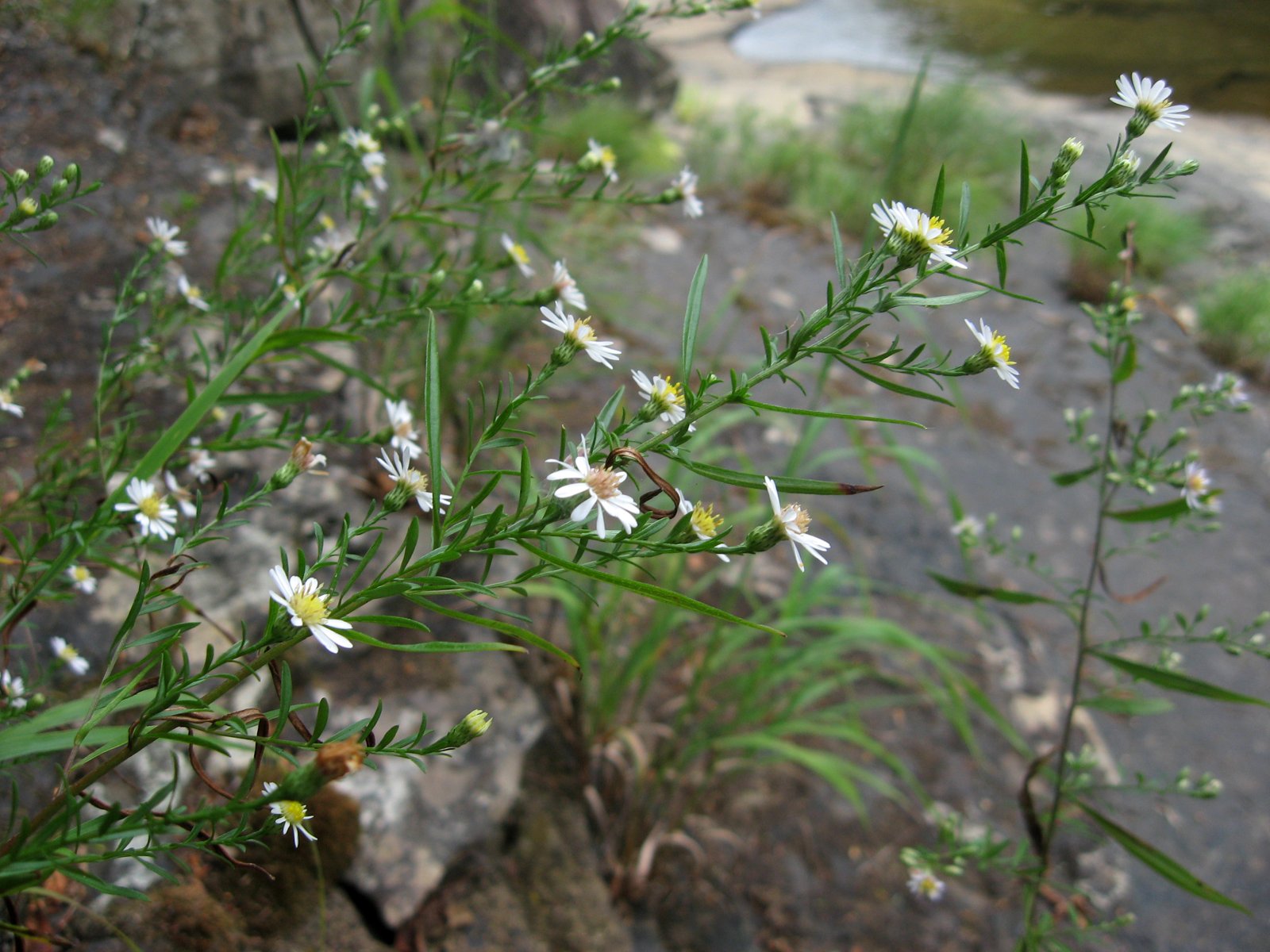
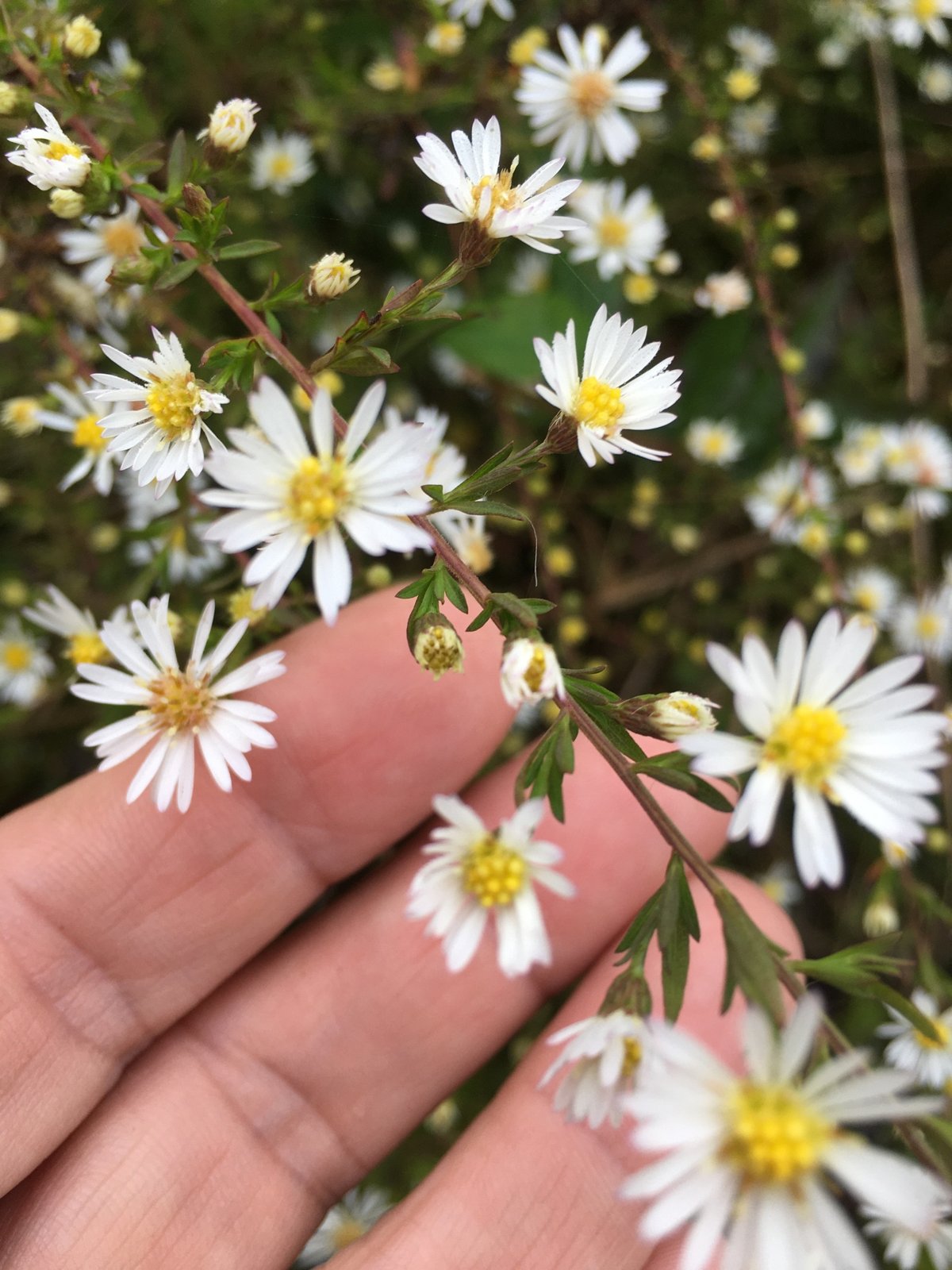
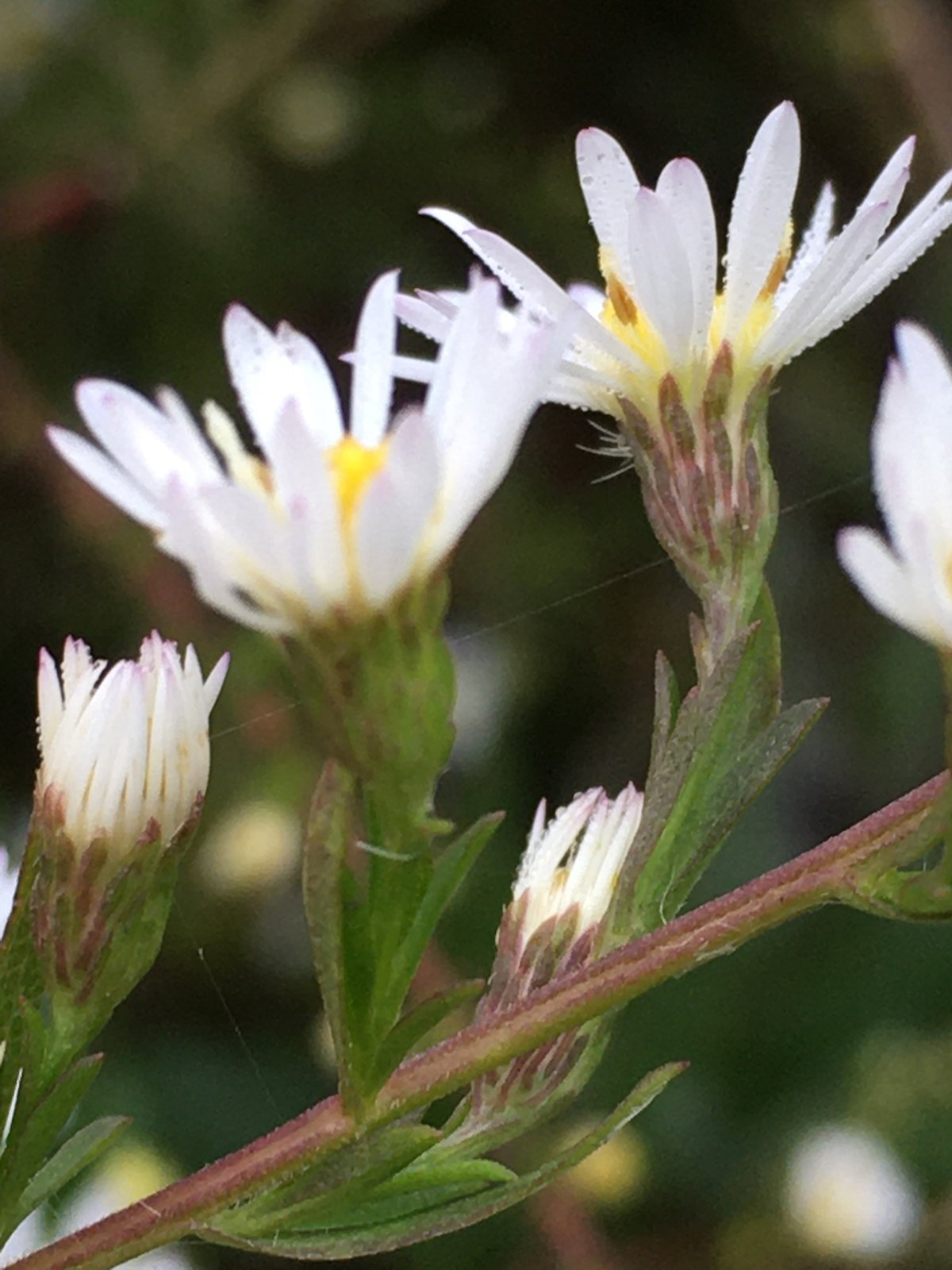
The first thing to check is the size of the flower heads, because “small” is doing real diagnostic work here. Each head is only 3/8 to 3/4 of an inch across — genuinely tiny, more like a shirt button than a daisy. Hold one next to your thumbnail and it will barely cover it. The heads are carried in loose, branching terminal panicles, dozens to hundreds of them, so the plant reads as a cloud of small flowers rather than a few showy blooms.
Each head is a classic aster in miniature: 15 to 33 ray florets — the petal-like straps around the edge — in white, pink, or lavender, sometimes pale blue, surrounding 15 to 30 disc florets in the center that start out cream to pale yellow and turn pink as the flower ages. That two-tone aging is a useful field mark: a single plant will often carry fresh yellow-centered heads and older pink-centered ones at the same time, like a string of lights at two different settings. The little cup of bracts under each head — the involucre, 4.5 to 6.3 millimeters long — is cylinder- to bell-shaped, with smooth, whitish bracts in four to six staggered rows.
The leaves are the second check, and they are just as narrow as the flowers are small. They are linear — long, thin, and grass-like — sessile (no leaf stalk; the blade attaches straight to the stem) and alternately arranged, getting smaller as they climb the flowering stems. The stems themselves are slim and much-branched, which is where the “bushy” in bushy aster comes from: the plant builds a loose, airy, twiggy framework and then hangs its hundreds of small heads all over it.
Underground, it is a colonial perennial, usually long-rhizomatous, which means a patch you find this year will likely be a bigger patch next year. That matters for both identification — look for a colony, not a single lonely stem — and for the garden, where it spreads by suckering and may need thinning to keep it under control.
One more thing the name tells you, if you like the nerdy part: Symphyotrichum comes from the Greek sýmphysis, “growing together,” and thríx, “hair.” It refers to a basal ring of hairs — the pappus — that was thought to occur on New England aster, the species the genus name was coined around. Most modern Symphyotrichum species, including this one, do not actually show that feature. The name stuck anyway. Botany is full of labels like that: a fossil of an old idea, carried forward because everyone already knows what it means.
Where it grows in Florida
Throughout Florida — the whole state, north to south — in sandhills, pine flatwoods, and hammocks. That is a wide ecological résumé for one plant, and it explains why it turns up in so many different-looking places: the dry, deep sands of a scrubby sandhill, the seasonally damp edge of a pine flatwoods, the dappled shade at a hammock’s edge. What those places share is sandy, acidic soil that is moderately moist to dry, and sun — full sun to partial shade. It is not a wetland plant and not a deep-shade plant; it is a plant of open, sandy, sunny-to-half-shady ground, which in Florida describes a very large amount of real estate.
Beyond Florida it is one of the most widespread asters in eastern North America, ranging from Texas to Maine to Wisconsin, north into Ontario, and — in a plot twist the range map does not prepare you for — native to Haiti and the Dominican Republic as well. Across that whole range it grows in much the same kinds of places: open or wooded ground on moist or wet soils, bogs and fens, old fields, sandhills, flatwoods, hammocks, and the sandy or mucky shores of lakes and ponds. It is a generalist with a preference for sand, which is a good way to be a successful plant in Florida.
Bloom in Florida runs primarily September through December, the great fall aster season — although it has been known to bloom throughout the year. Range-wide, Flora of North America gives flowering as August through October, which is a reminder that Florida’s long, warm fall stretches the season out on both ends. If you are walking a flatwoods trail in October and the air smells like fall and something small and white is blooming at knee height in every direction, this is a strong candidate for what you are looking at.
Growing it — or leaving it be
This is one of the friendlier native asters to grow, and the guidance is refreshingly simple, because it mostly amounts to recreate a sandhill edge and then get out of the way.
Sun and soil: Full sun to partial shade, in sandy, acidic, well-drained soil that runs moderately moist to dry. It does not want rich garden loam, it does not want fertilizer, and it definitely does not want to be kept wet. If your yard is Florida sand with a little leaf litter on top, you are already most of the way there. If you must feed it at all, a light top-dress of worm castings in spring is the gentlest option — but honestly, feed it nothing. Native soil is the point.
Water: None once established, beyond what the rain provides. This is a plant of dry sandhills; overwatering is a far bigger risk than drought. Let it be dry.
Where to put it: The Florida Wildflower Foundation’s advice is to grow it in mixed wildflower plantings, where its airy, twiggy habit fills the gaps between showier plants and its hundreds of small flowers do the pollinator work. Give it room, because it spreads by suckering and by rhizome, and a happy patch will widen. That spreading is a feature in a wildflower bed and a nuisance in a tidy border — plan accordingly, and thin it when it gets pushy. It propagates readily from seed, and plants are often available from nurseries that specialize in Florida native plants.
Leave the wild ones wild: The other half of the guidance is the part people skip. If you find rice button aster blooming in a scrub or a flatwoods, enjoy it there, photograph it, and leave the plant in the ground. Wild colonies are doing real ecological work — feeding late-season pollinators and hosting Pearl crescent caterpillars — and a dug-up plant rarely survives the move anyway. Buy nursery-grown plants, or grow it from seed, and let the wild patches keep doing their job.
Pollinators and wildlife value
Rice button aster is a profuse bloomer, and profuse blooming in October, November, and December is worth more than it sounds. By fall, most of Florida’s summer flowers are finished, and the pollinators still flying — butterflies, native bees, and a whole supporting cast of wasps, flies, and beetles — are running low on options. A single colony of rice button aster puts hundreds of small, open, nectar-and-pollen-rich heads on the table at exactly that moment, in exactly the dry, sunny places where pollinators are still working. The Florida Wildflower Foundation singles out butterflies and native bees in particular, and the flowers’ open, flat shape is the reason: any insect with a short tongue can reach the nectar, so the plant feeds generalists by the dozen rather than one specialist.
It also matters as a host plant. Rice button aster is a larval host for the Pearl crescent butterfly — a small, orange-and-black butterfly you have probably seen without knowing its name. The adult drinks the nectar; the caterpillar eats the leaves. That is the whole deal wildflowers offer, and it is the reason a patch of “weedy little white flowers” in a flatwoods is doing more for the local food web than a whole bed of sterile ornamentals. Plant it, and you are not just planting a flower. You are planting a caterpillar nursery that happens to look like snowfall.
Varieties
Botanists have named several varieties across this species’ very wide range, but in Florida the story comes down to two forms, separated mostly by which way their leaves point — the kind of distinction only an aster specialist could love, and exactly the kind of distinction this guide series exists to record.
Var. coridifolium — the widespread southern variety. Its leaves spread outward and descend, giving the plant a looser, more open look. This is the form most often encountered across the southern part of the range.
Var. subulifolium — the southernmost variety, ranging from southeastern North Carolina to southern Florida. Its leaves are strongly ascending, pointing upward along the stem, which gives the plant a tidier, more upright silhouette. If your rice button aster looks unusually neat and vertical, you may be looking at subulifolium.
Neither variety gets its own guide, and neither needs one: they grow the same way, in the same places, with the same flowers, and telling them apart takes a close look at leaf angle on a plant you have already identified as S. dumosum. They are recorded here so that if you ever meet the names in a flora or a herbarium record, you know what they mean — and so you know that the plant in your yard is one of these two, not something rarer or stranger.
Lookalikes: check before you decide
Fall asters are famously hard to tell apart — small white and lavender daisies on twiggy stems, all blooming at once, all looking like each other from six feet away. Rice button aster has two Florida relatives that cause the most confusion, and the differences between them are real, measurable, and checkable with a ruler and a close look.
Simmond’s aster (Symphyotrichum simmondsii) — the bigger, bluer cousin. This is the closest confusion and the one that matters most in Florida, because the two grow in overlapping ground and bloom in overlapping months. Simmond’s aster has noticeably larger heads: its ray florets are 9 to 11 millimeters long, nearly twice the 5 to 7 millimeters of rice button aster, and there are 18 to 38 of them per head. The rays read deeper — pale lavender to lilac, sometimes a soft violet — where rice button aster is usually white to pale pink. The leaves are the other giveaway: Simmond’s leaves are broader and oblanceolate (widest above the middle, like a tiny spoon) and rough — scabrous — to the touch, where rice button aster’s leaves are narrow, linear, and smooth. If the flower looks big for a “small white aster” and the leaves feel like fine sandpaper, you are probably looking at Simmond’s.
Smooth white oldfield aster (Symphyotrichum racemosum) — the smaller, whiter cousin. This one goes the other direction: smaller and whiter than rice button aster, with heads on very short peduncles — the little stalks under each head are so short the flowers look almost stalkless, crowded tight against the branch. Its ray laminae are narrower still, only 0.5 to 1.2 millimeters wide (rice button aster’s are 1 to 1.7 millimeters), and its seeds are smaller and more faintly nerved. In the field, the impression is a plant that looks like rice button aster but turned the whiteness and the compactness both up a notch. It is a close relative — the two can even hybridize — so do not feel bad if it takes you a second look.
Calico aster (Symphyotrichum lateriflorum) — the one with the cream centers. A third possibility, worth knowing because it is common and widespread. Its disc florets are whitish-cream rather than yellow, and their lobes are strongly reflexed — bent sharply backward, like tiny trumpets flaring open. Rice button aster’s discs are yellow turning pink, with lobes that stay mostly upright. If the centers look creamy-white and star-like rather than yellow and button-like, think calico.
The honest rule for all three: check the head size first, then the ray color, then the leaves. One character can mislead you — ray color varies within a species — but all three together almost never do.
Fun facts
- Rice button aster is one of the few Florida wildflowers whose common name is also a measurement: the heads really are about the size of a grain of rice crossed with a shirt button.
- Its disc florets change color as they age, from cream-yellow to pink — so a single plant can show you which flowers are fresh and which are finished, like a built-in freshness date.
- The genus name Symphyotrichum describes a ring of hairs that most species in the genus, including this one, do not actually have. The name is a 200-year-old fossil of an old idea.
- It is native to the Caribbean as well as to eastern North America — one of the few Florida asters with a range that jumps the ocean to Haiti and the Dominican Republic.
- It can hybridize with smooth white oldfield aster (S. racemosum), which is one reason the two can be so hard to separate where they grow together.
- The Pearl crescent butterfly, which uses this plant as a caterpillar host, is one of Florida’s most common small butterflies — you have almost certainly seen one, even if you did not know its name or its address.
Frequently asked questions
Are rice button aster and bushy aster the same plant?
Yes — one species, two common names. Symphyotrichum dumosum is called rice button aster in Florida wildflower circles and bushy aster through most of the rest of its range. Same plant, same flowers, same Latin name.
How big are the flowers, really?
Small: 3/8 to 3/4 of an inch across per head. Each head has 15 to 33 white, pink, or lavender rays around a yellow center that turns pink with age. The plant makes up for the small size with sheer numbers — hundreds of heads on one bushy plant.
When does rice button aster bloom in Florida?
Primarily September through December, though it has been known to bloom throughout the year. Florida’s long fall stretches the season out on both ends.
Where does it grow wild?
Throughout Florida, in sandhills, pine flatwoods, and hammocks — sandy, acidic, moderately moist to dry soils in full sun to partial shade. Beyond Florida it ranges across eastern and central North America, plus Haiti and the Dominican Republic.
Is it really a host plant for the Pearl crescent butterfly?
Yes. The Florida Wildflower Foundation lists rice button aster as a larval host for the Pearl crescent — the caterpillars eat the leaves, and the adults drink the nectar. It is also heavily visited by native bees and other butterflies.
Can I grow it in my yard?
Yes — it is one of the easier native asters to grow. Give it full sun to partial shade, sandy well-drained soil, no fertilizer, and no extra water once established. It does best in mixed wildflower plantings, and plants are often available from Florida native plant nurseries. Grow it from seed or from nursery stock, and leave wild plants where they are.
Will it take over my garden?
It spreads — by suckering and by long rhizomes — and a happy patch will widen, so give it room and thin it when it gets pushy. In a wildflower bed that spreading is a feature; in a tidy border, plant it where it has space to roam.
How do I tell it from Simmond’s aster?
Check three things: head size (Simmond’s rays are 9–11 mm long, nearly twice rice button’s 5–7 mm), ray color (Simmond’s is pale lavender to lilac; rice button is usually white to pale pink), and leaves (Simmond’s are broader, oblanceolate, and rough to the touch; rice button’s are narrow, linear, and smooth).
How do I tell it from smooth white oldfield aster?
Smooth white oldfield aster is smaller and whiter, with heads on very short stalks that look almost stalkless, and narrower rays. If the plant looks like rice button aster but whiter and more tightly crowded, think S. racemosum.
Is rice button aster rare or protected?
No. It is common and widespread across Florida and the eastern United States, and NatureServe rates it globally secure (G5). No special protection applies — but wild plants should still be left where they grow, because they are doing pollinator and caterpillar work that a garden plant cannot replace.
🌱 Keep learning
Three related guides worth reading next:
- Aster: The Genus Guide — How the old genus Aster split into ten genera, and where Symphyotrichum fits in the family.
- Calico Aster — Rice button aster’s cream-centered lookalike, and how the reflexed disc lobes give it away.
- Butterflies of Florida — The Pearl crescent and 789 other Florida butterflies, including the ones this aster feeds in fall.