
🌿 Plumose Aster
What it looks like
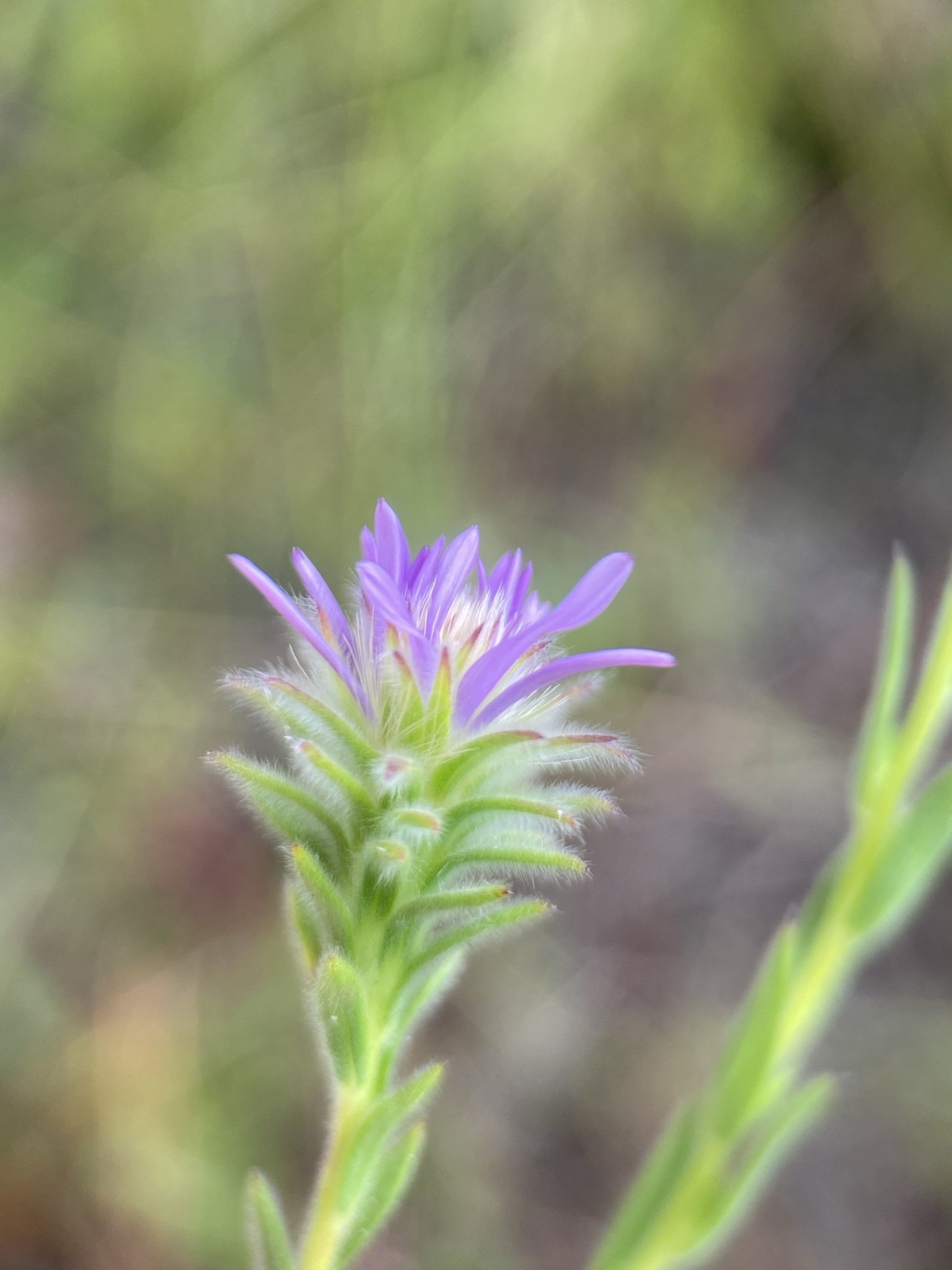
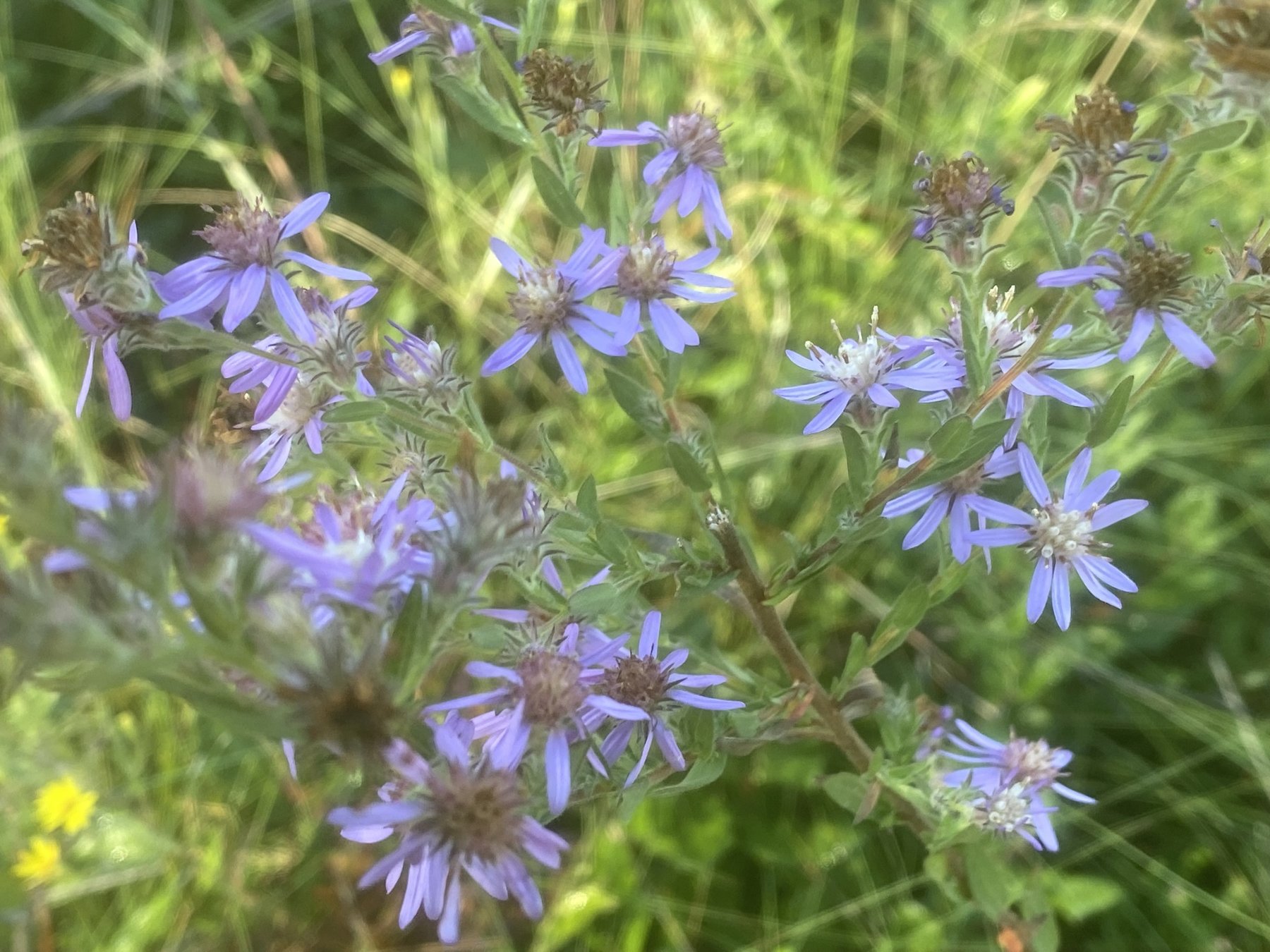
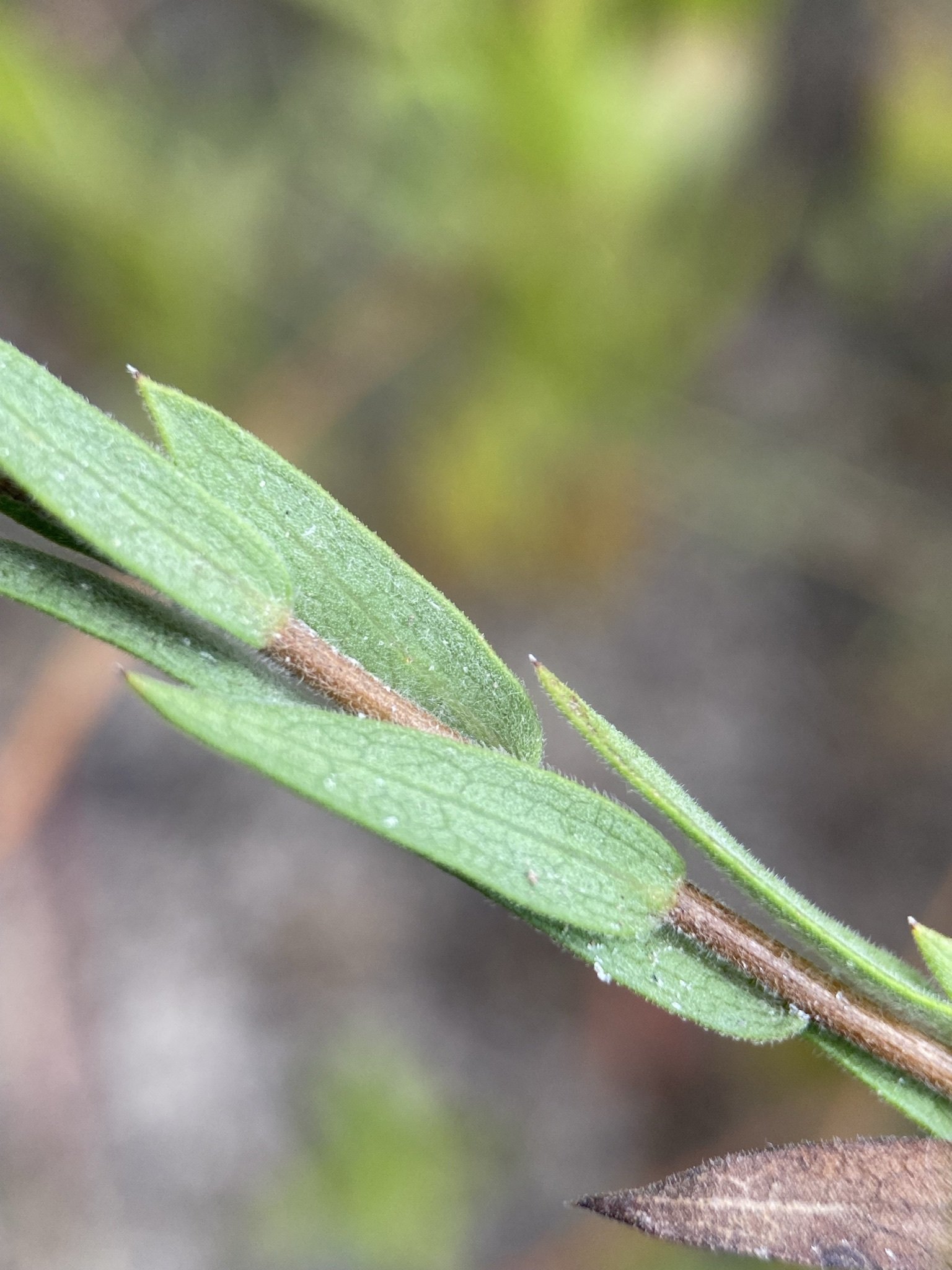
Plumose aster is a perennial herb, 40 to 100 cm tall (about 16 inches to just over three feet), growing in tufts from a corm-like, woody rootstock — a swollen underground base that stores reserves through fire and drought, the kind of rootstock that says “I have survived things.” The stems are five to ten or more per plant, erect or arching, light to dark brown, sparsely to moderately woolly-hairy below and more densely so toward the top.
The leaves are the first thing to notice, and they are beautiful: grayish, soft, and silvery-silky to the touch. The basal leaves wither by flowering time; the lower stem leaves are oblanceolate, 20 to 30 mm long by 4 to 8 mm wide, with rounded, half-clasping bases; the upper leaves are lance-shaped to narrowly ovate, 8 to 15 mm long, getting smaller toward the top. Every leaf face carries that silvery, silky hair — plumosum means feathery or plumed, and the whole plant looks dusted with silver silk.
The flowers bloom in October and November, late even for an aster. The heads sit in open, branching, panicle-shaped arrays — not the narrow, wand-like spike of its closest relative, but a loose, open spray. The involucre is bell-shaped, 7 to 9 mm tall, and the phyllaries are the decisive character: in three to four series, spreading to reflexed (bending outward and back), linear, with green, leaf-like tips — the outer phyllaries are more or less foliaceous, little green leaves in their own right. The ray florets are rose-purple, and the disc florets start pink and turn purple. The seeds are smooth (glabrous), which matters — see the lookalikes section.
One honest wrinkle, stated up front because this site does not hide disagreements between sources: the two floras disagree on how many ray florets a head carries. Franck’s 2025 Flora of Florida key counts 13 to 36 rays (and 15 to 48 disc florets); the older Flora of North America treatment counts 7 to 12 rays (and 14 to 20 discs). The Florida key is the authority to use in Florida, and the flower color and the spreading, leafy phyllaries are the same in both accounts — but if you count rays and land outside one flora’s numbers, you have found a real disagreement in the literature, not a mistake in your counting.
Lookalikes: check before you decide
Plumose aster has one serious lookalike, and the Florida key is built around the pair.
Eastern silver aster (Symphyotrichum concolor) is the closest relative — so close that plumose aster spent decades classified as one of its varieties (see the Varieties section). Both have corm-like rootstocks and silvery, silky leaves. The split, from Franck’s key: plumose aster has branched stems, open panicle-shaped arrays, outer phyllaries that are more or less leaf-like, and smooth seeds; eastern silver aster has simple (unbranched) stems, narrow, wand-shaped arrays, outer phyllaries that are not leaf-like, and densely hairy seeds. In the field: if the plant branches openly and the flower cup wears little green leaf-tips, you are looking at plumose aster. If it is a single straight wand with a narrow spike of flowers, it is eastern silver aster.
Silky aster (Symphyotrichum sericeum var. microphyllum) is another silvery, silky aster in the same Florida key group, but it is a different plant with a different habit and range, and it is not the plumose aster’s twin — the key separates the corm-rootstock group (plumose, eastern silver) from the rest before silky aster even enters the picture.
One more warning, because the key invites the confusion: Symphyotrichum pratense (barrens silky aster) appears in Franck’s key right next to plumose aster — it shares the spreading, reflexed phyllaries — but it is not a Florida species. It is in the key because the key covers neighboring taxa. If you are in Florida and you think you have found S. pratense, re-check: you almost certainly have plumose aster or eastern silver aster instead.
Where it grows in Florida
Nowhere else. Plumose aster is endemic to Florida — it grows in this state and in no other place on Earth. The Atlas of Florida Plants lists it as native and endemic. It lives in the central Florida Panhandle, in deep, dry to moist, sandy soils: pine flatwoods and pine–scrub oak woods, at elevations of 0 to 40 meters. Flora of North America adds a telling detail: it is “favored by fires and clearcuts” — a plant of open, sunlit ground that fire keeps open, the way fire keeps so much of Florida’s flatwoods alive.
Its known range has grown as botanists have looked harder. The 2006 Flora of North America treatment says it “is known only from Franklin County,” and the type specimen — the pressed plant that defines the species — was collected at Aspalaga in Gadsden County in October 1897. NatureServe’s more recent mapping records it across eight central Panhandle counties: Calhoun, Franklin, Gadsden, Gulf, Jackson, Leon, Liberty, and Wakulla. The honest reading is that the older “only Franklin County” statement reflects how little had been documented by 2006, and the wider map reflects more recent records — not that the plant has spread, but that people have finally looked. It is still a narrow-range endemic, and every population sits inside that one corner of the Panhandle.
NatureServe ranks it Imperiled (G2). That is a conservation rank, not a gardening label: it means the species is at high risk of extinction because its range is small and its habitat — fire-maintained flatwoods on deep sand — is shrinking and fragmenting. It is the only one of our Florida asters in this batch that carries that weight, and the whole guide is written around it.
How to grow it — or leave it
Leave it. That is the whole growing advice, and it is not a dodge — it is the only honest answer the evidence supports.
No nursery trade in plumose aster was found. No verified cultivation protocol exists — no published guidance on soil mix, watering, propagation, or seed handling for this species, and no record of it being grown in gardens. What is known about its habitat tells you why: it is a fire-dependent flatwoods plant on deep sand, in a narrow corner of the Panhandle, and its rootstock, its silvery leaves, and its October bloom are all tuned to a place with prescribed fire, open canopy, and deep, well-drained sand. A garden bed in Keystone Heights is not that place, and a plant that cannot be bought, cannot be reliably grown, and is imperiled in the wild should not be dug up to try.
Do not collect it. Do not pick the flowers, do not dig the rootstock, do not gather seed from wild plants. An imperiled endemic does not have spare individuals. If you see it in the wild — most likely in the Apalachicola National Forest or surrounding Panhandle flatwoods — admire it, photograph it, note the place and the date, and leave every part of the plant exactly where it is. If you want to help it, the useful actions are unglamorous and real: support prescribed fire in Panhandle flatwoods, support the conservation organizations that protect flatwoods habitat, and leave the plant alone.
If you live in the Panhandle and your land is pine flatwoods on deep sand, the best thing you can do for this aster is nothing horticultural at all: keep the canopy open, let fire do its work where it is safe and legal to do so, and do not plant anything into a spot where it already grows. The plant knows its habitat. Your job is to not get in its way.
Wildlife value
Here the honest answer is: no pollinator records specific to plumose aster were found in the sources checked. That is not the same as saying it has no pollinators — a rose-purple aster blooming in October and November in open flatwoods is certainly visited by bees and butterflies — but nobody has published which ones, and this guide will not invent a list. What is known is the genus pattern: fall asters are late-season nectar plants, and their open, many-headed arrays feed generalist bees and butterflies when little else is flowering. For plumose aster, that pattern is a reasonable expectation, not a verified record, and it is labeled as such.
What is known with more confidence is its place in the food web as a native flatwoods plant: it is part of a fire-maintained community, and its seeds, like other aster seeds, are the kind of small, wind-carried seed that feeds birds and reseeds open ground after fire. The conservation value of this plant is not in what it does for a garden — it is in what it is: a species that exists nowhere else, holding a small piece of Florida’s flatwoods together.
Varieties — and a taxonomy story
No varieties of plumose aster are recognized. The Varieties section here is instead the story of how this plant got its name, because the name changes are the reason it is so easy to misidentify in older books.
John Kunkel Small first described it in 1924 as Aster plumosus — the feathery aster, for those silky, plumed leaves. Later botanists folded it into eastern silver aster as a variety: Symphyotrichum concolor var. plumosum, the plumose variety of a more widespread species. Then John Semple’s work in 2002 raised it back to full species rank as Symphyotrichum plumosum, on the strength of the branched stems, the open arrays, the leaf-like outer phyllaries, and the smooth seeds — and the field observation that no intermediates with eastern silver aster were seen where the two grow. Franck’s 2025 Flora of Florida follows Semple and treats it as a full species, endemic to Florida.
That history matters for identification: if you are using a field guide or a website that still calls it Symphyotrichum concolor var. plumosum, or Aster plumosus, you are looking at the same plant under an older name. And if a source tells you it is “just a variety of eastern silver aster,” that source is out of date — the current Florida flora treats it as its own species, and the key separates the two cleanly.
Frequently asked questions
Where does plumose aster grow?
Only in Florida — it is endemic to the state, in the central Panhandle. NatureServe maps it across eight counties: Calhoun, Franklin, Gadsden, Gulf, Jackson, Leon, Liberty, and Wakulla. Its habitat is deep, sandy soil in pine flatwoods and pine–scrub oak woods, at elevations under 40 meters.
Is it rare?
Yes. NatureServe ranks it Imperiled (G2), meaning it is at high risk of extinction because its range is small and its fire-maintained flatwoods habitat is shrinking. It is a Florida endemic — it grows nowhere else on Earth.
Can I buy it or grow it?
No — and you should not try. No nursery trade in plumose aster was found, no verified cultivation protocol exists, and it is a fire-dependent flatwoods plant, not a garden plant. Do not dig it, do not collect seed from wild plants, and do not try to transplant it. Admire it where it grows.
How do I tell it from eastern silver aster?
Four characters, all from Franck’s Florida key. Plumose aster has branched stems, open panicle-shaped flower arrays, outer phyllaries that are more or less leaf-like, and smooth seeds. Eastern silver aster has simple, unbranched stems, narrow wand-shaped arrays, outer phyllaries that are not leaf-like, and densely hairy seeds.
When does it bloom?
October to November — late even for an aster. The flowers are rose-purple rays with discs that start pink and turn purple.
Why do the floras disagree on how many rays it has?
Franck’s 2025 Flora of Florida key counts 13 to 36 ray florets; the older Flora of North America treatment counts 7 to 12. The two floras genuinely disagree, and the Florida key is the one to use in Florida. The flower color and the spreading, leaf-like phyllaries agree in both accounts.
What does “plumose” mean?
Feathery or plumed — from the Latin plumosus. It refers to the plant’s silvery, silky, feathery hairs, which cover the leaves and the phyllaries. The whole plant looks dusted with silver silk.
Is it related to eastern silver aster?
Very closely — it was classified as a variety of eastern silver aster (Symphyotrichum concolor var. plumosum) for decades. Semple raised it to full species in 2002, and Franck’s Flora of Florida follows that treatment. Its former names were Aster plumosus (Small, 1924) and S. concolor var. plumosum.
What pollinators visit it?
No pollinator records specific to plumose aster were found in the sources checked — that is an honest gap, not an oversight. As a fall aster it is presumably visited by generalist bees and butterflies, but nobody has published which ones. If you photograph a pollinator on it, that observation is genuinely useful science.
How can I help it?
Leave it alone, and help its habitat. Support prescribed fire in Panhandle flatwoods, support the organizations protecting flatwoods, and if you see it, photograph it and walk away. Do not pick it, dig it, or collect its seed. For an imperiled endemic, the most useful thing a person can do is nothing at all — except protect the ground it stands on.
🌱 Keep learning
Three related guides worth reading next:
- Aster: Growing Guide — The genus guide: how the old catch-all Aster became Symphyotrichum, and what all our native asters share.
- Habitat Gardening in Florida: One Tree, One Thicket — How native flatwoods and woodland edges become habitat — and why fire-kept open ground matters for plants like this one.
- Climbing Aster — Another Florida-native aster, and a very different one — a vine that climbs instead of standing — to show how wide this genus runs in our state.