
🌺 Coral Honeysuckle
What it looks like
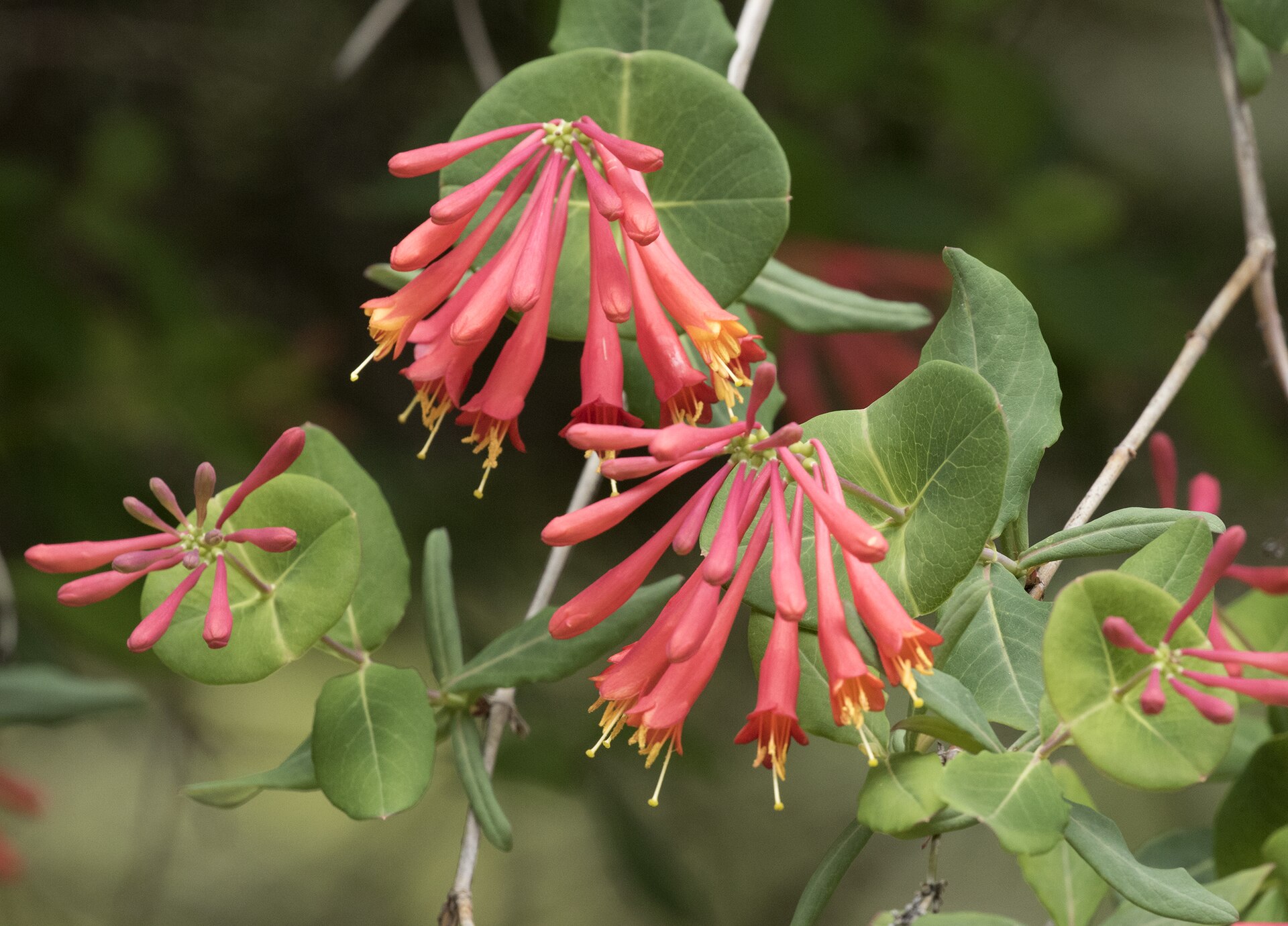
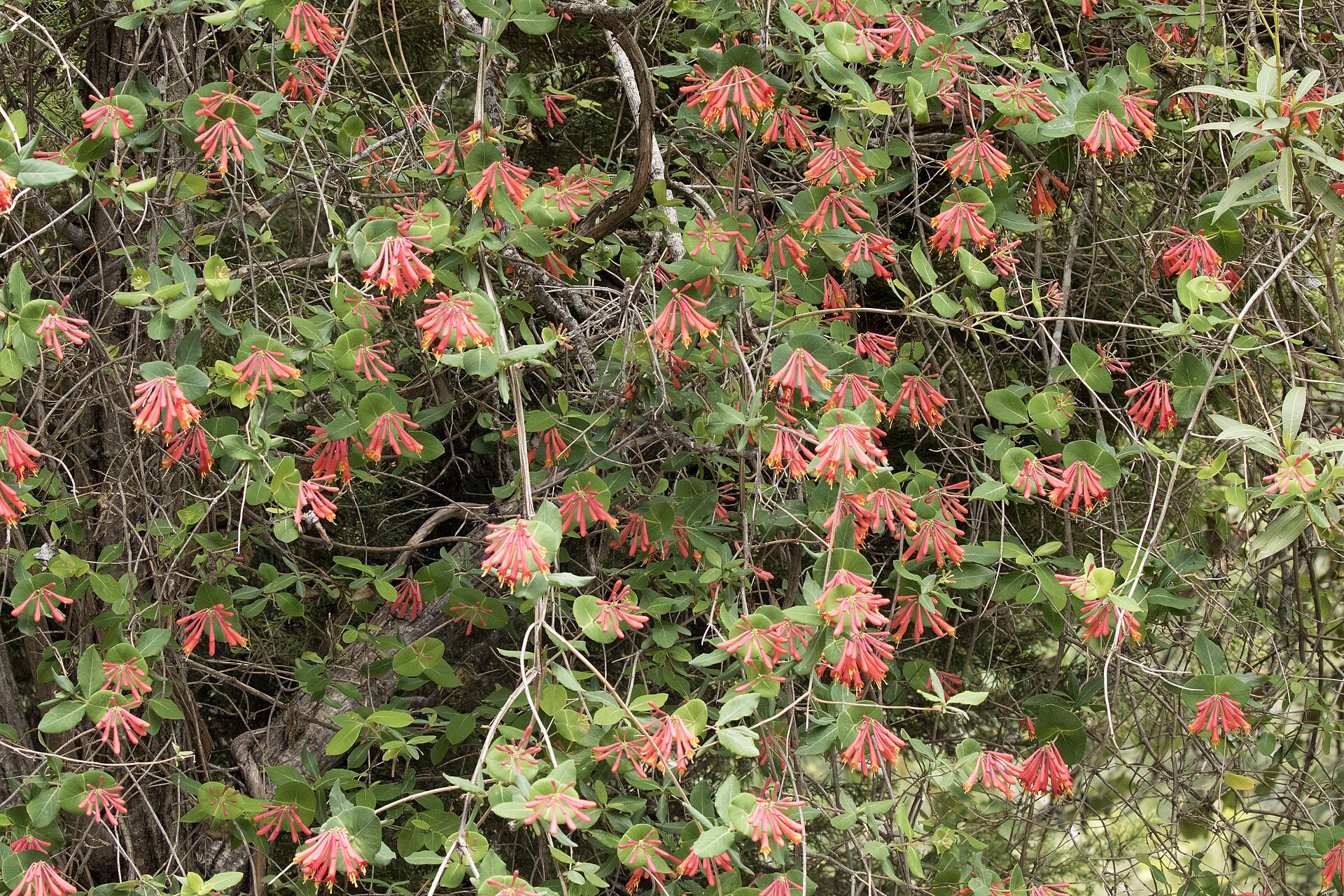
Coral honeysuckle is a twining vine with smooth, oval leaves that fuse into a little cup around the stem just below each flower cluster, a handy field mark that separates it at a glance from the invasive Japanese honeysuckle, whose leaves never do that trick. The flowers are long, slender trumpets, coral-red outside and yellow-orange inside, opening in clusters at the vine tips from spring into fall, followed by small red berries.
In a garden it behaves like a polite vine, not a takeover artist: it climbs by twining, it does not root along the ground at every node the way Japanese honeysuckle does, and it stays where you train it. Give it a fence, an arbor, or a sturdy trellis and it will cover it in a season or two, with evergreen to semi-evergreen leaves in mild winters and a fresh flush each spring.
Why this variety
Choose coral honeysuckle when you want a hummingbird plant that is actually native to Florida and will not escape into the woods behind your fence. Ruby-throated hummingbirds work the long tubes all season, and the vine’s long bloom window means it is feeding birds long after most spring shrubs have finished.
It is also the honest swap for the sweet-smelling invasive honeysuckle many gardeners grew up with. Coral honeysuckle is less fragrant, and that is the trade: you give up perfume and gain a plant that belongs here, supports the birds that co-evolved with it, and will not need to be ripped out of a hedge in five years.
How to grow
Plant in fall or spring in sun to light shade, in soil that drains after rain. Dig a hole twice the pot width, set the plant at the same depth it grew in the pot, water it in deeply, and mulch with 2 to 3 inches of pine bark or leaves, kept off the stem. Train the first stems onto the support and tie loosely; once it finds the trellis, it twines on its own.
Prune after a flush of bloom if it outgrows its space, cutting back to a leaf pair or a side shoot. A hard late-winter tidy-up is fine for an overgrown vine, since it blooms on new growth, but do not shear it into a box: a vine wants to climb, and shearing just makes a thicket of weak shoots.
Water & feeding
Water deeply once or twice a week while it establishes, then back off. Coral honeysuckle is fairly drought tolerant once rooted, and soggy soil is a bigger enemy than a dry spell. A light feed of compost in spring is plenty; heavy fertilizer pushes soft, leafy growth with fewer flowers.
In sandy Florida soil, mulch is the watering plan: it holds moisture, cools the roots, and breaks down into the organic matter sand always needs. Skip the sprinkler-every-day routine, which keeps the surface wet and the roots shallow.
Common problems
Leafy but flowerless: usually too much shade or too much nitrogen. Move it toward sun and stop feeding, and the trumpets return.
Aphids on new tips: a strong jet of water knocks them off, and the vine outgrows a light attack. Avoid broad insecticides, which also kill the pollinators the vine is planted for.
Winter dieback in the north of its range: cold snaps can brown the tips. Wait until spring growth shows, then cut back to live wood rather than guessing in February.
Confusion with Japanese honeysuckle: check the leaves. Fused pairs cupping the stem below the flowers mean coral honeysuckle; separate leaves and white-to-yellow fragrant flowers mean the invasive cousin, which should come out.
Harvest
There is no edible harvest here, and the red berries are for birds, not for people, so leave them on the vine. The real harvest is the season itself: months of coral trumpets, hummingbirds working the fence line, and a vine that looks after itself once it is up.
If you want cut flowers, snip a few tip clusters in the morning and use them the same day; they are short-lived in a vase. The longer-lasting yield is the vine’s winter structure and its second-year cover, when a fence that was bare wire becomes a green wall.
Saving seeds
Coral honeysuckle is generous with its seed, in the same way it is generous with everything else: long trumpets for hummingbirds, red berries for birds in late summer and fall, and a vine that will happily cover a fence if you let it. Saving seed is simply a matter of intercepting a few of those berries before the birds finish the job, and then giving the seed the cold nap it expects before it will wake up. Leave most of the berries on the vine, by the way. The birds earned them, and a vine stripped bare of fruit is a poorer garden than one with a few berries left for the winter visitors.
Collect berries when they are fully red and soft, in late summer or fall. Mash them gently in a bowl of water, rub away the pulp, and rinse the seeds clean; seed left in fermenting pulp stores badly and germinates worse. Spread the cleaned seed on paper indoors until it is thoroughly dry, which matters more than it sounds in a humid Florida autumn, and then store it in a labeled envelope or jar in a cool, dark, dry place. Seed sown fresh, as soon as it is ripe, is the easiest route of all, and it is the one nature uses: a berry falls, winter passes, spring wakes the seed.
Stored seed is where patience enters the story, because coral honeysuckle seed carries a dormancy that cold breaks. The standard advice, and the one worth following, is a cold stratification of around two months: mix the seed with barely damp sand or a damp paper towel in a sealed bag in the refrigerator, check it now and then so it stays damp but never moldy, and sow after that chilling period. Without that cold treatment, germination is slow and patchy, and a tray of unchilled seed can sit looking like a tray of dirt for a discouragingly long time. Sow shallowly in a well-drained mix, keep it evenly moist, and expect germination over weeks to a few months rather than days; this is a woody vine, not a radish, and it germinates on vine time.
Grow the seedlings on in pots through their first winter rather than rushing them into the garden, and plant them out in late spring or early summer once they are sturdy and the weather is settled. They will need a season or two before they flower like the parent vine, so do not judge a first-year seedling by a mature plant’s standards. And here is the true-to-type catch, stated plainly: seedlings grown from a named cultivar will be coral honeysuckle, but they will not necessarily be that cultivar. Flower shade, vigor, and leaf color can all drift, because seed shuffles genes while cuttings copy them. If you want another Major Wheeler or another Sulphurea exactly as the parent, take softwood cuttings in early summer or layer a low stem to the ground, both of which root reliably and keep the cultivar true. Save seed when you want more vines cheaply, when you are growing the straight species, or when you enjoy a little genetic lottery on your fence line, and keep the labeled jar cool, dry, and far from the damp corner of the shed where Florida turns good seed into compost.
Varieties
Named coral honeysuckle cultivars with their own full guides include Major Wheeler Coral Honeysuckle, Alabama Crimson Coral Honeysuckle, and Sulphurea Coral Honeysuckle. See also Coral Honeysuckle: All Varieties.