
🫐 Evergreen Huckleberry
What it looks like
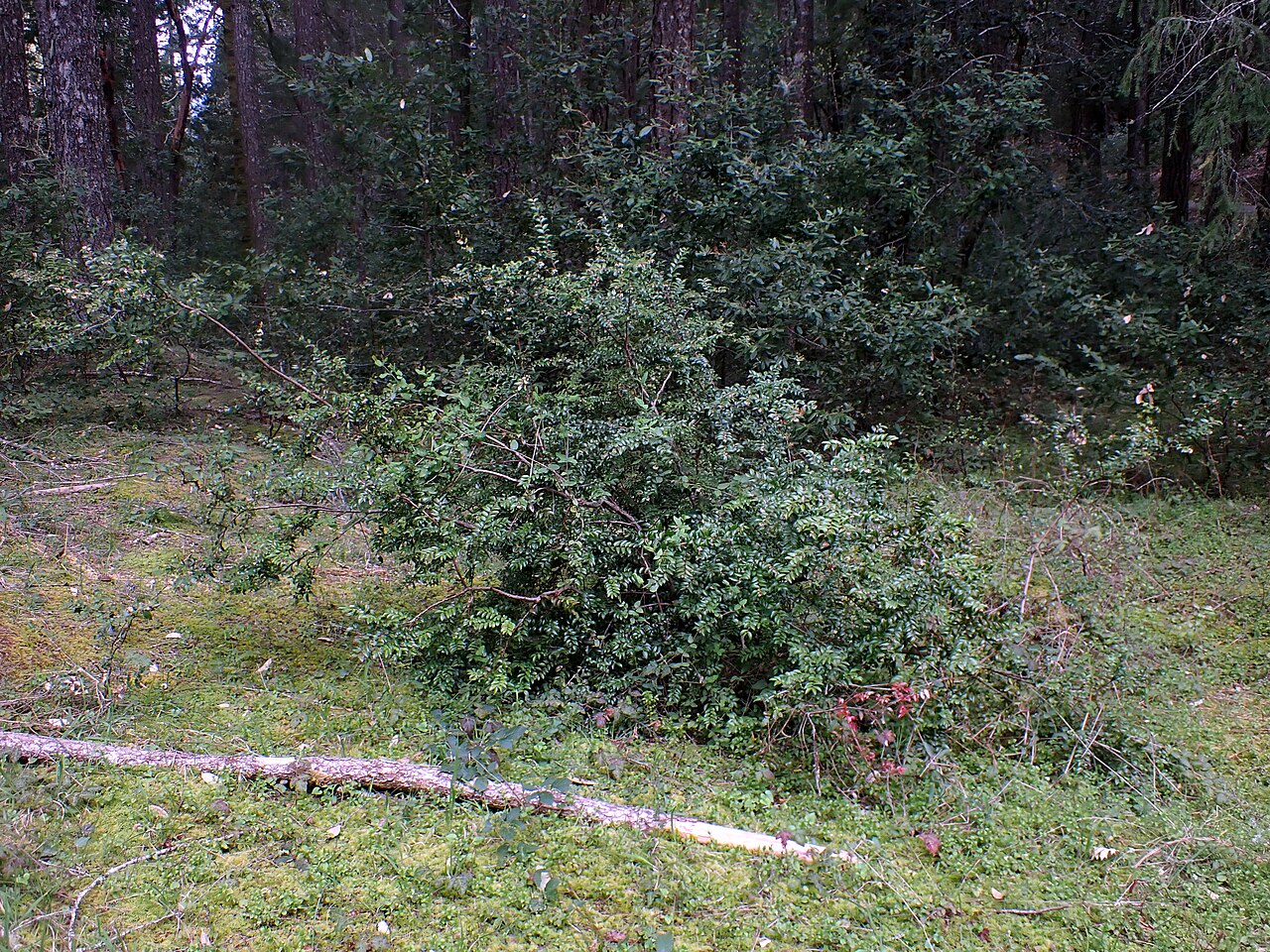
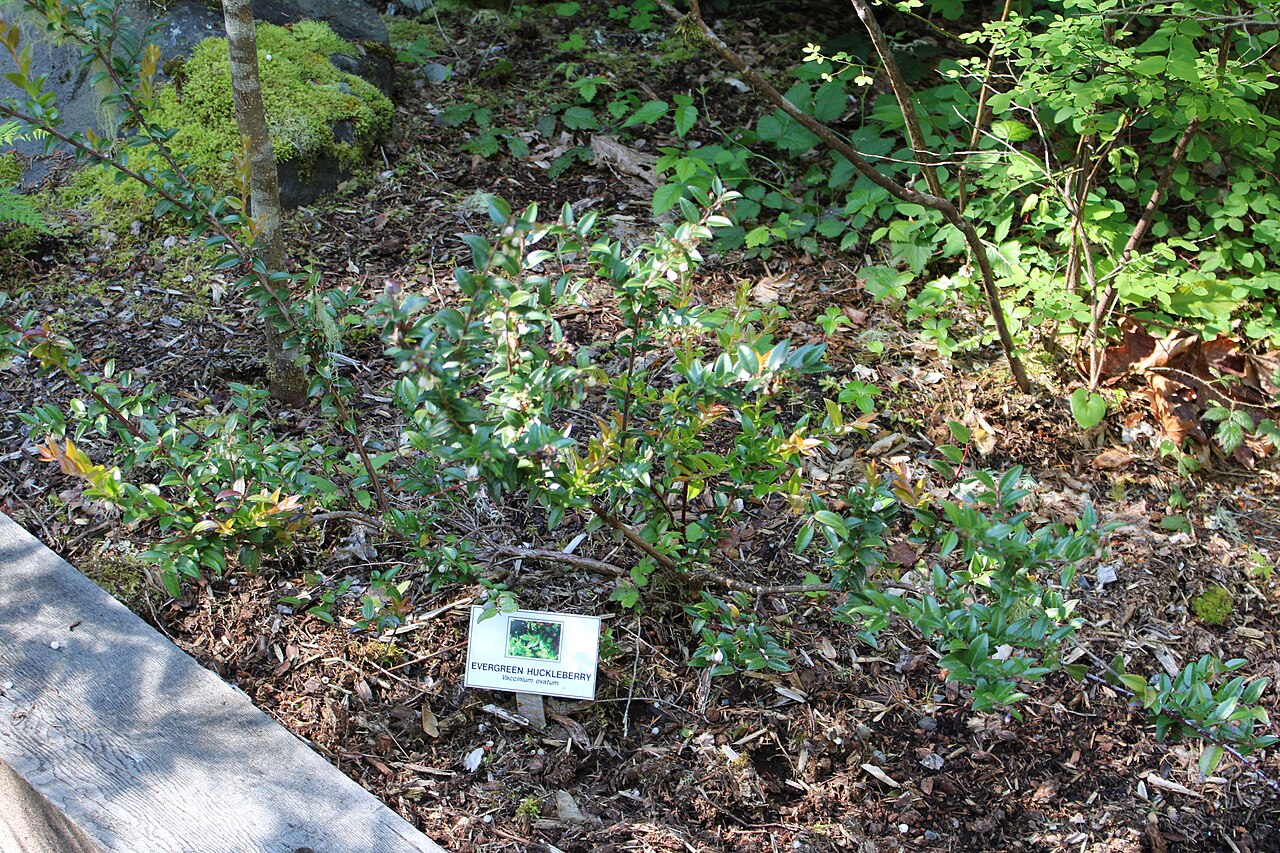
Quick facts
- Sun: Full sun to shade; more sun means more berries, more shade means a taller, more open plant
- Soil: Well-drained, humus-rich, acidic soil (pH 4.5–6.5)
- Spacing: 3–5 feet apart; wider for a hedge
- Mature size: 2–3 feet tall in sun, 4–5 feet in a garden, up to 12 feet tall in deep shade
- Zones: USDA zones 7–9 (some listings 6–9)
- Florida: The most Florida-plausible huckleberry of the four — a north Florida trial, not a statewide promise; see the honest Florida note below
What it is
Evergreen huckleberry breaks the huckleberry stereotype in the best way: it keeps its leaves all year. Vaccinium ovatum is a Pacific coastal native, from British Columbia south to California, growing in low-elevation forests, forest edges, and canopy openings. Its small, ovate, glossy dark green leaves look good in every season, its spring growth flushes bronze-red before maturing to green, and its spring flowers — small, urn-shaped, white flushed with pink — are followed by glossy blackish-purple berries in late summer to early fall.
It is also a shape-shifter, and that is worth knowing before you plant it. In full sun it stays short, dense, and compact — a 2- to 3-foot shrub. In shade it stretches upward, sometimes to 12 feet, with a more open, almost vine-like habit. Same species, wildly different silhouette, depending entirely on light. Gardeners use it as an informal hedge, a woodland backdrop, a container plant, and a florist’s foliage plant — its branches are cut commercially for arrangements, which tells you how handsome and long-lasting the leaves are.
The berries are small but genuinely good: sweet-tart, spicy, and best, by reputation, after a touch of frost — though the practical advice is to pick them when ripe rather than waiting for weather that may not cooperate. Indigenous peoples of the Pacific Northwest harvested them fresh, mixed with oil, or dried into cakes for winter, and modern foragers still seek them out.
How to grow
Plant in spring or autumn in humus-rich, well-drained, acidic soil, in sun to shade depending on the shape you want. More sun means more fruit and a denser plant; more shade means a taller plant and fewer berries. Water regularly for the first year or two — it is slow to establish but grows nicely once settled — and mulch with acidic organic matter to keep the roots cool and the soil biology happy. Flowering and fruiting are best with at least a half-day of sun, even though the plant tolerates fairly deep shade.
Prune after flowering, removing dead wood and shaping lightly; it can be trimmed into a formal hedge or left as an informal thicket, and it tolerates pruning well. It also tolerates salt spray, which makes it a genuinely useful coastal plant in its home range — a rare combination of edible, evergreen, and seaside-tough.
Water & feeding
Keep soil evenly moist during establishment, then water during dry spells; established plants are moderately drought-tolerant but fruit better with steady moisture. Feed lightly, if at all, with an acid-forming fertilizer or compost in spring — this is a plant of forest soils, not a heavy feeder, and over-fertilizing buys leafy growth at the expense of berries.
Common problems
Problems are mostly about site: alkaline soil causes chlorosis, waterlogged soil causes root rot, and deep shade causes a tall, sparse plant with few berries. Pests are minor in its home range. Slow establishment is not a problem, it is a personality trait — give it two seasons before judging it.
Harvest
Pick berries in late summer to early fall, when they are fully dark purple-black and soft. The fruit is small, so a pie takes patience — but the flavor is worth it, and fresh eating straight off the bush is the simplest reward. Leave some for birds and small mammals, which rely on these thickets for food and shelter.
The honest Florida note
Of the four huckleberries in this set, evergreen huckleberry is the one a Florida gardener can most reasonably trial — and “trial” is still the operative word. Its zone range reaches zone 9, which includes north Florida, and it tolerates heat better than its mountain cousins. But it still wants acidic, humus-rich, well-drained soil, protection from hot afternoon sun, and regular moisture — conditions a north Florida gardener can create with shade, mulch, and acidic amendments, and a central or south Florida gardener should not count on. Plant it in north Florida as an experiment in a sheltered, shaded, acidic bed, and keep expectations modest: this is a Pacific coastal forest plant visiting the subtropics, not a plant that moved here.
Nerdy fact: green huckleberry’s leaves are so valued by florists that wild branches have been harvested commercially for bouquets for decades — the glossy, finely cut foliage holds up in arrangements long after cut flowers fade. It is one of the few edible shrubs that earns its keep in a vase before it ever earns it in a pie.
Where it fits in the Living Root guides
This plant is also covered in our survey guide to the wider group — see Huckleberry: Growing Guide for how it compares with its relatives. Browse all the plant guides in the Plant Guides index.
Saving seeds
Evergreen huckleberry seed saving begins with a pie problem: the berries are small, delicious, and slow to pick, so every seed you save is a berry you chose not to eat. Pick fully ripe fruit in late summer to early fall, when the berries are dark purple-black and soft, and leave plenty on the bush for the birds and small mammals that rely on these thickets. Hand-picking into a bucket works, and beating a branch gently over a bucket works faster. Either way, pick from a healthy, vigorous plant.
Cleaning is where most people quit, and it is easier than it looks once you accept that the seeds are minuscule. Chill the berries for a few days first, which helps them soften, then mash them in a bowl of water and float off the pulp and the unsound seed, pouring off the floating debris while the good seed sinks. Strain the water through cheesecloth or clean pantyhose to catch the tiny seeds, because an ordinary kitchen sieve will wave them straight through and into the drain, which is a tragedy in miniature. Rinse the cleaned seed gently and spread it to dry for a couple of days at ordinary room temperature. Do not roast it, do not leave it in direct sun, and do not rush it into a jar while it is still damp.
Storage is where huckleberry quietly shows off. Seed dried briefly and kept refrigerated in an airtight container is reported in a long-running USDA-cited source to remain viable for many years, up to about twelve, an unusually generous shelf life for a berry seed and one more reason to label the packet carefully. In Florida humidity, the airtight container plus a desiccant packet is not optional garnish; it is the difference between a viable seed lot and a damp one. Keep the packet cool, dark, and dry, and write the species and year on it plainly.
To wake the seed, remember that it comes from a forest understory plant that expects a winter. Fresh seed sown outdoors in autumn may germinate without fuss, but stored seed generally germinates better after one to three months of cold, moist stratification in the fridge, mixed with damp peat or sand. Sow in flats or small pots in an acidic mix of sand and peat moss, scatter the seed on the surface or cover it only barely, since light and alternating warmth and coolness help, and keep the mix evenly moist. Seedlings begin to emerge in about a month and keep straggling in afterward, so do not discard a flat that looks sparse. Transplant seedlings into larger pots roughly six to seven weeks after emergence, and settle in: huckleberry seedlings are slow, typically taking two to three years to reach a saleable size, and they demand acidic soil, roughly pH 4.5 to 5.5, plus the drainage and organic matter of a forest floor, not a limed Florida bed.
Two honest footnotes close the project. First, seedlings do not replicate a named cultivar; if you want an exact named huckleberry, propagate by cuttings or layering, though even cuttings root sporadically and layering asks for patience, which is why most gardeners simply buy nursery plants and save seed as a side experiment. Second, the Florida note: of the huckleberries, this is the one a Florida gardener can most reasonably trial, and trial is still the operative word, since heat, humidity, and alkaline soils all push against it. Save seed, try a pot in acid mix in shade, and treat any seedling that thrives as a small victory rather than a promise.
Varieties
Every named variety of Evergreen Huckleberry with its own growing guide:
- Cascade Jewel Evergreen Huckleberry — The bred-for-berries evergreen: a tetraploid Oregon State release with medium-to-large, shiny purple-black summer berries.
- Scarlet Ovation Evergreen Huckleberry — The fiery spring shrub: bronze-red new growth over a compact 3-foot frame, with tasty dark-blue berries in late summer.
- Cascade Sunburst Evergreen Huckleberry — The variegated showpiece: green-and-yellow leaves with glowing coral new growth, plus glossy dark berries in summer.