
🌿 Late Purple Aster
What it looks like
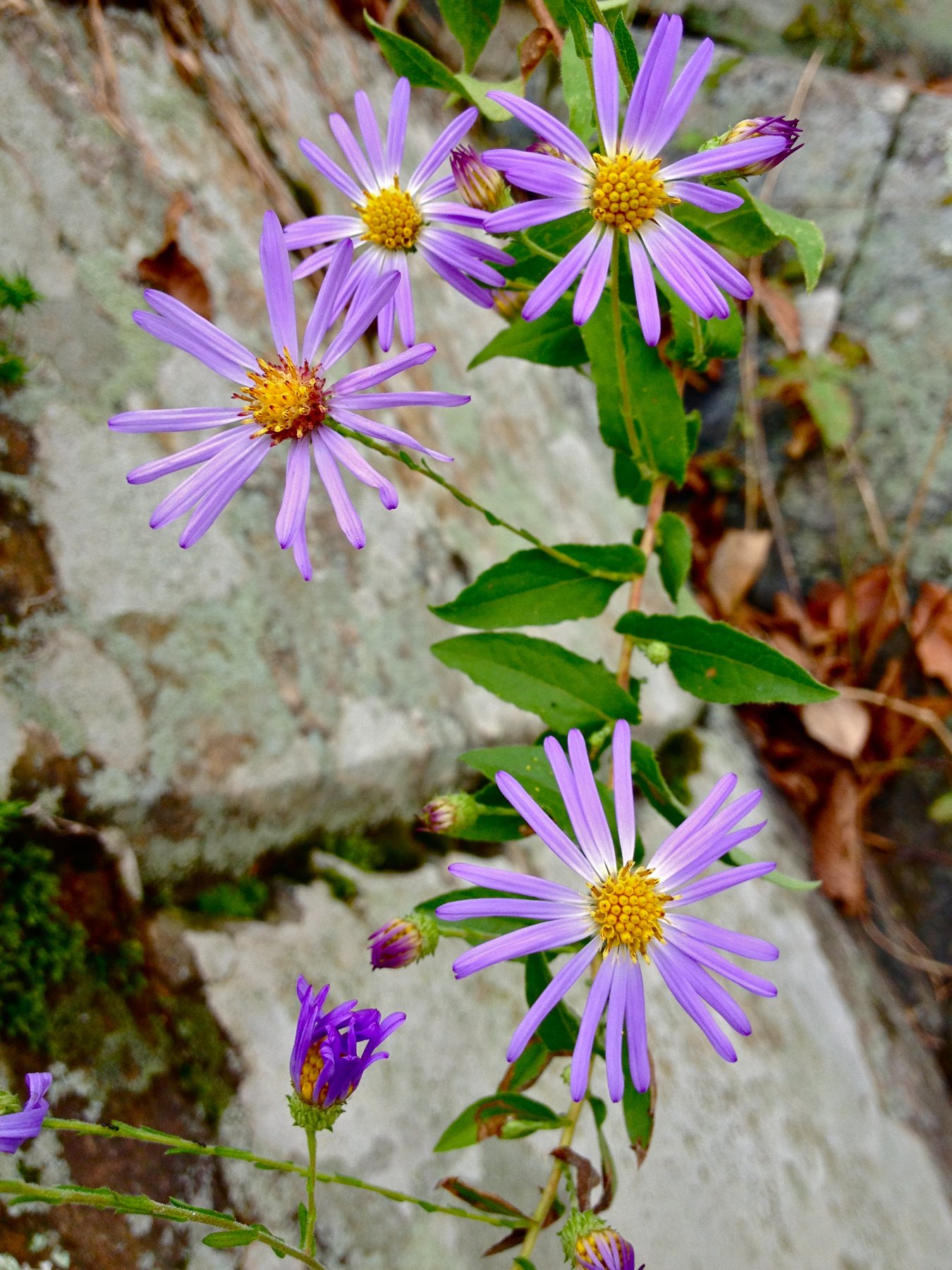
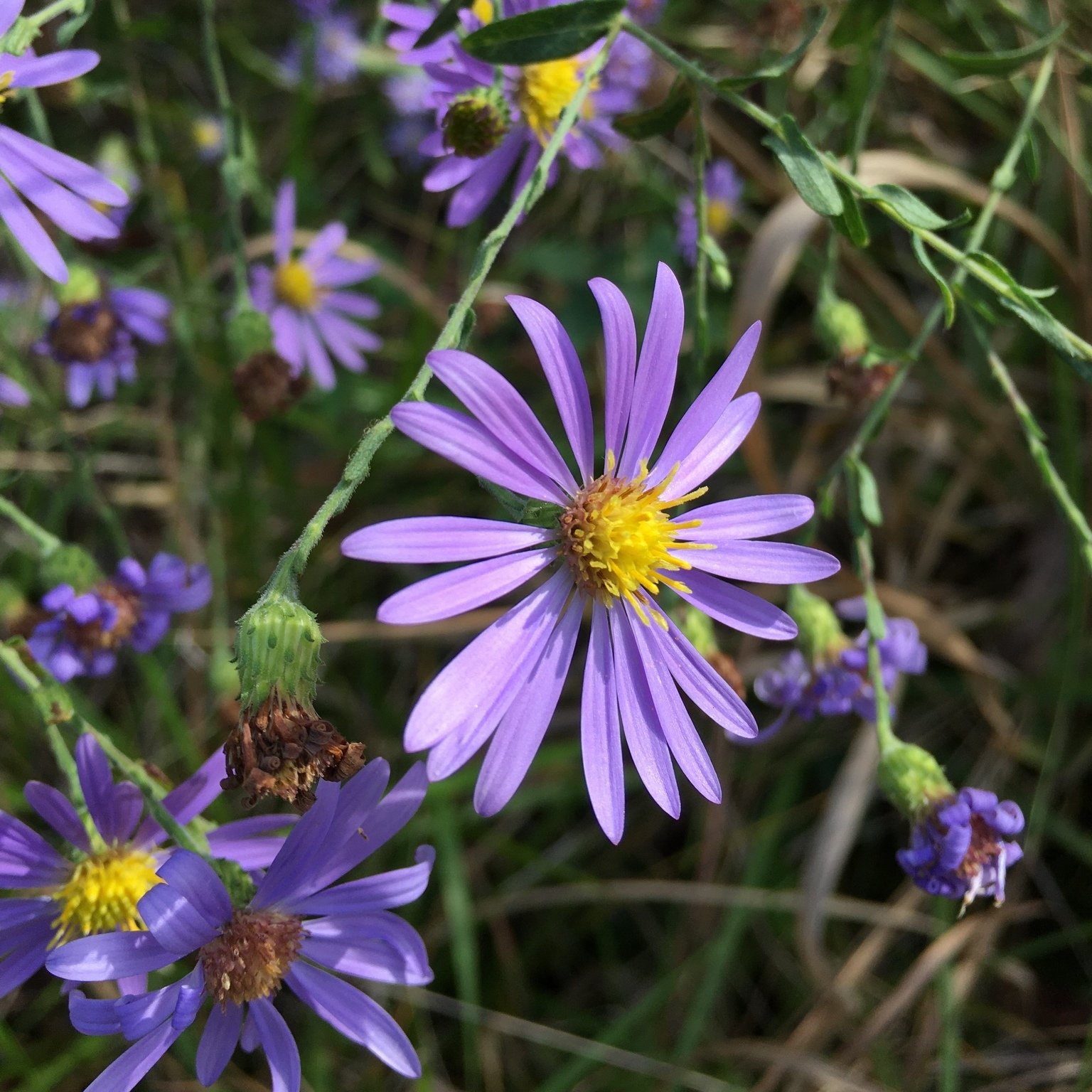
Late purple aster is a perennial, usually one to three feet tall (occasionally four), growing in tufts from a short, thick, woody base with long rhizomes — the underground runners that let it form loose colonies. The stems are ascending to erect, often stout and brownish, sparsely to densely rough-hairy, and a little villous (shaggy) toward the top. The whole plant feels rough to the touch: the leaves are thick, stiff, and scabrous, like fine sandpaper with opinions.
The leaves are the identification. The basal leaves wither early, so by flowering time you are looking at stem leaves — and they are sessile, meaning no stalk at all, sitting straight on the stem and hugging it. The lower stem leaves are ovate to lance-shaped, roughly 1 to 3 inches long, with bases that are strongly heart-shaped and clasping, the lobes wrapping around the stem like little ears (botanists call this auriculate-amplexicaul, which is just Latin for “eared and hugging”). The upper leaves are smaller, narrowly to broadly ovate, and their tips end in a tiny sharp point — mucronate to white-spinulose, if you want the technical words. The key detail, the one the Florida key hangs the whole species on: the base of the lower stem leaf is broadened just below a constriction, then clasps the stem. Run your eye down a leaf to where it meets the stem and you will see it — a little waist, then a flare that grabs the stem.
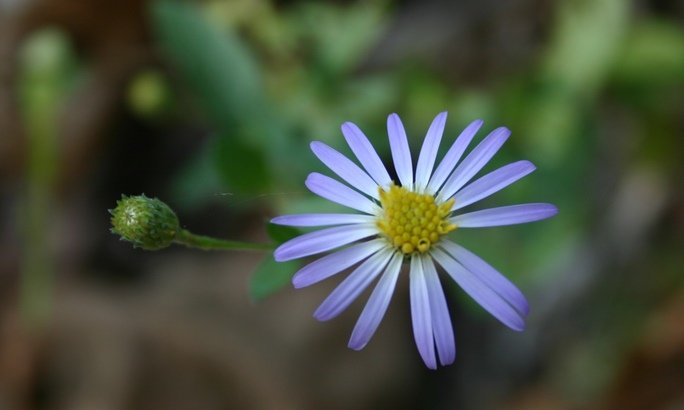
The flowers are the payoff. The heads sit in open, branching, panicle-shaped arrays with spreading branches, each head on a stiff, slender stalk. The involucre — the little green cup under each flower head — is bell-shaped and 5.5 to 12 mm tall. Each head carries 12 to 24 or more ray florets in light lavender-violet to mauve (rarely white or pinkish), each ray 10 to 18 mm long, around 20 to 50 disc florets that start yellow, cream, or white and turn purple as they age. A single head is under an inch and a quarter across; the show is the whole branching spray of them, blooming from August into October — late in the season, which is exactly what the common name says. The seeds (cypselae) are dull purple or brown, 2 to 3.5 mm long, with silky or stiffly hairy faces and a tawny pappus — the little parachute tuft that carries them on the wind.
The name tells the story twice over. Patens means spreading — the branching, open flower array. And it used to be Aster patens, named by Aiton in 1789, before DNA showed the New World asters were a different lineage from the Old World ones and the genus Symphyotrichum swallowed them. Same plant, new genus on the label.
Lookalikes: check before you decide
Late purple aster is one of the clasping-leaf asters, and Florida has a whole crowd of them — Franck’s 2025 Flora of Florida key groups them together precisely because they confuse people. Here is how the key separates this one from its closest Florida relatives.
Georgia aster (Symphyotrichum georgianum) is the nearest lookalike and the one most likely to fool you. Both have clasping leaves and purple flowers. The split: Georgia aster’s phyllaries (and stems and leaves) are stipitate-glandular — covered in tiny stalked glands, sticky to the touch — its leaf margins roll under (revolute), and its rays are longer, 14 to 24 mm. Late purple aster’s phyllaries are not glandular in that stalked way, its leaf margins are flat, and its rays run 10 to 18 mm. Bigger flowers plus sticky glands equals Georgia aster. Our Georgia aster guide covers it in full.
Florida water aster (Symphyotrichum fontinale) is the other clasping cousin in the key, and it is a Florida endemic. The split is at the leaf base: in Florida water aster the lower stem leaf bases are not constricted — no waist, no flare — and its upper leaves are lance-shaped to oblong with wedge-shaped to rounded bases that only half-clasp, with involucres 6 to 7.6 mm. If the leaf base has that broadened flare below a constriction, you are holding late purple aster, not Florida water aster.
White arrowleaf aster (Symphyotrichum urophyllum) and wavyleaf aster (Symphyotrichum undulatum) are separated one step earlier in the key, by the leaf stalk: both have winged petioles — the leaf stalk is flattened into a wing — where late purple aster’s stem leaves are sessile, with no stalk at all. And their flowers run white to pale pink (white arrowleaf) rather than the lavender-violet of late purple aster. No winged stalk plus purple flowers plus a clasping, flared leaf base: late purple aster.
The practical field test, in one sentence: sessile stem leaves whose bases flare and hug the stem below a little constriction, rough-hairy stems, and lavender-violet heads under an inch and a quarter across, blooming late. If any of those three fails, start over at the key.
Where it grows in Florida
Late purple aster is a native eastern North American species, ranging from southern Maine south and west to eastern Texas, and the Atlas of Florida Plants lists it as native in Florida, with vouchered specimens collected from 1931 to 2005. It is a plant of sunny to mostly sunny sites: open woodlands, thickets, and the margins of glades, in sandy to rocky soils. Think woodland edge rather than deep shade, and dryish ground rather than a wet ditch.
In Florida it is at the southern edge of its range, and it is not a plant you will trip over in a Keystone Heights yard — it is a Panhandle and north-Florida woodland-edge plant far more than a peninsula garden plant. That matters for the growing advice below: this is a wildflower to recognize and leave be where it grows, and a garden plant only where its conditions genuinely match. NatureServe ranks it Secure (G5) globally, so this is not a rare plant in trouble — it is a widespread native doing fine across the eastern United States, just uncommon in the Florida peninsula.
How to grow it — or leave it
Here is the honest version. No Florida-specific cultivation trials for this species were found, so what follows is standard native-aster practice, not a recipe tested on late purple aster in a Florida garden. It is a wildflower first and a garden plant second.
Grow it if: you have full sun to part shade and well-drained soil — sandy, rocky, or loamy, dry to medium moisture — and you want a late-season native perennial for a meadow edge, a woodland border, or a naturalized bed. Plant in spring or fall, water until established, and then mostly leave it alone. It spreads by rhizomes into loose colonies, so give it room or give it neighbors that can hold their own; it is not a plant for a tidy six-inch border. No fertilizer needed — rich soil and extra feeding just make floppy stems and fewer flowers. If it gets leggy, the standard aster move is a mid-season cutback (the Chelsea Chop) in late spring to early summer, which keeps it shorter and bushier.
Leave it if: your soil stays wet, your site is deep shade, or you are in the central or southern peninsula where this plant does not naturally occur. A plant at the edge of its range, in the wrong soil, will sulk — and there are Florida-native asters that actually want your yard. Do not dig plants from the wild. If you want it, buy seed or plants from a native nursery that propagates its own stock, and buy by Latin name: “spreading aster” and “clasping aster” are also used for this species, and the nursery trade has a long habit of labeling asters loosely.
Seed: the standard aster handling applies — collect the fluffy heads when they turn brown and the seed pulls away easily, dry thoroughly, and store cool, dry, and dark (airtight with a desiccant in Florida humidity). Aster seed generally needs a cold, moist spell or a fall sowing outdoors to wake up; surface sow, barely covering, because these seeds need light to germinate. Seedlings from a mixed aster border are surprises, not copies — asters cross readily — so if you want an exact plant, divide a clump instead.
Wildlife value
Late purple aster blooms when the season is winding down, and that timing is its whole ecological job. The nectar draws butterflies and native bees in September and October, when most summer flowers have finished — a last full table before the cold. The genus Symphyotrichum supports specialist native bees, including several Andrena (mining bee) species and Colletes simulans, and the late purple aster’s open, many-headed arrays are built for exactly that kind of traffic: small flowers, easy landing pads, dozens of them per plant.
The caterpillar side is a genus story too. True asters are among the host plants of the Pearl Crescent butterfly — our Pearl Crescent guide lists true asters among its caterpillar hosts — so a patch of late purple aster is not just a nectar bar, it is potential caterpillar nursery. Leave the seed heads standing through winter and the birds get the second course: goldfinches and other seed-eaters work aster heads hard, and the hollow stems shelter insects until spring.
Varieties
Flora of North America recognizes three varieties of late purple aster, and the differences are mostly in the involucre — the little green cup under the flower head — and in geography. Variety patens is the robust eastern form, mostly east of the Mississippi River, with bell-shaped involucres 6 to 7.5 mm tall and mid-phyllaries that are densely glandular and sparsely hairy. This is the Florida variety. Variety gracile is the slender form, from Alabama to Texas and north to Kansas, with smaller involucres 5.5 to 6.5 mm tall and narrow mid-phyllaries. Variety patentissimum is the western and Interior Uplands form, west of the Mississippi, with turbinate (top-shaped) involucres 8 to 12 mm tall and densely hairy, mostly glandless phyllaries. No named garden varieties of the wild species were verified, and none is claimed here. This guide covers Symphyotrichum patens only — variety patens is the one you will meet in Florida.
Frequently asked questions
Is late purple aster native to Florida?
Yes. The Atlas of Florida Plants lists Symphyotrichum patens as native, with vouchered Florida specimens collected from 1931 to 2005. It is a widespread eastern North American native, ranging from southern Maine to eastern Texas.
How do I tell it from Georgia aster?
Check the phyllaries and the flower size. Georgia aster has stalked glands on its phyllaries, stems, and leaves, its leaf margins roll under, and its rays are 14 to 24 mm long. Late purple aster is not stalked-glandular, its leaf margins are flat, and its rays are 10 to 18 mm. Sticky glands plus bigger flowers equals Georgia aster.
What is the one field mark to remember?
The leaf base. The lower stem leaves are stalkless, and their bases broaden just below a constriction, then clasp the stem with heart-shaped, ear-like lobes. That flared, hugging base below a little waist is the character Franck’s Florida key uses to separate this species from its closest relatives.
When does it bloom?
August to October. It is one of the later asters, which is where the common name comes from — it is still flowering when most summer wildflowers are done.
What color are the flowers?
Light lavender-violet to mauve, rarely white or pinkish, with yellow, cream, or white disc florets that turn purple as they age. Each head is under an inch and a quarter across, with 12 to 24 or more rays.
Can I grow it in my Florida garden?
If you are in north Florida with full sun to part shade and well-drained sandy or rocky soil, yes — treat it as a standard native aster: plant in spring or fall, water until established, then leave it alone. In wet soil, deep shade, or the central and southern peninsula, leave it be and pick a Florida-native aster that wants your conditions.
Will it spread?
Yes, by long rhizomes into loose colonies. Give it room or neighbors that can hold their own. It is a meadow-edge and woodland-border plant, not a tidy small-border plant.
Is it good for pollinators?
Very good, and especially valuable because of its timing — it blooms late, when nectar is scarce. Butterflies and native bees work it hard, the genus supports specialist mining bees, and true asters host Pearl Crescent caterpillars. Leave seed heads standing for birds through winter.
Is it rare or endangered?
No. NatureServe ranks it Secure (G5) globally. It is a widespread, secure native across the eastern United States — just uncommon in the Florida peninsula, where it sits at the southern edge of its range.
What are its other names?
Spreading aster and clasping aster are both used for this species, and its former scientific name was Aster patens (Aiton, 1789). Buy and plant by the Latin name Symphyotrichum patens, since common names get shared around the aster family with abandon.
🌱 Keep learning
Three related guides worth reading next:
- Aster: Growing Guide — The genus guide: how the old catch-all Aster became Symphyotrichum, and what all our native asters share.
- Georgia Aster — Late purple aster’s closest Florida lookalike — the sticky-glanded, bigger-flowered clasping aster to compare it against.
- Habitat Gardening in Florida: One Tree, One Thicket — How a woodland edge of native plants like this one becomes habitat that feeds something all year.