
Smooth white oldfield aster is the quiet one at the fall party. While the purple asters shout from across the meadow, this one opens hundreds of tiny white heads — each barely half an inch across, with rays so narrow they read as white threads around a yellow center — on slender, arching stems that look, from a few feet away, like a spray of white fireworks frozen mid-burst. It is a plant of moist ground: marsh edges, wet meadows, swamp borders, and alluvial soils, and in Florida it is vouchered from the Panhandle all the way south to Miami-Dade, which makes it one of the most widespread white asters in the state.
The “smooth” in its name is a field character, not a compliment. It separates this species from its hairy twin, the white oldfield aster (Symphyotrichum pilosum): smooth white oldfield aster has stems that are glabrous or nearly so, while its lookalike is densely hairy. But the real identification of this plant hangs on measurements so small they feel like a joke — the width of a ray floret, in tenths of a millimeter, and the faintness of the nerves on a seed you need a hand lens to see. That is the honest truth about the small white asters: they are separated by characters you measure, not characters you admire. This guide gives you those measurements, because guessing at white asters is how you end up calling everything “frost aster” and being wrong four times out of five.
What it looks like
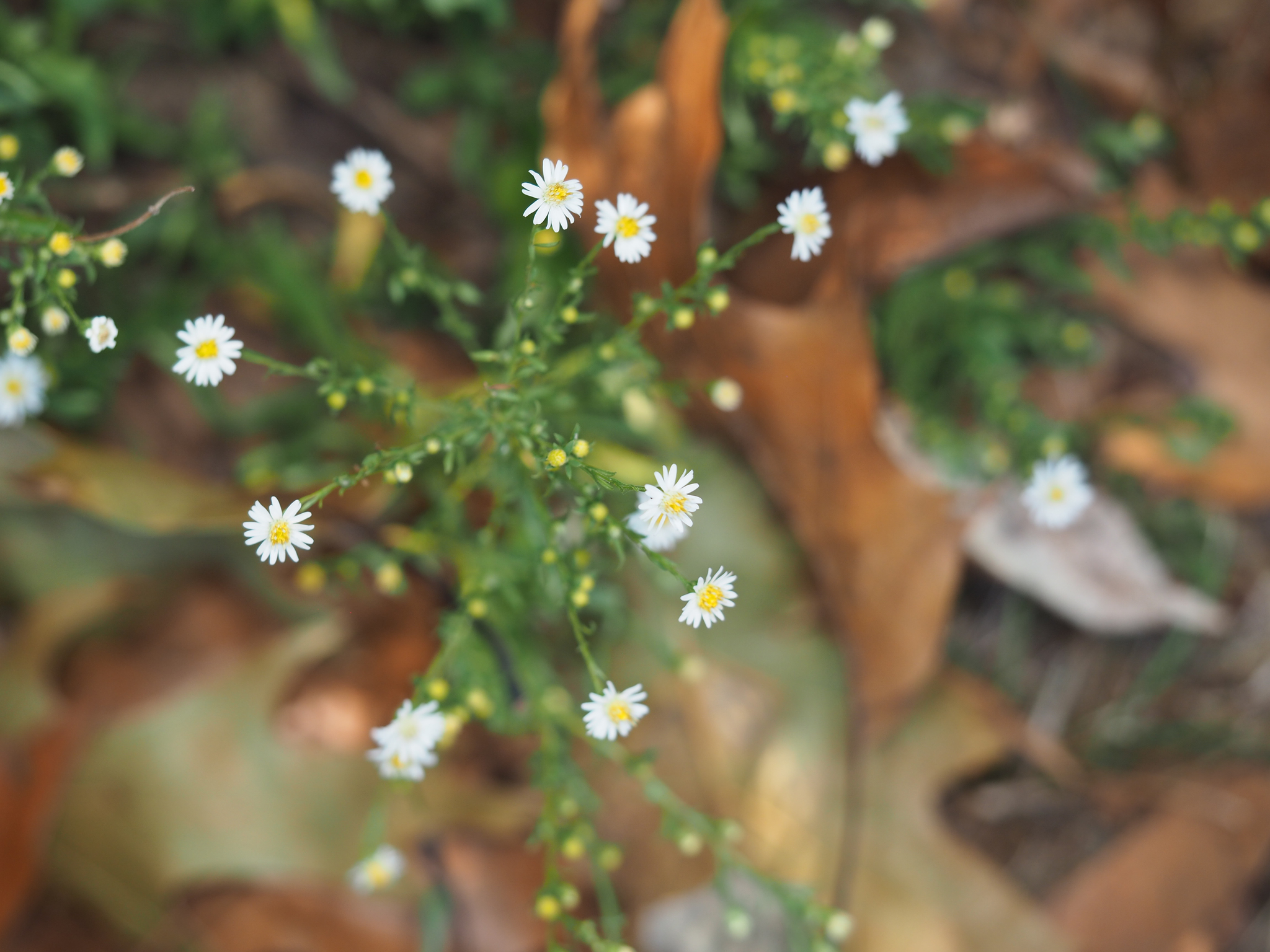
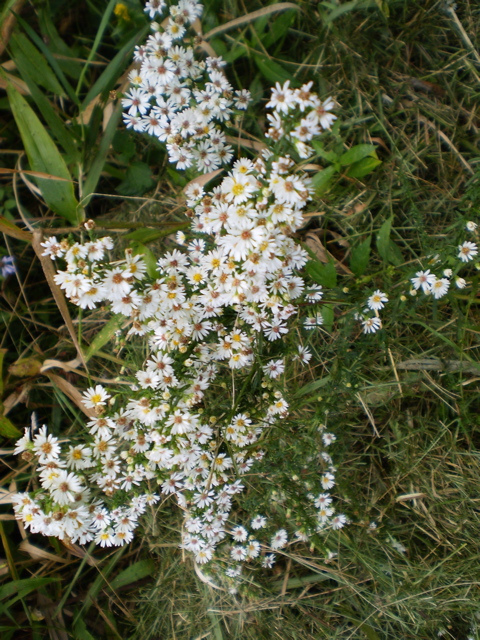
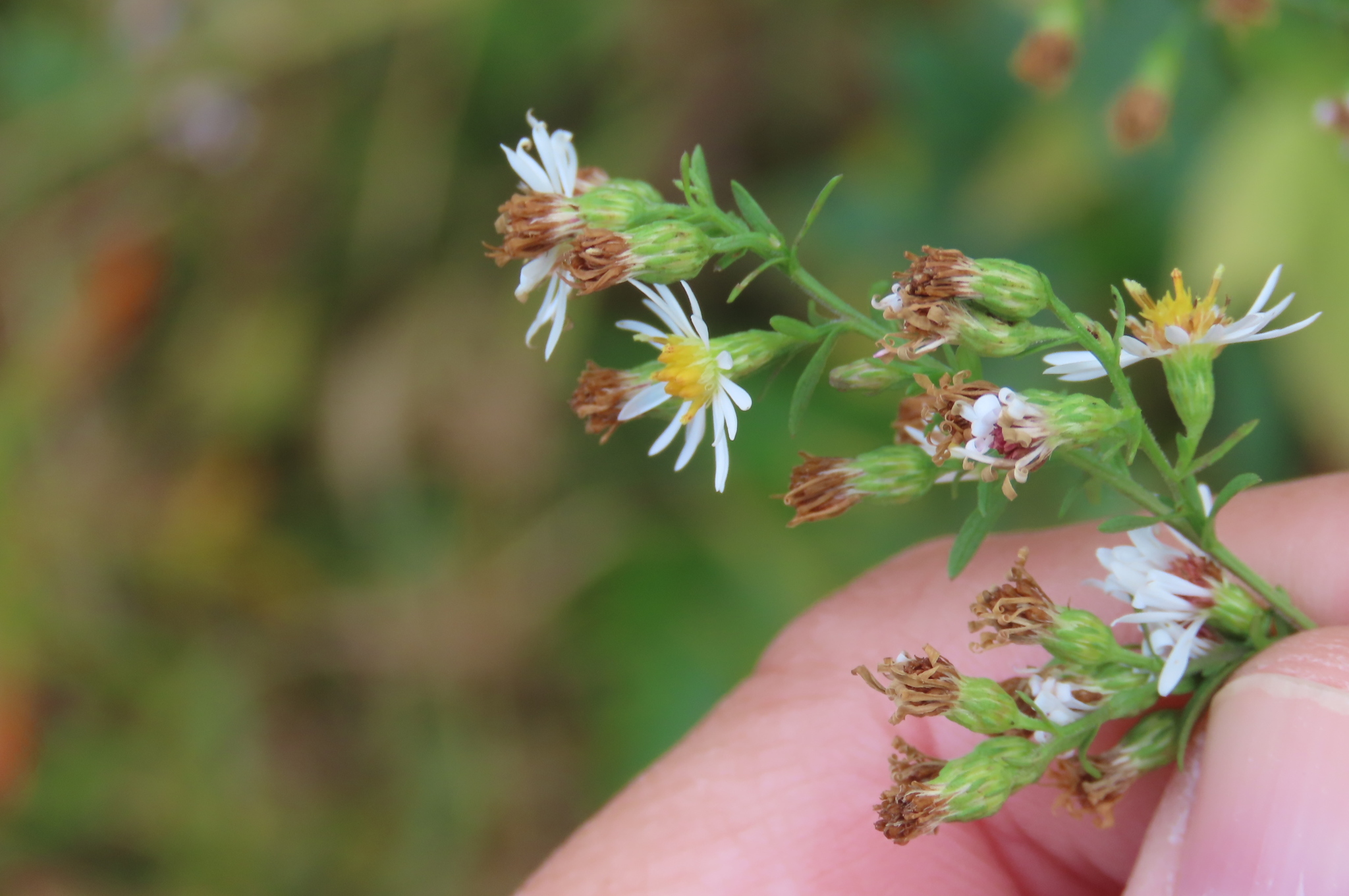
Smooth white oldfield aster is a colonial or tufted perennial, 30 to 90 centimeters tall (about one to three feet), rarely reaching a meter, spreading by long rhizomes or growing from woody root crowns. The stems are one to three or more per plant, erect and straight, glabrous or nearly so — smooth, with at most a faint fuzz, and sometimes tinged purple. The leaves are thin, with margins that often roll under slightly and feel rough to the touch, and the tips end in a tiny point; most leaf axils carry clusters of smaller leaves. The basal leaves wither by flowering time, and new spring rosettes are often already present. The stem leaves get progressively smaller up the stem, the lower ones stalked and elliptic to lance-shaped, the upper ones stalkless, linear-lance-shaped, and notably unequal in size.
The flower heads sit in a diffuse, roughly pyramidal panicle, the branches loose, spreading horizontally or arching, each branch carrying its heads along one side in a raceme-like arrangement. The heads are rather small — that is the first thing Franck’s key tells you. Each head is carried on a slender stalk that often bears 5 to 15 tiny bracts, 1 to 2 millimeters long, grading into the phyllaries. The involucre is cylindrical, 3.5 to 4.5 millimeters long. Each head carries 16 to 20 ray florets, usually white and rarely pink, the rays only 5 to 8 millimeters long and 0.5 to 1.2 millimeters wide, around 10 to 20 disc florets that start cream or pale yellow and become pink or red as they age. The seeds are gray to tan, 1 to 1.8 millimeters long, faintly 4- to 5-nerved, with a white pappus 2.5 to 3.5 millimeters long. Flowering runs August to October.
Lookalikes: rice button aster, calico aster, and white oldfield aster
The hardest lookalike is rice button aster (Symphyotrichum dumosum), and the split between the two is exactly the pair of measurements in the description above. Rice button aster’s rays are wider — laminae 1 to 1.7 millimeters, against this species’ 0.5 to 1.2 — and its rays run pinkish, bluish, to white rather than almost always white. Its seeds are bigger, 1.5 to 2.5 millimeters, and prominently 3- to 4-nerved, where smooth white oldfield aster’s are 1 to 1.8 millimeters and only faintly 4- to 5-nerved, and its pappus is longer, 3 to 4.5 millimeters. If you have a ruler, a hand lens, and a mature seed head, you can settle it. If you have only the flower color, you cannot — both can be white, and that is the trap.
Calico aster (Symphyotrichum lateriflorum) is the other close call, and it is separated by the disc florets: calico aster’s are whitish to cream with lobes that bend strongly backward, and its heads are often crowded along one side of the branch. Smooth white oldfield aster’s disc florets are cream to pale yellow becoming pink or red, with lobes that stay recurved to upright. White oldfield aster (Symphyotrichum pilosum), also called frost aster, is the hairy twin: its stems are densely pilose or hirsute — obviously fuzzy to the eye and hand — where this species’ stems are smooth. Run a finger up the stem: smooth means racemosum, furry means pilosum. Panicled aster (Symphyotrichum lanceolatum var. latifolium) has rather larger heads and thin, flat-margined leaves, and its flower-stalk bracts number 5 to 13 and are leafier than this species’ tiny 1- to 2-millimeter ones.
In Florida
Smooth white oldfield aster is native to Florida and listed as Native, FACW (facultative wetland) in the Atlas of Florida Plants. It is one of the more widespread asters in the state: preserved specimens voucher it from the Panhandle — Liberty, Jackson, Holmes, Washington, Calhoun, Gadsden, and Leon counties — through north-central Florida in Alachua, Clay, and Taylor counties, and south to Miami-Dade County. Across its whole range it runs from southern Maine to Illinois, south to northern Florida and east Texas, and it is introduced in Canada, where the northern records are mostly this species’ close relatives misidentified.
Its habitat is the wet end of the landscape: moist to wet, often alluvial soils, often brackish, in marshes, savannas, bogs, wet meadows, prairie swales, swamps, the borders of swamps, and open bottomwoods. In Florida that means ditch banks, wet flatwoods edges, marsh margins, and the damp ground along rivers and ponds. The “often brackish” in the habitat description is worth noting: this is a white aster that tolerates a little salt in the soil, which is more than most of its relatives can say.
Grow it or leave it
Grow it — if you have the damp spot, and if you have room. Smooth white oldfield aster wants full sun and moist to wet soil, and it will take the wet corner of the yard, the rain garden, or the edge of a pond the way other plants take a sunny border. It spreads by rhizomes into colonies, and one gardener in Georgia reports it taking over a bed almost entirely — the spindly stems let sun through to the spring and summer perennials below, so it plays fairly well with others, but it is not a plant for a tidy small border. Give it a meadow edge, a wet swale, or a spot where it can arch and sprawl, and cut it back hard in late winter.
The honest Florida caveat is about water, not cold. This plant is hardy far north of Florida and has no trouble with a Panhandle winter; what it will not do is thrive in dry sand. In most of peninsular Florida it belongs in the damp ground — the low spot, the pond margin, the rain garden that actually holds water — not in the dry, sunny bed. It tolerates brackish soils, so a coastal gardener with a damp, slightly salty corner has an option here that most native asters do not offer. No fertilizer: lean, damp soil and sun are the whole recipe, and rich soil mostly makes floppy stems. Leave the seed heads standing for the birds through winter.
One warning about buying it: Flora of North America notes this species is sold commercially under the name Aster ericoides cultivar ‘Spray’ — a mislabel that has been circulating in the trade for years. Buy from a native-plant nursery that labels by true species, and check the Latin name on the tag. The old name Aster vimineus was also applied to this plant for many years, but that name was misapplied and belongs to a different plant; it still shows up on old herbarium sheets and older field guides.
Pollinators and wildlife
Smooth white oldfield aster is a late-season nectar source for bees and butterflies before frost sets in — one church native-plant guide in Virginia calls it out for exactly that, and it is the plant’s main ecological job. The flowers are small, and small flowers are the right size for small pollinators: native bees, syrphid flies, and skippers work it alongside the bumblebees and butterflies. Like other asters, it belongs to the host-plant group that feeds Pearl Crescent caterpillars — the genus Symphyotrichum as a whole is listed as a Pearl Crescent host, and this species is part of that group. If you grow it for the crescents, do not spray the patch: the caterpillars are the point. The seeds feed birds through the fall and winter, and the standing stems shelter overwintering insects.
Varieties
No varieties of smooth white oldfield aster are recognized — Flora of North America treats it as a single, undivided species, and Franck’s 2025 Flora of Florida lists it the same way. Its synonyms tell the naming history: it was Aster racemosus when Elliott described it in 1823, and Aster vimineus in the books that misapplied that name to it for most of the twentieth century. This guide covers Symphyotrichum racemosum only. Its other common name, small white aster, is the name most northern field guides use; smooth white oldfield aster is the Atlas of Florida Plants name, and the one this guide uses as its title.
Frequently asked questions
Is smooth white oldfield aster native to Florida?
Yes. It is listed as Native in the Atlas of Florida Plants, vouchered from the Panhandle through north-central Florida and south to Miami-Dade County — one of the most widespread white asters in the state.
How do I tell it from rice button aster?
Measure the rays and the seeds. Smooth white oldfield aster has white rays 0.5–1.2 mm wide and seeds 1–1.8 mm long, faintly 4–5-nerved, with a pappus 2.5–3.5 mm. Rice button aster has rays 1–1.7 mm wide (often pinkish or bluish), seeds 1.5–2.5 mm, prominently 3–4-nerved, with a pappus 3–4.5 mm. You need a ruler and a hand lens — flower color alone will not settle it.
How do I tell it from white oldfield aster (frost aster)?
Feel the stem. Smooth white oldfield aster (S. racemosum) has glabrous or nearly smooth stems; white oldfield aster (S. pilosum) has densely hairy stems. That is the field split, and it works without any measuring.
Will it spread aggressively?
Yes, in moist ground. It spreads by rhizomes into colonies and can take over a bed. Plant it where it has room — a meadow edge, a wet swale, a rain garden — and divide it if it outgrows its spot. It is not a plant for a small tidy border.
Does it need wet soil?
It wants moist to wet soil — marsh edges, wet meadows, swamp borders, alluvial ground — and it tolerates brackish soils. In a dry sandy Florida yard it will struggle; give it the damp corner or leave it to the wild places.
When does it bloom?
August to October. It is a late-season bloomer, and its small white heads are a nectar source for bees and butterflies in the weeks before frost.
What pollinators does it feed?
Late-season bees and butterflies, including small native bees, syrphid flies, and skippers, and it belongs to the aster group that hosts Pearl Crescent caterpillars. The seeds feed birds in fall and winter.
Why is it sold as ‘Aster ericoides Spray’?
That is a trade mislabel. Flora of North America notes this species is cultivated commercially under the name Aster ericoides cultivar ‘Spray’ — but heath aster (S. ericoides) is a different plant. Buy from a native-plant nursery and check the Latin name on the tag.
Is it the same as Aster vimineus?
No — but the name Aster vimineus was misapplied to this species for many years, so you will still find it under that name in older books and on old herbarium sheets. The true Aster vimineus is a different plant. The current correct name is Symphyotrichum racemosum.
Can I grow it in south Florida?
It is vouchered as far south as Miami-Dade County, so it does occur in south Florida — but only in wet ground. In south Florida, give it a reliably damp spot with full sun. In dry ground anywhere in the state, it will not thrive.
🌱 Keep learning
Three related guides worth reading next:
- Calico Aster — The other small-headed fall aster, with whitish-cream disc florets whose lobes reflex strongly backward.
- Heath Aster — The white aster most often confused with this one in the nursery trade — the plant behind the ‘Spray’ mislabel.
- Aster — The genus guide: how the North American asters got their name back from Aster, and what ties them all together.