
Willowleaf aster is the tall drink of water in the fall aster crowd — a perennial that can top five feet, wears narrow willow-like leaves, and then, in August through October, covers itself in pale lavender daisies with cream centers that blush pink as they age. It is a plant of wet ground: wet prairies, ditch banks, lake shores, the damp end of the meadow where nothing else wants to stand with wet feet. In Florida it is a north-Florida plant, vouchered from the Panhandle east to Columbia County, and it is at its best exactly where Florida gardeners usually complain about the soggy spot.
The name is a field guide in miniature. Praealtum means “very tall,” and salicifolius — the name it carried as Aster salicifolius for two centuries — means “willow-leaved.” Both are true: the leaves are long, narrow, and willow-like, and the plant is one of the tallest asters you will meet. The trick to identifying it is not the height or the flowers, though — it is the leaves, and specifically the undersides of the leaves, which carry a neat, roughly square net of veins and a waxy sheen on top. That is the character that separates it from its closest lookalike, Simmonds’ aster, and it is the reason this guide has a photograph of a leaf underside. Botany is sometimes a magnifying-glass hobby, and this is one of those times.
What it looks like
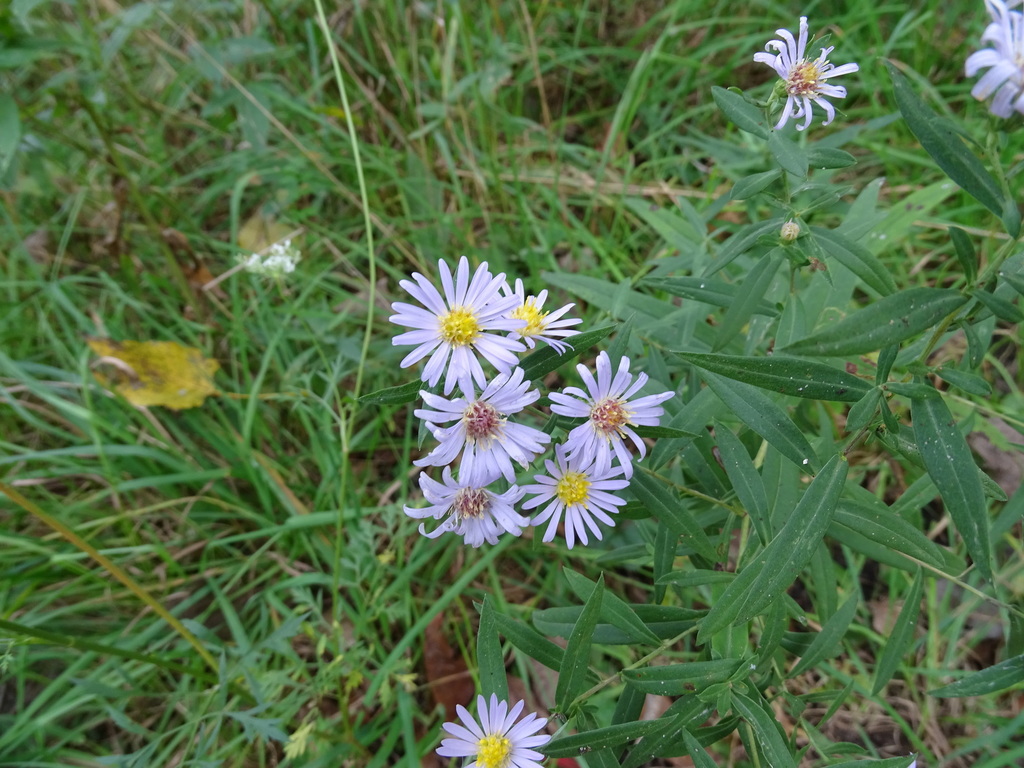
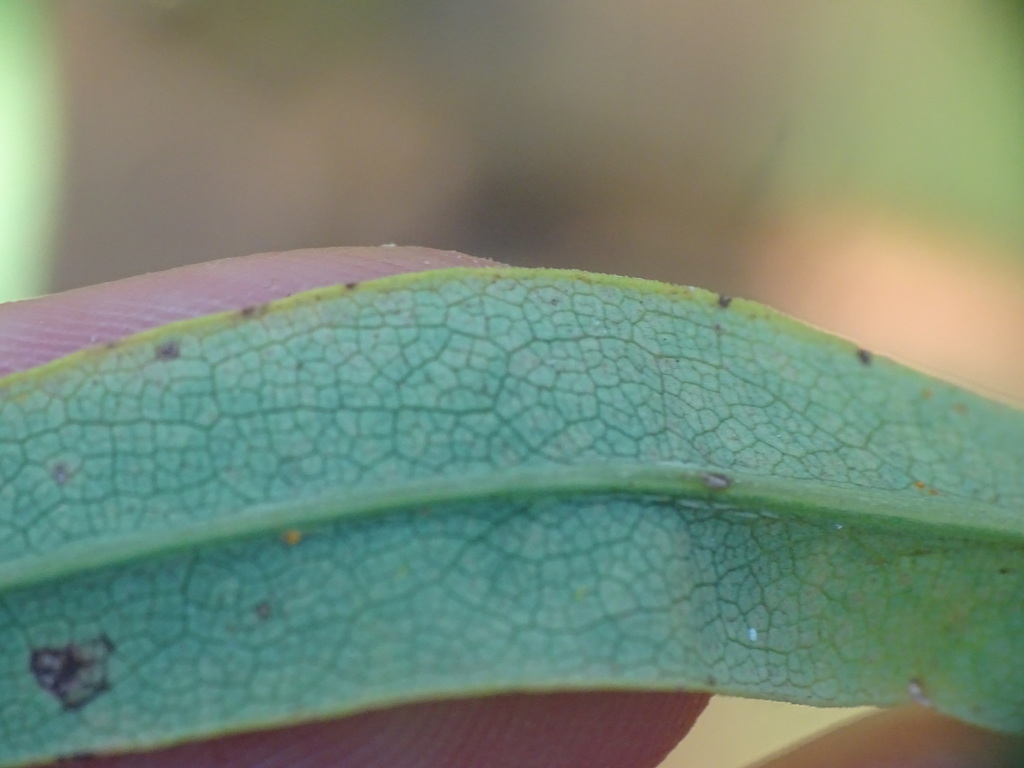
Willowleaf aster is a colonial perennial, 50 to 150 centimeters tall (about a foot and a half to five feet), occasionally reaching two meters, spreading by fleshy, long rhizomes into dense stands. The stems are usually single, erect to ascending, stout, and often glaucous or reddish. The leaves are thick and firm, with margins that often roll under and feel rough — scabrous — to the touch, and the tips end in a tiny hard point. The basal leaves wither by flowering time, so what you see in fall is the stem leaves: elliptic to lance-shaped, 4 to 10 centimeters long (up to 15), getting progressively smaller as they climb the stem, with little clusters of smaller leaves tucked into the leaf axils. The upper leaf surface is waxy; the underside is smooth, with a conspicuous network of veins forming small, roughly equal-sided areoles — the net pattern in the photograph above.
The flower heads sit in an ample, leafy, usually dense panicle — a branching cluster — with ascending to spreading branches. Each head is carried on a short stalk 0.3 to 2 centimeters long, wrapped in 5 to 12 or more leaf-like bracts, the uppermost of which hug the head closely and do not grade into the phyllaries (the green scales cupping the head). The involucre — the cup itself — is bell-shaped, 5 to 7 millimeters long. Each head carries 20 to 35 ray florets, pale blue-violet to lavender or rose-purple, rarely white, the rays 5 to 10 millimeters long, around 20 to 30 or more disc florets. The disc corollas start cream or pale yellow and turn pinkish purple as they age, which is why a single plant can show yellow-centered fresh heads and pink-centered old ones at the same time. The seeds — cypselae — are 1.5 to 2 millimeters long, 4- to 5-nerved, each wearing a tuft of white bristles, the pappus, 4 to 6.5 millimeters long. Flowering runs August to October.
Lookalikes: Simmonds’ aster and panicled aster
Willowleaf aster’s hardest lookalike in Florida is Simmonds’ aster (Symphyotrichum simmondsii), and the two are separated in Franck’s 2025 Flora of Florida key by a set of small, checkable characters — not by flower color, which overlaps. Simmonds’ aster has its stem leaves sharply reduced on the flowering branches, its upper leaf surfaces are not waxy, and the vein areoles on the leaf undersides are indistinct and elongated rather than well-marked and roughly square; it has no axillary leaf clusters. Its flower-stalk bracts are reduced and grade into the phyllaries, its disc florets are yellow turning reddish (not cream turning pinkish), and its cypselae are larger, 2 to 2.6 millimeters. If you are holding a plant and cannot decide, flip a leaf: waxy top plus a neat square net underneath points to willowleaf; a dull top and a faint, stretched net points to Simmonds’.
Panicled aster (Symphyotrichum lanceolatum var. latifolium), the Florida variety of the panicled aster, is the other close call. Its leaves are thin with flat margins — willowleaf’s are thick and firm with margins that roll under — and it carries 5 to 13 bracts on its flower stalks with linear-lance-shaped phyllaries that are nearly equal in length, the outer ones often leaf-like. Willowleaf’s leaves are the giveaway again: thick, waxy, willow-narrow, and progressively smaller up the stem.
In Florida
Willowleaf aster is native to Florida and listed as Native, FACW (facultative wetland) in the Atlas of Florida Plants. It is a plant of the northern part of the state: preserved specimens voucher it from Leon, Jackson, Gilchrist, Wakulla, Franklin, Okaloosa, and Columbia counties, with scattered records reaching as far south as Seminole and Polk counties. Across its whole range it runs from Ontario and New England south to Florida and west to Texas, and south into the mountains of northern Mexico; it has also been introduced in central Europe, where it has been confused with panicled aster.
Its Florida habitat is the wet stuff: wet prairies and meadows, lake and stream shores, oak savannas, open woods and thickets, moist banks, ditches, and roadsides, on wet, loamy soils. It is not a xeric plant — the words of every grower who has tried it dry — and in a Florida garden it belongs in the damp corner, the rain garden, or the edge of a pond, not in the dry sandhill bed. It is globally secure, but it is listed as endangered in New Jersey and threatened in Ontario, a reminder that a plant can be common across a continent and scarce at the edges of its range.
Grow it or leave it
Grow it — if you have the wet spot. Willowleaf aster wants full sun, moist to wet conditions, and fertile loamy soil, and it is hardy roughly to zone 4, far colder than anything Florida will throw at it. Plant it where the ground stays damp, give it room, and then mostly leave it alone. It spreads by rhizomes into colonies, which is a feature in a meadow or rain garden and a warning in a small border: a happy plant will wander, and the way to keep it in bounds is division every few years or a root barrier and a pair of shears. It does not self-pollinate — it needs a genetically distinct plant nearby and insect visitors to set seed — so a single lonely plant will spread by rhizome but set little seed.
The honest Florida caveat: this is a north-Florida plant. In the Panhandle and north Florida, in a wet spot, it is a straightforward native perennial. In central and south Florida it is out of its comfort zone — the vouchered records from Seminole and Polk counties show it can occur there, but a plant that wants a real winter and wet loam will not love a hot, dry, sandy yard. If your ground is dry sand, leave this one to the north and plant a dry-loving aster instead. Water it like a prairie plant that lives in a swale: enough to establish, then let the site do the work. No fertilizer — rich soil plus water mostly produces floppy stems that need staking. Cut the stems back hard in late winter; leave the seed heads standing through fall and winter for the birds.
Pollinators and wildlife
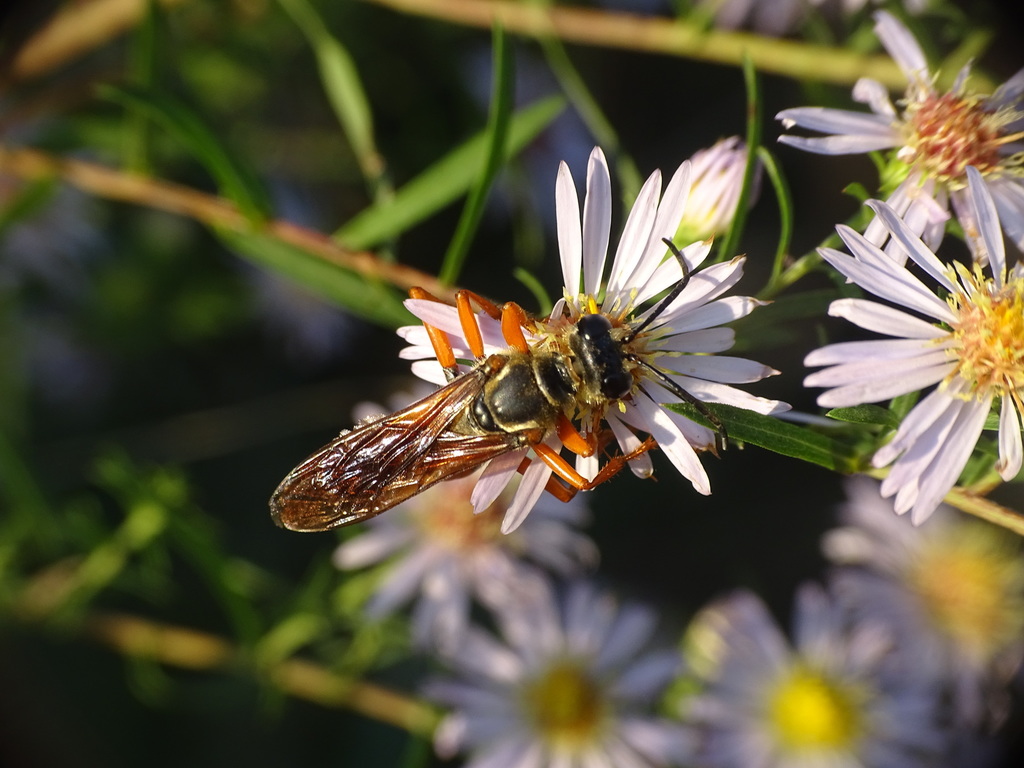
Willowleaf aster is a late-season pollinator magnet, and that is its real job in a garden. Its flowers are visited by long-tongued and short-tongued bees — honeybees, bumblebees, halictine bees, and late-flying andrenid bees — as well as syrphid flies, butterflies, and skippers, and it is a noted nectar source for migrating monarch butterflies fueling up for the flight south. One observer in Tennessee reports bumblebees gathering on the flowers at the end of the day and even slumbering on them overnight on cool autumn mornings, which is exactly the kind of detail that makes you leave the patch alone in October.
It is also a caterpillar host plant. The caterpillars of the Pearl Crescent (Phyciodes tharos) and the Silvery Checkerspot (Chlosyne nycteis) feed on the foliage, along with the caterpillars of several moth species. If you grow it for the Pearl Crescent, do not spray the patch: the whole point of a host plant is the caterpillars eating it, and a sprayed aster is a dead end for the butterflies it exists to feed. The seeds are eaten by birds, including Wild Turkey, and deer browse the plant occasionally while rabbits nibble young foliage.
Varieties
Several varieties of willowleaf aster have been named in the literature — var. praealtum, var. angustior, var. nebraskense, var. subasperum, and var. texicola — but Flora of North America notes that while some of these deserve recognition, the validity of others needs confirmation, and Franck’s 2025 Flora of Florida lists the Florida plants simply as the species, with no variety recognized. There is no separate Florida variety to chase, and no named garden varieties of the wild species were verified. This guide covers Symphyotrichum praealtum only. Its old name, Aster praealtus (and before that, Aster salicifolius), still appears on old nursery tags and herbarium sheets; buy and plant by the current Latin name.
Frequently asked questions
Is willowleaf aster native to Florida?
Yes. It is listed as Native in the Atlas of Florida Plants, vouchered from the Panhandle and north Florida — Leon, Jackson, Gilchrist, Wakulla, Franklin, Okaloosa, and Columbia counties, with scattered records further south.
How do I tell it from Simmonds’ aster?
Flip a leaf. Willowleaf aster has waxy upper leaf surfaces, well-marked roughly square vein areoles on the underside, little leaf clusters in the axils, and leaf-like flower-stalk bracts that hug the head; its disc florets turn from cream to pinkish and its seeds are 1.5–2 mm. Simmonds’ aster has non-waxy leaves, indistinct elongated areoles, no axillary clusters, reduced bracts that grade into the phyllaries, yellow disc florets turning reddish, and larger seeds, 2–2.6 mm.
Will it take over my garden?
It can, in the right spot. It spreads by fleshy rhizomes into colonies, and in moist, sunny ground a happy plant will wander. Give it a meadow, a rain garden, or a wet corner with room, and divide it every few years if it outgrows its welcome. In a small dry border it will mostly sit still — but it will not be happy there either.
Does it need wet soil?
Yes — it is a facultative wetland plant (FACW) of wet prairies, shores, ditches, and moist banks. It wants damp, loamy ground and full sun. Dry sand is the one thing it will not tolerate, which is worth knowing before you plant it in a Florida yard that drains like a sieve.
When does it bloom?
August to October, late in the season when most of the garden has finished. It is often one of the last nectar sources standing, which is why monarchs and bumblebees crowd it in fall.
What pollinators does it feed?
Bees of all kinds — honeybees, bumblebees, halictine and andrenid bees — plus syrphid flies, butterflies, and skippers, and it is a noted monarch nectar plant. Its foliage also hosts Pearl Crescent and Silvery Checkerspot caterpillars.
Why does my single plant never set seed?
Willowleaf aster is self-incompatible: it needs pollen from a genetically distinct plant, carried by insects, to make viable seed. A lone plant will spread by rhizome but set little seed. Plant two or more genetically different plants — from seed, or from different sources — and let the bees do the rest.
Is it the same as panicled aster?
No. Panicled aster (Symphyotrichum lanceolatum var. latifolium in Florida) has thin leaves with flat margins and nearly equal-length phyllaries; willowleaf aster has thick, firm, waxy leaves with rolled-under margins and progressively smaller leaves up the stem. The two have been confused in Europe, where willowleaf aster is introduced, but they are distinct species.
Can I grow it in central or south Florida?
It is a north-Florida plant, and it will struggle in hot, dry, sandy ground. If you have a reliably damp spot in central Florida it may do fine, but for most of the peninsula a dry-tolerant native aster is the better bet. In the Panhandle and north Florida, plant it with confidence.
Should I deadhead it?
No need. Leave the seed heads standing — birds eat the seed, and the hollow stems shelter overwintering insects. Cut the whole plant back hard in late winter, before spring growth starts.
🌱 Keep learning
Three related guides worth reading next:
- Calico Aster — Another fall-blooming Florida native aster, with whitish-cream disc florets whose lobes reflex strongly.
- Elliott’s Aster — The big wetland aster of Florida, with sheath-like leaf bases and heads twice the size.
- Aster — The genus guide: how the North American asters got their name back from Aster, and what ties them all together.