
🌳 Cottonwood
What it looks like
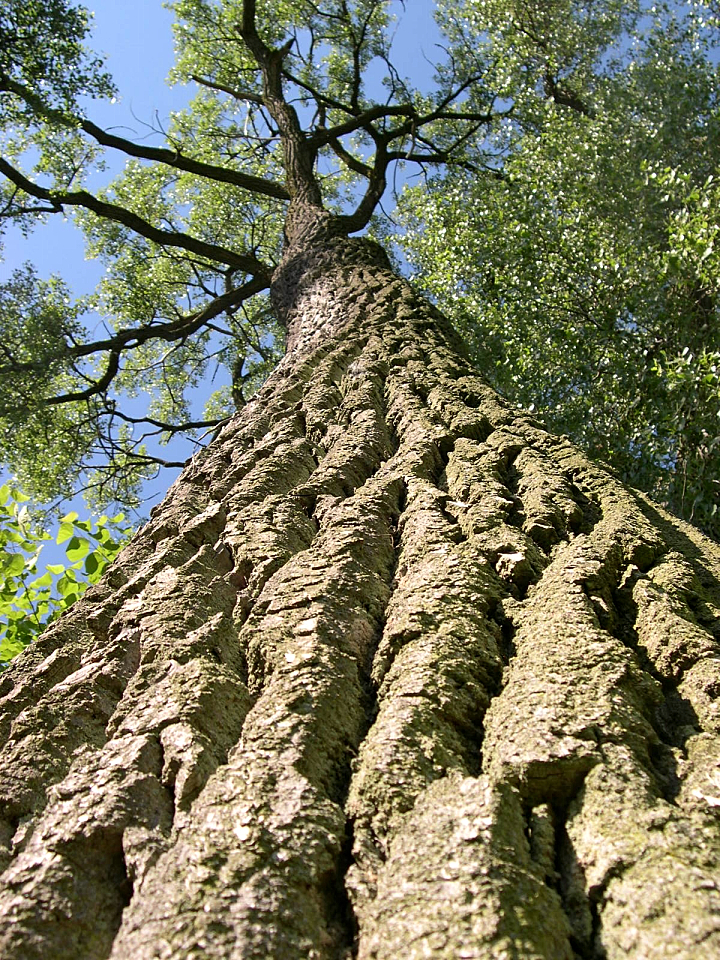
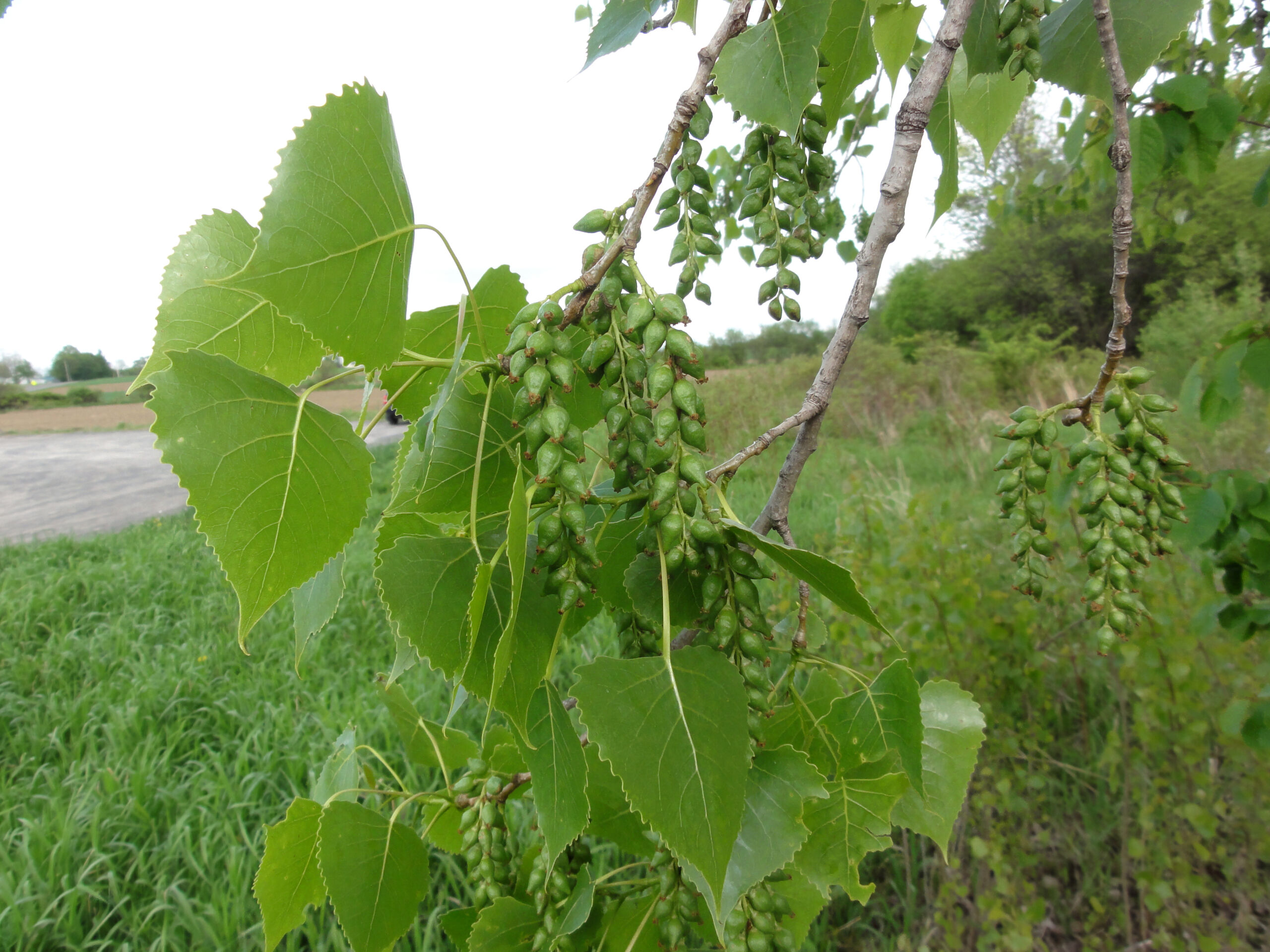
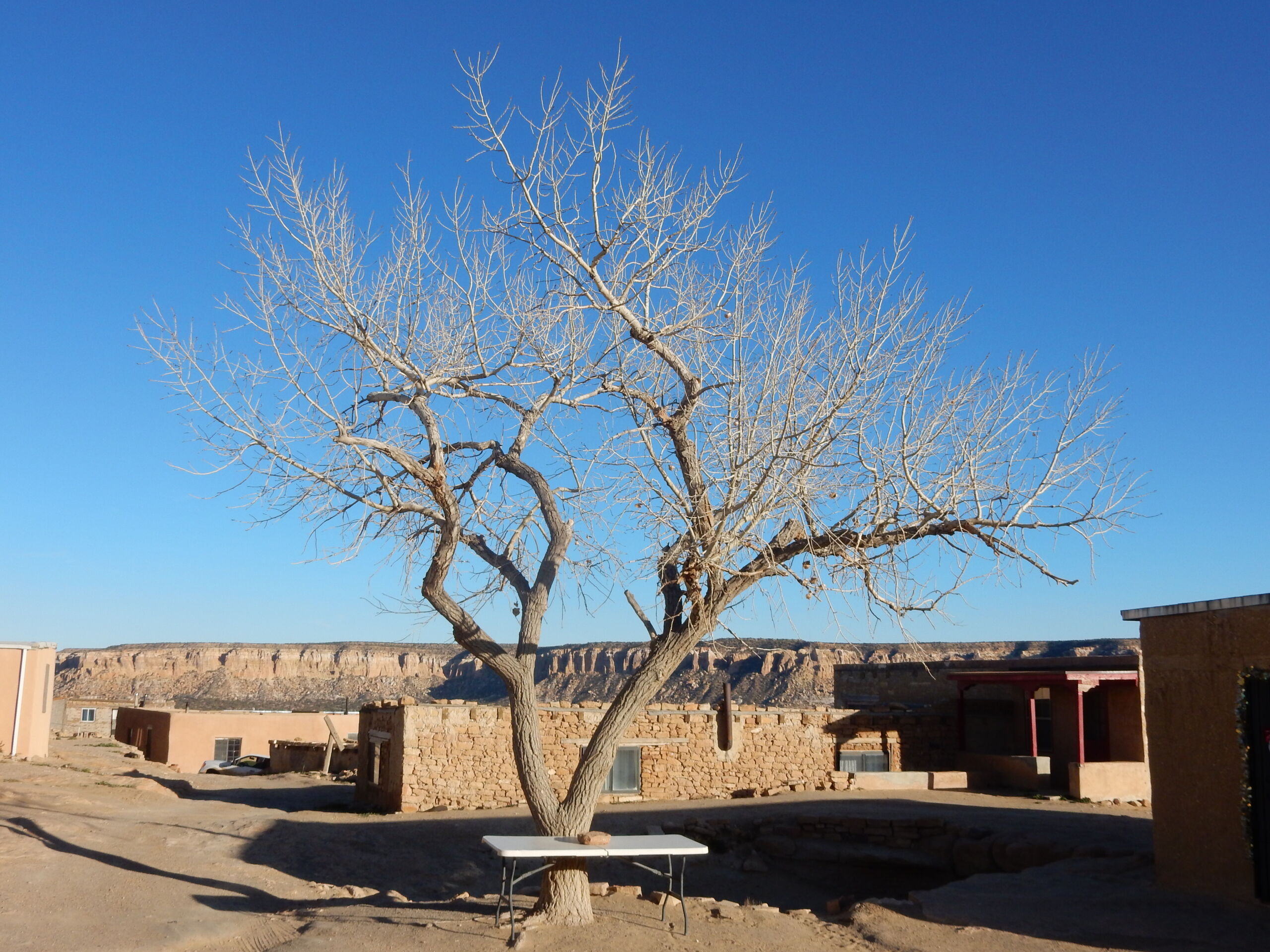
Cottonwood, in this guide, means one species: Populus deltoides, the eastern cottonwood, also called common cottonwood, eastern poplar, and necklace poplar, a tree in the willow family, Salicaceae. It is one of the largest and fastest-growing native hardwoods in North America, a deciduous tree growing 65 to 100 feet tall, with some sources giving 80 to 100 feet and exceptional specimens taller, and a trunk up to about 9 feet in diameter on the oldest trees. The bark tells the tree’s age at a glance: silvery-white, smooth or lightly fissured when young, becoming dark gray and deeply fissured on old trees, with ridges deep enough to hide a finger. The crown is broad and spreading, 35 to 60 feet wide, and the whole tree has the look of something that grew in a hurry and never apologized for it, because that is exactly what it did.
The leaves are the identification, and they are the reason for the Latin name. They are alternate and simple, broadly triangular, deltoid, like the Greek letter delta, 2 to 4 inches long and nearly as wide, with a flat base, rounded corners, coarse rounded teeth, and an abrupt pointed tip, hanging from a flattened leaf stalk. That flattened stalk is the tree’s wind instrument: it lets each leaf flutter, shimmer, and rattle in the slightest breeze, so a cottonwood in a summer wind sounds like rain on a tin roof and looks like it is applauding itself. The leaves turn yellow in fall, a clear, bright yellow that is one of the tree’s few tidy habits, and then they drop, all at once, in a drift that will bury a small garden if you let it.
Cottonwood is dioecious, which is a polite botanical way of saying that there are boy trees and girl trees, and only the girl trees make the cotton. In spring, before or with the leaves, the trees carry dangling catkins, inconspicuous flowers that nobody plants a cottonwood for. On female trees, those catkins become capsules that split open in late spring and release a cloud of seeds, each attached to fine, cottony hairs, which drift on the wind, pile in drifts like snow, clog gutters, coat lawns, and give the tree its common name. On male trees, there is no cotton at all, which is the entire business model behind the seedless cultivars in the varieties section. The species is divided into three subspecies: subsp. deltoides, the eastern cottonwood of southeastern Canada and the eastern United States, west to North Dakota and Texas; subsp. monilifera, the plains cottonwood of the central United States and Canada; and subsp. wislizeni, the Rio Grande cottonwood of the Southwest. Gardeners usually meet the species, not the subspecies, but the distinction matters in the West, where the Rio Grande tree is the local cottonwood.
Two plain-text disambiguations, because the word cottonwood is used loosely everywhere. First, this site already has a Poplar growing guide, which covers the genus Populus broadly, and a Siouxland Poplar guide, which covers one cultivar in depth. A genus guide does not cover a single species, and a cultivar guide does not cover its parent species, so this guide exists as the species guide for Populus deltoides itself, separate from both. Second, this site also has an eastern cottonwood native-plant profile, which covers the Florida angle, where the tree grows along Panhandle rivers at the southern edge of its range in zones 8 to 9. That profile is a native-plant account; this guide is the growing guide, with the full planting, spacing, and problem advice a grower needs. And third, a note for butterfly gardeners: when a butterfly guide says cottonwood without a Latin name, it may mean any cottonwood, including Fremont cottonwood in the West or black cottonwood in the Northwest. This guide covers eastern cottonwood specifically, and the host records that name Populus deltoides outright, including the mourning cloak’s, are the ones this guide answers directly.
How to grow
Grow cottonwood where it grows in the wild: in full sun, on moist ground, near water, with room to be enormous. It is native across the eastern and central United States, from southern Quebec to Montana and south to Texas and the Southeast, and it is almost always found near streams, lakes, floodplains, river bottoms, sandbars, and moist bottomlands. It prefers moist soils but tolerates drier sites, tolerates salt and soil compaction, tolerates wet sites, and is adaptable on pH, including alkaline soil, which makes it one of the most soil-forgiving large trees available. What it does not tolerate is a small space. Space trees 50 to 75 feet apart, and plant no cottonwood anywhere near a building, a pipe, a septic system, a sidewalk, or a power line: the roots are aggressive and water-seeking, the crown is huge, the wood is weak, and the mature height of 80 to 100 feet means a falling limb is a serious event, not a cleanup. This is a tree for riverbanks, floodplains, very large rain gardens, windbreaks, and natural areas, and the honest planting advice is that most suburban yards are not big enough for it, and pretending otherwise is how cottonwood gets its bad reputation.
Hardiness is generous and genuinely disputed at the edges. University of Minnesota and Utah State both give zones 2 to 9, and that range is used in this guide’s hero stats. Other references give zones 3 to 9, including this site’s own native-plant profile, and Illinois Extension gives zones 3 to 8. The practical reading is that eastern cottonwood is hardy through very cold winters, zone 2 or 3 at the cold end, and grows through zone 9 at the warm end, with Florida’s Panhandle, zones 8 to 9, at its southern limit, where it needs real cold winters and wet ground and will not thrive in central or South Florida. Plant in spring or fall, in a hole no deeper than the root ball and twice as wide, water deeply at planting, and prune while young for a strong central leader, because a tree that grows 5 or more feet a year when young can grow into a bad fork just as fast as it grows into a good one, and a bad fork on an 80-foot tree is a problem you will pay an arborist to solve. Growth rate is the tree’s famous trait: fast, very fast, among the fastest of any North American hardwood, and a young tree in moist, sunny ground can race upward several feet in a single season.
Do not plant cottonwood as a street tree, a patio tree, or a tree for a small garden, and do not plant a female tree where the cotton will be a problem. If you want cottonwood and you do not want cotton, plant a male cultivar, Siouxland above all, and confirm with the nursery that the tree you are buying is male, because a mislabeled female will announce the error across your whole neighborhood in its first fruiting spring. If you want cottonwood for wildlife, a female tree is the better choice: the catkins feed early pollinators, the seeds feed birds, the cavities of old trees shelter wildlife, and the fluttering canopy is a landmark for everything that flies. Either way, plant it once, plant it far from everything you value, and let it grow: cottonwood resents being moved, resents being topped, and rewards a gardener who gives it room and then gets out of the way.
Water & feeding
Water is the one thing cottonwood will never refuse. It wants moist ground, it tolerates seasonally flooded soil, and in a dry site it needs deep, regular watering to achieve its famous growth rate. In a riparian planting or a floodplain, nature handles it. In a drier landscape planting, water deeply and infrequently, soaking the root zone rather than sprinkling the surface, because shallow watering teaches the shallow, aggressive roots to stay near the surface, where they lift sidewalks and invade pipes even faster. A young tree in its first two years needs steady water through dry spells, and a mature tree in a drought will drop leaves early and slow its growth, which is stress, not dormancy, and a deep drink is the correct response.
Feeding is simple: usually nothing. Cottonwood grows fast in average to rich moist soil without fertilizer, and in a floodplain it is fed by the river. In a poor, sandy planting, a spring application of a balanced fertilizer can help a young tree establish, but heavy feeding on an already fast tree produces weak, brittle wood on top of wood that is already brittle, which is the wrong direction. Mulch a young tree with bark or wood chips, kept off the trunk, to hold moisture and suppress grass competition, and let the leaf fall do the rest: cottonwood leaves are a free, annual mulch, and raking them away from the tree’s own root zone is throwing away the fertilizer the tree made for itself.
Common problems
- Aggressive, water-seeking roots. The most expensive cottonwood problem. Roots invade pipes, septic systems, drains, and foundations, lift sidewalks and driveways, and travel far beyond the crown in search of moisture. Never plant within 50 to 75 feet of any of those things, and never believe a seller who says a particular cottonwood has well-behaved roots.
- Weak, brittle wood. Cottonwood is fast and weak, and large limbs break in storms, ice, and high wind. Keep it away from roofs, play areas, and power lines, prune for structure while young, and budget for arborist work on a mature tree, because a mature cottonwood is not a plant-and-forget tree.
- Cotton litter. Female trees release clouds of cottony seed fluff in late spring, which coat lawns, clog air-conditioner filters and gutters, and drift into every open window in the neighborhood. It is not pollen, and it does not cause hay fever, but it is a genuine nuisance, and it is the reason male cultivars exist. Plant male if you plant near people.
- Short life. Cottonwood is fast but short-lived, seldom living past about 80 years, and often declining sooner in a stressful site. Plant it knowing that your grandchildren may plant its replacement, and that a cottonwood’s job is fast shade and wildlife value now, not a 300-year legacy.
- Cankers and bacterial disease. Cottonwood is listed with bacterial disease and canker problems, and even the rust-resistant Siouxland cultivar becomes susceptible to cankers and other diseases with age. Remove affected limbs cleanly, keep the tree vigorous with water and space, and do not wound the bark unnecessarily, because wounds are where cankers start.
- Rust and leaf diseases. Leaf rust and other leaf spots disfigure the foliage in wet years, rarely killing an established tree but weakening young ones. Siouxland was selected partly for rust resistance, which is one more reason it dominates the cultivar trade, and good air circulation plus sun help more than any spray.
- Wrong site. A cottonwood planted in a small yard, a dry courtyard, or a street strip will be a problem tree within a decade, through roots, limbs, litter, or all three. The failure is usually the planting decision, not the tree, and the fix is to plant it where it belongs: big, moist, and far from infrastructure.
Harvest
There is no food harvest from cottonwood, and the harvests it does offer are shade, windbreak, wildlife, and streambank work. A mature tree shades a house, a barn, or a whole picnic ground, breaks the wind across a field, stabilizes a riverbank with roots that hold soil through floods, and feeds and shelters wildlife from its catkins to its cavities. Butterfly gardeners plant it as a host: cottonwood appears as a host plant for the mourning cloak, which names Populus deltoides outright, and for Lorquin’s admiral, the viceroy, and Weidemeyer’s admiral, which list cottonwood and poplar among their hosts. A cottonwood on a riverbank is a butterfly nursery, a bird feeder, and a shade tree in one enormous package, and that is a harvest worth measuring in decades, even if the tree itself does not live for centuries.
Propagation is famously easy, which is how cottonwood colonizes sandbars in the first place. Hardwood cuttings root readily, a trait shared across the poplars, and a cutting stuck in moist ground in late winter will often root and leaf out the same spring. Seed, by contrast, is a sprint: it germinates immediately on moist bare soil and dies quickly if it dries out, which is why cottonwood seeds itself on fresh sandbars and floodplains and nowhere else. For gardeners, the honest advice is to buy a nursery tree of known sex, male if you want no cotton, female if you want wildlife seed, and to take cuttings only from a tree whose sex and health you know, because a cutting from a female tree is a female tree, cotton and all.
Saving seeds
Start with the warning that matters more than any seed recipe: cottonwood is an enormous tree with roots that hunt water, so plant it far from pipes, septic systems, drains, and foundations, and never as a dainty garden specimen. Then comes the sex question, because cottonwood is dioecious — male and female flowers grow on separate trees. Only female trees make the famous cotton snowstorm; male trees make pollen in spring and no cotton at all. If you want cottonwood without the fluff, plant a known male clone. If you want seed, you need a female tree with a male tree nearby, and you need to know that seed is the least reliable way to get a particular tree.
The sane propagation route is cuttings, and any honest seed section should admit it. Hardwood cuttings of current-season growth, roughly 20 to 40 centimetres long, taken in late autumn or winter and pushed into a sheltered outdoor bed or directly into moist ground, root very easily — this is the tree that colonises sandbars, after all, and it brings that same vigour to a cutting bed. No rooting hormone is normally needed. A cutting is a clone, so it keeps the parent’s sex, growth habit, and traits exactly, which is how nurseries reliably sell male trees. If you love a specific cottonwood, take cuttings; seed is for experiments, restoration plantings, and people who enjoy a gamble.
Seed itself is a sprint, not a savings account. Female catkins ripen into capsules in late spring, each capsule splitting to release tiny seeds on tufts of cottony fibre, and those seeds are built to land on moist, bare soil and germinate immediately. Collect capsules just as they begin to split, and sow within days — surface-sow or barely cover on moist trays, and keep them constantly moist. Fresh seed can germinate very well, but the seedlings are delicate for their first weeks: drying out, fierce sun, and damping-off fungi kill many of them, so shade lightly, water gently, and prick out into individual pots when large enough to handle, growing them on under cover until the following spring if they are not big enough to plant out in late summer.
Do not try to store cottonwood seed like bean seed. Left in an ordinary dry jar, it loses viability in days to weeks — it is among the shortest-lived seeds in the plant kingdom. Only prompt drying to low moisture followed by cold storage near freezing, or frozen storage in research conditions, stretches viability to months or years, and that is not a home-garden method to rely on. The rule for gardeners is simple: sow it the week you collect it, or do not bother. And do not expect seedlings to come true: poplars hybridise freely with each other, so seed collected where other poplars grow may produce trees that differ from the parent in form, vigour, and sex. A seedling cottonwood is a brand-new tree wearing a familiar name, and it should be planted with the same respect — and distance from the pipes — as any other.
Varieties
Eastern cottonwood has few garden cultivars, and one of them dominates the trade. Only real, verified varieties and forms are listed here, in plain text, with botanical subspecies kept separate from garden cultivars so the two are not confused.
- ‘Siouxland’: The only widely available cultivar, a male selection from South Dakota, released by South Dakota State University, growing quickly to 70 to 90 feet tall with a pyramidal to rounded crown, yellow fall color, and resistance to leaf rust. As a male form it produces no seeds and no cotton, which is why it is sold as a cottonless cottonwood and why it already has its own Siouxland Poplar guide on this site. With age it can become susceptible to cankers and other diseases, and its roots are just as aggressive as the species, so it needs the same 50 to 75 feet of space.
- Purple Tower Cottonwood: The cottonwood that forgot to be green: bronzy-purple leaves on a fast, upright shade tree that still thinks it is a river tree.
- ‘Noreaster’, ‘Robusta’, and ‘Sparks’: Additional cultivars named by Utah State University Extension in its eastern cottonwood listing. Each now has its own growing guide with verified details, linked below, and a seller offering one of them should still be able to show what makes it distinct from Siouxland and the straight species.
- Populus deltoides subsp. deltoides (eastern cottonwood): The typical subspecies, found in southeastern Canada and the eastern United States, west to North Dakota and Texas. This is the tree most gardeners mean when they say eastern cottonwood.
- Populus deltoides subsp. monilifera (plains cottonwood): The central United States and Canada subspecies, with leaves that taper longer to the tip and usually two glands on the leaf, adapted to the Great Plains.
- Populus deltoides subsp. wislizeni (Rio Grande cottonwood): The southwestern subspecies, the cottonwood of the Rio Grande valley and the Southwest, adapted to hotter, drier river country than its eastern cousin.
No other named varieties were verified for this guide. Hybrid poplars, which often have Populus deltoides as a parent for cold hardiness and fast growth, are not varieties of this species and are not listed here: a hybrid is a different tree, with its own guide, not a cottonwood with a fancy name.